A serious accident can change your life in seconds, but you don't have to face it alone.
One moment you're driving home on a Houston freeway, crossing an intersection in Dallas, or heading to work in San Antonio. The next, you're dealing with pain, a damaged vehicle, missed work, medical appointments, and an insurance adjuster who wants a statement before you've had a chance to catch your breath.
That's usually when the question hits hard: do i need a personal injury lawyer texas, or can I handle this myself?
The honest answer is that some minor claims can be handled without a lawyer. If it was a small fender-bender, no one was hurt, liability is clear, and the insurer is paying your out-of-pocket costs, you may not need legal help. But once injuries are involved, the risk changes fast. Your claim becomes about more than a repair estimate. It becomes about your health, your income, your future treatment, and whether an insurance company will use Texas law to reduce what it pays you.
Your Life Changed in an Instant Now What?
After a crash, individuals often don't feel “ready” to make legal decisions. They're sore, tired, worried, and trying to keep the household running. I've seen people spend the first few days doing what seems sensible: reporting the accident, answering the insurer's calls, and hoping the process will be straightforward.
Then the problems start. The back pain gets worse. The other driver changes their story. The adjuster asks for a recorded statement. A quick settlement offer shows up before a doctor can explain what's really going on.
A serious accident claim in Texas often turns on what happens early. That's why your first moves matter. If you need a practical starting point, review these steps to take after a Texas car accident and focus on protecting your health and your documentation.
What most injured people are really asking
You may be wondering:
- Is this serious enough for a lawyer
- Will hiring one change the outcome
- Can I afford help right now
- Should I wait and see what the insurance company offers
Those are fair questions. They deserve direct answers.
Practical rule: If your accident caused real injury, time away from work, disputed fault, or pressure from an insurance company, get legal advice early.
When you may not need a lawyer
A lawyer isn't necessary for every claim. You may be able to handle it yourself if:
- The crash was minor: Property damage is limited and there are no real injuries.
- Medical care was minimal: You recovered quickly and don't expect ongoing treatment.
- Liability is accepted: The insurer has clearly accepted responsibility.
- The offer covers your losses: Your out-of-pocket expenses are being fully addressed.
But if any of those facts change, the case changes too. That's especially true in Texas, where fault arguments and insurance tactics can shrink a claim faster than anticipated.
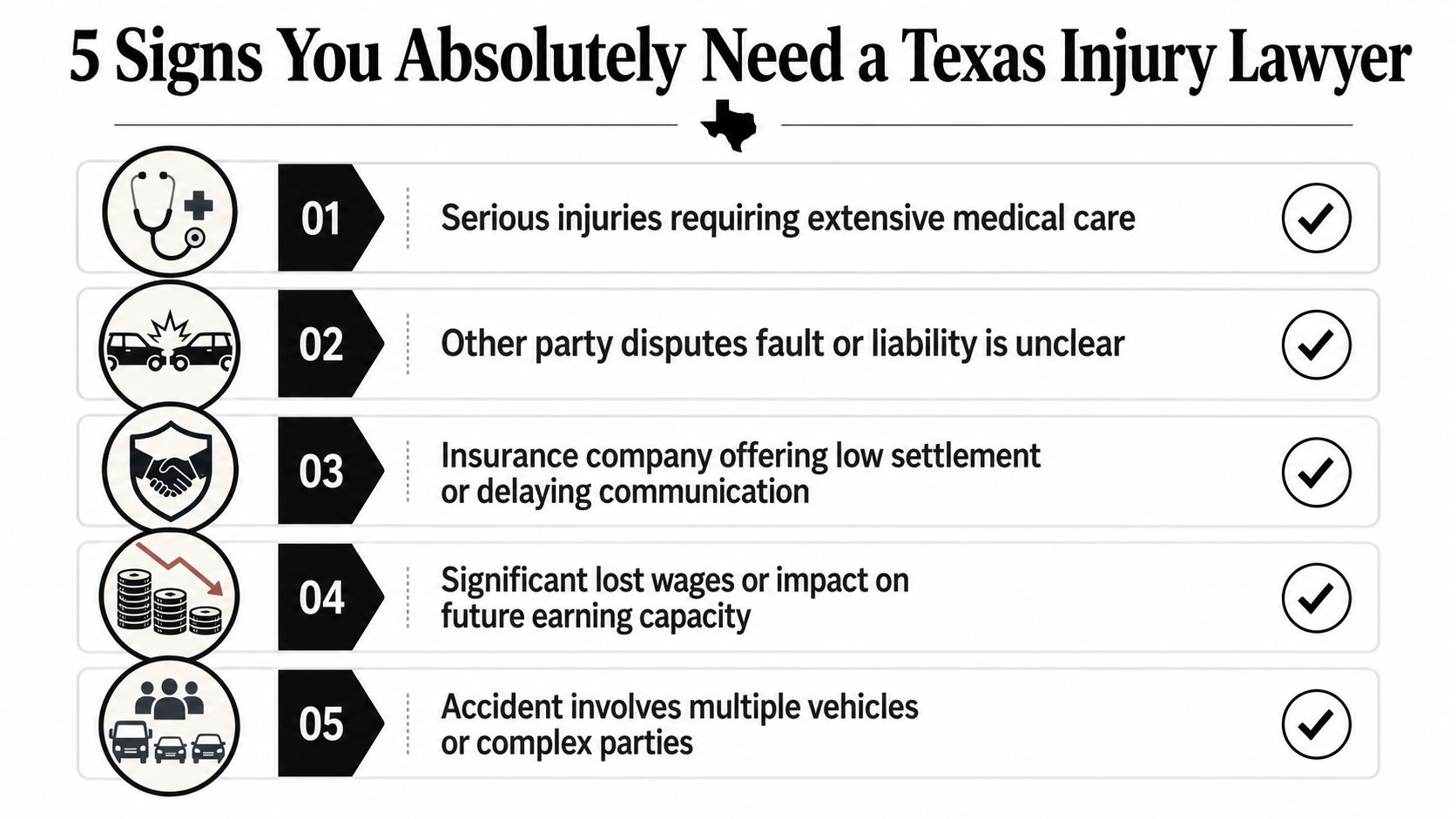
5 Signs You Absolutely Need a Texas Injury Lawyer
Some cases don't call for guesswork. They call for immediate legal help.
If any of the signs below apply to you, waiting usually helps the insurance company, not you. Research cited by Houston Car Wreck Lawyers says accident victims with legal representation received settlement offers 300% higher than those without attorneys, and that gap widens the longer someone waits to hire a lawyer.
Serious injuries changed your routine
If you need imaging, specialist care, pain management, or ongoing rehab, the claim is no longer simple. A “wait and see” approach often leads injured people to settle before they understand the full impact of their condition.
If you're not sure whether your pain pattern points to follow-up treatment, this physical therapy necessity guide offers a useful plain-English overview of when lingering symptoms may need more attention.
The other side is blaming you
Texas uses a modified comparative responsibility system. That means fault matters. If the insurer can push more blame onto you, it can reduce what it pays. In some cases, that fight over fault becomes the entire case.
After a Houston freeway crash, for example, one driver may say you changed lanes without signaling while you know the truck drifted into your lane. Without early evidence, that dispute can define the entire claim.
A truck or commercial vehicle was involved
A collision with an 18-wheeler, delivery van, or company vehicle is different from a two-car wreck. There may be multiple defendants, corporate insurers, maintenance records, driver logs, onboard data, and fast-moving defense teams trying to control the narrative.
If you need a truck crash lawyer Houston families can call quickly, that's not because truck cases sound dramatic. It's because they are document-heavy and time-sensitive.
The insurance company is stalling or lowballing
If the adjuster delays callbacks, asks for the same records repeatedly, or pushes a fast settlement before your treatment is clear, treat that as a warning sign. Insurers often move quickly when they think a person doesn't yet know the value of the claim.
When an insurance company wants to settle before your doctors understand your injuries, that speed usually serves the insurer, not you.
A death or life-changing injury occurred
If your family lost someone in a crash, or your loved one suffered a catastrophic injury, this is not a claim to manage casually. Wrongful death and severe injury cases involve far more than immediate bills. They affect income, care needs, family stability, and long-term planning.
In those situations, you should speak with a wrongful death lawyer Texas families can trust to handle the legal side while you focus on your family.
What a Personal Injury Lawyer Actually Does for Your Case
After a serious Texas wreck, the legal work starts long before any lawsuit is filed. What changes the outcome is usually not courtroom drama. It is early case building, damage analysis, and keeping the insurance company from boxing you into a cheaper claim before the full picture is clear.
People who handle claims alone often see only the obvious losses at first. The ER bill. The body shop estimate. A few missed paychecks. Insurance carriers see something else. They see a file they can close before future treatment is known, before fault is fully investigated, and before you understand how Texas rules on comparative fault or uninsured and underinsured motorist coverage can reduce what you recover.
A good lawyer works to stop that from happening.
The first job is protecting evidence before it disappears
In real cases, delay costs money. Video gets erased. Witnesses stop answering calls. Vehicle damage gets repaired. In commercial cases, driver logs, inspection records, and onboard data may not stay available forever unless someone sends the right preservation notice quickly.
Early legal work often includes:
- Getting reports: crash reports, incident reports, witness names, and any 911 or bodycam materials that may exist
- Preserving footage: traffic camera video, store surveillance, dashcam files, and other recordings before routine deletion
- Collecting records: medical records, billing records, wage-loss documents, photographs, and treatment updates
- Sending preservation letters: especially in truck, business, and premises cases where key records can disappear fast
That work matters because weak proof gives the insurer room to argue that you were partly at fault. In Texas, that can directly cut the value of your case.
A lawyer measures the full value of the claim, not just the first stack of bills
Insurance adjusters often value a claim from the smallest starting point. If you are still treating, they may act as if your case is worth only what has already been billed. That is a problem in Texas injury cases, because the actual loss often shows up later.
A lawyer should look at the parts of the case that are easy to miss early on:
- Medical expenses already incurred
- Future medical care
- Lost income
- Reduced earning capacity
- Pain and suffering
- Physical impairment and long-term limitations
For example, a Houston driver may think the case is straightforward after an ER visit and a few weeks of therapy. Then an orthopedic specialist recommends surgery three months later. If the claim was settled too early, that extra cost usually comes out of the injured person's pocket, not the insurer's.
A lawyer handles insurer communication with Texas-specific risks in mind
Insurance companies ask questions for a reason. A recorded statement can lock you into an incomplete version of events. A broad medical release can send the insurer fishing through years of unrelated records. A quick settlement offer can look like relief when bills are piling up, even if it leaves you underpaid.
In Texas, that risk is even sharper in comparative fault and UIM cases. If the carrier can shift 20 percent, 30 percent, or more of the blame onto you, they cut what they may have to pay. If your own UIM carrier is involved, many people are surprised to learn they are still dealing with an insurance company protecting its own bottom line rather than paying what seems fair.
Part of my job is to control that process, document the claim correctly, and keep the insurer from defining the case before your treatment and losses are understood.
A lawyer prepares the case as if it may need to be tried
Cases settle better when they are prepared seriously. That means identifying the liable parties, organizing proof, working with treating doctors when needed, calculating damages clearly, and building a file that can stand up if negotiations fail.
It also means advising you on the cost side of representation. If you are worried about hiring a lawyer while medical bills and household bills are already stacking up, review this explanation of how contingency fees work in Texas personal injury cases. For many injured people, that fee structure changes the timing question from "Can I afford a lawyer?" to "How much will waiting cost me?"
Handling Your Claim Alone vs. With a Texas Injury Lawyer
| Task | Handling It Alone | With a Texas injury lawyer |
|---|---|---|
| Investigating the crash | You request records yourself and may miss video, witnesses, or business records | Legal team gathers records, preserves evidence, and builds proof on fault |
| Dealing with insurance adjusters | You answer calls directly and may give incomplete or harmful statements | Attorney handles insurer communication and protects the claim |
| Valuing the case | You may focus on current bills only | Legal team includes future care, lost income, and long-term harm |
| Managing deadlines | You track requests, notices, and filing dates on your own | Legal team manages the timeline and follows up on missing evidence |
| Negotiating settlement | You negotiate against trained adjusters using limited documentation | Attorney uses records, medical support, and case preparation to press for a fair result |
| Preparing for trial if needed | You likely have no litigation process in place | Counsel can file suit, conduct discovery, and prepare the case for court |
Strong injury claims are built early. In Texas, every week of delay can make it easier for an insurer to dispute fault, minimize treatment, or exploit coverage issues that an unrepresented person may not see coming.
How Can I Afford a Lawyer? The Contingency Fee Promise
One of the biggest reasons people wait to call a lawyer is simple. They assume they can't afford one.
In most Texas personal injury cases, that fear shouldn't stop you. Personal injury lawyers commonly work on a contingency fee, which means you pay no upfront fee and no attorney's fee unless the case results in a recovery. If you want a plain-language breakdown, this guide on how contingency fees work in Texas personal injury cases is a helpful starting point.

What contingency really means
This arrangement changes the conversation for injured families. You don't need to come up with a retainer while you're trying to pay for medical care, car repairs, and ordinary bills.
It also aligns incentives. If the lawyer doesn't recover compensation for you, there's no attorney's fee to collect. That's why contingency representation makes legal help available to people who otherwise might try to face a serious claim alone.
Why this matters in uninsured and underinsured driver cases
Texas drivers run into another problem that catches many people off guard. Sometimes the at-fault driver has no insurance, or only minimal coverage. In other situations, your own Uninsured/Underinsured Motorist coverage has to come into play.
According to Lee Legal Group's discussion of Texas personal injury questions, Texas has high rates of uninsured drivers and many insured drivers carry only the minimum liability limit of $30,000. When you have to make a UIM claim, you can end up in an adversarial position with your own insurer.
That surprises people. They assume their insurer will do the right thing because they paid premiums. But a UIM claim is still a contested insurance claim, and the company may dispute liability, medical causation, or the value of your injuries.
Here's a short overview that helps explain how injury claims are funded and pursued:
Questions to ask before you sign
During a free consultation, ask direct questions:
- How are fees explained: You should get a written explanation of how the fee works.
- Who pays if there is no recovery: Make sure you understand the arrangement clearly.
- Who handles the case: Ask whether your matter will stay with the lawyer or be passed around.
- What experience do they have with UIM claims: These cases require a different level of insurance knowledge.
If a lawyer can't explain the fee agreement in simple English, keep looking.
Why Waiting Is the Biggest Mistake Texas Accident Victims Make
Many people hear that Texas gives them time to act and assume that means they should wait. Legally, Texas gives most injury victims two years from the date of injury to file a lawsuit. But that deadline doesn't mean waiting is harmless.
According to Mahdavi Law Firm's discussion of Texas injury claims, over 95% of personal injury cases settle out of court. That means the most important work usually happens before trial, during the evidence-gathering and negotiation stage.

The clock on value starts before the legal deadline
A claim can weaken long before the statute of limitations expires.
Here's what often disappears first:
- Video evidence: Businesses overwrite surveillance footage. Dashcam files get deleted.
- Witness memory: People forget speeds, lane positions, timing, and what they heard.
- Vehicle evidence: Damage patterns change once repairs begin or vehicles are sold.
- Scene details: Debris, skid marks, weather context, and traffic conditions are gone quickly.
If your case involves a commercial truck, rideshare driver, or multi-vehicle crash, delay can be even more damaging because records need to be identified and preserved fast.
Waiting also helps the insurance company frame the story
The insurer starts evaluating your case immediately. If you haven't documented your injuries, followed up medically, or preserved key evidence, the insurer gets room to argue that your condition wasn't serious or wasn't caused by the crash.
That's one reason I tell injured people not to measure time by the filing deadline alone. Measure it by what can be lost this week.
If you've already missed a few days or even a few weeks, don't assume your case is gone. It means you should act now, not give up.
What to do in the first stretch after a serious accident
If you're still early in the process, keep it simple:
- Get medical care: Follow through on treatment and keep records.
- Avoid detailed insurer conversations: Don't guess about injuries or fault.
- Save everything: Photos, receipts, discharge papers, prescriptions, and employer notes.
- Talk to a lawyer before signing anything: A release can end your claim.
A Houston car accident attorney can often do more to protect a case in the early stage than after key evidence is gone.
How to Choose the Right Texas Personal Injury Law Firm
Not every lawyer is the right fit for a serious injury case. You need someone who handles these cases regularly, understands Texas procedure, and can explain the process without talking over your head.
A consultation should leave you clearer, not more confused. If you walk away unsure who will handle your claim or how the firm approaches fault disputes, that's useful information.

Ask about focus and case type
Start with the basics. Ask whether the lawyer regularly handles:
- Car wrecks in Texas
- Commercial truck collision claims
- Catastrophic injury cases
- Wrongful death lawsuits
- Uninsured and underinsured motorist disputes
If your case involves a fatal crash, ask about experience with wrongful death lawyer Texas claims. If it involves a tractor-trailer on I-10 or I-45, ask about truck-specific evidence and corporate defendants.
Ask how they prove difficult cases
A good lawyer should be able to tell you how they investigate, what records they pursue, and when they bring in outside experts. According to Parker Law Firm's discussion of expert testimony in Texas, top personal injury attorneys maintain networks of pre-vetted expert witnesses who meet Texas evidentiary standards, and strategically deployed expert testimony can increase jury awards by 25-40% in contested cases.
That doesn't mean every case needs an expert. It means the lawyer should know when expert help adds real value and when it doesn't.
For a practical checklist, this guide on how to pick a personal injury attorney can help you compare firms with the right questions.
Signs you're talking to the right lawyer
Look for a lawyer who does these things well:
- Explains Texas fault rules clearly: They should be able to discuss negligence and comparative responsibility in plain language.
- Talks about your treatment, not just your case value: Good representation starts with understanding your injuries.
- Prepares for resistance: They should expect insurer pushback and have a plan.
- Communicates directly: You should know who to call and what happens next.
The right lawyer doesn't just sound confident. They answer your questions with specifics about evidence, fault, damages, and timing.
Your Path to Recovery Begins with a Conversation
The day after a crash often feels worse than the crash itself. The pain settles in, the bills start showing up, and the insurance company calls before you have a clear picture of what your case is worth.
That timing is not accidental. In Texas, delay can cost you money fast. A recorded statement can be used to shift part of the blame onto you under comparative fault rules. A quick settlement can cut off your ability to recover for future treatment. If there is uninsured or underinsured motorist coverage in play, waiting too long or saying the wrong thing to the wrong carrier can create problems that are hard to fix later.
A first conversation with a Texas personal injury lawyer gives you a practical answer to one question: what needs to happen now to protect this case?
Sometimes the answer is preserving vehicle data, dashcam footage, or scene photos before they disappear. Sometimes it is getting the insurance adjuster to stop calling you directly. Sometimes it is reviewing your own policy for UIM coverage and notice requirements before the insurer turns a coverage issue into a denial. In serious injury cases, early legal help also helps tie the medical story to the legal claim, so the insurer cannot argue later that your treatment was unrelated or excessive.
You do not need to have every document organized before you call. You do not need to know whether you have a lawsuit. You need clear advice about deadlines, fault exposure, insurance coverage, and whether waiting is likely to make your position weaker.
That clarity matters.
Many injured people call after they have already given a statement, signed a release, or accepted part of the insurer's version of events without realizing what it may cost them. The earlier the conversation happens, the more options you usually have.
If you were hurt in a crash or lost a loved one because of someone else's negligence, contact the Law Office of Bryan Fagan, PLLC for a free consultation. You can speak with a Texas personal injury lawyer about your rights, your next steps, and whether your case should be handled now rather than later. If you are dealing with a car wreck, truck collision, catastrophic injury, UIM dispute, or wrongful death claim, the firm can help you understand your options and protect your claim before delay makes the case harder.