A serious accident can change your life in seconds. One moment you’re heading down Central Expressway, picking up your kids, or driving home from work. The next, you’re dealing with pain, car damage, missed work, and calls from insurance adjusters who want answers before you’ve even had time to breathe.
That early confusion is real. Many people in Dallas are hurt, overwhelmed, and unsure what to do first. If you’re searching for a dallas personal injury attorney, you probably want more than legal jargon. You want a clear path, practical advice, and some reassurance that recovery is still possible.
Your Path to Recovery Begins Now
A lot of injury cases start the same way. A driver runs a light. A truck changes lanes without enough room. A distracted rideshare driver brakes too late in traffic. Then the injured person goes home thinking the worst part is over, only to wake up the next day with neck pain, a growing headache, and no idea how to handle the insurance process.
You are not alone in this.
In Dallas County, 2023 saw 52,433 traffic crashes and 1,463 suspected serious injuries, according to Dallas crash statistics collected and discussed here. Those numbers reflect what many families already know from experience. Serious collisions are part of daily life on North Texas roads, and the claims process that follows can feel almost as stressful as the crash itself.
That’s why it helps to understand what a lawyer does in these cases. If you’re unsure where legal help fits in, this overview of what a personal injury lawyer does is a useful starting point.
Practical rule: The strongest cases usually begin with calm, early decisions. Get medical care, protect evidence, and avoid rushing into statements or settlements.
A Texas personal injury lawyer isn’t just there to file paperwork. Good representation means building proof, protecting your words from being used against you, and putting a value on losses that insurance companies often try to minimize. That may include medical bills, lost income, future treatment, pain, and the disruption the injury has caused in your daily life.
Recovery isn’t only about money. It’s also about regaining control. When people understand their rights and the steps ahead, they make better decisions. That matters whether your case involves a routine rear-end collision, a catastrophic injury, a disputed fault claim, or a family searching for a wrongful death lawyer Texas residents can trust.
Immediate Steps to Protect Yourself After a Crash
The first day or two after a crash can shape the rest of your claim. What you do during that time affects the medical record, the police report, the evidence available later, and the insurance company’s view of your case.

Get medical care even if you think you can wait
A common mistake is assuming soreness will pass. Some injuries show up hours or days later. A same-day or next-day medical evaluation creates a record that connects the injury to the crash, and that link can matter a great deal if the insurer later argues that your symptoms came from something else.
If emergency responders recommend transport, listen. If you leave the scene without an ambulance, go to an urgent care clinic, emergency room, or your doctor as soon as possible.
Report the crash and preserve the basics
If police respond, make sure an official report is created. Ask how to get the report later. That document can become one of the first neutral records in the case.
At the scene, gather what you can safely gather:
- Photos of vehicle damage: Capture all cars involved, license plates, debris, and the point of impact.
- Roadway conditions: Include skid marks, traffic signals, lane markings, weather, and visibility.
- Visible injuries: Bruising, cuts, swelling, and mobility issues can change fast.
- Witness contact details: Independent witnesses can help when drivers tell different stories.
A quick example helps. After a Houston freeway crash, a driver may remember only the impact. But photos can show lane position, broken lights, and traffic flow in a way memory never will. The same is true after a Dallas wreck on I-635 or US-75.
Tell your insurer only the basics
You should notify your own insurance company promptly. Keep it simple. Confirm that a collision happened, identify the vehicles, and state where and when it occurred. Don’t guess about injuries, speed, or fault if you’re not sure.
The sentence “I’m okay” has hurt many claims. People often say it out of shock or politeness, then learn later that they’re not okay at all.
If the other driver’s insurer calls right away, you are not required to give a detailed recorded statement on the spot. It’s often smarter to wait until you understand your injuries and have legal guidance.
Start a file before details start slipping away
Create one place for everything. Use a folder, binder, or secure note app. Save discharge papers, prescriptions, repair estimates, towing receipts, work absence notes, and screenshots of any insurance messages.
A simple damage log is also useful. Write down:
- Pain levels and symptoms: Include headaches, sleep issues, stiffness, dizziness, and mobility problems.
- Daily disruptions: Note trouble driving, lifting, walking, working, or caring for children.
- Appointments and mileage: Keep track of treatment visits and related travel.
- Out-of-pocket costs: Medications, medical devices, rides, parking, and replacement help at home may matter.
This short video gives a practical overview of what to do right after a collision.
What not to do
Some mistakes are avoidable if you know them early.
| Situation | Better choice |
|---|---|
| You want to apologize at the scene | Stay polite, but don’t discuss fault |
| An adjuster asks for a recording right away | Wait until you’ve had guidance |
| You feel “mostly fine” | Get checked anyway |
| You want to post about the crash online | Don’t. Those posts can be misread later |
For a Houston car accident attorney or Dallas injury case alike, the first priority is the same. Protect your health, protect the record, and give yourself room to make informed choices.
Understanding Your Rights Under Texas Injury Law
Texas injury law gets easier to understand once you strip away the labels. In plain English, most cases come down to responsibility. Who failed to act carefully, and what harm followed?
Texas is a fault-based system
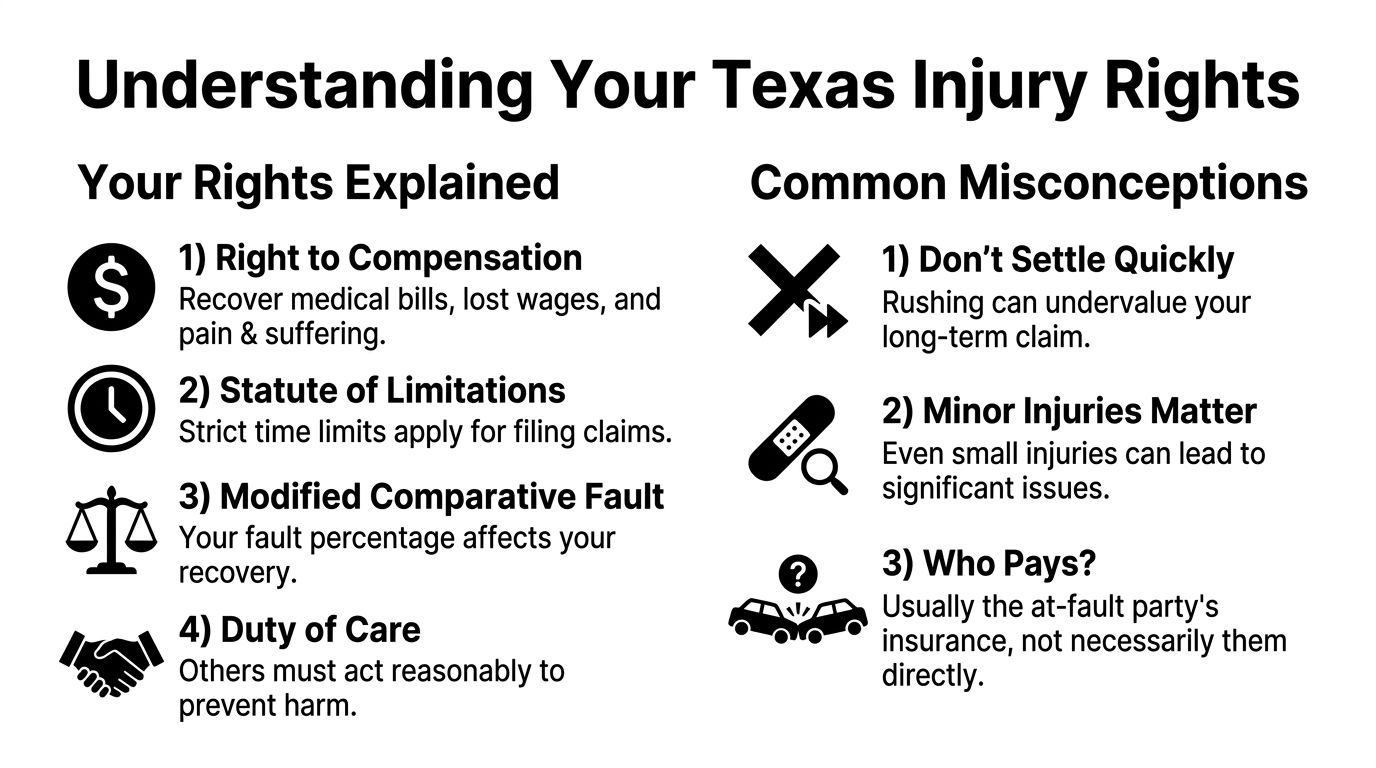
Texas follows a fault system for car accident and many other injury claims. That means the person who caused the crash, or more often that person’s insurer, is generally responsible for the losses that flow from it. Those losses may include medical expenses, lost wages, property damage, pain, suffering, and future care.
Negligence is the legal word for carelessness that causes harm. A simple example is a driver who looks down at a phone instead of watching stopped traffic ahead. If that driver causes a rear-end crash, the injured person may have a negligence claim.
Shared fault can reduce or block recovery
Many cases are not as clean as people expect. The insurance company may argue that you were partly to blame. Texas uses a rule called proportionate responsibility.
Under Texas Civil Practice and Remedies Code § 33.001, you cannot recover damages if you are found to be 51% or more at fault. If you are 20% at fault, a $100,000 award is reduced to $80,000, as explained in this discussion of Texas proportionate responsibility rules.
That rule creates a real trade-off in negotiations. Sometimes the dispute isn’t whether you were injured. It’s whether the insurer can shift enough blame onto you to reduce what it has to pay.
A case can be won or lost on small details about lane position, timing, visibility, and what the records show in the first few days.
That’s one reason evidence matters so much. Photos, witness accounts, vehicle damage, and medical records help counter blame-shifting arguments.
The statute of limitations matters
Texas also has a filing deadline, usually called the statute of limitations. In most personal injury cases, you generally have two years from the date of the injury to file a lawsuit. Families in fatal cases often face a similar deadline for wrongful death claims.
Waiting creates problems long before that deadline arrives. Witnesses become harder to reach. Surveillance footage may disappear. Vehicles get repaired or sold. Doctors may no longer recall details beyond what is in the chart.
What your legal rights look like in real life
A short example shows how these rules come together. Suppose you’re hit at an intersection in Dallas by a driver who says you entered too fast. If the evidence shows that driver ran the light, your claim may still be strong. If the insurer finds a way to argue you were also careless, your compensation could be reduced.
Your rights usually include the right to:
- Seek compensation: for medical care, income loss, property loss, and human damages like pain and suffering.
- Reject a quick offer: you do not have to accept the first settlement.
- Ask for proof: insurers should support liability decisions with facts, not guesswork.
- Hire counsel at any stage: many people call a lawyer after the first low offer or denial.
If you’re also dealing with severe harm, a trucking issue, or the death of a family member, those rights become even more important. That’s where a Texas personal injury lawyer, a truck crash lawyer Houston families may need after a commercial collision, or a wrongful death lawyer Texas households rely on can step in and protect the claim before it narrows.
How to Handle Insurance Adjusters and Document Your Damages
Insurance adjusters often sound helpful. Some are courteous, responsive, and easy to talk to. But their role is not the same as yours. Your goal is to protect your health and recover your losses. Their goal is to close the claim for as little as the company will pay.
That difference affects every conversation.
Be careful with recorded statements
Many injured people hurt their own case by talking too freely too early. A recorded statement can lock you into facts before you know the extent of your injuries. It can also give the adjuster phrases to quote later, especially if you guessed about speed, impact, or how you felt.
If you want a deeper look at common tactics, this guide on how to deal with insurance adjusters can help you spot problems before they grow.

A good rule is simple. Be polite, be accurate, and don’t volunteer more than necessary. If the adjuster asks for a recording, broad medical authorizations, or a quick settlement before treatment is clear, slow the process down.
“I’m still receiving treatment, and I’m not prepared to give a recorded statement right now” is often the right answer.
If you need to keep your own call notes organized, especially in a business or commercial vehicle context, a resource like this complete guide to business call recording can help you think more carefully about documentation practices and why accurate records matter.
Understand what damages actually include
Many people assume their case is only about hospital bills and car repairs. It’s broader than that. Damages usually fall into two categories.
Economic damages
These are the financial losses you can usually document on paper.
- Medical expenses: emergency care, follow-up visits, imaging, therapy, prescriptions, and future treatment
- Lost wages: missed paychecks, reduced hours, and lost earning capacity if the injury changes your work
- Property damage and related costs: vehicle loss, towing, rental expenses, and other out-of-pocket losses
Non-economic damages
These losses are real, even if they don’t come with a receipt.
- Pain and suffering: physical pain, discomfort, and limitations
- Emotional distress: anxiety, fear, sleep disruption, and trauma after the crash
- Loss of normal life: inability to exercise, travel, parent the same way, or take part in daily routines
Why preparation changes settlement value
Only 4% to 5% of personal injury cases go to trial, but preparing a case as if it will go to trial often strengthens the settlement position, as explained in this discussion of trial preparation and settlement strategy. Insurance companies know the difference between a loosely documented file and a claim built for litigation.
That doesn’t mean every case should be filed immediately. It means evidence should be gathered, treatment should be tracked, and the full impact should be documented before serious settlement decisions are made.
A lawyer can help with that process. One option is the Law Office of Bryan Fagan, PLLC, which handles Texas personal injury matters on a contingency-fee basis and investigates crash evidence, witness accounts, and medical documentation. The key is choosing counsel who will treat the file like it may need to be proven, not merely packaged.
For readers comparing claim types, the same principle applies whether you need a car accident attorney, a truck crash lawyer Houston victims may call after a commercial wreck, or counsel for a serious Dallas collision. Records drive value. Gaps give insurers room to minimize the claim.
Deciding When to Hire a Dallas Personal Injury Attorney
Some injury claims can be handled without much conflict. Others become difficult the moment the insurer starts disputing fault, questioning treatment, or pushing an early release. The question isn’t just whether you can handle a claim alone. It’s whether doing so creates avoidable risk.
Cases that usually need legal help
If your injuries are serious, the stakes rise fast. The same is true when liability is disputed, several vehicles are involved, or a commercial policy enters the picture.
You should strongly consider hiring a dallas personal injury attorney if:
- Your injuries are significant: surgery, hospitalization, extended therapy, or permanent symptoms usually mean the claim needs a fuller damages analysis.
- Fault is being challenged: if the insurer says you caused part of the crash, the law and evidence become central.
- A truck, company vehicle, or rideshare is involved: these cases often include layered insurance issues and additional investigation.
- A loved one died: wrongful death claims need careful handling from the start.
- The insurer is rushing you: pressure to settle early usually benefits the carrier, not the injured person.
What a lawyer actually changes
A lawyer doesn’t change the facts of the crash. A lawyer changes how those facts are developed, preserved, and presented.
That can include interviewing witnesses, collecting records, reviewing the police report for errors, organizing medical proof, and pushing back when the insurer cherry-picks details. It also means calculating future losses instead of focusing only on today’s bills.

A practical example: after a multi-vehicle crash, one driver may blame another, and each insurer may point in a different direction. Without someone assembling the timeline and records, the injured person can get stuck in the middle while treatment continues and bills grow.
The best time to get legal advice is usually before you make a statement that can’t be taken back or sign a release that ends the claim.
The contingency-fee question
Many people wait to call because they assume hiring a lawyer will cost too much upfront. In many Texas injury cases, attorneys work on a contingency fee. That means the fee is tied to recovery, and there is no attorney’s fee unless money is recovered for the client.
That arrangement changes the decision for many families. It lets you focus on treatment while someone else handles investigation, negotiation, and if needed, trial preparation.
If you’re researching how law firms communicate their services and educate clients online, this guide to accelerating law firm growth offers a useful look at how firms structure content around client questions. For injured people, that matters because clear information often makes it easier to choose counsel and avoid delay.
The right time to call is usually earlier than people think. Not because every case has to become a lawsuit, but because early guidance often prevents the mistakes that make fair recovery harder later.
Navigating Wrongful Death and Uninsured Driver Claims
Some cases carry a different kind of weight. A fatal crash changes a family permanently. An uninsured driver claim adds frustration to injury because the person who caused the harm may have little or no coverage available.
When a family is facing a wrongful death claim
A wrongful death case is never just another file. Families are often trying to grieve, manage funeral issues, answer insurance calls, and figure out whether they even have the energy to start a legal claim.
In Texas, certain surviving family members may be able to bring a wrongful death action when negligence causes a death. These cases can involve lost financial support, loss of companionship, and other damages recognized by law. If your family is dealing with that loss, this page on a Dallas wrongful death attorney may help you understand the next step.
A brief example shows why timing matters. After a fatal highway crash, families sometimes receive contact from insurers before they have the full crash report. Early legal help can preserve evidence and create space for the family to make decisions without added pressure.
When the at-fault driver has no insurance
Uninsured and underinsured claims confuse many people because you may need to make a claim under your own policy after someone else caused the crash. That feels backward, but it is often how recovery works.
With approximately 14% of Texas drivers uninsured, UM/UIM coverage can become critical, and victims often must turn to their own insurer even though that insurer may still deny or underpay the claim, as noted in this overview of Texas uninsured driver claim issues.
That means your own carrier may stop acting like a good neighbor and start acting like an opposing party. Documentation matters here too. So does a careful reading of the policy.
If you’re looking for a Texas personal injury lawyer after a car wreck, a rideshare crash, a commercial collision, or a search for a wrongful death lawyer Texas families can count on, the key point is the same. Recovery is possible, but it usually works best when the claim is handled with patience, evidence, and a clear plan.
If you or your family is dealing with the aftermath of a serious accident, Law Office of Bryan Fagan, PLLC offers free consultations for Texas personal injury matters. You can get clear answers about your rights, your next steps, and what recovery may look like in your case. You don’t have to sort this out alone. Help is available, and a path forward is still there.