Skip to content
In Texas, most personal injury lawyers charge a contingency fee of 33% to 40% of the recovery, and you pay nothing upfront. That means if your lawyer doesn't recover money for you, you don't owe attorney's fees.
A serious accident can change your life in seconds, but you don't have to face it alone. If you're reading this after a crash in Houston, a trucking collision near Dallas, or a fatal wreck that left your family searching for answers, you're probably asking a very practical question first: how much does a personal injury lawyer cost Texas clients in real life?
That concern is reasonable. After an injury, money gets tight fast. Medical bills start arriving. Work may stop. Insurance companies may call before you've even had time to rest. Many people assume hiring a Texas personal injury lawyer means paying a retainer or hourly bills they can't afford. In most injury cases, that's not how it works.
This article breaks the topic down in plain English. You'll see how contingency fees work, why the percentage can change, what case expenses mean, and what to confirm before you sign anything. I'll also cover other issues accident victims often need to understand, including fault, negligence, comparative responsibility, and the statute of limitations in Texas.
You Can Afford an Expert Legal Advocate After an Accident
After a wreck, individuals aren't comparing law firms the way they'd shop for a phone plan or home repair. They're sitting in pain, trying to figure out how to pay bills and whether they can trust the insurance company.
That's why cost matters so much. If you've been hurt in a freeway collision, lost a loved one in a fatal crash, or you're trying to recover after a serious injury, the idea of paying a lawyer out of pocket can feel impossible. The good news is that personal injury representation in Texas is designed to remove that barrier.
Why the cost question matters so much
When someone searches for a Houston car accident attorney or a truck crash lawyer Houston residents can call after a major wreck, they usually want two answers right away:
- Can I afford legal help
- Will I owe money if the case doesn't work out
For most injury cases, the answer is reassuring. You usually won't pay upfront to hire a lawyer. The fee comes from the recovery if the case succeeds.
Practical rule: If a lawyer's payment depends on winning your case, that fee arrangement is meant to reduce your financial risk while your case is pending.
The bigger legal picture in Texas
Cost is only one part of the decision. You also need to know whether you may have a claim under Texas law.
A personal injury case usually turns on fault and negligence. In simple terms, negligence means another person or company failed to act with reasonable care and caused harm. After a Houston freeway crash, that may involve distracted driving, speeding, failing to yield, following too closely, or unsafe trucking practices.
Texas also follows comparative responsibility. That means fault can be shared. If the insurance company argues you were partly responsible, that can affect what you recover. This is one reason early legal advice matters.
And timing matters too. Texas injury claims are subject to a statute of limitations, which is the deadline for filing suit. If you wait too long, you can lose the right to pursue compensation. That's true whether you need help with a car crash, a catastrophic injury, or a wrongful death lawyer Texas families may need after a fatal accident.
How Contingency Fees Make Justice Accessible in Texas
A contingency fee lets an injured person hire a lawyer without writing a check at the start of the case. The lawyer is paid from the recovery, not from your savings or your credit card while the case is pending. If there is no recovery, there is no attorney's fee.

How the arrangement works in real life
After a serious crash, money usually feels tight fast. You may be missing work, sorting out medical treatment, and getting calls from the insurance company. A contingency fee arrangement allows you to get legal help during that period without paying a retainer upfront.
This arrangement functions as shared risk. You bring the facts of what happened and the harm the accident caused. Your lawyer brings time, strategy, investigation, negotiation, and courtroom preparation if the case requires it. The lawyer accepts the risk of doing that work before being paid.
The State Bar of Texas explains that a contingent fee must be in writing and should explain how the fee is calculated, including whether litigation and other expenses are deducted before or after the contingent fee is calculated. That detail matters because two fee agreements with the same percentage can produce different net results for the client.
Why this system helps injured Texans
Contingency fees open the courthouse doors to people who would otherwise be priced out. If a family is dealing with an ER bill, car repairs, and lost income, hourly legal billing may be unrealistic. A contingency agreement changes the timing of payment, which often makes quality representation possible.
It also keeps your lawyer focused on results. If the case succeeds, the lawyer is paid from that outcome. If the case fails, the lawyer does not collect an attorney's fee for that work.
That still leaves one question many clients ask right away. What about the out-of-pocket costs needed to build the case. Those costs are separate from the attorney's fee, and reputable firms often advance them so the client does not have to fund the case as it moves forward. If you want a plain-English overview before comparing firms, this guide to contingency fee lawyers near me gives a helpful starting point.
A written fee agreement should clearly tell you when the lawyer gets paid, what percentage applies, and how case costs are treated.
Texas ethics rules still apply
Contingency fees are common in injury cases, but they are not a blank check. Texas Disciplinary Rule 1.04 requires a lawyer's fee to be reasonable.
In plain language, that means the lawyer should be able to explain the percentage, the circumstances that can change it, and the treatment of expenses in words a client can understand. If a fee agreement feels confusing, ask questions until it makes sense. A good Texas personal injury lawyer should welcome those questions.
Why Your Lawyer's Fee Percentage Might Change
The percentage isn't always the same from start to finish because the work isn't the same from start to finish. A claim that settles early with the insurance company usually requires less time, less risk, and fewer resources than a case that has to be filed in court and prepared for trial.

The common sliding scale in Texas
According to this breakdown of Texas injury fee percentages, contingency fees often work on a sliding scale:
- 33⅓% if the case settles before a lawsuit is filed
- 37% after a lawsuit is filed but before trial
- 40% if the case goes to trial or appeal
The same source gives a clear example on a $100,000 recovery: $33,333 at the pre-lawsuit stage, $37,000 after filing but before trial, and $40,000 if the case reaches trial or appeal.
Why the percentage goes up
Here's what often changes once litigation begins:
- The lawyer files a lawsuit: That moves the dispute out of ordinary insurance negotiation and into the court system.
- Discovery begins: Both sides gather evidence, request documents, and take formal statements.
- Experts may get involved: In a truck wreck or catastrophic injury case, proving fault and damages may require outside specialists.
- Trial preparation becomes real: Lawyers prepare witnesses, exhibits, legal arguments, and courtroom strategy.
A simple rear-end collision may resolve through negotiation. A multi-vehicle commercial truck crash on I-10 may not. If the insurer disputes fault, downplays your injuries, or points fingers at multiple drivers, the legal work becomes more demanding.
What this means for you: A higher percentage usually reflects a harder, riskier case, not a surprise charge added at the end.
Why this matters in fault disputes
Texas negligence law often becomes more contested as the case gets more serious. The insurance company may argue that you caused part of the crash, failed to brake in time, or had injuries that existed before the collision. Those arguments can affect how comparative responsibility is applied.
That's one reason litigation can become necessary. If a fair settlement doesn't happen voluntarily, your lawyer may need to use the formal court process to push the case forward.
Understanding Case Expenses What Your Lawyer Pays For Upfront
Attorney's fees and case expenses are not the same thing. People often lump them together, and that creates confusion.
Think of them as two separate buckets. One bucket is the lawyer's fee for doing the legal work. The other bucket holds the out-of-pocket costs required to build and prove the case.
Common expenses in a personal injury case
According to this explanation of injury case expenses in Texas, costs such as filing fees, expert witnesses, and depositions are commonly advanced by the law firm and deducted from the recovery. That same source notes that filing fees can range from $200 to $1,000+.
Here are common examples:
| Expense Category | Typical Cost Range | Purpose in Your Case |
|---|---|---|
| Filing fees | $200 to $1,000+ | Opens a lawsuit and pays required court charges |
| Expert witnesses | Qualitative | Helps explain liability, injuries, or future medical needs |
| Depositions | Qualitative | Records sworn testimony from parties, witnesses, or experts |
| Investigation costs | Qualitative | Helps gather records, evidence, and supporting facts |
Why these costs matter
A strong case often needs more than your word against the insurance company's version of events. In a disputed crash, your lawyer may need medical records, crash reports, witness statements, deposition transcripts, or expert analysis to prove what happened and how badly you were hurt.
That becomes even more important in complex matters such as commercial truck collisions, severe brain injuries, or medical negligence claims. For readers who want more context on expert analysis in medical cases, Texas Autopsy Services offers a useful article on providing clarity in malpractice cases.
Who pays those expenses while the case is pending
This is the part many injured people are relieved to learn. In a standard contingency arrangement, the firm advances these costs while the case is ongoing. You don't have to pay them out of pocket as they arise.
The same Texas expenses source states that if the case is not successful, you owe nothing for those advanced expenses.
Ask this question directly before signing: “If the case does not recover money, do I owe any case expenses?” The answer should be in writing.
One practical caution
Your fee agreement should explain when expenses are reimbursed and whether the attorney's percentage is calculated from the gross recovery or after certain deductions. That wording affects your net result.
For accident victims, this transparency matters just as much as the percentage itself. If you're dealing with a car crash, a commercial vehicle collision, or a fatal accident claim, don't focus only on the headline fee. Make sure you understand the full financial picture.
For example, if you need help after a passenger vehicle collision, a commercial trucking case, a fatal loss, or a life-changing injury, it's smart to compare firms that handle car accident claims, truck wreck cases, wrongful death matters, and catastrophic injury claims, and to ask each one how expenses are advanced.
A Real-World Example Calculating Your Take-Home Settlement
A settlement can sound large until you see how the final check is calculated.
Say you were hurt in a Houston freeway crash. Another driver hit your SUV, you got medical treatment, and your case later settled for $60,000. Your lawyer handled the case on a 33% contingency fee and advanced $3,000 in case expenses while the claim was pending.
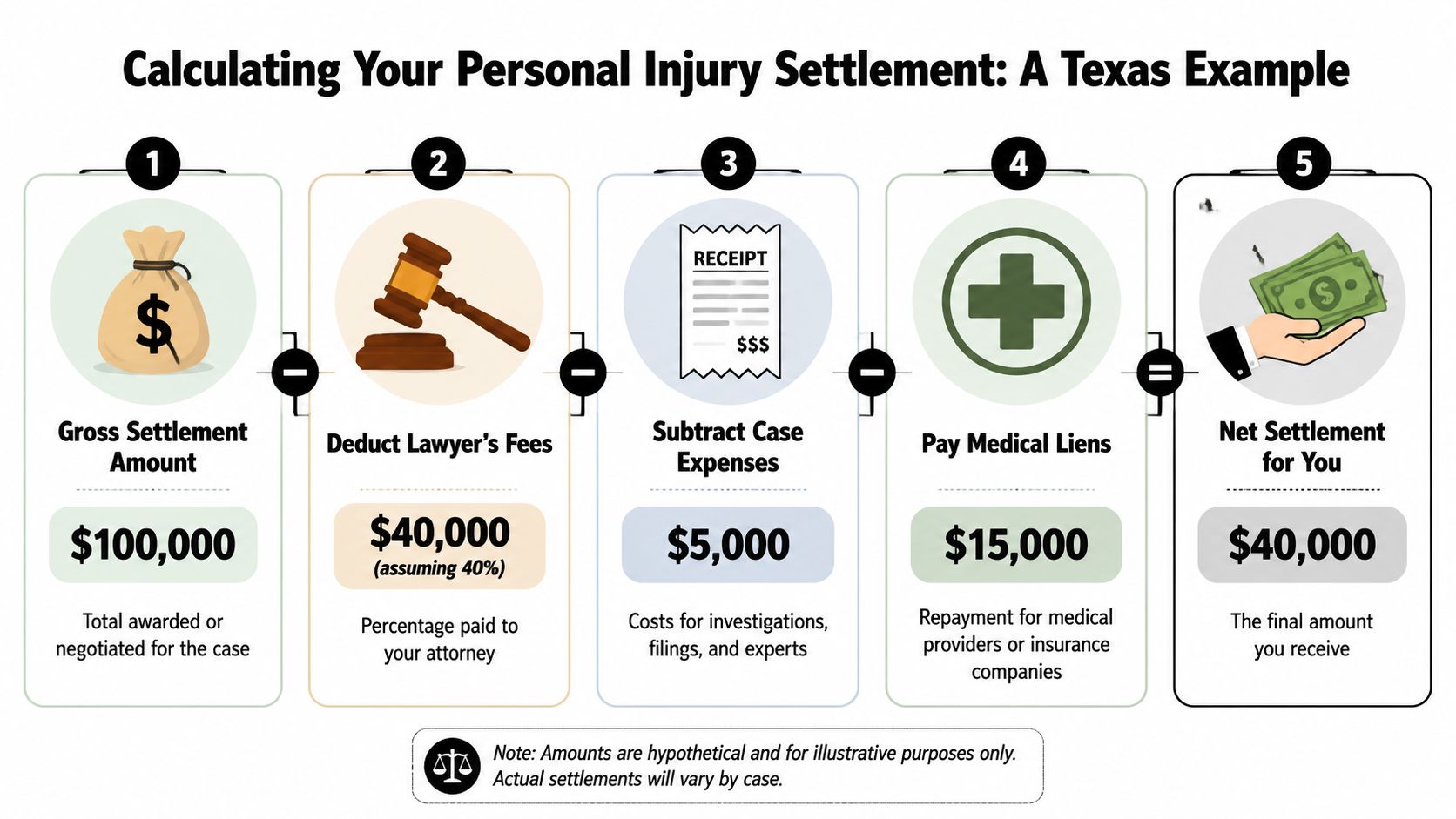
Example using a gross-based calculation
Some fee agreements calculate the attorney's percentage from the full settlement amount first. Then expenses are reimbursed from the recovery.
Using that setup, the math would look like this:
- Gross recovery: $60,000
- Attorney's fee at 33% of $60,000: $19,800
- Case expenses reimbursed to the firm: $3,000
- Estimated client net before other deductions: $37,200
That means a client who never paid those expenses out of pocket during the case still gets the benefit of having the law firm carry that financial load upfront. For many injured people, that is the difference between being able to pursue a claim and having to walk away from it.
How a net-first setup can change the result
Other agreements subtract case expenses first and calculate the attorney's percentage after that. Using the same numbers, the result changes:
- Gross recovery: $60,000
- Case expenses deducted first: $3,000
- Adjusted amount: $57,000
- Attorney's fee at 33% of $57,000: $18,810
- Estimated client net before other deductions: $38,190
Same case. Same settlement. Same percentage. Different contract language.
That is why clients should never stop at, “What percentage do you charge?” A better question is, “How do you calculate the fee, and when are case expenses deducted?” If you want a closer look at how these numbers are built, this guide on how to calculate a car accident settlement walks through the process in more detail.
This video also walks through the topic in a visual way:
Don't forget other deductions may exist
The settlement is not always the same as the amount you take home. Medical bills, health insurance reimbursement claims, hospital liens, and unpaid balances can still need to be resolved before money is disbursed to you.
A final settlement statement should read like a receipt. It should show the total recovery, the attorney's fee, the case expenses advanced by the firm, and every other deduction line by line.
A transparent lawyer should be able to show you, line by line, how the final number reaching you is calculated.
Your Fee Agreement Checklist What to Confirm Before You Sign
Before you sign a representation agreement, slow down and read it closely. A good lawyer won't rush you through it.
Questions worth asking out loud
You don't need legal jargon. You need direct answers.
Use this checklist when you review the contract:
- Exact fee percentages: Confirm the percentage that applies if the case settles early, after filing, or after trial work begins.
- Case expenses: Make sure the agreement says the firm advances expenses during the case.
- If there is no recovery: Confirm in writing that you owe no attorney's fee and no advanced expenses if the case is unsuccessful.
- Gross or net calculation: Ask whether the fee is calculated before or after case expenses are deducted.
- Settlement statement: Ask whether you'll receive a written breakdown when the case resolves.
- Communication: Confirm who will answer your questions and who will handle the file.
Why this checklist protects you
A fee agreement is more than a payment form. It tells you how the financial side of your case will work from beginning to end.
This matters even more if your case may involve contested liability, comparative responsibility arguments, or serious damages. In those situations, costs and legal work can grow over time, and you deserve to know how the contract handles that.
If you want to understand one of the first letters many firms send after taking a case, this page on a lawyer letter of representation adds helpful context.
A final review standard
If a contract feels vague, ask for it to be explained in plain English. If someone won't explain it clearly, keep looking.
You should leave the consultation knowing three things: what percentage may apply, how expenses are handled, and what happens if the case doesn't recover money.
Recovery is Possible Your Next Steps are Clear and Risk-Free
The financial side of a personal injury case can feel intimidating until someone explains it plainly. Once you understand the structure, the key point becomes clear. In Texas, you usually do not need money upfront to hire a lawyer after an accident.
That matters because the days after a crash are hard enough. You may be dealing with treatment, lost income, vehicle damage, grief, or pressure from adjusters who want a fast statement or a cheap settlement. Legal help shouldn't add another burden.
Your next steps are usually simple:
- Get medical care: Your health comes first.
- Preserve records: Keep photos, bills, discharge papers, and insurance letters.
- Be careful with insurers: Don't guess, speculate, or accept a quick offer before you understand your injuries.
- Talk to a lawyer early: Prompt advice can help protect evidence, deadlines, and your ability to pursue full compensation.
If you're worried about fault, negligence, comparative responsibility, or how long you have to file a claim, those are exactly the issues a consultation should address. The same is true if you need help after a fatal crash, a serious truck wreck, or a life-changing injury.
Recovery is possible. Clear answers are available. And for most injury victims in Texas, getting those answers is risk-free.
If you were hurt in a crash or your family lost someone because of another driver's negligence, Law Office of Bryan Fagan, PLLC can review your situation in a free consultation. You can get plain-English answers about fees, case expenses, fault, deadlines, and your next steps without any upfront cost.