A serious accident can change your life in seconds, but you don’t have to face it alone.
One moment you’re heading down a Houston freeway, thinking about work, school pickup, or getting home. The next, your car is spun around, your phone is buzzing, your neck hurts, and someone from an insurance company is already asking questions you’re not ready to answer. That confusion is normal. So is the fear about medical bills, missed paychecks, and whether your life will get back to normal.
If you’re looking for a houston auto accident attorney, you probably don’t need marketing language. You need a clear plan. You need to know what to do today, what mistakes to avoid this week, and how to protect both your injury claim and your future. That’s what this guide is for.
Your Life Changed in an Instant Here’s What to Do Next
A Houston crash often unfolds the same way. You are driving a route you know well, traffic tightens, someone brakes late, and a routine trip turns into ambulance questions, body pain, and a damaged car sitting on the shoulder. In the first few hours, injured drivers are asked to make decisions before they have a clear picture of their injuries, their coverage, or how long recovery will take.

Houston roads carry a heavy crash burden. The Texas Department of Transportation tracks collisions statewide through its Crash Records Information System, and Harris County sees serious wrecks every year. For an injured driver, that matters for one reason. What happened to you is common enough that insurers have a playbook for it. You need one too.
Start with the two problems that cause the most damage if they are ignored early: untreated injuries and missing documentation. Both can follow you for months. A back injury that seemed minor can interrupt work. A short gap in treatment can become an argument from the insurance company that you were not really hurt.
That is why the first goal is not just to open a claim. It is to protect your health and put yourself in a position to recover financially later, including after the settlement check arrives.
Focus on the decisions that matter first
After a wreck, people often worry about the car before they think about the case value. That is understandable. You still need transportation, income, and answers. But the strongest claims usually begin with disciplined choices in the first day or two.
Keep your attention on these priorities:
- Get evaluated by a medical professional. If you declined an ambulance, see a doctor promptly. Early records connect the crash to the injury.
- Preserve the basic evidence. Save photos, witness names, the other driver’s information, tow details, discharge papers, and receipts.
- Be careful with recorded statements. You may need to notify your carrier, but you do not need to guess about fault or minimize your symptoms.
- Use a clear checklist. This what to do after a car accident guide helps keep the process organized.
- Review practical car-loss issues. If your vehicle may be totaled, these steps after car accident can help you deal with transportation and property-damage decisions.
One more point gets overlooked too often. A settlement is not only about paying the first round of bills. It may need to cover future treatment, time away from work, reduced earning ability, and the cost of rebuilding stability at home. Clients who understand that early tend to make better decisions throughout the case.
You do not need to solve everything today. You need to avoid the early mistakes that make recovery harder later.
The First 24 Hours After a Houston Car Accident
The first day after a wreck is usually messy. You may be talking with police, trying to find your car, calling family, missing work, and wondering whether you should already have a lawyer. Start with order. The more organized you are in the first day, the less room the insurance company has to argue later.

What to do at the scene if you can
If you’re physically able, stay calm and think in this order:
- Safety first. Move out of active traffic if it can be done safely.
- Call 911. In Houston, getting police and emergency responders involved helps create an official record.
- Exchange basic information. Names, insurance, vehicle information, and contact details.
- Take photographs. Get wide shots and close-ups. Include the cars, skid marks, lane positions, debris, traffic lights, weather conditions, and visible injuries.
- Identify witnesses. A neutral witness can make a major difference when stories conflict.
Don’t argue about fault at the scene. Don’t apologize in a way that sounds like an admission. Stress makes people say things they don’t mean.
What to photograph and save
A useful crash file is more than a few car pictures. Try to preserve:
- Vehicle damage: All sides of every vehicle involved.
- Road evidence: Glass, debris, standing water, damaged signs, and lane markings.
- Your injuries: Bruising, cuts, swelling, burns, and mobility aids if they’re needed later.
- Paper trail: Towing receipts, discharge instructions, prescriptions, and repair estimates.
A simple folder on your phone works. The point is to stop evidence from disappearing.
Later in the day, this walkthrough can help you compare your own actions against sound steps after car accident guidance, especially if you’re trying to fill in what you missed in the confusion.
Get examined even if you think you can wait
A lot of injuries don’t announce themselves immediately. Neck pain, back pain, headaches, concussion symptoms, and soft tissue injuries often show up after the initial shock fades. Go to the emergency room, urgent care, or your doctor based on the seriousness of your symptoms. Then follow through.
Going to a doctor is not “building a case.” It’s taking care of yourself and creating an honest medical timeline.
Here’s a short video that explains the immediate aftermath in a practical way:
What not to do in the first day
Some mistakes are easy to avoid once you know them:
- Don’t post about the crash: Insurance companies may look for anything they can twist.
- Don’t skip follow-up care: If a provider tells you to return, go back.
- Don’t throw away documents: Keep every bill, receipt, and instruction sheet.
- Don’t give a detailed statement while medicated or overwhelmed: You’re allowed to pause and get advice.
The first day isn’t about being perfect. It’s about protecting your body, your records, and your options.
Building Your Case and Dealing with Insurance Companies
Three days after a Houston wreck, many people are surprised by what happens next. The pain gets worse, the bills start showing up, and an adjuster calls sounding calm, helpful, and in a hurry. That conversation can shape the value of the case long before a settlement offer arrives.
Insurance companies investigate early because early statements are useful to them. Sometimes the adjuster is gathering basic information. Sometimes the goal is to pin down your story before you know the full extent of your injuries, before all witnesses are found, or before vehicle damage is fully documented. A case is built the same way a case is lost. One record, one statement, one decision at a time.
What to tell your own insurer
Report the crash to your own carrier promptly. Keep it short and accurate. Give the date, time, location, the vehicles involved, and whether you have received medical care. If treatment is ongoing, say that plainly.
A good script is simple:
“The crash happened on this date in Houston. I am still being evaluated and treated, so I cannot fully describe my injuries yet.”
That is usually enough to open the claim without guessing.
Your own insurer may also ask about property damage, towing, rental coverage, med pay, or uninsured motorist coverage. Answer those questions carefully, but do not fill silence with estimates. If you do not know, say you do not know yet.
What to say to the other driver’s adjuster
The other driver’s insurer does not work for you. Start there.
You are not required to help them minimize your claim. In my experience, the biggest early mistakes are recorded statements, casual comments about feeling “fine,” and quick settlements before a doctor can tell whether the injury will resolve or turn into months of treatment. Once those words are in the file, the adjuster will return to them again and again.
Texas law can also reduce compensation if the insurer proves you were partly at fault. That is why adjusters ask narrow questions about speed, following distance, distractions, prior injuries, and what you “could have done” to avoid the crash. Those questions are not random.
A few phrases that protect you
Discipline matters more than sounding polished.
- When asked for a recorded statement: “I’m not prepared to give a recorded statement at this time.”
- When asked to estimate your injuries too soon: “I’m still receiving medical evaluation and treatment.”
- When pushed for quick settlement: “I’m not ready to discuss settlement until I understand my condition and losses.”
- When asked leading fault questions: “I want to stick to the facts as I know them.”
That approach protects accuracy. It also protects your future options.
What strengthens a claim, and what weakens it
Insurance companies look for gaps. They look for missed appointments, inconsistent symptoms, missing photos, and social media posts that seem to contradict your injuries. They also look for signs that you are under financial pressure and may take less money than the case is worth.
| Situation | What helps | What hurts |
|---|---|---|
| Medical treatment | Following the treatment plan and reporting symptoms consistently | Long gaps in care or stopping treatment without explanation |
| Communication | Short, factual answers | Guessing, minimizing pain, or arguing with the adjuster |
| Documentation | Saving bills, wage records, repair estimates, and photos | Assuming the insurer will collect and preserve everything |
| Settlement timing | Waiting until future care and missed income are clearer | Accepting a release before you know the long-term cost |
That last point deserves extra attention. A fair case value is not just today’s ER bill and car repairs. It can include future treatment, reduced earning ability, recurring pain, and the financial strain that follows a serious injury. The right strategy is not only to resolve the claim. It is to make sure the result supports your life after the case closes.
If the wreck has left you unable to work normally, needing follow-up care, or dealing with a liability dispute, bring in legal help early. A lawyer can handle insurer contact, gather records, preserve evidence, and frame the case around the full harm, not the insurer’s first version of it. For a practical primer before that first conversation, this guide on how to respond to insurance adjuster tactics after a car accident is useful.
One option some injured Texans consider is the Law Office of Bryan Fagan, PLLC, which handles motor vehicle injury claims and related insurance disputes on a contingency-fee basis.
Understanding Your Rights Under Texas Personal Injury Law
After a crash, a law school lecture isn't necessary. Plain English is what's needed. Texas injury law comes down to a few rules that shape almost every car wreck case.
Fault and negligence in simple terms
A driver is usually legally responsible when that driver failed to act with reasonable care and caused a crash. That can involve speeding, distraction, unsafe lane changes, drunk driving, or ignoring traffic signals. In legal terms, people call that negligence.
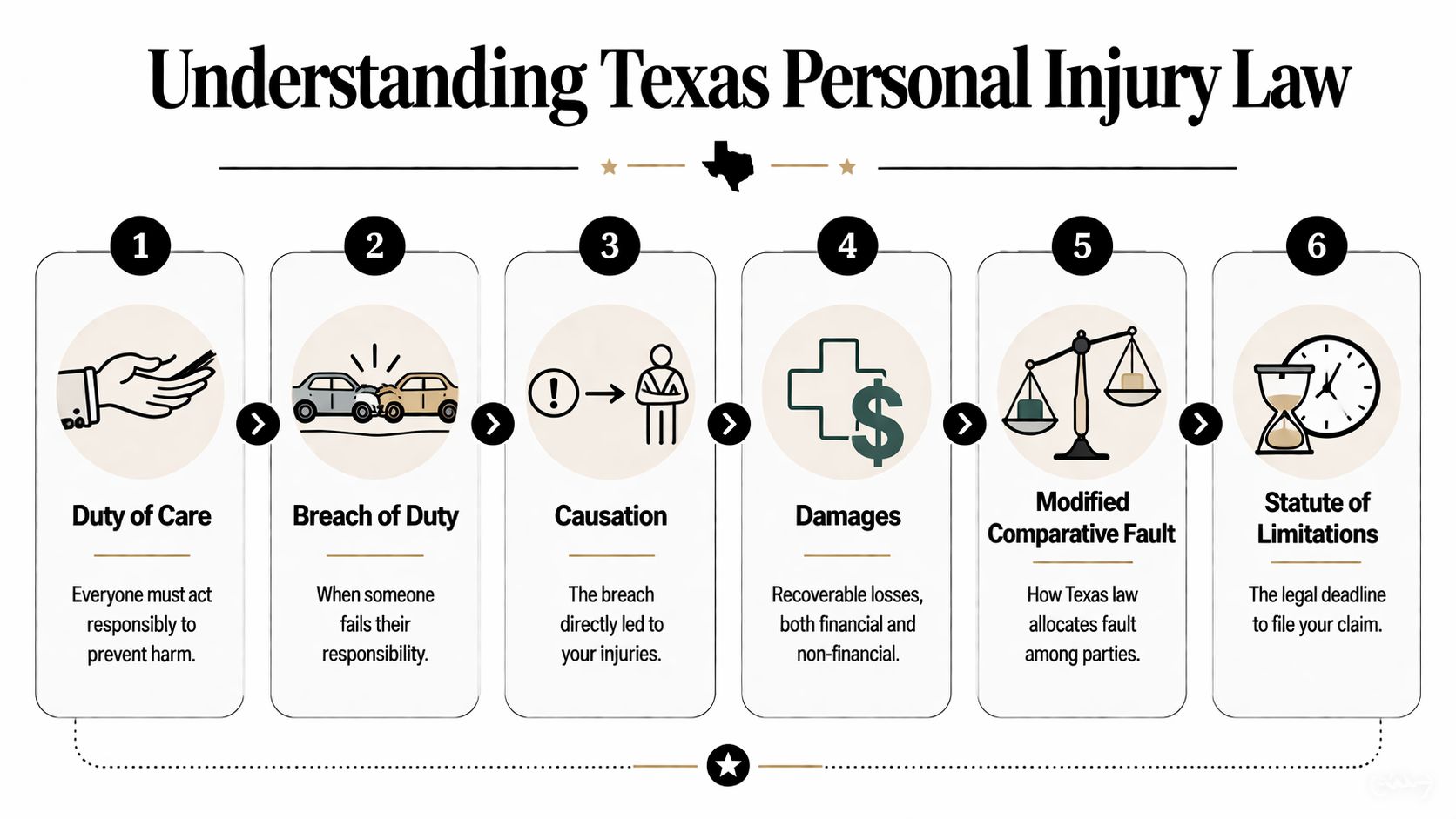
To build a case, you generally need to show four things:
- Duty of care: Drivers must operate vehicles safely.
- Breach: Someone failed to meet that duty.
- Causation: That failure caused the collision.
- Damages: You suffered losses because of it.
Those losses can be financial, physical, or personal.
Comparative responsibility in Texas
Texas uses a modified comparative responsibility system. That means more than one person can share blame for a crash. It also means your recovery can be reduced if you were partly at fault.
After a chain-reaction crash on I-45, for example, one driver may have braked suddenly, another may have been following too closely, and a third may have been speeding in wet conditions. The law tries to sort out who contributed and by how much.
The rule that matters most is this:
If you are found over 51% at fault, you cannot recover damages under Texas’s modified comparative negligence rule, as discussed in the earlier insurance section.
That is why fault arguments matter so much. The insurance company isn’t only debating money. It may be trying to push you past the line that blocks recovery.
How long do you have to file a claim in Texas
Texas also has a statute of limitations. For most car accident injury cases, the deadline is two years. Miss that deadline and your claim may be barred, even if the facts are strong.
That doesn’t mean you should wait close to the end. Evidence fades. Vehicles get repaired or sold. Witnesses become hard to find. Medical records become harder to connect cleanly to the crash if there are long delays.
A simple timeline helps:
| Legal issue | What it means for you |
|---|---|
| Fault | You must show the other side caused the crash |
| Comparative responsibility | Your recovery can be reduced if you share blame |
| Over 51% fault | Recovery may be barred |
| Two-year filing deadline | Waiting too long can end the case entirely |
Why early action matters
In practical terms, early action strengthens your position. You preserve photos, vehicle data, witness memory, and treatment records before they become harder to use.
If the crash involved a company vehicle, commercial truck, or death, that early legal review becomes even more important. A truck crash lawyer Houston families trust or a wrongful death lawyer Texas families can call should evaluate those cases quickly because the evidence issues are often more complex.
Valuing Your Total Damages Beyond the Initial Bills
A case can be undervalued long before settlement talks begin.
I see it often. Someone adds up the ambulance bill, the ER visit, the body shop estimate, and a week or two of missed work. That gives a starting point. It does not give the full value of the claim if the injury keeps affecting your health, your job, or your family months from now.
The right question is broader. What has this crash already cost, and what will it likely cost over time?
Economic damages and the costs you can track
Economic damages are the financial losses you can document. Medical bills are part of that picture, but not the whole picture. A proper damages review may include follow-up treatment, physical therapy, prescription costs, medical equipment, travel to appointments, home help, lost wages, lost job opportunities, and vehicle or property losses tied to the collision.
Future losses matter just as much as current ones.
If a back injury keeps you from lifting, a shoulder injury limits overhead work, or a concussion makes screen time and concentration harder, the claim should account for what that does to your earning ability. The same is true if you had to use sick time, turn down overtime, miss commissions, pause a business, or accept lighter work at lower pay.
A fair evaluation usually asks:
- What treatment is still ahead?
- What work did you miss, and what work can you no longer do the same way?
- Did the injury change your career path, hours, or income ceiling?
- Will you need help at home or paid support you did not need before?
Non-economic damages and the parts of harm that do not come with receipts
Some losses do not show up on a bill.
Pain, disrupted sleep, fear of driving, reduced mobility, strain on a marriage, missed time with children, and the loss of normal routines are real damages under Texas law. These damages often carry substantial value because they describe how the injury changed daily life, not just what treatment cost.
Specific details matter here. A jury understands more from "I cannot sit through my daughter’s school program without standing up in pain" than from "ongoing discomfort." A strong case ties the injury to concrete changes in work, home life, rest, hobbies, and independence.
A fair settlement should cover both the bills you can count and the future you now have to plan around.
Planning for life after the settlement
This part gets skipped far too often.
A settlement is not only about closing a case. It may need to support years of treatment, reduced earnings, household needs, and financial stability. If the injury is serious, the question shifts from "What is the case worth?" to "How do we make these funds last and protect what they are supposed to do?"
Start with the structure of the payment. Some clients do better with a lump sum because they need flexibility, debt cleanup, vehicle replacement, home changes, or business support right away. Others benefit from a structured settlement that pays over time. That can create predictable income, reduce the pressure to manage a large balance all at once, and match future payments to expected medical or living expenses. The right choice depends on age, health, work capacity, discipline with money, and whether future care costs are known or uncertain.
Large recoveries also require planning for protection. If the injured person is a child, has significant long-term care needs, or receives means-tested public benefits, a trust may need to be considered before money changes hands. In the right case, that protects eligibility for certain benefits and gives a clear framework for how funds are managed. It also helps families avoid preventable mistakes that can drain a recovery faster than expected.
Medical planning matters too. Before a case resolves, review whether future surgery, therapy, injections, medications, mobility aids, or in-home help are likely. Get that into the damages analysis early. After settlement, build a simple care budget. Divide expected needs into monthly costs, annual costs, and one-time costs such as a replacement vehicle, home modifications, or assistive equipment.
I also tell clients to slow down before spending. Pay the urgent obligations. Set aside taxes if any part of the recovery creates a tax question. Confirm what liens, subrogation claims, or medical balances must be resolved. Then talk with a qualified financial professional if the recovery is substantial. Good legal work gets the settlement. Good planning helps the settlement support your life five years from now.
UM and UIM claims when the other driver has too little coverage
Some cases are limited by insurance, not by injury.
If the at-fault driver has no coverage or too little coverage, your uninsured or underinsured motorist coverage may become one of the main sources of recovery. That does not make the claim simple. Your own insurer may still dispute the severity of your injuries, whether the treatment was reasonable, or how much compensation is appropriate.
These claims need the same careful proof as any other injury case, sometimes more.
When a fatal crash leads to a wrongful death claim
If a crash caused a death, damages go far beyond funeral bills and the last medical expenses. The case may include lost financial support, lost services, lost care, and the loss of the relationship itself as recognized by Texas law.
Families also need practical planning here. A recovery may have to support children, replace income that paid the mortgage, or stabilize a household that lost its primary earner. A wrongful death lawyer Texas families consult should look at both sides of the case. What the law allows today, and what the surviving family will need to stay secure in the years ahead.
Negotiation vs Trial What to Expect
Many clients worry that hiring a lawyer means they are signing up for court right away. Usually, that’s not how it works. Most cases move through negotiation first. Still, the strongest settlements often come from cases prepared like they may be tried.
That distinction matters.
What negotiation actually looks like
A serious injury claim usually develops over time. Records are gathered. Treatment is reviewed. lost income is documented. Liability evidence is organized. Then a demand is made to the insurance company with a clear explanation of fault, injuries, and damages.
The insurer responds. Sometimes the first offer is low. Sometimes it is insultingly low. Then the back-and-forth begins.
Good negotiation is not bluffing. It is showing the other side that you can prove the case. That means organized records, clear medical support, consistent facts, and a willingness to reject a weak offer.
When filing suit becomes necessary
If the insurer won’t deal fairly, a lawsuit may be the next step. That does not mean trial is tomorrow. It means the dispute moves into formal litigation.
A few terms clients should know:
- Discovery: Each side exchanges information and evidence.
- Depositions: Witnesses and parties answer questions under oath.
- Motions: Lawyers ask the court to decide certain legal issues before trial.
- Mediation: A structured settlement conference with a neutral third party.
For many people, litigation sounds intimidating until they see the rhythm of it. In reality, much of it is preparation, document work, sworn testimony, and negotiation under tighter pressure.
Trial preparation often improves settlement leverage because the insurance company can see the case is documented, organized, and ready.
The trade-off between settlement and trial
Settlement can bring closure sooner and reduce uncertainty. Trial can produce a better result in the right case, but it also brings delay, expense, and risk. There is no honest lawyer answer that fits every case.
The right question is not “Do I want trial?” The right question is “What path gives me the best chance at a fair outcome based on these facts?”
A prepared lawyer treats both paths as connected. The case is built thoroughly enough to settle well, and thoroughly enough to try if settlement fails.
How to Choose and Work With a Houston Auto Accident Attorney
Two weeks after a crash, many clients are still in pain, missing work, and getting calls from an insurance adjuster who sounds friendly but wants a recorded statement. That is usually the point where the choice of lawyer starts to matter. The right attorney does more than open a claim. Your attorney should protect the case, keep treatment and documentation on track, and help you plan for what happens after the settlement check arrives.

A good fit starts with clear, practical answers. Ask whether the lawyer regularly handles cases like yours. A rear-end collision with soft tissue injuries is handled differently than a crash involving surgery, a company vehicle, or a wrongful death claim. Ask who will work on the file, how often you will get updates, and what the firm expects from you during treatment. If the answers are vague in the first meeting, communication usually does not improve later.
Houston experience matters for reasons clients feel right away. Local lawyers know the roads where serious wrecks happen, the providers who create useful records, the courts where lawsuits are filed, and the insurance defense firms that appear again and again. That does not guarantee a result. It does help the lawyer make better early decisions.
What to look for first
Look for a lawyer who can do four things well.
- Explain the case in plain English. You should understand your options, your risks, and the likely timeline.
- Build the file while you recover. That means collecting records, tracking treatment, preserving evidence, and watching deadlines.
- Deal with the insurance company without losing focus on your health. A claim is stronger when the legal work and the medical picture stay consistent.
- Talk about the settlement after the case ends. The money has to cover more than today's bills. In serious cases, it may need to support future care, time away from work, debt cleanup, or a safer financial cushion for your family.
That last point gets missed too often. A settlement can disappear fast if no one has walked you through liens, taxes where applicable, future treatment costs, and how to avoid spending decisions made under stress.
What working with the right lawyer should feel like
Clients should know what stage the case is in and what comes next. They should know who to call. They should also hear honest advice, even when the advice is not what they hoped for.
Here is a simple way to judge the relationship:
| Good sign | Warning sign |
|---|---|
| Clear explanation of fees and case expenses | Unclear answers about costs or deductions |
| Regular requests for records, bills, and treatment updates | Little interest in your medical progress |
| Candid discussion of strengths and weak spots | Promises of a guaranteed payout |
| Attention to future losses, liens, and financial planning after settlement | Pressure to settle before the full impact of the injury is known |
Questions worth asking in a consultation
Ask direct questions and listen for direct answers.
- Who will communicate with me regularly?
- What do you need from me in the next seven days?
- Do you want me speaking with the adjuster, or will your office handle that?
- At what point would you recommend filing suit?
- How do you evaluate future medical care and lost earning capacity?
- After a settlement, do you help clients address liens, unpaid bills, and longer-term financial planning?
If you want a useful checklist before meeting with firms, review this guide on how to choose a personal injury attorney.
Understand the fee arrangement before you sign
Most car wreck cases are handled on a contingency fee. That means the lawyer is paid from the recovery, not by the hour up front. Still, you need details in writing. Ask what percentage applies before suit and after suit, how case expenses are handled, whether medical records or expert costs are advanced, and how liens are paid at the end.
Read the agreement carefully.
A settlement amount is not the same as the amount you take home. Clients need a realistic explanation of attorney's fees, case costs, medical balances, health insurance reimbursement claims, and any other deductions. Good lawyers explain that before you sign, not after the case resolves.
If you were hurt in a wreck and need straight answers from a Texas personal injury lawyer, contact the Law Office of Bryan Fagan, PLLC to schedule a free consultation. You can talk through what happened, learn your options, and get a practical plan for protecting your claim, your family, and your future.