Skip to content
A serious accident can change your life in seconds. One moment you're driving home, crossing an intersection, or riding with a family member. The next, you're dealing with pain, medical appointments, missed work, and an insurance company that already seems focused on paying as little as possible.
If you're searching for what factors affect injury settlement texas, you're probably not looking for legal theory. You want a clear answer about what will shape your recovery, what can reduce it, and what you can do right now to protect it. That's the right question.
In Texas, an injury settlement usually turns on a handful of practical issues. Who caused the crash. How serious your injuries are. What your records show. How much insurance is available. Whether the insurer can push part of the blame onto you. And whether deadlines, liens, or missing proof weaken your position before negotiations even begin.
Your Guide to Understanding Your Texas Injury Claim
After a Houston freeway crash, many people make the same assumption. If the other driver clearly caused the wreck, the insurance company will pay what the case is worth. In real life, it rarely works that cleanly.
A Texas injury claim is built like a chain. If one link is weak, the settlement can shrink. Fault disputes can reduce the claim. Incomplete treatment records can lower the insurer's valuation. Limited insurance can cap recovery even when the injury is severe. Deadlines and medical liens can further affect what you take home.
What usually drives settlement value
Three issues tend to shape the outcome more than anything else:
- Liability proof: Can you show the other party acted carelessly and caused your injuries?
- Damage proof: Can you document your medical care, lost income, and the way the injury changed your daily life?
- Collectability: Is there enough insurance or other available coverage to pay the claim?
That last point surprises many families. A strong case and a fully documented injury don't always mean full payment.
Practical rule: Settlement value and settlement recovery are not always the same thing. A case may be worth more than the insurance available to pay it.
Why this matters early
The first days after a crash often shape the final result. The police report gets written. Vehicles are repaired or destroyed. Video gets deleted. Witnesses become harder to find. Medical records begin to tell the story of your injury, for better or worse.
That's why early decisions matter. Prompt treatment, careful documentation, and smart communication with insurers can preserve a strong negotiating position. Delay and guesswork usually help the defense.
Proving Fault Under Texas Comparative Responsibility Rules
Everything starts with negligence. In plain English, that means someone failed to act with reasonable care and caused harm. A driver who runs a light, follows too closely, drifts into another lane, or drives distracted may be negligent. But proving that is not always simple, especially when the insurer argues that you share some blame.

How Texas handles shared fault
Texas follows a modified comparative negligence system with a 51% bar rule. If an injured person is found more than 50% at fault, they cannot recover compensation. If they are less than 50% at fault, the award is reduced by that percentage. One Texas source gives this example: a $100,000 award becomes $80,000 when the claimant is found 20% at fault in a Texas comparative negligence explanation.
Think of fault like a pie chart. The insurer wants a larger slice assigned to you because every extra share cuts what they pay. If they can push your responsibility high enough, they may avoid paying anything.
For a plain-language overview of how this works, review this explanation of comparative fault in Texas injury cases.
What helps and what hurts
The strongest claims are usually the ones with objective proof. In a disputed intersection crash, for example, a witness who saw the light change helps. A dashcam clip helps more. A crash report, scene photos, and prompt treatment that matches the mechanism of injury create a much stronger liability picture.
Here's what often makes a difference:
- Official reporting: Police reports can frame the first version of events.
- Independent witnesses: Neutral witnesses often carry more weight than the drivers involved.
- Video evidence: Dashcams, traffic cameras, and nearby business footage can stop blame-shifting quickly.
- Consistent medical history: If your treatment begins promptly and matches the crash, the defense has less room to argue your injury came from somewhere else.
When the insurer blames you, the fight is rarely just about what happened. It's about what you can prove.
A modern issue many people miss
Fault disputes now often turn on digital evidence. In rideshare, delivery, and commercial vehicle cases, app data, phone records, vehicle data, and surveillance footage can become central. If that evidence isn't preserved early, it may disappear before your case is fully evaluated.
That's one reason early legal help matters in car, truck, motorcycle, pedestrian, and wrongful death claims. A Houston car accident attorney or truck crash lawyer Houston clients trust isn't just arguing. They're preserving proof before it's lost.
Calculating the Full Value of Your Losses and Damages
Once fault is established, the next question is what your losses are worth. Many people underestimate their claim at this stage. They focus only on the first ambulance bill or the wages already missed, when the full extent of the harm may include future treatment, lasting pain, reduced mobility, and changes to the work you can do.
A Texas source explains that settlement value is driven by a causal chain of injury severity, documented medical expenses, and available insurance. It also notes that severe injuries such as traumatic brain injury or spinal damage increase both economic and non-economic damages in a discussion of Texas compensation factors.
Two broad categories of damages
Some losses are straightforward. Others are personal.
| Damage Type | What It Covers |
|---|---|
| Economic damages | Medical bills, rehabilitation costs, prescriptions, lost wages, future care, and reduced earning ability when supported by records and other proof |
| Non-economic damages | Pain, suffering, physical impairment, disability, scarring, disfigurement, and the broader human impact of the injury |
If you want a closer look at this distinction, this guide on economic and non-economic damages in Texas is a useful starting point.
Why records matter so much
Insurance adjusters usually don't value a case based on sympathy. They value what they can document and defend. That means your medical records, imaging, prescriptions, physician opinions, work records, and notes about future care all matter.
Missing records create openings for the defense. Gaps in treatment can lead to arguments that you got better quickly, weren't badly hurt, or made your condition worse by failing to follow through.
A strong damages file often includes:
- Itemized medical bills
- Imaging and test results
- Doctor recommendations for future treatment
- Proof of missed work or reduced hours
- Evidence of permanent restrictions or impairment
Real-world examples of valuation issues
After a truck collision, a fractured bone may heal, but the case may still involve months of therapy, time away from work, and lasting pain with lifting or standing. In a catastrophic injury case, the biggest component may not be the emergency room bill. It may be future care needs or the loss of earning capacity over time.
Key point: A fair claim value should reflect both what the injury has already cost you and what it will continue to cost you.
That's especially important in catastrophic injury and wrongful death lawyer Texas cases, where the full loss often goes far beyond the first wave of bills.
How Insurance Policy Limits Cap Your Recovery
This is one of the hardest parts of the process for injured people to hear. Your claim may be strong. Your injuries may be serious. Your documentation may be excellent. Yet the practical recovery can still be limited by insurance coverage.
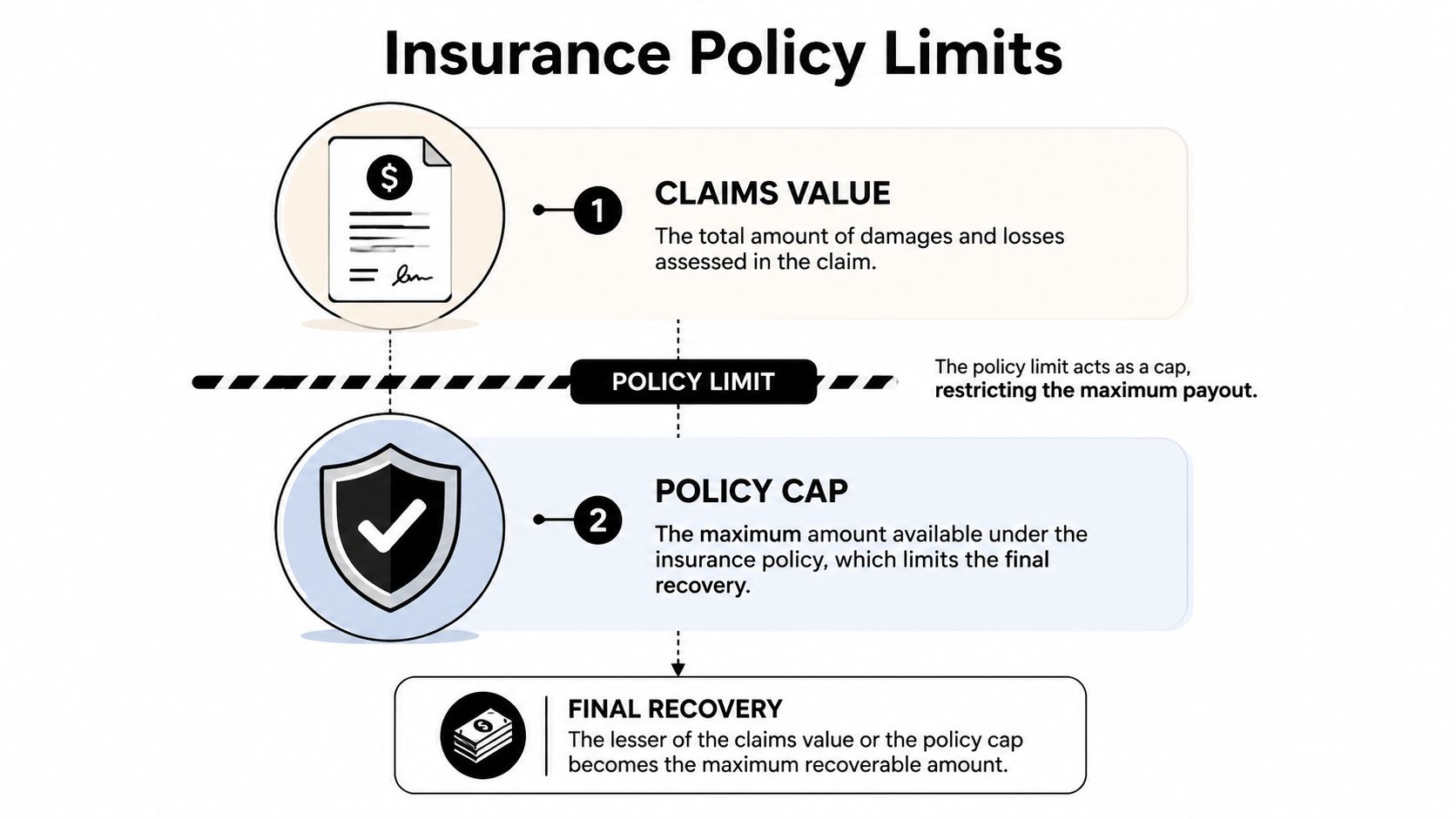
A Texas source explains that the state only requires minimum liability coverage of $30,000 per injured person and $60,000 per crash, and that a seriously injured victim can recover far less than the full value of the claim if the at-fault driver has only minimum limits and no other available assets or policies in this Texas insurance limits discussion.
Why policy limits matter so much
Suppose a driver causes a major crash on a Houston freeway. The injured person may face surgery, rehabilitation, months out of work, and long-term pain. But if the at-fault driver carries only the minimum required policy and there's no additional coverage, that insurance may set the ceiling for what can be collected from that source.
That doesn't automatically mean the case ends there. It means the investigation has to widen.
Where additional recovery may come from
In practice, lawyers often look for other layers of coverage or liability, such as:
- Your own UM or UIM coverage: This can help when the at-fault driver has too little insurance.
- Employer coverage: If the driver was working at the time, a company policy may apply.
- Multiple defendants: In some crashes, more than one person or entity may share legal responsibility.
- Commercial policies: Truck, delivery, and business-use vehicles may carry different insurance structures.
Many drivers don't fully understand how uninsured and underinsured motorist coverage works until they need it. This overview of essential auto insurance protection gives a helpful consumer-level explanation of why UM and UIM coverage can matter so much after a serious wreck.
For background on required Texas coverage, this page on Texas liability insurance can also help.
The practical takeaway
People often ask what their case is worth. A better question is sometimes, “What insurance is available to pay it?” Both questions matter. The first speaks to value. The second speaks to reality.
That's why early policy investigation matters in car, truck, motorcycle, pedestrian, rideshare, and wrongful death claims. If nobody identifies all possible coverage, money can be left on the table.
Navigating Legal Deadlines and Liens on Your Settlement
A good case can still be lost or reduced by procedural problems. Two of the most important are the filing deadline and the claims that may attach to your settlement after medical treatment is paid by someone else.
How long do you have to file a claim in Texas
In Texas, you generally have two years from the date of the accident to file a personal injury lawsuit. Missing that deadline can prevent you from recovering compensation at all.
That timeline sounds generous until real life gets in the way. People try to heal first. They assume the insurer is “working on it.” They wait for surgery decisions, employment issues, or family obligations to settle down. By the time they realize the claim isn't resolving fairly, key evidence may be harder to collect and the deadline may be close.
For families in fatal crash cases, the same urgency applies. A wrongful death lawyer Texas families consult should be involved early enough to preserve records, identify responsible parties, and avoid preventable timing problems.
What liens and subrogation mean
Even when a case settles, the full amount doesn't always go straight into your pocket. If a health insurer, hospital, or medical provider paid for treatment connected to the accident, they may seek reimbursement from the settlement.
Often, people get blindsided. They hear a settlement figure and assume that's what they'll receive. Then they learn there are medical balances, lien claims, or subrogation demands that must be addressed before final disbursement.
Common issues include:
- Health insurance reimbursement claims
- Hospital liens for unpaid treatment
- Provider balances that remain outstanding
- Coverage disputes over accident-related care
A settlement isn't just about what comes in. It's also about what has to be paid back out.
Why this affects strategy
Liens change negotiation strategy from the beginning. If there are significant reimbursement claims, your lawyer needs to evaluate not just gross settlement value but likely net recovery. In many cases, reducing those claims can make a meaningful difference to what the injured person receives.
That matters in every case, but especially in serious collisions where treatment is extensive. A seasoned Texas personal injury lawyer or truck crash lawyer Houston clients hire should be thinking about deadlines, proof, and lien resolution at the same time, not as separate problems.
Practical Steps to Protect Your Claim's Value
A common Texas claim loses value in the first week, not because the injury is minor, but because the evidence is weak, incomplete, or handed to the insurance company on its terms. While you are trying to get treatment and keep life together, the adjuster is already looking for gaps, inconsistencies, and anything that supports a comparative fault argument.

As noted in this Texas settlement factors article, claim value often turns on the quality of the proof. In practice, that means building a file early, before photos disappear, witnesses stop answering, and digital records are overwritten.
What to do right away
Start with the steps that protect both medical proof and liability proof.
- Get medical care early: Prompt treatment helps connect the crash to your injuries and makes it harder for the insurer to argue that something else caused your condition.
- Follow the treatment plan: Missed visits, long gaps, and stopping care too soon give the defense an opening to say you recovered quickly or were never badly hurt.
- Save every document: Keep discharge instructions, prescriptions, imaging records, bills, referrals, work excuses, and mileage records for treatment.
- Photograph the scene and your injuries: Vehicle damage, bruising, swelling, roadway conditions, skid marks, and debris can matter more later than they seem to matter now.
- Notify your employer in writing if work is affected: Reduced hours, missed days, or changed duties are easier to prove when they are documented as they happen.
Digital evidence deserves special attention. In many cases, it now makes the difference between a disputed claim and a persuasive one. If the crash involved a commercial truck, rideshare vehicle, delivery driver, or even a business-owned car, useful proof may include app activity, GPS data, onboard systems, dashcam footage, text logs, or nearby surveillance video. That material can disappear quickly.
What not to do
A few mistakes can reduce settlement value fast.
- Do not give a recorded statement to the other driver's insurer without legal advice
- Do not guess about speed, distance, or how the crash happened if you are unsure
- Do not minimize pain just to sound tough or polite
- Do not post photos, comments, or activity updates on social media
- Do not accept an early settlement before you understand your diagnosis, treatment needs, and time away from work
A short explanation from a legal perspective may help:
Build a file that tells the story clearly
Strong claims usually come from organized, ordinary proof. A daily journal is one of the most useful tools injured clients can keep, and it costs nothing. Write down pain levels, sleep problems, medications, appointments, missed family activities, trouble driving, and any task that now takes longer or requires help.
That record does two things. It shows how the injury affects daily life beyond the medical chart, and it helps your lawyer respond when the insurance company argues that you are exaggerating or that your limitations are unrelated.
Digital evidence matters here too. If the other side claims you caused part of the wreck, phone photos, timestamped messages, location history, dashcam clips, and surveillance footage may help answer that argument. In Texas, even a good case can lose significant value if comparative responsibility is not challenged with solid proof.
One more practical point often gets overlooked. Insurance policy limits can place a hard ceiling on recovery no matter how serious the injury is. That is why preserving evidence early matters so much. Strong proof can improve settlement value, identify additional liable parties, and sometimes uncover other available coverage.
If you are not sure what should be preserved, a consultation with a Houston car accident attorney, a catastrophic injury lawyer, or the Law Office of Bryan Fagan, PLLC can help you spot evidence issues early and avoid preventable damage to the claim.
How a Texas Personal Injury Lawyer Maximizes Your Settlement
The legal system asks a lot from injured people at the worst possible time. You're expected to document treatment, deal with adjusters, understand fault arguments, identify insurance coverage, protect digital evidence, and keep track of deadlines while trying to heal. That's a difficult job even for someone who works in this field.
What legal representation changes
A lawyer's role isn't limited to sending demand letters. Good representation affects the value of the case in several ways:
- Investigation: Gathering reports, witness statements, video, phone or app-related evidence, and other proof before it disappears
- Valuation: Organizing medical records, future care evidence, wage loss proof, and impairment evidence into a claim the insurer has to take seriously
- Coverage analysis: Looking beyond the obvious policy to identify other possible sources of recovery
- Negotiation: Responding to blame-shifting, low offers, and incomplete evaluations with documented facts
- Resolution planning: Addressing liens and reimbursement claims so the final recovery is handled carefully
Why trial readiness matters
Insurance companies usually pay more attention when they believe the case has been prepared thoroughly and can be tried if necessary. That doesn't mean every case goes to court. It means the file has substance behind it.
For injured Texans, that matters in everything from a rear-end collision to a catastrophic truck crash or a fatal roadway case. A Texas personal injury lawyer who understands how fault, damages, insurance limits, and lien issues interact can often improve both the strength of the claim and the clarity of the process for the client.
You don't have to solve every part of this alone. With the right guidance, recovery is possible, and the legal process becomes far more manageable.
If you were hurt in a crash or lost a loved one because of someone else's negligence, help is available. The Law Office of Bryan Fagan, PLLC offers free consultations for Texans dealing with car wrecks, truck collisions, catastrophic injuries, UM/UIM disputes, and wrongful death claims. You can speak with a lawyer about your rights, your next steps, and what may affect the value of your case. The process can feel overwhelming, but you don't have to carry it by yourself.