A serious accident can change your life in seconds, but you don’t have to face it alone.
If you were hurt at work in Texas, you may be dealing with pain, missed paychecks, medical appointments, pressure from your employer, and a lot of confusion. Many injured workers start with the same questions. Does workers' comp cover this? What if my boss says I can’t file? What if the claim gets denied? What if my employer doesn’t even carry coverage?
Texas has some of the most unusual workplace injury rules in the country. That’s why searches for workers compensation rules texas often lead people into a maze of forms, deadlines, and legal terms that don’t answer the question that matters most. What do I do next?
A Workplace Injury Can Change Everything But You Are Not Alone
Workers' compensation is supposed to provide medical care and some wage support after a job-related injury. In a basic sense, it is a no-fault system. That means you usually don’t have to prove your employer meant to hurt you or even acted carelessly. You generally need to show that the injury happened in the course of your work.
But Texas adds a major complication. Employers here can choose whether to participate in the state workers' compensation system. Some do. Some don’t. That single fact changes almost everything about your rights.
If your employer subscribes to workers' comp, your case usually moves through the Texas workers' compensation system. If your employer is a non-subscriber, you may not have automatic no-fault benefits at all. Instead, your path may be a negligence claim against the employer or another responsible party.
That legal difference affects your medical care, your wage recovery, your deadlines, and whether you can sue for pain and suffering.
The emotional side matters too. A workplace injury often brings fear, sleep problems, frustration, and a loss of control. Some workers also struggle after the physical emergency passes. If that sounds familiar, a resource on trauma-informed therapy can help you understand why stressful medical and legal events can affect your body and mind long after the accident itself.
You don’t need to understand every rule on day one. You do need to protect your rights early, document what happened, and avoid signing away options before you know where your claim stands.
What Is Workers Comp and Does It Cover Your Injury
Workers' comp is often described as an insurance benefit. In practice, it’s a trade-off.
If your employer carries workers' compensation coverage, you may receive approved medical treatment and income benefits for a work injury. In exchange, you usually give up the right to file a standard negligence lawsuit against that subscribing employer. That’s why the first question in a Texas work injury case is not just how you got hurt. It’s whether your employer subscribes.
What no-fault really means
“No-fault” does not mean every injury is automatically covered. It means you generally don’t have to prove your employer’s negligence to access benefits through the workers' comp system.
You still must show the injury happened while you were doing your job. Lawyers and insurance carriers often call this the course and scope of employment. A Houston delivery driver hit in a crash while making a scheduled delivery may be covered. A worker injured during a personal errand off the clock usually faces a harder argument.
Coverage also gets murky when the employer claims you were horseplaying, violating policy, intoxicated, or off duty. Those disputes are common, especially when there’s no prompt written report and no clean medical timeline.
Subscriber and non-subscriber paths look very different
Texas uniquely allows employers to opt out of the state workers' compensation system. These non-subscribers now make up a significant share of Texas businesses, and injured workers at those companies do not have automatic no-fault benefits. Uninsured workers are 2.6 times more likely to have emergency admissions, and total work-related hospital charges exceed $615.2 million annually, according to the Texas workers' compensation industry update.
Here’s the practical difference:
- Subscriber employer: You usually pursue workers' comp benefits. You don’t need to prove fault, but your recovery is limited to the benefits allowed under the system.
- Non-subscriber employer: You may need to file a personal injury claim. That can be harder in some ways because negligence matters, but it can also open the door to broader damages.
- Third-party case: If someone other than your employer caused the injury, such as a negligent driver or contractor, a separate injury claim may exist even if workers' comp also applies.
For a fuller overview of how work injury claims can intersect with civil claims, see this guide on hurt at work cases in Texas.
Does it cover your injury
A few examples make this easier:
- Company vehicle crash: If you were driving for work and another driver hit you, workers' comp may apply if your employer subscribes. A separate claim against the other driver may also exist.
- Warehouse lifting injury: If your back gave out while moving inventory during your shift, that usually fits within a work injury claim, though carriers sometimes fight over causation or preexisting conditions.
- Off-site lunch injury: If you left work for a personal meal and got hurt, coverage may be disputed because you were not performing job duties at that moment.
Practical rule: Don’t assume your injury is “not serious enough” or “probably not covered.” Report it, get medical attention, and preserve the record before the employer or carrier defines the story for you.
Employer Status Is Everything Subscriber vs Non-Subscriber
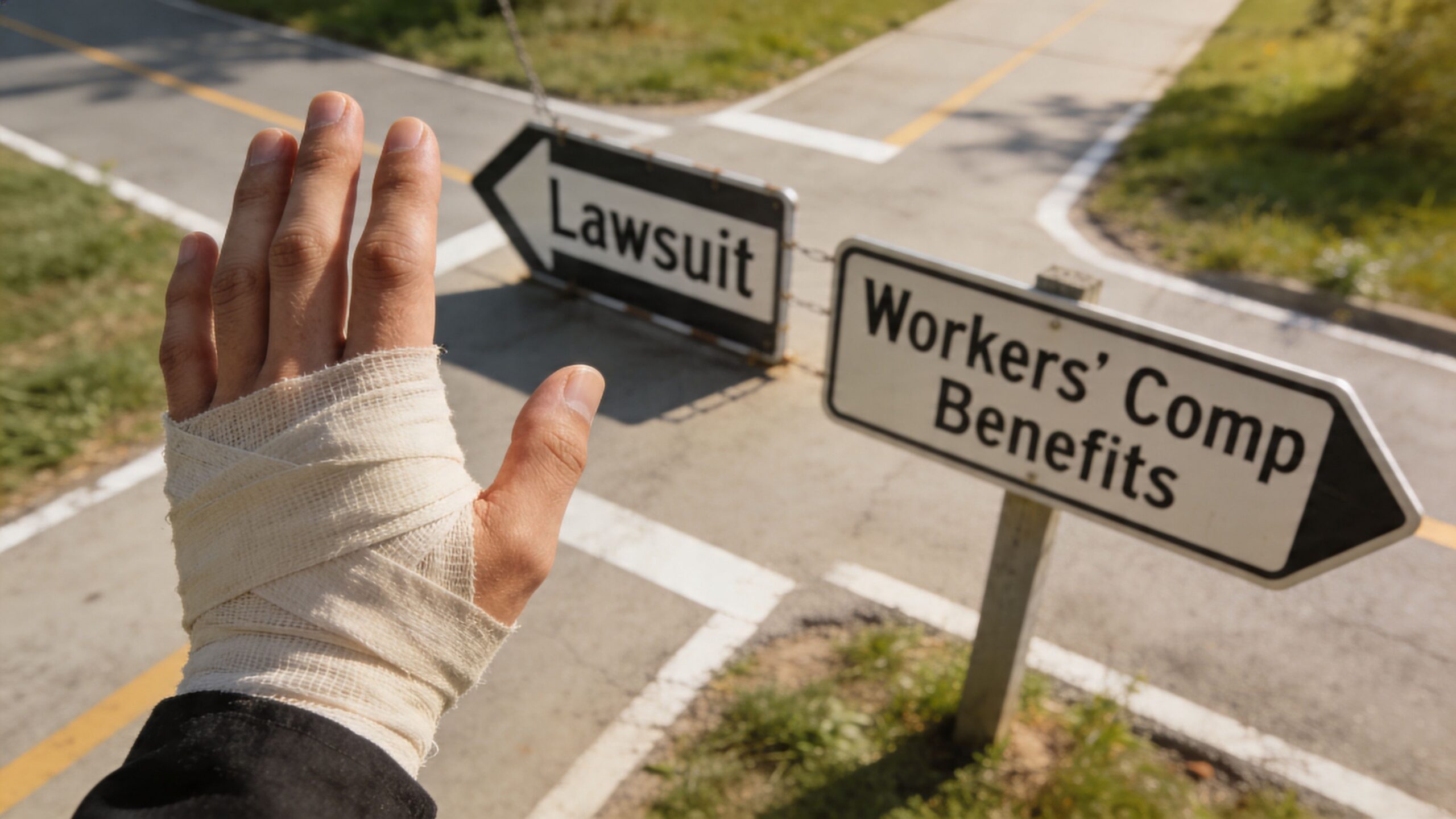
In Texas, employer status is not a technical detail. It is the fork in the road.
Roughly 30-40% of Texas employers are non-subscribers. Workers at those companies do not receive automatic workers' comp benefits and usually must pursue a personal injury lawsuit for medical bills, lost wages, and pain and suffering. Under Texas law, those employers also lose important defenses, including blaming the worker’s own contributory negligence, which can significantly strengthen the injured worker’s case, according to The Hartford’s Texas workers' compensation overview.
If your employer is a subscriber
When an employer subscribes, the system gives workers a defined path. That path can still be frustrating, but it is structured.
You typically seek approved medical treatment, income benefits, and other statutory benefits through the workers' comp process. The upside is that you don’t usually have to prove employer negligence. The downside is that the system limits what you can recover. Pain and suffering is not part of a standard workers' comp claim.
A common real-world example is a machine operator who suffers a hand injury on a production line. If the employer carries workers' comp, the claim usually centers on medical treatment, wage replacement, work restrictions, and impairment issues. The case is not about punishing the employer.
If your employer is a non-subscriber
A non-subscriber case is different from the first phone call.
You do not have an automatic no-fault claim. Instead, the case may turn on whether the company failed to provide a safe workplace, adequate training, proper supervision, functioning equipment, or enough help for the task. In such instances, negligence law applies.
In a negligence claim, the key ideas are straightforward:
- Duty: The employer had a duty to provide a reasonably safe workplace.
- Breach: The employer failed to meet that duty.
- Cause: That failure contributed to your injury.
- Damages: You suffered losses such as medical bills, lost income, and pain.
Comparative responsibility matters in Texas personal injury law generally, but non-subscriber cases have their own strategic rules. That’s one reason these claims should be evaluated carefully before you accept any company payment, sign a statement, or agree that the accident was “just one of those things.”
How to find out which kind of employer you have
Start with direct questions and written proof.
Ask human resources whether the company carries Texas workers' compensation insurance. Check employee onboarding materials, safety postings, and any injury packet you were given after the accident. If an adjuster contacts you, note who they work for and what type of claim they say is being opened.
Watch for mixed messages. Some employers say they “have coverage” but are referring to an occupational injury plan, not state workers' comp. Those are not the same thing.
A practical checklist helps:
- Get it in writing: Ask whether the company is a subscriber to Texas workers' compensation.
- Save every document: Keep pay records, employee handbooks, injury reports, and all emails or texts about the incident.
- Identify witnesses early: Co-workers move, forget details, or get nervous. Names and contact information matter.
- Don’t rely on oral promises: If a manager says the company “will take care of it,” that is not the same as a protected legal claim.
The label on the employer’s coverage can decide whether your case stays in the benefits system or becomes a lawsuit for full damages.
What works and what usually backfires
What works is fast documentation, immediate medical care, and early legal review when employer status is unclear. What often backfires is waiting, trusting informal assurances, or giving a recorded statement before you understand your rights.
After a Houston freeway crash involving a worker in a company truck, the legal answer often depends less on the fact of the collision and more on who employed the worker, who caused the crash, and what coverage was in place that day. That same framework often applies whether you need a Houston car accident attorney, a truck crash lawyer Houston, or a Texas personal injury lawyer for a job-related vehicle claim.
Understanding the Four Types of Workers Comp Benefits in Texas
Once you know the employer subscribes, the next question is simpler. What benefits are available?
Texas workers' comp benefits do not function like a blank check. They fall into categories. Understanding those categories helps you spot underpayments, delays, and mistakes before they become normal.
Medical benefits and temporary income benefits
Medical benefits are meant to pay for treatment related to your work injury. In many cases, the practical dispute is not whether you are hurt but whether the carrier approves a doctor, test, procedure, referral, or ongoing treatment.
Temporary Income Benefits, often called TIBs, replace part of your wages while you are recovering. Texas calculates TIBs as 70% of the difference between your average weekly wage and what you earn after the injury. They do not start immediately. You are not paid for the first week unless you are disabled for 30 or more consecutive days, in which case that first week is paid retroactively, as explained in the Texas risk management workers' compensation guidelines.
That detail matters a lot in real life. A worker who misses a little over two weeks may be surprised to learn the first seven days are not paid. A worker who remains out for at least thirty consecutive days may recover that first week.
Impairment income benefits and severe injury benefits
Impairment Income Benefits, or IIBs, address lasting physical damage after your condition stabilizes. These benefits are based on an impairment rating assigned by a physician. Texas uses a formula where each percentage point of impairment equals three weeks of benefits, paid at 70% of the worker’s average weekly wage, according to the Texas workers' compensation guide from EMPLOYERS.
That means a worker with a 30% impairment rating would receive 90 weeks of IIBs. These benefits are important because they can continue even after a return to work. In practice, disputes often center on the rating itself, the medical records supporting it, and whether a second opinion is needed.
For the most catastrophic cases, Texas also provides Lifetime Income Benefits for qualifying injuries. Families who lose a loved one may also be entitled to death benefits through the system. Those claims are emotionally heavy and often require close review of employment status, dependency issues, and medical records.
Texas Workers' Compensation Benefits at a Glance
| Benefit Type | What It Covers | How Long It Lasts |
|---|---|---|
| Medical Benefits | Approved treatment for the work-related injury | As allowed for medically necessary care within the system |
| Temporary Income Benefits | Part of lost wages during recovery | Until maximum medical improvement or the legal limit applies |
| Impairment Income Benefits | Compensation for permanent physical impairment | Based on impairment rating, with each percentage point worth three weeks |
| Lifetime Income Benefits | Ongoing income for qualifying catastrophic injuries | Potentially ongoing for qualifying cases |
| Death Benefits | Financial support for certain surviving family members | Based on the claim and eligibility rules |
Two calculations workers often misunderstand
The first is wage reporting. TIBs are based on your wage history before the injury. If the employer reports your wages incorrectly, your benefits can be too low.
The second is timing. TIBs can continue until you reach maximum medical improvement or the legal limit described in the Texas guidelines. That timing affects treatment decisions, return-to-work pressure, and settlement discussions.
A few practical habits can protect your claim:
- Check your wage statement: Compare reported earnings to your actual pay records.
- Read every doctor note: Work status restrictions often drive benefit decisions.
- Track missed time carefully: The timing of your disability period can directly affect TIB payments.
- Question low impairment ratings: A rating controls IIB duration. Small numbers can mean large financial differences.
If your checks seem low, your restrictions are ignored, or your doctor’s opinion is being minimized, don’t assume the carrier got it right.
The Right Way to Report Your Injury and File a Claim
Many work injury cases are damaged in the first few days. Not because the injury wasn’t real, but because the record was weak.
The safest approach is simple. Report promptly, report in writing, and keep proof. Then file the formal claim paperwork instead of assuming your employer already handled it.
Start with notice to your employer
Tell your supervisor or employer about the injury as soon as possible. Include the date, time, location, what you were doing, what body parts were hurt, and who saw it happen.
Written notice is far stronger than a hallway conversation. An email, text, incident report, or written statement creates a record that is hard to deny later.
After a warehouse fall in Houston, for example, a worker may tell a lead about the accident but never complete a written report. Weeks later, when the pain worsens, the employer may claim the injury happened at home. That dispute is much harder to fight when the first report was informal.
Then file your claim
Texas workers often hear, “We sent it to insurance.” That may or may not mean a legal claim was filed properly.
The formal claim document is the Employee’s Claim for Compensation for a Work-Related Injury or Occupational Disease, commonly called DWC Form-041. If there is any question about whether the employer or carrier is handling things correctly, get confirmation and keep copies.
This article on Sedgwick workers comp claims in Texas can help if a third-party administrator or claims company is involved and communication is breaking down.
A short checklist that prevents big problems
- Write the report yourself: Include facts, not guesses. Stick to what happened and what hurts.
- Request medical care fast: Delays give carriers room to argue your condition came from something else.
- Keep a claim file: Save forms, denial letters, prescriptions, mileage records, and work-status slips.
- Avoid minimizing the injury: If your back, shoulder, and knee all hurt, say that early. Adding body parts later often triggers disputes.
One of the hardest moments in any case is a denial letter. According to the TexasLawHelp workers' compensation fact sheet, claim denials in 2025 rose by 8%, with nearly a quarter of claims initially rejected. The same source notes that a denial is not the end of the road and that the first step is to request a Benefit Review Conference within 90 days.
What not to do
Do not assume the nurse line, clinic visit, or supervisor report replaces a formal claim. Do not rely on a verbal promise that “you’re covered.” Do not wait until the pain becomes unbearable before documenting the incident.
If there is a serious injury, a disputed mechanism of injury, a company vehicle crash, or any sign that your employer may be a non-subscriber, it is wise to speak with counsel early. That is especially true if your situation overlaps with a third-party wreck, a catastrophic injury claim, or even a fatal event that may involve a wrongful death lawyer Texas families can turn to for answers.
Fighting a Denied Claim The DWC Dispute Process
A denial stings because it usually arrives when money is tight and your medical care is already disrupted. Still, a denial is not a final judgment on your worth or the truth of your injury.
Texas gives injured workers a dispute process. The key is to treat that process like a case, not a complaint.
Why claims get denied
Most denials fit into a handful of categories. The carrier says the injury was not work-related, the medical evidence is insufficient, the worker missed a deadline, or the worker was outside the course and scope of employment.
Other denials come from disputes over body parts, extent of injury, disability status, or impairment rating. In work vehicle cases, the carrier may accept a crash happened but fight whether you were on a work errand or a personal detour.
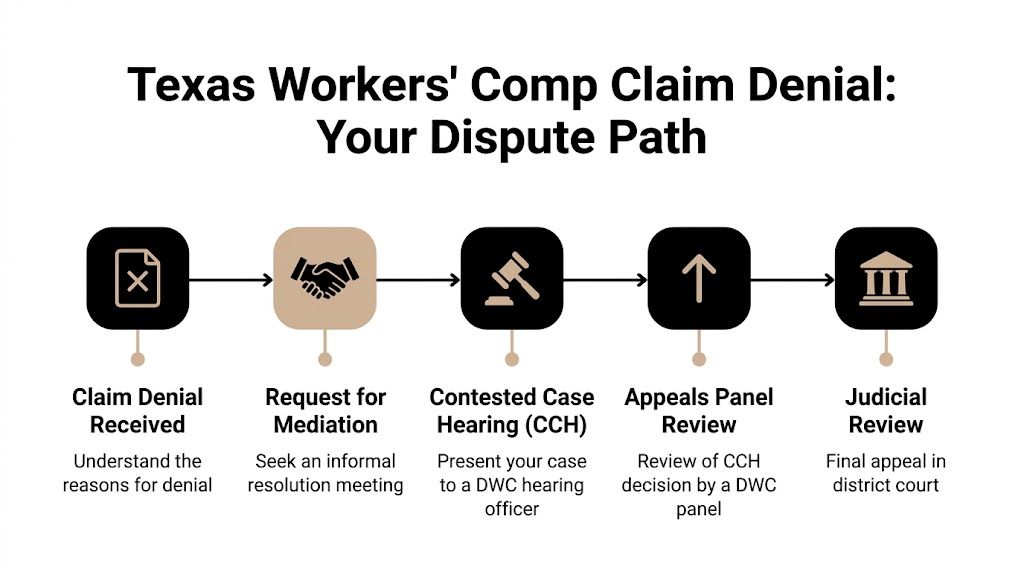
The dispute path after a denial
The process can feel formal, but it follows a sequence.
Benefit Review Conference
This is often the first structured chance to resolve the dispute. It is less formal than a hearing, but preparation still matters. You need the right records, timeline, and medical support.Contested Case Hearing
If the dispute does not resolve, the case can proceed to a hearing before a DWC hearing officer. During this hearing, evidence, witness credibility, and legal framing become much more important.Appeals Panel
If the hearing result is unfavorable, the next level is review by the DWC Appeals Panel.Judicial review
In some cases, disputes continue into court review.
A denial often means the paperwork, medical proof, or legal theory wasn’t strong enough yet. It does not always mean the injury claim lacks merit.
What actually helps in an appeal
Strong appeals are built, not improvised. The workers who do best usually have clear records from the beginning or they take fast action to fill the gaps.
Helpful evidence often includes:
- Consistent medical history: The doctor’s notes should match how and when the injury happened.
- Witness support: Co-workers, drivers, supervisors, or bystanders can confirm the event or your job duties.
- Work records: Schedules, route logs, texts from supervisors, and incident reports can prove you were working.
- Focused legal arguments: The issue might be disability, causation, impairment, or extent of injury. Each requires a different response.
When legal representation matters most
An attorney becomes especially useful when the case involves disputed causation, serious injuries, surveillance, preexisting conditions, low impairment ratings, or overlapping third-party liability. At that stage, representation is not just about paperwork. It is about organizing proof and presenting it in the right forum.
The Law Office of Bryan Fagan, PLLC handles Texas injury matters involving workplace accidents, vehicle crashes, and serious injury claims. In a disputed workers' comp case or a related negligence case, counsel can gather records, prepare witnesses, and evaluate whether a lawsuit outside the comp system is also available.
For many people, the most important shift is mental. Stop treating the denial as a closed door. Start treating it as the beginning of a formal dispute that can be won with evidence and timing.
When You Can Sue The Power of a Personal Injury Claim
Workers' comp is not always the only remedy. In some cases, it is not even the strongest one.

Two situations where a lawsuit may exist
The first is a non-subscriber employer case. If your employer opted out of workers' comp, you may be able to sue for negligence. That can allow recovery for losses that ordinary workers' comp does not cover.
The second is a third-party liability case. If someone outside your employer caused the injury, you may have a separate personal injury claim even if workers' comp benefits are also available. This comes up often in driving cases, construction site incidents, and equipment failures.
Consider an Austin office employee sent across town on a work errand. If a commercial truck runs a light and causes a crash, that worker may have a workers' comp claim through a subscribing employer and a negligence claim against the truck driver or trucking company. That is where a truck crash lawyer Houston or Texas personal injury lawyer may step in even though the injury happened during work.
Why the lawsuit path can matter so much
The financial difference can be dramatic. The average recovery for a serious injury within the workers' comp system is about $22,500 for medical and wage benefits, while successful third-party lawsuits for similar injuries can average over $464,000, because they can include pain, suffering, and future damages, according to the Texas workplace injury analysis published by the Nonsubscriber Alliance.
That doesn’t mean every lawsuit produces a larger result. It does mean workers' comp has built-in limits that civil claims do not.
For a plain-language comparison of those options, this page on workers comp vs personal injury claims in Texas is a useful starting point.
Fault, negligence, and filing deadlines still matter
A personal injury case requires proof. You may need to show unsafe practices, negligent driving, poor training, dangerous premises, or defective equipment. Evidence fades quickly, especially after a jobsite gets cleaned up or a vehicle gets repaired.
Texas personal injury law also involves fault, negligence, comparative responsibility, and the statute of limitations. In plain terms, timing matters and blame can affect recovery. That is one reason injured workers should not wait to investigate whether a civil claim exists alongside or instead of workers' comp.
This short video gives a helpful overview of when a separate claim may be available.
A company vehicle crash may call for a Houston car accident attorney. A fatal work incident involving a contractor or driver may require a wrongful death lawyer Texas families trust to investigate both employment issues and outside negligence. A severe crush injury, burn, or brain injury may also involve a broader catastrophic injury case.
Your Path to Recovery Starts Here
You don’t need to solve every legal issue while you’re hurt, worried, and trying to keep your household afloat. You do need a clear plan. In Texas, that starts with identifying your employer’s status, reporting the injury properly, protecting your medical record, and finding out whether your case belongs in workers' comp, a lawsuit, or both.
Recovery is not only legal. It is physical, emotional, and practical. If surgery is part of your treatment, a guide on recovering from surgery at home may help you prepare your space and daily routine while your claim is pending.
You still have options, even if the system already feels stacked against you.
If you were hurt on the job, in a company vehicle, or by a negligent non-subscriber employer, a consultation can help you understand what path fits your case. Contact the Law Office of Bryan Fagan, PLLC to speak with a Texas personal injury lawyer about your rights, your deadlines, and the next steps toward recovering medical costs, lost income, and full compensation where the law allows. Free consultations are available, and legal help is available when you’re ready.