A serious accident can change your life in seconds, but you don't have to face it alone.
If you're reading this after a crash, a fall, or a fatal accident involving someone you love, you're probably dealing with pain, paperwork, calls from insurance adjusters, and a lot of uncertainty. The initial focus isn't typically on legal questions, but rather on practical ones. Who pays for treatment? What should I say to the insurer? How do I prove what happened? Do I even have a case if my pain showed up later or I already had a bad back?
The best way to make a personal injury claim is to treat it like both a medical issue and a legal issue from day one. Protect your health first. Then protect the evidence. Then protect yourself from saying or signing something that lets the insurance company shrink the value of a valid claim.
In Texas, that approach matters in car wrecks, truck collisions, workplace vehicle cases, pedestrian injuries, catastrophic injury cases, and wrongful death claims. It also matters when fault is disputed. Texas injury claims turn on fault, negligence, and sometimes comparative responsibility, which means the insurance company may try to argue that you caused part of the accident so it can reduce what it pays. A strong claim is built with facts, records, and timing, not guesswork.
If you've wondered what is the best way to make a personal injury claim, the answer is simple to say and harder to do. Get care quickly, document everything, communicate carefully, and get legal advice before a short-term decision hurts your long-term recovery.
Your First Actions After an Accident in Texas
Following an accident, it's natural to feel rattled. That's normal. The key is to slow things down and take a few steps in the right order.
Start with safety and medical care
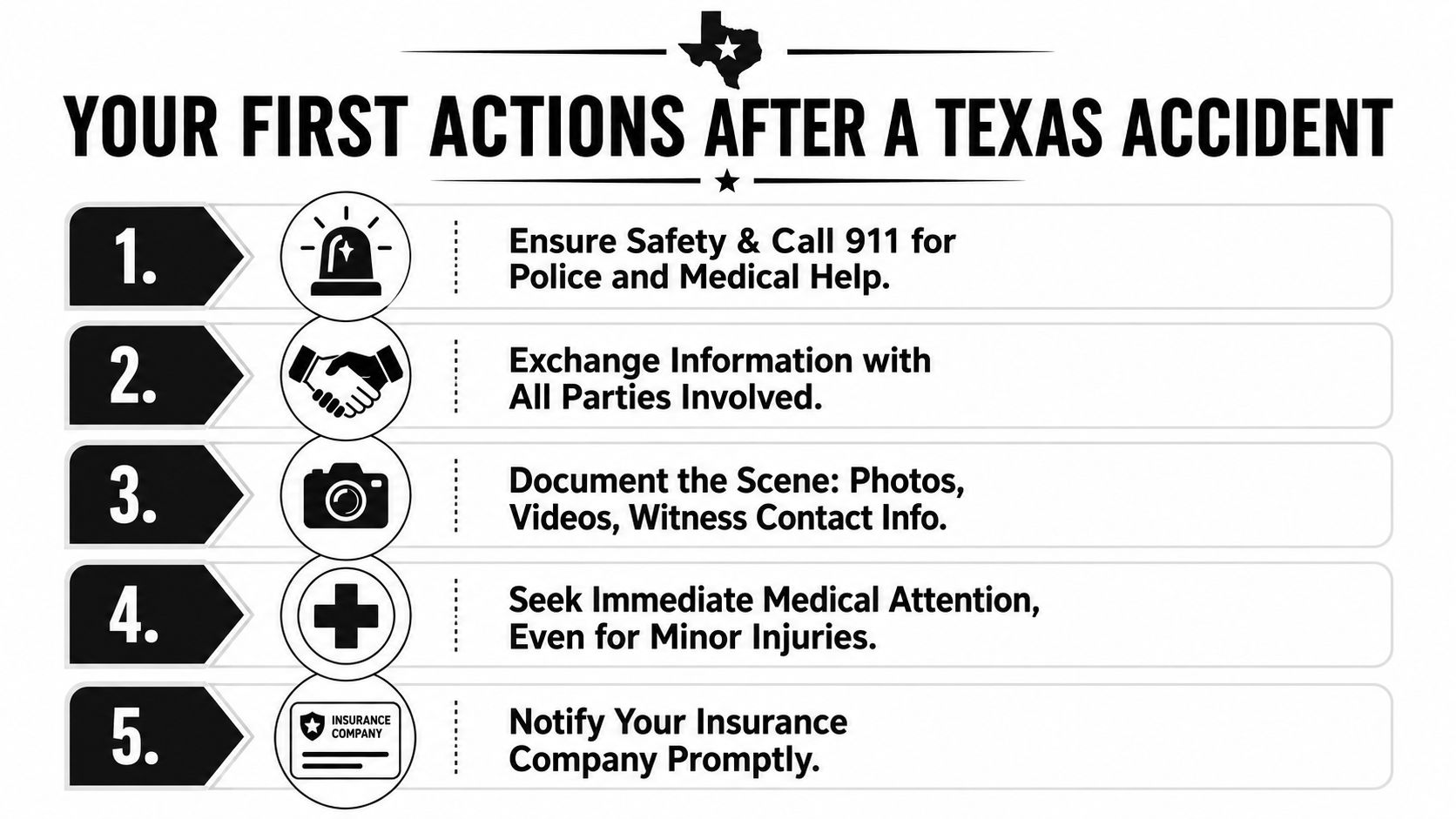
Move to safety if you can do it without making your injuries worse. Call 911. Ask for police and medical help. Even if you think you can “shake it off,” let a medical professional evaluate you.
Texas law requires drivers involved in collisions resulting in injury, death, or vehicles that can't be safely driven to immediately report the crash to law enforcement, and officers must create a written report when the crash involves injury, death, or property damage of at least $1,000 according to VB Law Group's discussion of filing an injury claim in Texas. That report often becomes one of the most useful pieces of early evidence.
Practical rule: If you feel “mostly okay,” still get checked. Delayed symptoms are common, and gaps in treatment create problems later.
After a Houston freeway crash, for example, a driver may walk away with adrenaline masking neck pain, head pain, or internal injuries. By the next day, stiffness, dizziness, or numbness can set in. If there's no prompt medical record, the insurer may later argue the injury came from something else.
Gather the right information before the scene changes
If you're able, exchange basic information with the other driver. Get names, contact information, insurance details, plate numbers, and vehicle descriptions. Don't argue about fault at the scene.
Use your phone to collect evidence while it still exists:
- Photograph vehicle damage from several angles.
- Capture road conditions such as skid marks, debris, lane markings, traffic signs, and weather.
- Take photos of visible injuries if they can be seen safely.
- Get witness names and contact details before people leave.
- Keep the police report information so you can later request the Texas crash report.
If your injuries came from a passenger or driver collision, Car Accident Lawyer in Texas is one resource focused on representation for drivers and passengers injured in Texas car accidents.
Notify your own insurer, but stay measured
You should report the accident to your own insurance company promptly. Give basic facts. Keep it short and accurate. Don't speculate about speed, fault, or injuries you don't fully understand yet.
A police report, early medical treatment, and scene photos often do more for your claim than anything you say in the first few hours. That's why the first stage of a case is about preservation, not persuasion.
Building Your Case and Documenting Everything
The strongest claims usually don't look dramatic at first. They look organized.
Once the immediate emergency has passed, your job is to create a clean record of what happened, what treatment you received, how the injury affected your life, and what it cost you. Insurance companies often challenge claims by pointing to missing records, treatment gaps, or inconsistent descriptions. Good documentation closes those doors.

Keep every record, even the small ones
Save every document connected to the accident and your recovery. That includes emergency room paperwork, imaging results, follow-up instructions, prescriptions, therapy notes, discharge summaries, invoices, and receipts.
Also keep proof of how the injury affected your work and daily routine:
- Medical bills and records that show diagnosis, treatment, and follow-up care
- Pay records or employer notes that show missed work or reduced duties
- Out-of-pocket receipts for medication, travel to appointments, braces, or other care-related expenses
- Written communications with insurers, including emails, claim letters, and adjuster notes
- Accident-related photos that show healing, bruising, swelling, or mobility limits over time
If you want a fuller checklist, this guide on evidence needed for an injury claim in Texas is a useful starting point.
A simple journal can help prove daily impact
Not every injury shows up neatly on an X-ray. Pain, interrupted sleep, fear of driving, reduced movement, and missed family activities matter too. Write them down as they happen.
Your journal doesn't need legal language. It just needs consistency. Note your pain level, doctor visits, work problems, activities you had to skip, and how the injury affects ordinary tasks like lifting, bathing, driving, or caring for children.
Keep the journal factual. “Couldn't sit through my child's school event because my lower back tightened after twenty minutes” is far more useful than broad statements like “I felt terrible all day.”
Pre-existing conditions do not erase a valid claim
Many injured people become discouraged too early. If you had a prior back injury, arthritis, neck degeneration, or an old fracture, the insurance company may try to treat that as the whole story. It often isn't.
After a truck crash on I-45, for example, someone with a history of lower back pain may suffer a clear worsening of that condition. Texas law can still allow recovery when an accident aggravates a pre-existing problem. The issue becomes proof.
A critical strategy for countering a “prior injury” defense is obtaining comparative medical imaging and expert testimony to show the accident caused a new injury or worsened an existing one, as discussed in this article on maximizing compensation in a personal injury case.
That means your lawyer may compare pre-accident and post-accident records, build a clear medical timeline, and show the difference between baseline symptoms and post-crash limitations.
If you're trying to understand insurer tactics in this phase, Dealing With Insurance Companies After a Texas Accident covers how insurers try to reduce payouts and how to protect your claim.
Navigating Communications with Insurance Companies
Many people think the hard part is proving they got hurt. Often, the hard part is not letting the insurance company use your own words against you.
The adjuster may sound polite, concerned, and efficient. That doesn't mean the conversation is harmless. The other driver's insurer is evaluating risk and trying to limit what it pays. Early calls matter because they happen before you know the full extent of your injuries.
A major pitfall is giving a premature or recorded statement to an adjuster. Claims with incomplete evidence or delayed medical care often see settlement values reduced by 30–50% according to Case Barnett's discussion of personal injury claim mistakes.
What to do on adjuster calls
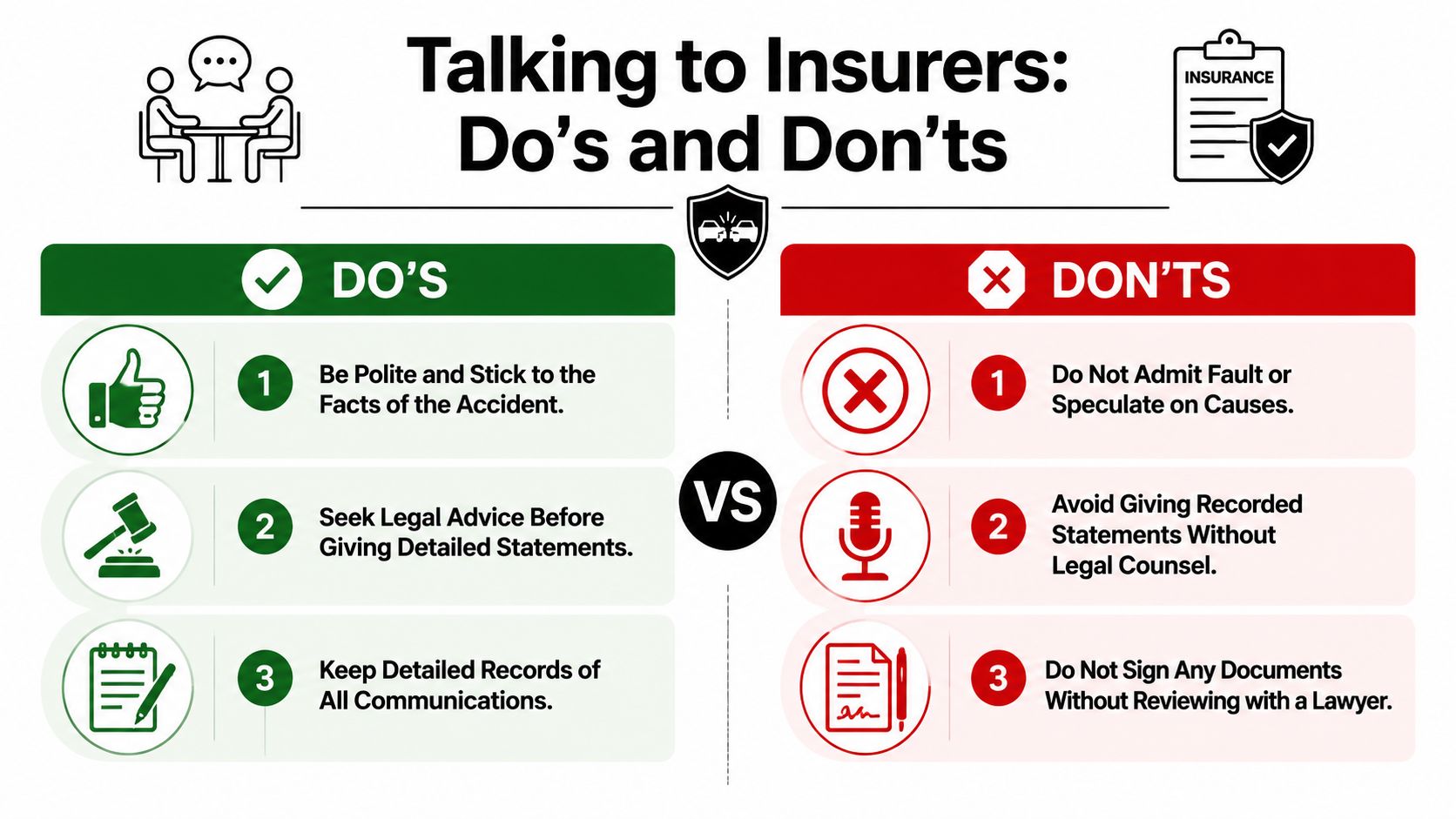
Be courteous. Stay brief. Confirm basic facts such as the date, location, vehicles involved, and your contact information. If you're still treating, say so.
Good phrases include:
- “I'm still receiving medical evaluation and don't want to guess.”
- “I'm not prepared to give a recorded statement.”
- “Please send your request in writing.”
- “I'll respond after I've had a chance to review the information.”
Those statements protect accuracy. They also stop the conversation from drifting into speculation.
What not to say
Don't say you're fine. Don't estimate speed unless you know for sure. Don't fill in gaps with “I think” or “maybe.” Don't agree that weather, traffic, your old injury, or a momentary distraction caused the wreck unless you have already spoken with counsel and know the facts support it.
Here's a common example. After a rear-end collision in Houston, a driver tells the adjuster, “I'm okay, just sore.” That sentence may sound polite. Later, the insurer points to it to question why the person sought treatment for a serious neck injury.
This short guide on what not to say to an insurance adjuster in Texas addresses these communication traps in more detail.
The safest approach is simple. Facts only. No opinions. No recorded statement without legal advice.
A short video can also help you think through those calls before you answer the next one.
Use writing whenever possible
Written communication creates a timeline. It also slows the conversation down, which helps you avoid careless wording. If an adjuster calls, you can often follow up by email and confirm what was discussed.
A useful approach looks like this:
| Situation | Better response |
|---|---|
| Adjuster asks how you feel | Say you're under medical evaluation and will rely on records |
| Adjuster asks for a recording | Decline until you've spoken with a lawyer |
| Adjuster sends forms to sign | Review them carefully before signing anything |
| Adjuster pushes quick payment | Wait until your injuries and losses are clearer |
Texas claims often come down to credibility and consistency. Careful communication protects both.
Understanding and Calculating Your Claim's Value
One reason people settle too early is that they only count the obvious bill in front of them. A valid injury claim is usually broader than that.
In Texas, claim value usually starts with economic damages and non-economic damages. Economic damages are the financial losses you can track on paper. Non-economic damages address the human impact of the injury, including pain, disruption, and loss of normal life.
Economic damages you can document
After a Houston freeway crash, economic losses may include ambulance charges, hospital care, imaging, physical therapy, prescription costs, mileage to medical appointments, and wages lost while you couldn't work. In a more serious case, future care may become part of the picture too.
A well-prepared claim often includes:
- Past medical expenses tied to the injury
- Ongoing treatment costs supported by records and provider opinions
- Lost wages from missed work
- Reduced earning ability if the injury changes your job capacity
- Property damage when a vehicle or other personal property was damaged
Non-economic damages matter too
These losses are harder to measure, but they are real. A catastrophic injury can take away independence, sleep, mobility, hobbies, intimacy, and peace of mind. A wrongful death claim can involve losses a family lives with every day.
If a truck crash leaves someone unable to return to a trade they spent years building, the case is not just about invoices. It's about a changed life. That is why careful testimony, medical records, and a detailed personal timeline matter.
A demand package should show not only what the injury cost, but what it changed.
Over 90% of personal injury cases are resolved through settlement negotiations, and the success of those negotiations hinges on a well-crafted demand letter detailing both economic damages and non-economic damages according to HKGC Law's guide to filing a personal injury claim.
That's where a lawyer adds structure. A Texas Personal Injury Lawyer handles representation for injury victims across Texas on a no-fee-unless-we-win basis, and part of that role is assembling the records, timelines, and legal arguments needed to present the full value of a claim.
Fault and comparative responsibility affect value
Texas personal injury law also looks at negligence and comparative responsibility. If the insurer claims you were partly at fault, it may argue your recovery should be reduced. That's why claim valuation is never just math. It also depends on how well fault is developed and defended.
The stronger the evidence on liability and damages, the harder it is for an insurer to discount your case.
How Long You Have to File a Claim in Texas
Time's importance is often underestimated. Waiting can hurt a case in two ways. Evidence gets weaker, and legal deadlines get closer.
For most Texas injury cases, the filing deadline is strict. Under Texas Civil Practice and Remedies Code Section 16.003(a), you have exactly two years from the date of the injury to file a personal injury lawsuit, and claims against state government entities require notice within six months, while some local governments require notice in as little as 30 to 90 days, as explained in this Texas statute of limitations overview.
The standard deadline and the common exceptions
For many people, the basic rule covers car crashes, truck wrecks, motorcycle accidents, and slip-and-fall claims. Miss that deadline and your claim is generally barred.
There are also narrower rules that can change timing:
- Claims involving minors may follow a different timeline because the limitations period can be paused until the child turns 18.
- A parent's claim for a child's pre-18 medical bills still follows the standard two-year rule from the date of injury.
- Government claims often require notice much sooner than an ordinary negligence claim.
Delayed symptoms and the discovery rule
This issue confuses many injured people. They assume the clock starts only when they feel pain. That is not always how these cases work, and it is one reason delayed-onset injuries need legal review early.
In some situations, the discovery rule may apply when an injury was not reasonably apparent at first. Think of internal trauma after a crash, or nerve damage that becomes clear only after swelling, imaging, or specialist evaluation. These situations are fact-specific. They are not automatic exceptions.
If pain appears later, don't assume you missed your chance. Don't assume you're safe either. Get the timeline reviewed while records are fresh.
A practical example helps. After a side-impact crash in Houston, a person may leave the scene with minor soreness and no obvious fracture. Weeks later, imaging reveals a more serious condition. That doesn't necessarily end the case, but it does raise questions about proof, timing, and how to connect the delayed diagnosis to the collision.
The safest habit is this. Don't measure your deadline from memory or from what an adjuster tells you. Measure it from the law, the facts, and a lawyer's review.
When and How to Hire a Texas Personal Injury Lawyer
Some claims can start without a lawyer. Fewer can finish well without one.
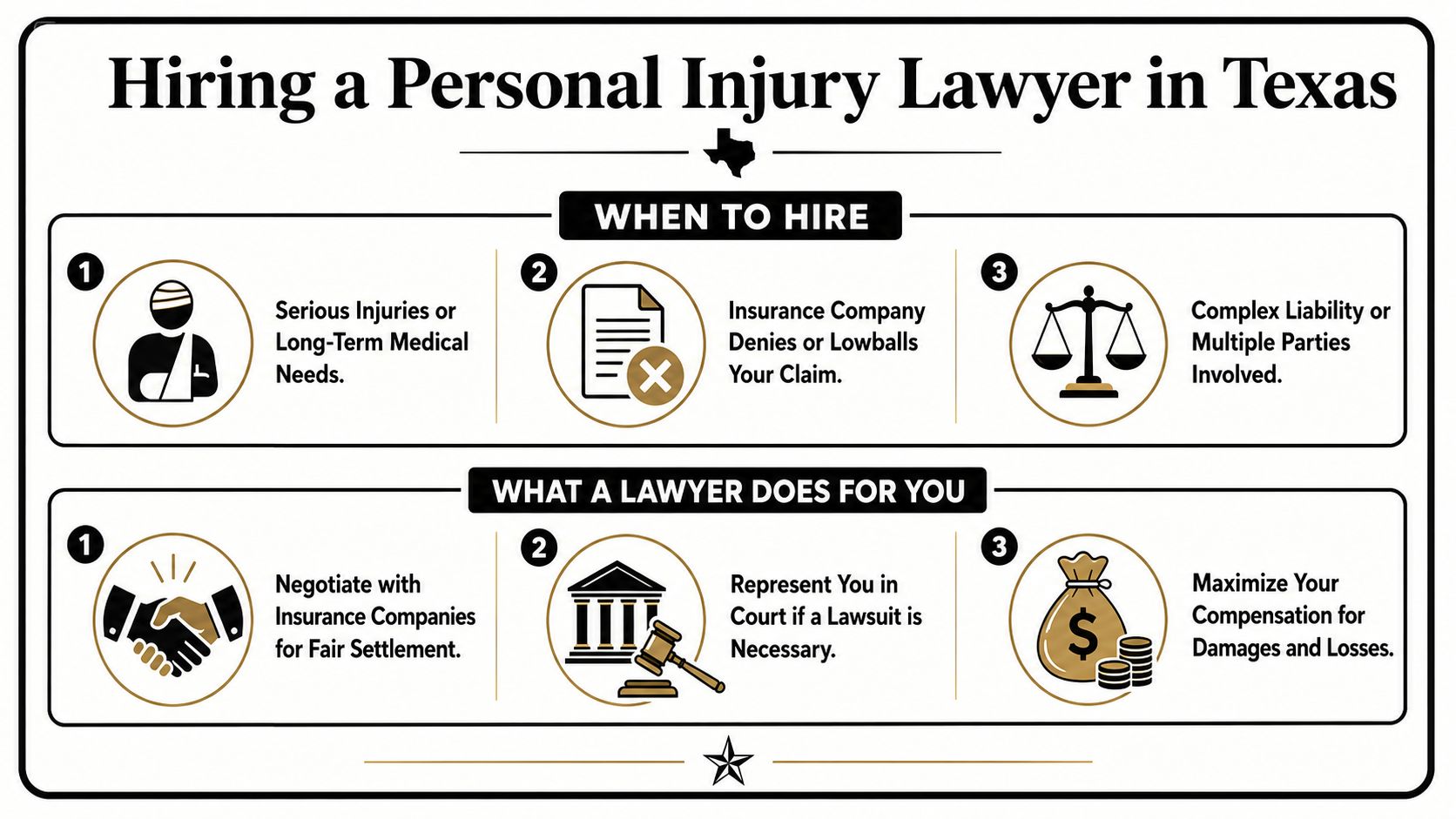
You should seriously consider hiring counsel when injuries are significant, fault is disputed, multiple vehicles are involved, a trucking company is part of the case, a loved one died, or the insurer starts delaying, denying, or pushing a quick settlement. This is especially true if you're dealing with delayed-onset symptoms or a pre-existing condition the insurer is already trying to use against you.
Signs you shouldn't handle the claim alone
If any of these are happening, the case usually needs professional help:
- Serious medical treatment such as surgery, hospitalization, specialist care, or long-term therapy
- Fault disputes where the other side says you caused all or part of the wreck
- Commercial vehicle involvement such as an 18-wheeler, company truck, or delivery vehicle
- Wrongful death losses where a family is pursuing accountability after a fatal crash
- Low offers or repeated delays from the insurance company
A Houston car accident attorney can take over communications, gather records, work with experts when needed, and prepare the case for negotiation or suit. A truck crash lawyer Houston families call after a serious commercial vehicle wreck often has to investigate multiple layers of responsibility, from the driver to the company. In fatal cases, a wrongful death lawyer Texas families trust can also help identify who may bring the claim and what damages may be available.
What a lawyer actually does
A lawyer's value isn't just courtroom work. Much of it happens earlier. Counsel organizes medical proof, secures records, reviews policy issues, handles adjuster contact, prepares the demand package, and watches deadlines.
The Law Office of Bryan Fagan, PLLC is one Texas-based option for people seeking representation in motor vehicle accident and serious injury cases. The firm handles claims involving car, truck, wrongful death, and catastrophic injury matters across Texas communities.
The right time to call a lawyer is usually before you give a recorded statement, before you sign a release, and before you accept a check.
What to ask before you hire anyone
Not every lawyer is the right fit for every case. Ask clear questions:
| Question | Why it matters |
|---|---|
| Who will handle communication with the insurer? | You need to know who is actually managing the file |
| How will the firm document my medical treatment and losses? | Documentation often drives case value |
| Has the lawyer handled truck, catastrophic injury, or wrongful death cases like mine? | Complex claims require specific experience |
| What happens if the insurer won't make a fair offer? | You need a plan beyond early negotiation |
It's also smart to talk with more than one lawyer before deciding. Texas injury victims are often told to consult three to five different attorneys before moving forward, as noted in the earlier VB Law Group discussion. That helps you compare communication style, case assessment, and practical judgment.
One final point matters to many families. Personal injury representation commonly works on a contingency-fee basis, which means the fee comes from the recovery rather than an upfront payment. That structure lets injured people get legal help without having to fund litigation while they're trying to recover.
If you were hurt in a crash, lost a loved one, or you're getting pressure from an insurance company before you even know the full extent of your injuries, legal guidance can make the process clearer and safer. The Law Office of Bryan Fagan, PLLC offers free consultations for Texas injury and wrongful death cases. You can talk through what happened, learn what steps make sense next, and get answers about deadlines, fault, insurance issues, and the value of your claim. Recovery is possible, and help is available.