A serious accident can change your life in seconds, but you don't have to face it alone.
If you've just been served with a lawsuit after a crash, you may be feeling two things at once. First, the memory of the accident itself. Second, the fear of what comes next. A knock at the door, a certified envelope, or papers with court language can make it feel like your life has been pulled into something bigger than you can control.
That reaction is normal. Being sued after a car accident is serious, but it's also manageable when you act quickly, keep your focus, and get the right legal guidance. In Texas, these cases usually turn on evidence, timing, and whether the other driver can prove fault and damages under state law. Many people hear the lawsuit and immediately assume they've already lost. That isn't how civil cases work.
If you're asking, How do you defend a car accident lawsuit? the answer starts with a calm, practical approach. Protect the facts. Notify insurance. Respond on time. Avoid making the case harder with rushed statements or missing documents. Then work with counsel to test whether the person suing you can prove negligence, causation, and damages under Texas law.
Texas personal injury law also matters from the broader family perspective. The same legal system that governs defense in a crash lawsuit also governs claims brought by injured people and grieving families, including cases involving a Texas personal injury lawyer, a Houston car accident attorney, a truck crash lawyer Houston, or a wrongful death lawyer Texas. Whether you're defending a claim or trying to understand your rights after a devastating collision, clarity matters.
The Unsettling Moment You Are Sued for a Car Accident
A lot of people first read the lawsuit standing in their kitchen, still in work clothes, trying to make sense of words like “petition,” “plaintiff,” and “damages.” They replay the crash in their mind. Was it really my fault? Why is this happening now? What if they're asking for more than my insurance covers?
After a Houston freeway crash, for example, a driver may have believed the insurance claim was already being handled. Then the lawsuit arrives months later. That doesn't always mean the case against you is strong. It often means the claim wasn't resolved informally and the other side has decided to bring the dispute into court.
What matters most in that first moment is resisting two bad instincts. Don't ignore the papers, and don't start calling the other driver or their lawyer to explain yourself. Both choices can make a difficult situation worse.
Practical rule: Treat service of a lawsuit like a legal emergency, not a personal argument.
A car accident case in Texas usually centers on familiar legal ideas. Fault asks who caused the crash. Negligence asks whether someone failed to use reasonable care. Comparative responsibility asks whether more than one person shares blame. And the statute of limitations limits how long someone has to file suit. Those rules shape both injury claims and defense strategy.
Here's the good news. A lawsuit is a process. It has deadlines, stages, and rules. That means it can be answered, challenged, and defended. Your job is not to master every legal doctrine overnight. Your job is to preserve your position and get help before small mistakes become expensive ones.
Protecting Your Case Before a Lawsuit Is Filed
The strongest defense often begins before anyone files suit. What you do in the hours, days, and weeks after a crash can determine whether the facts stay clear or become a fight over memory.
Preserve the scene and the paper trail
In any serious collision, the initial investigation matters. Immediate and systematic preservation of evidence, including photos, witness statements, and police reports, creates the factual foundation that can support or refute liability. When that evidence isn't secured promptly, the plaintiff's ability to prove negligence can drop by 30 to 40% according to industry litigation data discussed in this auto accident case process overview.
That principle matters on defense too. If the vehicles are moved, dashcam footage is lost, text messages disappear, or repair records are scattered, both sides lose clarity. Courts in major markets, including Texas, expect diligence in gathering proof early.
A simple post-crash file should include:
- Scene photos: Vehicle damage, skid marks, lane position, traffic lights, weather, and road conditions.
- Police information: The report number, responding agency, and the officer's name.
- Witness details: Names, phone numbers, and what each person saw.
- Vehicle records: Repair estimates, maintenance records, tow receipts, and photos taken before repairs.
- Insurance communications: Every email, letter, claim number, voicemail, and adjuster contact.
If someone is already communicating with insurers or opposing counsel on your behalf, a lawyer letter of representation often becomes the document that formally redirects communication and helps keep the process organized.
Be careful with police interactions
One of the most overlooked risks in Texas car accident cases is the implicit admission of fault via police interactions. Drivers often think they should apologize or explain the crash in a way that sounds polite. But a casual statement like “I didn't see you” can later be framed as an admission of negligence by insurers or opposing counsel, as discussed in this Texas-focused guide to defending against a car accident lawsuit.
That doesn't mean you should be evasive. It means you should be accurate.
Use plain, neutral language:
- State facts, not conclusions: “I was traveling in the middle lane,” not “I caused it.”
- Answer what you know: If you didn't see the impact clearly, say that.
- Don't guess: Guessing fills gaps in a way that can hurt you later.
- Stay respectful: Calm and concise is better than defensive or emotional.
When people are shaken up, they often try to be decent human beings first and careful witnesses second. In court, that can become a problem.
This same discipline matters whether you're a defendant or someone seeking help from a Car Accident Lawyer in Texas, which provides representation for drivers and passengers injured in Texas car accidents.
Handle insurance contacts carefully
Soon after the crash, you may get calls from insurance adjusters. Your own carrier still needs prompt notice. Give basic, truthful information, but don't volunteer extra theories, speed estimates, or blame assessments unless your lawyer advises you to do so. A rushed recorded statement can lock you into wording that doesn't reflect what really happened.
You Have Been Served What Happens Next
When you're formally served, you'll usually receive two core documents. The citation is the official notice from the court telling you that you've been sued and must respond. The original petition is the other side's written statement of what they claim happened, why they say you're legally responsible, and what damages they want.
Read both carefully, but don't try to handle them alone.
One visual summary helps many people see the road ahead:
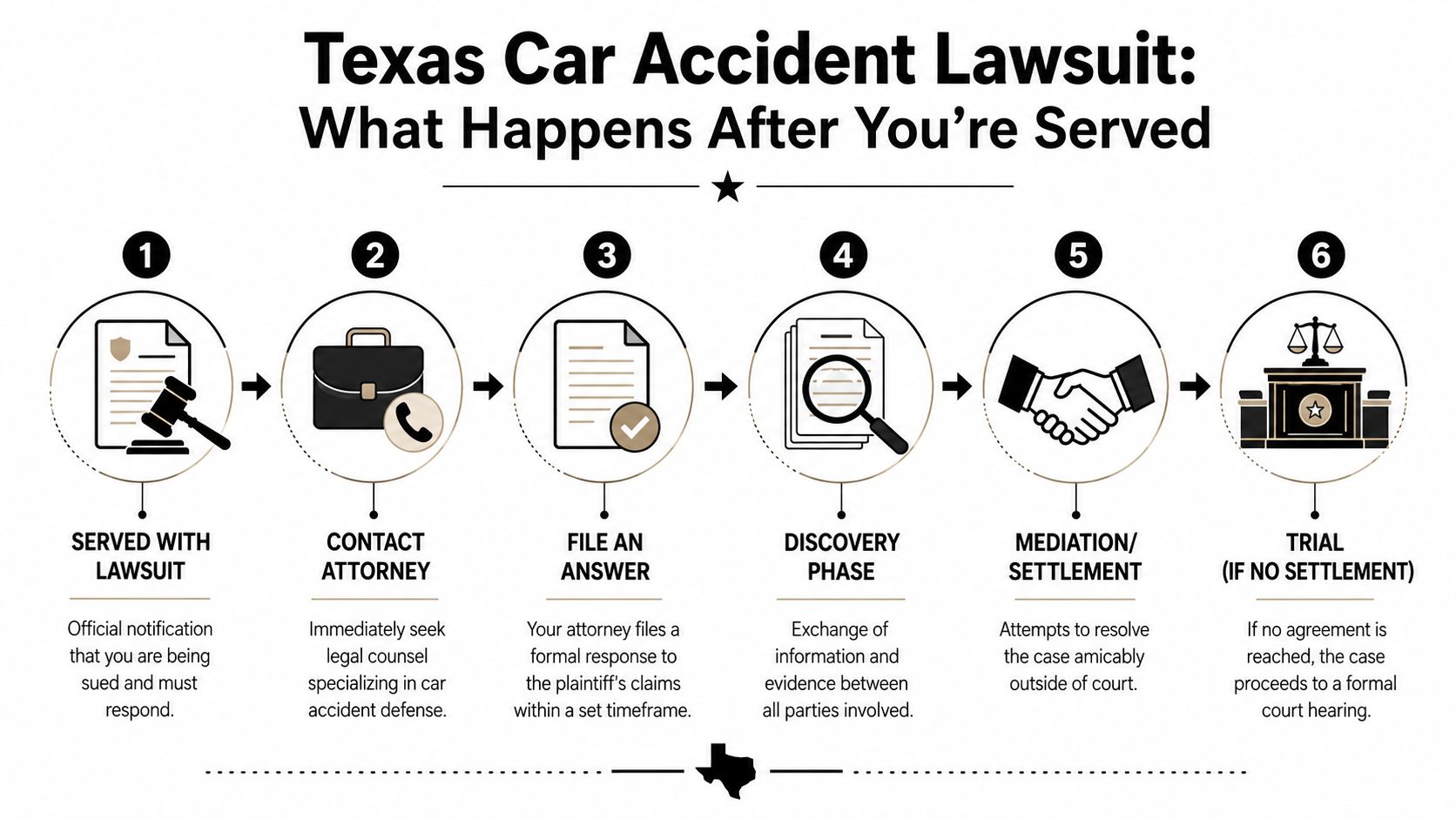
Your first call should be to your insurance carrier
If the crash falls within your policy, your auto insurer will often assign defense counsel to represent you. That can be an enormous relief. It usually means someone will prepare and file the formal response, communicate with the plaintiff's lawyer, and begin building the defense.
Send the lawsuit papers to the insurer immediately. Don't summarize them by phone and assume that's enough. Forward the full packet and confirm receipt.
In higher-exposure cases, some people also seek a separate consultation for independent advice. That can make sense if there are catastrophic injuries, a fatality, multiple vehicles, disputed coverage, or concern that the claimed losses may exceed available policy limits.
For readers who want a plain-English overview, this short video gives a useful big-picture sense of the process:
Don't miss the deadline to answer
Texas procedure sets a response deadline, and missing it can lead to a default judgment. That means the court may accept the plaintiff's allegations as unanswered and move forward without your side being properly heard.
You don't need to draft your own answer unless a lawyer has specifically told you to. But you do need to make sure one gets filed on time.
A quick breakdown helps:
| Document | What it means | What you should do |
|---|---|---|
| Citation | Notice from the court that you've been sued | Contact insurance and a lawyer immediately |
| Original Petition | The plaintiff's allegations and requested damages | Read it, save it, and send it to counsel |
| Answer | Your formal response filed with the court | Make sure it is filed before the deadline |
What not to do after service
The biggest mistakes after service are usually avoidable.
- Don't ignore the papers: Silence doesn't make the case go away.
- Don't post online about the wreck: Social media can become evidence.
- Don't contact the plaintiff directly: That rarely helps and may create new problems.
- Don't throw away records: Preserve messages, photos, receipts, and repair documents.
If the crash involved a commercial vehicle, a family fatality, or severe trauma, the case can overlap with issues often handled in truck, catastrophic injury, or wrongful death litigation. That doesn't change your duty to respond. It does mean the stakes may be much higher.
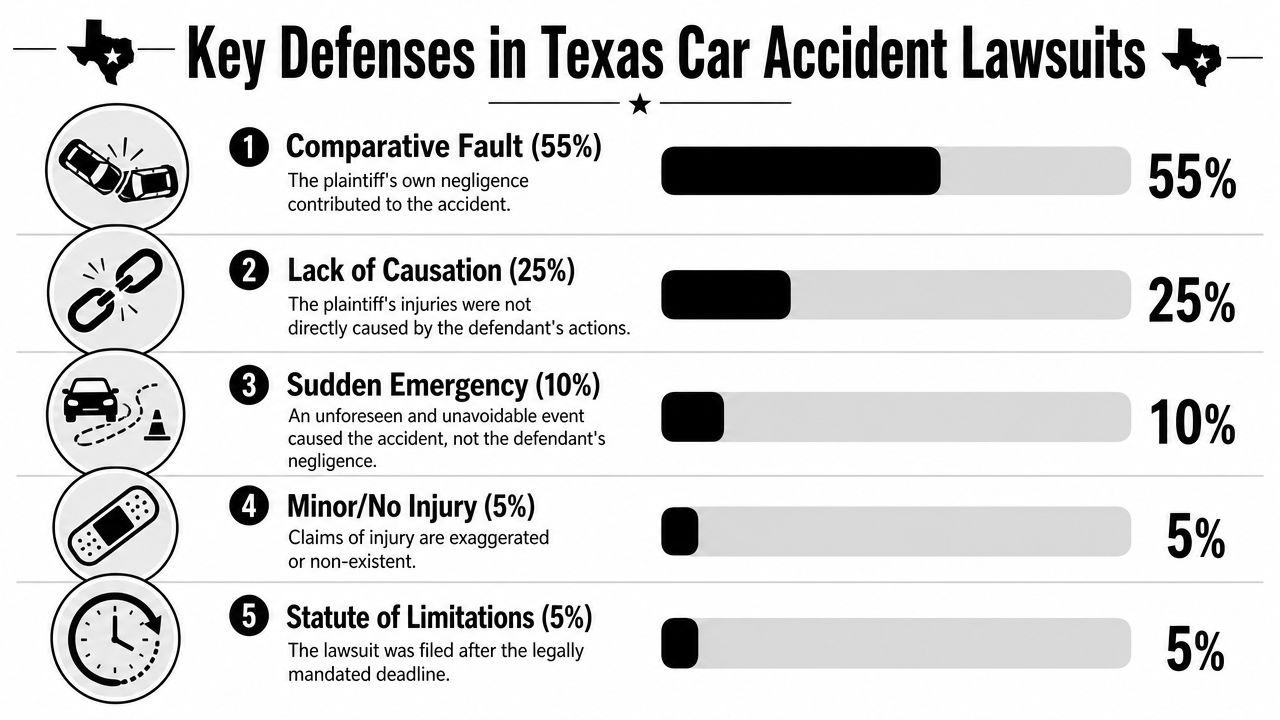
Understanding Key Defenses in Texas Car Accident Cases
Many defendants think their only option is to deny everything. That's not how strong car accident defense works in Texas. A real defense looks at fault, causation, damages, and the plaintiff's own conduct.
Proportionate responsibility often drives the case
Texas uses modified comparative negligence, also called proportionate responsibility. Under Texas's 51 percent rule, an injured party can still recover damages if they were partly at fault, but they are barred from compensation if their share of responsibility exceeds 50%, as explained in this discussion of Texas comparative fault laws.
That rule is also tied to Texas Civil Practice and Remedies Code section 33.001. A liable defendant is responsible only for the percentage of damages that matches their assigned fault percentage, as summarized in this explanation of proportionate responsibility in Texas.
A practical resource on the idea is this definition of comparative fault, which helps explain why fault allocation matters so much in serious collision claims.
Here is the key point. The plaintiff doesn't win just by showing an injury happened. In many cases, the defense asks whether the plaintiff's own actions helped cause the collision or worsened the outcome.
A Houston lane-change example
Take a common Houston scenario. Two drivers are moving through heavy traffic on the freeway. One driver changes lanes. The other is speeding, following too closely, or driving in a blind spot. A crash follows.
That case may not be about one perfect driver and one reckless driver. It may be about how a jury divides fault after looking at lane position, speed, reaction time, signaling, witness testimony, and vehicle damage.
If the person suing you is found to be 51% or more at fault, they recover nothing under Texas law. If they are less than that, any recovery is reduced in proportion to their responsibility. For defendants, that's a major strategic issue. It means the case is often about allocation, not merely accusation.
Some car accident lawsuits are won by proving the other driver caused the wreck. Others are defended by showing the other driver helped create it.
Comparative negligence is an affirmative defense with real proof requirements
Texas law doesn't allow empty finger-pointing. To invoke comparative negligence as an affirmative defense, the defendant must prove two things: the plaintiff was negligent under the circumstances, and that negligence legally caused the injury, meaning the harm would not have happened without the plaintiff's conduct and the result was foreseeable. That standard is described in this explanation of how shared fault works in Texas.
That matters in practice. If a plaintiff made a minor mistake that had nothing to do with the crash, it may not support the defense. If their conduct directly contributed, it can.
Other defenses that may matter
Not every defense is about shared fault. Depending on the facts, counsel may examine:
- Causation disputes: The plaintiff must connect the claimed injuries to this wreck, not just show they are hurt.
- Damage disputes: The amount claimed may not match the medical evidence, work history, or repair evidence.
- Statute of limitations issues: Texas injury claims are subject to filing deadlines, and timing can matter.
- Credibility issues: Inconsistent statements, changed versions of events, or contradictory records can reshape the case.
If the collision involved a commercial truck, these same defense issues often appear in claims that would also be familiar to a truck crash lawyer Houston. If the crash caused a fatality, fault and causation questions also become central in litigation that a wrongful death lawyer Texas would analyze from the plaintiff side.
Navigating Discovery and Depositions
Most lawsuits are not decided on the day you're served. They move into discovery, which is the formal exchange of information between the parties. This is the long middle stretch, and for many people it feels more stressful than service itself because it brings paperwork, sworn testimony, and repeated requests for detail.
What discovery looks like in real life
Discovery usually includes written questions, document requests, and depositions.
- Interrogatories: Written questions about the collision, your background, the vehicle, and the damages claimed.
- Requests for production: Demands for documents such as photos, repair records, phone records, insurance materials, and communications.
- Requests for disclosure or admissions: Tools used to narrow disputes and pin down positions.
- Depositions: Sworn, out-of-court testimony taken by lawyers, usually with a court reporter present.

The other side is not just collecting facts. They are testing you. They want to see whether your version stays consistent, whether documents support it, and whether you come across as careful, evasive, angry, uncertain, or credible.
How to prepare for a deposition
A deposition isn't a conversation. It's sworn testimony. Every answer matters.
Meet with your lawyer beforehand and go over the timeline carefully. Refresh your memory using records, photos, and the police report if counsel approves. Don't try to memorize a speech. That almost always backfires.
A few habits help a lot:
- Listen all the way through: Wait until the question is finished.
- Answer only the question asked: Short, truthful answers are usually best.
- Don't guess: “I don't know” is better than an inaccurate answer.
- Avoid volunteering extra detail: Extra words often create new areas of attack.
- Stay even-tempered: Opposing counsel may probe for frustration or contradiction.
“Tell the truth, stop when the answer is complete, and let your lawyer object when needed.”
Discovery can help your defense
People often think discovery only helps the plaintiff. That's not true. It can expose weak causation, inflated damage claims, inconsistent medical histories, and contradictions between what the plaintiff says and what records show.
For example, after a Dallas-area multi-vehicle crash, discovery may reveal that the plaintiff's timeline changed, treatment was delayed, or a witness saw something very different from what was alleged in the petition. In another case, vehicle data, repair patterns, or roadway photos may undercut a broad claim that one driver alone caused everything.
This is also where a legal team's practical experience matters. If you're working with appointed insurance counsel, stay engaged. Respond promptly to document requests from your own side. Review drafts carefully. If you seek outside guidance, firms such as the Law Office of Bryan Fagan, PLLC may provide case-specific advice about litigation posture, evidence preservation, and exposure analysis.
Working with Your Attorney Toward a Resolution
By the time a case reaches mediation, serious settlement talks, or trial preparation, most of the work has already happened. The records have been gathered. The statements have been compared. The legal defenses have been tested. Your lawyer isn't just arguing. Your lawyer is making decisions about risk.
Settlement and trial involve trade-offs
Some cases should settle. Others should be pushed harder. The right path depends on the evidence, the credibility of the witnesses, the seriousness of the injuries, the available insurance, and how a jury is likely to view shared fault.
Settlement brings certainty. Trial brings the chance of a better result, but also more risk. If the injuries are severe or the claimed losses are high, even a defensible case requires careful evaluation.
A useful way to consider this:
| Path | Potential benefit | Main concern |
|---|---|---|
| Settlement | Faster closure and controlled outcome | You may pay to avoid litigation risk |
| Trial | Chance to defeat or reduce the claim | A jury may see the facts differently |
A broader overview of that process can help if you want context on what litigation lawyers do.
Stay involved without taking over
Clients sometimes hurt their own defense by doing too much. They draft emails to opposing counsel, search social media obsessively, or try to “clarify” facts without legal review. Others disappear and assume the insurance lawyer will handle everything without their help.
Neither extreme works well.
Give your lawyer documents quickly. Tell the truth, including bad facts. Ask direct questions about exposure, settlement authority, and whether there are concerns beyond policy limits. If your family is dealing with a catastrophic injury claim, a truck wreck, or a death case on the other side of the dispute, that emotional pressure is real. Good legal strategy makes room for that reality without letting it control decisions.
If you've been asking yourself how to defend a car accident lawsuit, the answer is not to panic and not to hide. It's to respond, preserve, cooperate, and make disciplined choices. Recovery is possible after a hard crash, and legal help is available when the process feels heavier than you can carry alone.
If you need clear guidance after a serious crash or lawsuit, Law Office of Bryan Fagan, PLLC offers free consultations for Texans dealing with car accidents, truck collisions, catastrophic injuries, and wrongful death matters. You can speak with a lawyer confidentially, get a better understanding of your rights and next steps, and move forward with a plan.