A serious accident can change your life in seconds. You don't have to face it alone.
One minute you're driving home on I-10, walking through a parking lot, or heading to work in Houston. The next, you're in an ambulance, answering insurance calls, missing work, and wondering how you're supposed to pay for treatment while your life has been thrown off course.
That moment after an accident is often the hardest. People feel pain, confusion, anger, and pressure all at once. A spouse may be trying to get updates from doctors. A parent may be wondering how to pick up the kids. After a fatal crash, a family may be trying to grieve while also dealing with bills, paperwork, and questions no one feels ready to answer.
If you're asking, how do I sue for personal injury in Texas, you're really asking something bigger. You're asking how to protect your future, how to hold the right party accountable, and how to regain some control after someone else's carelessness changed your life.
A Serious Accident Can Change Your Life in Seconds
A crash on a Houston freeway can turn an ordinary day into a chain of hard decisions. You may be in pain, your car may be totaled, bills may already be coming in, and an insurance adjuster may be asking for a statement before you have even seen the full medical picture.
That is usually the starting point of a personal injury case. The legal claim matters, but the first question is control. Who gets to shape what happened, how serious your injuries are, and what this will cost you next month and next year?
In Texas, a personal injury case gives you a process for answering those questions with proof. Medical records, scene evidence, witness accounts, employment records, and expert opinions can show what happened and what the injury has taken from you. Used well, that process puts pressure on the insurer to deal with the claim based on facts instead of assumptions.
The first phase is about protecting your choices
Early decisions carry real consequences.
If you delay treatment, the insurer may argue you were not badly hurt. If you give a recorded statement too soon, you may guess about facts that later turn out to be incomplete. If you accept a fast settlement, you may sign away your claim before you know whether you will need more care, more time off work, or help at home.
I often tell injured clients the same thing. A case is rarely won by one dramatic event. It is built by making sound decisions early and staying consistent as the evidence develops.
Families face the same pressure after fatal or life-changing accidents. If a loved one dies, or suffers an injury that may permanently affect work or daily life, waiting too long can make it harder to secure records, identify all responsible parties, and preserve evidence before it disappears.
Reclaiming control starts with the right roadmap
You do not need to know every Texas rule on the first day. You do need to understand the key turning points.
One turning point is medical. Another is insurance. For many people, understanding your car insurance claim process helps explain why the insurer asks for certain documents and why early communications matter. A third turning point is deciding whether the offer on the table covers the full loss, including future care, lost earning capacity, and the disruption to your daily life.
Some cases become more complex quickly. A collision with a commercial vehicle may require immediate review of driver logs, maintenance records, company safety practices, and other evidence tied to 18-Wheeler and Commercial Vehicle Accidents in Texas. Other cases involve long-term injuries where a [Car Accident Lawyer in Texas] can assess not just current bills, but the cost of living with the injury over time.
The system can feel intimidating at first. In practice, it is a series of strategic decisions. Each good decision helps you protect your health, your finances, and your ability to demand accountability.
What to Do Immediately After an Accident in Texas
The first hours and days matter. What you do now can affect your health and the strength of any future claim.

Start with safety and medical care
Get medical attention as soon as you can. Even if you think you're just sore, symptoms often show up later. Concussions, soft tissue injuries, internal injuries, and back problems don't always feel severe right away.
Medical care also creates a record. That record helps connect the crash or incident to your injuries. Gaps in treatment give insurance companies room to argue that you weren't really hurt, or that something else caused your condition.
A simple checklist helps:
- Call 911 if anyone may be hurt: Emergency response creates documentation and helps protect everyone at the scene.
- Accept evaluation when it's offered: You don't need to "tough it out" to prove anything.
- Follow up quickly after release: If the ER sends you home, schedule the next appointment and keep it.
Preserve evidence before it disappears
After a Houston-area crash, a police report often becomes one of the first pieces of evidence used to establish what happened. But it shouldn't be the only one.
Take photos of vehicle damage, skid marks, debris, the road, visible injuries, and anything else that helps show how the incident happened. Get witness names and contact information if possible. Save damaged clothing, helmets, or personal items. If there were cameras nearby, act quickly to identify them.
Texas injury cases often turn on early documentation. In Texas personal injury practice, careful pre-suit documentation can directly affect case outcomes, and cases where crucial electronic evidence is preserved within the first 90 days are resolved on more favorable terms or achieve higher jury verdicts.
The best evidence is usually gathered before anyone starts arguing about fault.
That can include dash-cam footage, surveillance video from a business, vehicle data, and complete medical records. Waiting too long can mean those records are lost.
Be careful with insurance conversations
You should report the accident to your own insurer promptly. But you should be cautious with the other driver's insurer. Their adjuster may sound friendly, but their job is to limit what the company pays.
Don't guess about speed, injuries, or fault. Don't agree to a recorded statement before you understand your injuries. Don't accept a quick payment just because the adjuster says it's standard.
If you need a plain-English overview of first-party reporting, this guide on understanding your car insurance claim process can help you get organized before those conversations move too fast.
For readers looking into options for auto-collision representation, Car Accident Lawyer in Texas refers to representation for drivers and passengers injured in Texas car accidents.
Keep your case organized from day one
A strong claim often starts with simple habits.
| What to save | Why it matters |
|---|---|
| Medical records and discharge papers | Shows diagnosis, treatment, and timing |
| Bills and receipts | Helps prove out-of-pocket losses |
| Photos and videos | Preserves scene conditions and injuries |
| Wage-loss information | Documents missed work and income disruption |
| Insurance letters and emails | Tracks what was said and when |
If you're unsure whether your case is "serious enough," don't let that stop you from preserving evidence. It's much easier to decide later not to sue than to rebuild a case after key proof is gone.
Understanding Critical Texas Deadlines and Legal Rules
Texas law gives injured people rights, but those rights come with deadlines and rules that shape every case.
The filing deadline matters more than most people realize
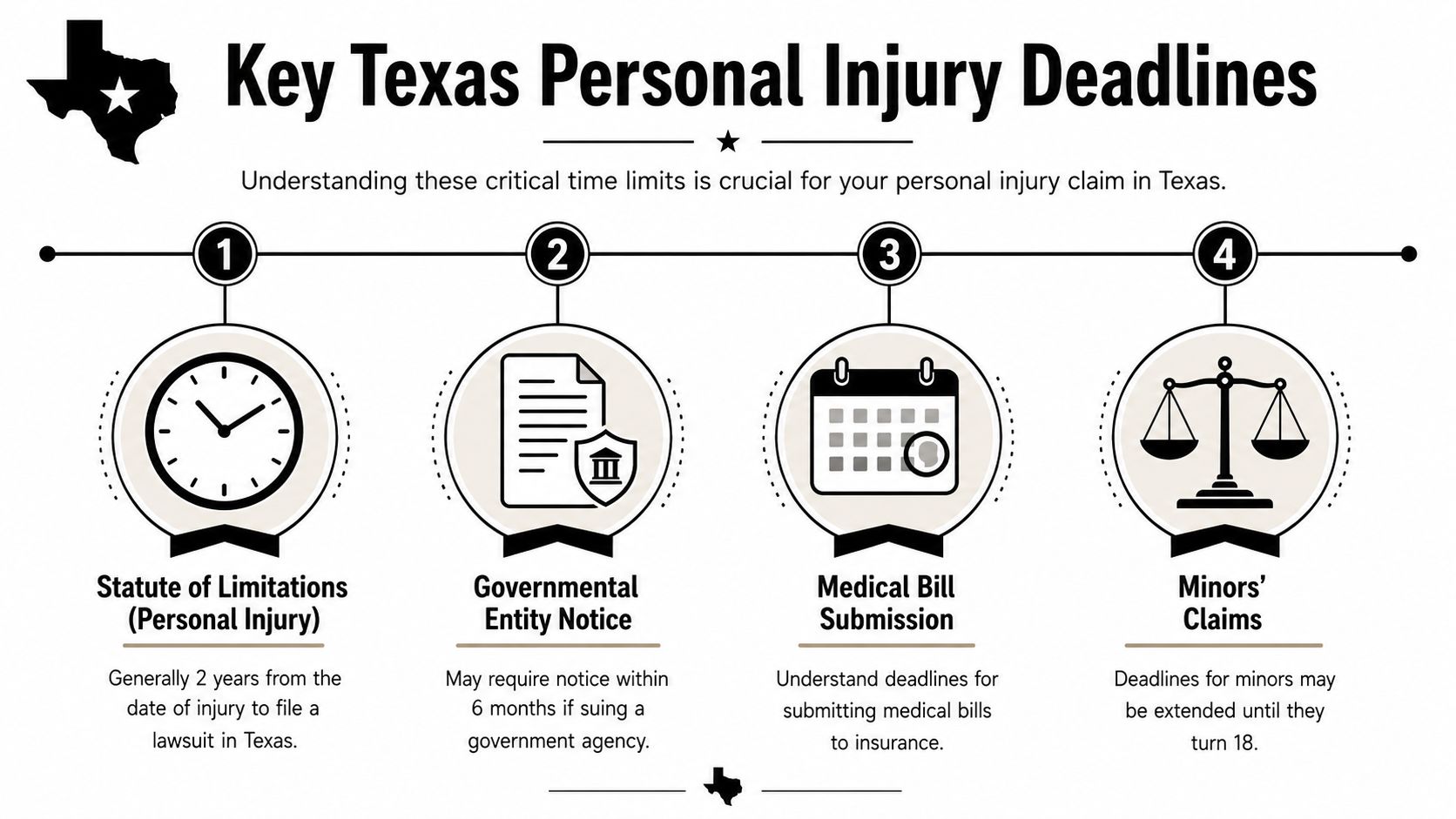
In most Texas injury cases, you generally have two years from the date of the accident to file suit. If your claim involves a government entity under the Texas Tort Claims Act, you generally have only six months from the date of injury to provide notice or make the claim, as explained in this discussion of Texas personal injury filing deadlines.
That difference is huge.
If a city vehicle hits you, if a dangerous roadway condition contributed to a crash, or if another public entity may be involved, waiting too long can end the case before it starts. People often assume "I have two years," then learn too late that a government notice rule applied.
For a closer look at how timing issues affect injury claims, see this guide on the Texas personal injury statute of limitations.
Fault in Texas is shared, but only up to a point
Texas uses a modified comparative fault system. If you're 51% or more at fault, you recover nothing. If you're less than 51% at fault, your damages are reduced by your percentage of fault, as outlined in this explanation of Texas personal injury settlement rules.
That rule affects real cases every day.
After a Dallas intersection crash, for example, one driver may argue the other was speeding while the other says a red light was ignored. In a slip-and-fall case, a business may claim you weren't watching where you were going. These arguments aren't just about blame. They're about money and whether compensation is available at all.
A good case isn't only about proving the other side did something wrong. It's also about limiting unfair blame placed on you.
Urgency helps even when you're unsure
People often wait because they hope injuries will improve, they don't want conflict, or they think the insurer will eventually do the right thing. Sometimes that happens. Often it doesn't.
The practical problem with waiting is that memories fade, records get harder to collect, and witnesses move on. If venue issues or filing mistakes happen close to the deadline, your options shrink fast.
A simple way to think about the rules is this:
- Time limits protect the court system, not your recovery: The court won't excuse delay just because your injuries are real.
- Fault arguments affect value: Even a valid claim can be reduced if the defense shifts part of the blame to you.
- Government cases move faster: Those cases need immediate review.
If you're asking whether you should sue, the first question usually isn't "Will I win?" It's "Do I still have time, and what rules apply to my facts?"
Building Your Claim and Dealing with Insurance
Most injury cases are built before a lawsuit is ever filed. That's where your claim takes shape.

What your claim is really made of
A personal injury claim has two core parts. First, you show liability. Second, you prove damages.
Damages usually fall into two broad categories. Texas law allows recovery for economic and non-economic damages, including medical bills, lost wages, and pain and suffering, and there's generally no statutory cap on pain and suffering damages in standard negligence cases except in specific settings such as medical malpractice, as explained in this overview of pain and suffering damages in Texas.
Here is what that means in everyday terms:
- Economic damages: Bills, wage loss, treatment costs, rehabilitation expenses, and other financial losses you can document.
- Non-economic damages: Physical pain, mental distress, loss of enjoyment of life, and the human cost of living with an injury.
- Future losses: Ongoing care, permanent limitations, or reduced ability to earn a living.
A real-world example of claim value
Take a truck crash on I-45. A driver may have a totaled SUV, emergency treatment, follow-up orthopedic care, and weeks without work. If the injury leads to surgery or permanent back problems, the claim may also include future treatment and reduced earning ability.
If the crash causes a fatality, the legal issues change. A surviving spouse, child, or parent may need to evaluate a wrongful death claim and the financial support the family has lost. In those situations, a wrongful death lawyer Texas families consult will usually focus on both the financial losses and the deeper personal harm that can't be measured by receipts alone.
Insurance adjusters evaluate risk, not fairness
Insurance companies don't pay because your story is upsetting. They pay when the evidence makes the risk of nonpayment expensive.
That's why a strong demand package matters. It usually includes liability evidence, medical records, bills, wage-loss proof, photographs, and a clear explanation of how the injury changed your life. The goal is to present a case the insurer can't dismiss as minor or unsupported.
What works: a documented claim with consistent treatment, clear liability evidence, and a realistic demand.
What doesn't: a rushed demand sent before the injuries are understood or the records are complete.
If your injuries involve a commercial vehicle, the investigation may also include company records, driver qualification issues, and maintenance evidence. That's why many people speak with a Houston car accident attorney or truck-injury lawyer early, before the insurer has framed the case on its own terms.
Not every case should follow the same path
Some lower-value disputes may be handled through small claims or informal resolution. Texas justice courts can hear small claims up to $20,000, as noted in the Texas small claims guide. For modest injuries and straightforward liability, that may be a practical path.
But when injuries are serious, fault is disputed, or future care is uncertain, a quick settlement can be costly. You get one resolution. If you settle too early, you usually can't go back for more later.
The Texas Lawsuit Process from Filing to Resolution
A lawsuit changes the balance of the case.
Until suit is filed, the insurance company controls much of the pace. After filing, a judge sets the rules, deadlines start to matter, and the defense has to answer in a formal way. For many injured people, that shift is the moment they stop feeling pushed around and start getting answers.
Filing the petition starts the formal case
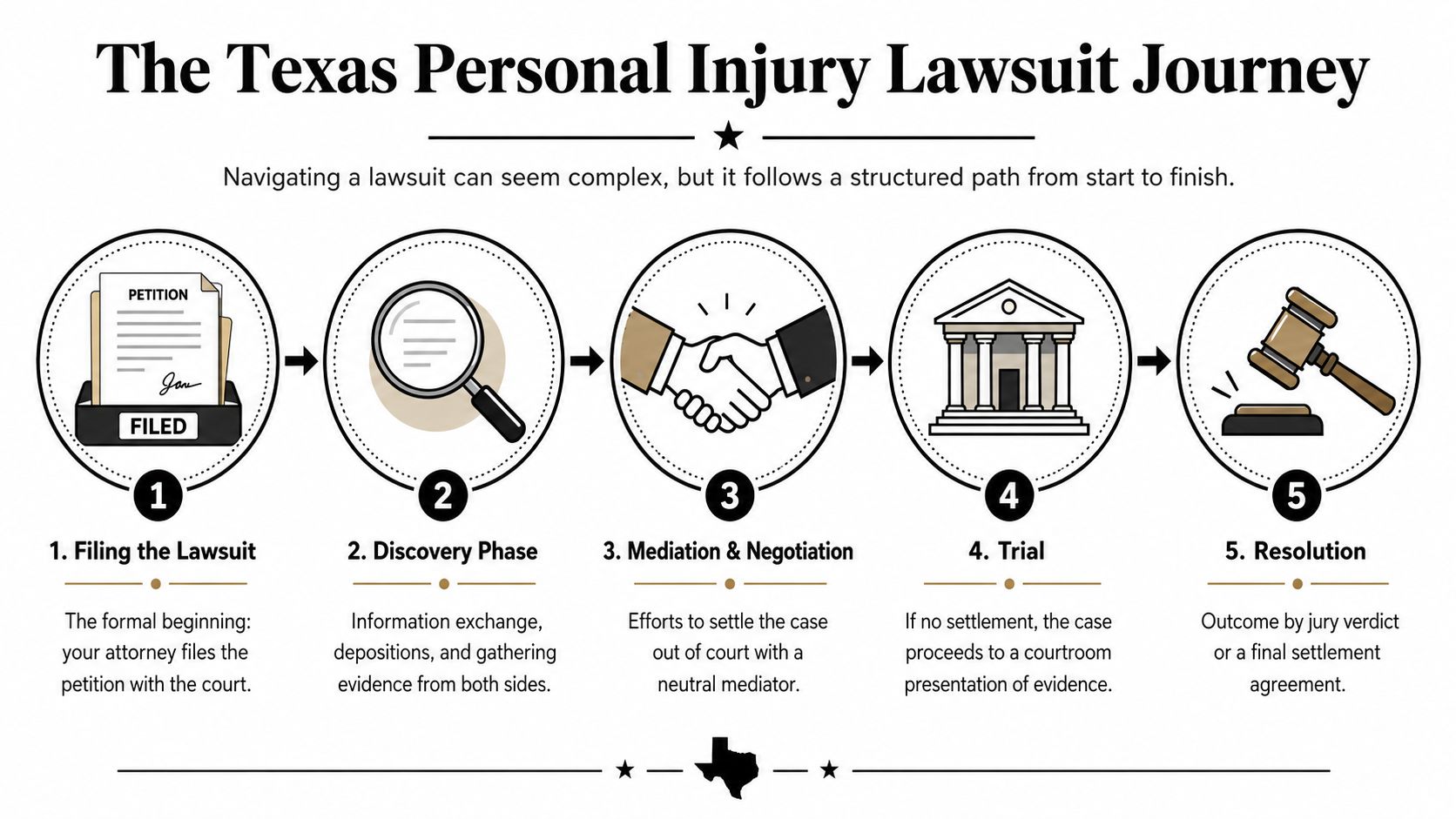
The case begins when your lawyer files a petition in the right Texas court. That pleading identifies the parties, states what happened, explains the legal basis for the claim, and requests damages. The defendant must then be served and given time to respond.
This step is more than paperwork. It is a decision point.
Sometimes filing suit is the right move because the insurer is dragging its feet, disputing clear liability, or refusing to make a reasonable offer before the statute of limitations runs out. In other cases, waiting a bit longer makes sense if medical treatment is still unfolding and the full value of the harm is not yet clear. Good timing matters because filing too early can make damages harder to present, while filing too late can damage settlement opportunities or risk missing a deadline altogether.
If you want a practical overview of the early litigation stages, this page on what happens after filing an injury claim in Texas walks through the next steps in plain language.
Discovery is where the strength of a case is proven
Discovery is the stage where both sides exchange information under rules set by the court. Your lawyer may send written questions, request records, and take depositions from the defendant, witnesses, company representatives, or other key people. The defense can do the same.
This part of the case often decides how seriously the other side treats your claim. A file that looked easy to dismiss before suit can look very different after sworn testimony, medical records, employment proof, photographs, and internal business documents are on the table.
Three tools usually matter most:
- Written discovery: Questions and document requests that pin down the defense's story and reveal insurance, records, and other evidence.
- Depositions: Sworn testimony that shows how witnesses present, what they remember, and where the weak points are.
- Expert work: In larger cases, experts may address fault, medical causation, future treatment, lost earning capacity, or long-term care needs.
I often tell clients that discovery is where uncertainty starts to shrink. That matters because cases settle more fairly when both sides can see the true strengths and true risks.
For readers curious about the kind of written advocacy lawyers use in litigation, this primer on how to write a legal brief gives a useful look at how legal arguments are organized.
Mediation often becomes the turning point
Texas courts frequently require mediation before trial. Mediation is a structured settlement conference with a neutral mediator, usually after the main evidence has been developed. No one testifies in front of a jury. Instead, each side presents its position, the mediator works between rooms, and negotiations continue until the case settles or reaches an impasse.
A well-timed mediation can be productive because the case has been tested by then. The plaintiff has a clearer medical picture. The defense has heard the testimony and reviewed the records. Both sides have a more realistic view of what trial could look like.
That does not mean every offer should be accepted.
One of the hardest decisions in a personal injury case is whether to settle now or keep going. A fair settlement gives certainty and closes the case. Going forward to trial may increase pressure on the defense, but it also brings delay, expense, and risk. The right choice depends on the evidence, the injuries, the available insurance, and your tolerance for uncertainty.
Trial is the final decision point
If the case does not settle, it moves toward trial through motions, exhibit preparation, witness planning, and jury selection. Trial is the point where a jury, not an adjuster, decides fault and damages.
Cases can still settle shortly before trial, and sometimes during trial, because deadlines force both sides to confront the evidence realistically. But if a verdict is needed, the process is there to get one.
That is the larger purpose of suing for personal injury in Texas. It is a way to use the court system to regain control, force disclosure, test the defense, and put your case in a position to resolve on terms that reflect what the injury cost you.
How to Afford a Lawyer and Get Help Today
One of the biggest reasons people delay calling a lawyer is cost. They assume they can't afford one, especially after missing work or facing growing medical bills.
In many Texas injury cases, that's not how representation works.
Why contingency fees matter
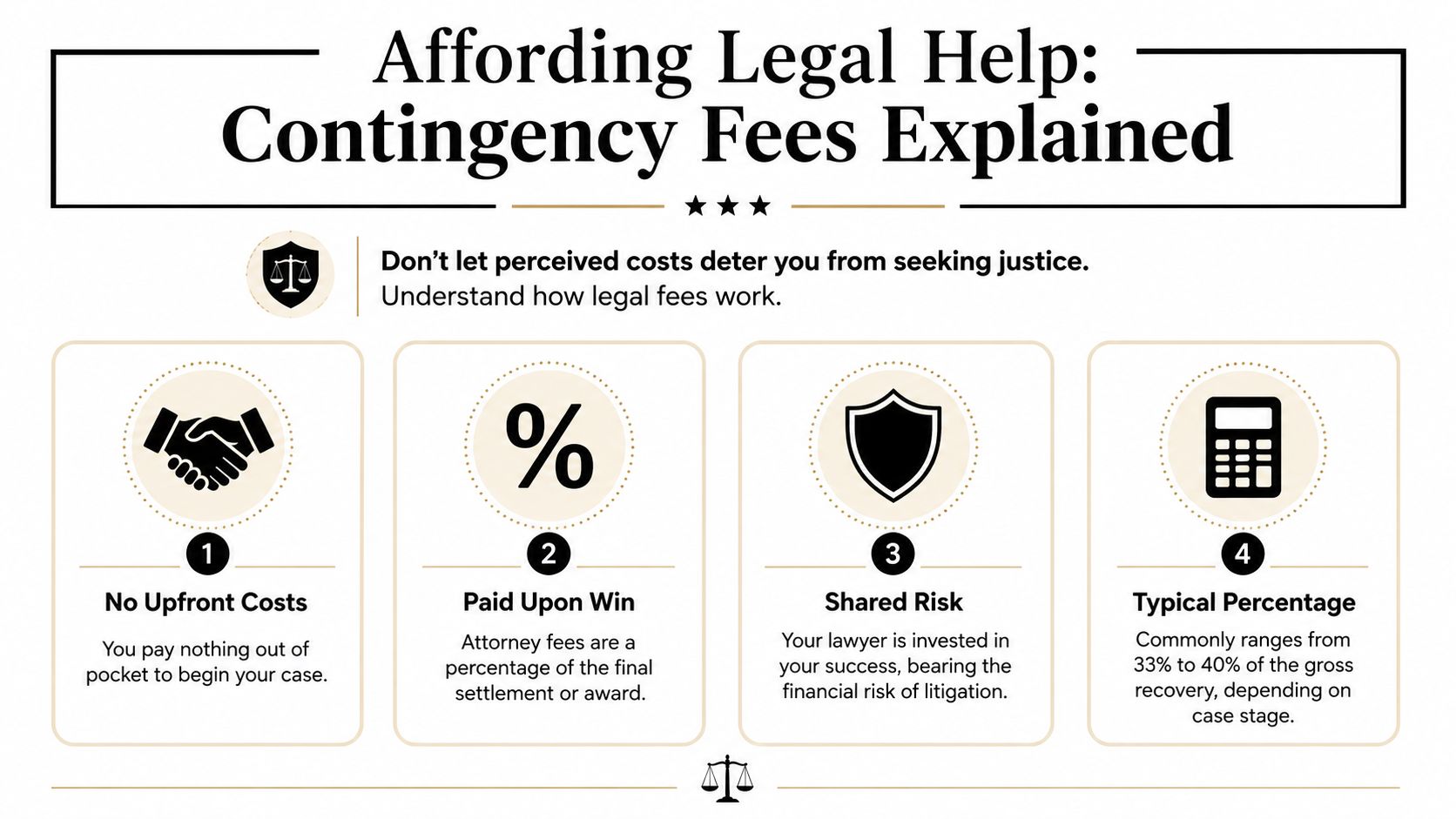
Personal injury lawyers commonly work on a contingency fee. That means the fee comes out of the recovery if the case succeeds, instead of requiring payment upfront. The infographic above notes that a typical percentage commonly ranges from 33% to 40% of the gross recovery, depending on case stage.
That model matters because it gives injured people access to legal help without paying hourly bills while they're already under financial pressure. It also means the lawyer has to evaluate the case carefully, because the lawyer is taking on risk too.
For a straightforward explanation, this page on how contingency fees work in Texas personal injury cases can help you understand what questions to ask before signing anything.
Hiring counsel often changes outcomes
People sometimes wonder whether they should just handle the case themselves, especially if the insurer seems cooperative at first. But national data indicate that plaintiffs who hire counsel typically receive around $77,600 in settlements, compared with roughly $17,600 for those who proceed without an attorney, according to the same personal injury statistics source cited earlier.
That doesn't mean every represented case is large. It does mean legal representation often affects how claims are documented, valued, negotiated, and pushed when resistance shows up.
If you're comparing attorneys, it helps to look beyond advertising. This article on LegalRev insights on law firm selection offers practical considerations people often use when deciding who to trust with an important case.
What to ask before you hire anyone
Not every lawyer handles serious injury cases the same way. Ask direct questions.
- Who will handle the case day to day: You should know whether your file will be managed by the attorney you met or passed off immediately.
- How do you prepare if the insurer won't settle: A lawyer should be able to explain investigation, negotiation, and litigation in plain English.
- How are expenses and fees explained: You should understand how the agreement works before you sign it.
A short video can also help clarify what the attorney-client relationship may look like during an injury case.
The Law Office of Bryan Fagan, PLLC handles Texas personal injury matters involving motor vehicle collisions, serious injuries, wrongful death, and related insurance disputes. For many families, a free consultation is the simplest way to understand whether a case is worth pursuing and what the next step should be.
You don't have to have every answer before you call. You just need enough information to start protecting your rights.
If you've been hurt in a crash, if an insurer is pressuring you, or if your family is dealing with the loss of a loved one, legal help can turn confusion into a plan. Recovery takes time, but it can begin with one informed conversation.
If you need guidance after a crash or fatal accident, schedule a free consultation with Law Office of Bryan Fagan, PLLC. You can talk through your situation with a Texas personal injury lawyer, get clear answers about your options, and find out what steps make sense now. Recovery is possible, and help is available.