A serious accident can change your life in seconds, but you don’t have to face it alone.
If you are searching for crash report texas, you are likely in a particular emotional state. You’re hurting, your phone won’t stop ringing, the insurance company wants a statement, and you still don’t fully know what the officer wrote down about the wreck. That uncertainty matters, because the crash report often becomes the first official version of what happened.
After a Houston freeway crash, for example, a driver may leave the scene thinking the facts are obvious. Then the report arrives and suddenly the wording, the diagram, or the injury code creates doubt. That’s when people realize this isn’t just paperwork. It’s evidence.
Texas continues to see a devastating number of fatal crashes. In 2025, Texas recorded 3,249 fatalities from car crashes, and for victims in Houston, Dallas-Fort Worth, Austin, and San Antonio, a detailed TxDOT crash report often becomes the foundation for proving negligence in an injury claim, as noted in Texas car accident statistics for 2025. If your collision wasn’t fatal, the same principle still applies. The report can shape how fault, injuries, and damages are viewed from the start.
If you’re also dealing with questions about your vehicle’s roadworthiness after the crash, a practical resource on guide for Kwik Kar state inspections can help you understand inspection basics and related vehicle issues that sometimes come up after an accident.
For immediate next steps, this what to do after a car accident in Texas guide can help you protect your health, your claim, and your peace of mind.
After the Crash The First Step Toward Clarity and Justice
The first useful thing you can do after the chaos settles is get the official report and read it carefully. Not later. Not after the adjuster tells you what they think happened. Early.
That document gives structure to a moment that probably felt fast, loud, and confusing. It identifies the people involved, records the location, summarizes the officer’s observations, and usually points toward the issues that will control the claim.
Practical rule: The crash report is often the first neutral document in your case, but it should never be the last word if it contains mistakes.
A good report helps. A flawed one can still be overcome. What matters is knowing how to use it.
What Is a Texas Crash Report and Why It Matters So Much
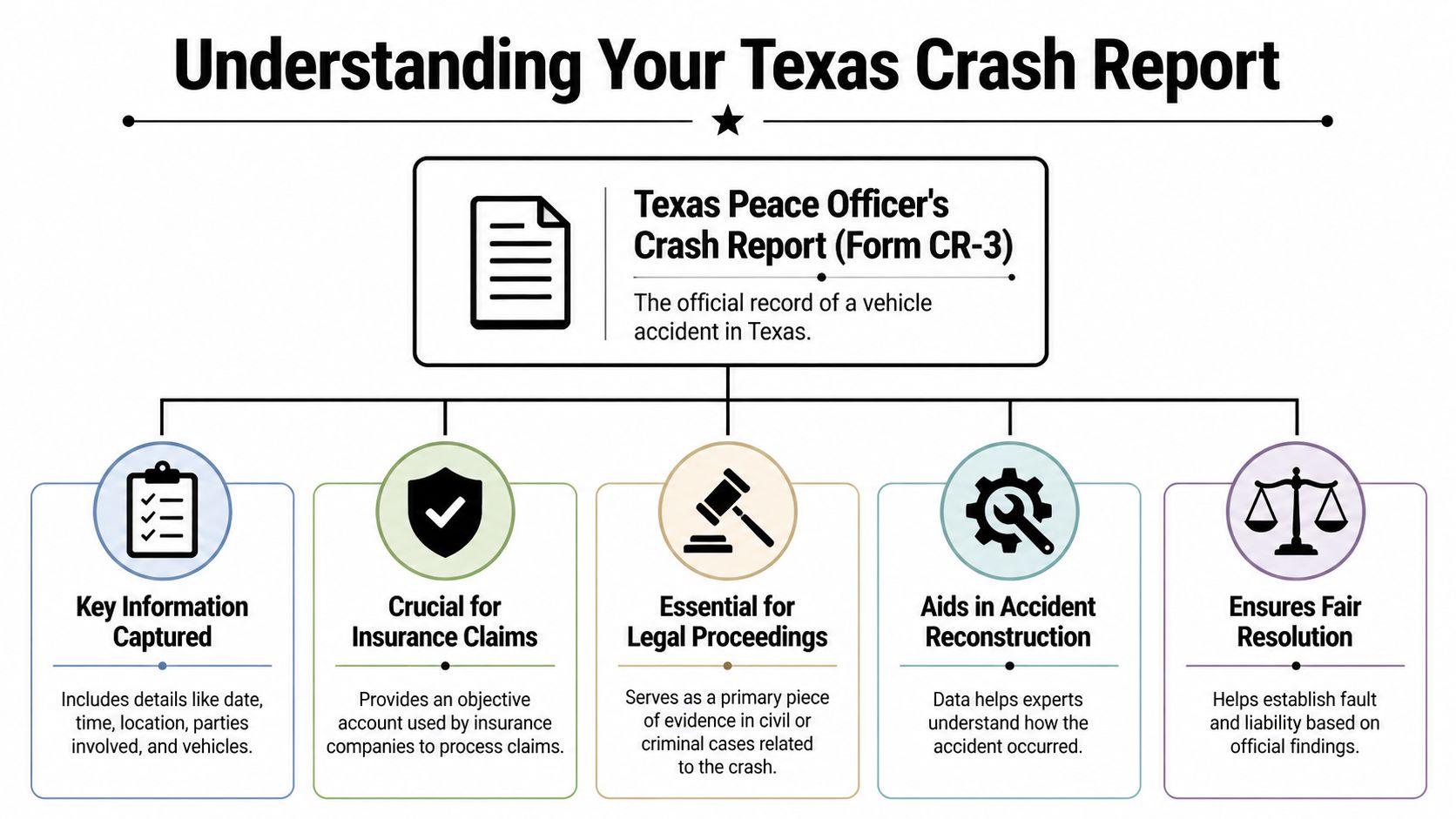
In Texas, the official accident report is the Texas Peace Officer’s Crash Report, commonly called the CR-3. Officers submit crash information through TxDOT’s Crash Records Information System, or CRIS. According to TxDOT crash data and records information, officers document location, vehicle types, injury severities, and up to three investigator-assessed contributing factors for every reportable crash in the state.
What the CR-3 usually contains
When clients first see a CR-3, they often focus on the obvious parts. Names. Insurance details. Vehicle information. Those matter, but they’re only the beginning.
The report also commonly includes:
- Scene details that place the crash at a specific road, lane, intersection, mile marker, or direction of travel
- Vehicle placement information that helps explain impact points and movement before and after the collision
- The officer’s narrative describing how the crash appears to have happened
- A diagram that may support the narrative, or sometimes contradict it
- Contributing factors chosen by the investigating officer
- Injury coding assigned at the scene
- Road and environmental observations such as lighting, traffic control devices, and surface conditions
Insurance adjusters study these sections closely. Defense lawyers do too. If the narrative suggests you changed lanes unsafely, or if the contributing factor points toward inattention on your part, the insurer may use that from day one to reduce or deny the claim.
Why this document carries so much weight
The CR-3 matters because it creates the first organized record of fault-related facts. It doesn’t decide the case by itself, but it often shapes the first conversations about liability.
A rear-end collision in Dallas may look straightforward until the report suggests a sudden stop. A truck crash near San Antonio may seem obvious until the officer lists only one contributing factor and leaves out a key issue visible in later evidence. The report gives everyone a starting point, and whoever understands that starting point best usually has an advantage.
A crash report is not a verdict. It is a snapshot taken quickly, often before the full medical and technical picture is available.
What works and what doesn't
Here’s the trade-off many injured people face:
| Approach | What happens |
|---|---|
| Treat the report as final | You may miss errors that hurt fault or damages |
| Ignore the report entirely | The insurer still won’t ignore it |
| Review it critically and early | You can spot problems while evidence is still fresh |
What works is a careful read backed by outside proof. Photos, medical records, witness statements, video, and vehicle data can strengthen a solid report or correct a bad one.
What doesn’t work is assuming the insurance company will fill in the blanks fairly.
How to Get Your Official Texas Crash Report
Getting your report sounds simple until you try to do it while recovering from injuries. Some people don’t know which agency responded. Others aren’t sure whether they should use the state system or contact a city department. The right path depends on who handled the crash.

Option one through the state system
If the report was submitted into the TxDOT system, you may be able to obtain it through the CRIS portal. This is often the most direct route for a standard request.
Start with the basic facts from the collision:
- Date of crash so you can narrow the search
- Location details including city, roadway, or nearby intersection
- Names of the drivers involved if you don’t have the report number
- Your own identifying information if the request requires confirmation of your connection to the crash
If you were injured in the Houston area, this Houston accident report resource can help you understand where reports are commonly requested and what information usually speeds up the process.
Option two through the local agency
Some crashes are handled by a city police department, sheriff’s office, or another responding agency. In those cases, the local records division may be the quickest source, especially early on.
That’s common after a city-street collision in Austin, a suburban intersection crash outside Fort Worth, or a sheriff-handled wreck on a county road. Call the records department, ask whether the CR-3 is available, and confirm what they need before you show up or submit a request.
What works here is precision. Have the date, time, roadway, and names ready. What doesn’t work is asking for “the accident report from last week” and hoping the clerk can identify it for you.
If the report isn't ready yet
Reports aren’t always available right away. Officers have to complete them and submit them through the system. Delays happen.
If you check too early, don’t assume the report doesn’t exist. Follow up. Keep a written record of who you contacted and when. That timeline can matter if the insurance company pressures you to move forward without the report.
This overview may help if you want to see the process in action:
A practical request checklist
Use this short list before you start:
- Identify the responding agency by checking any exchange form, case card, or paperwork given at the scene.
- Gather the crash basics such as date, location, and driver names.
- Request the official CR-3 rather than relying on informal summaries.
- Save the copy securely and keep both a digital and printed version.
- Review it before speaking at length with the insurer if fault is disputed or injuries are serious.
Reading and Understanding What's in Your Report
Once you have the report, don’t skim it. Read it like someone on the other side is looking for reasons to question your case, because that’s usually what happens.
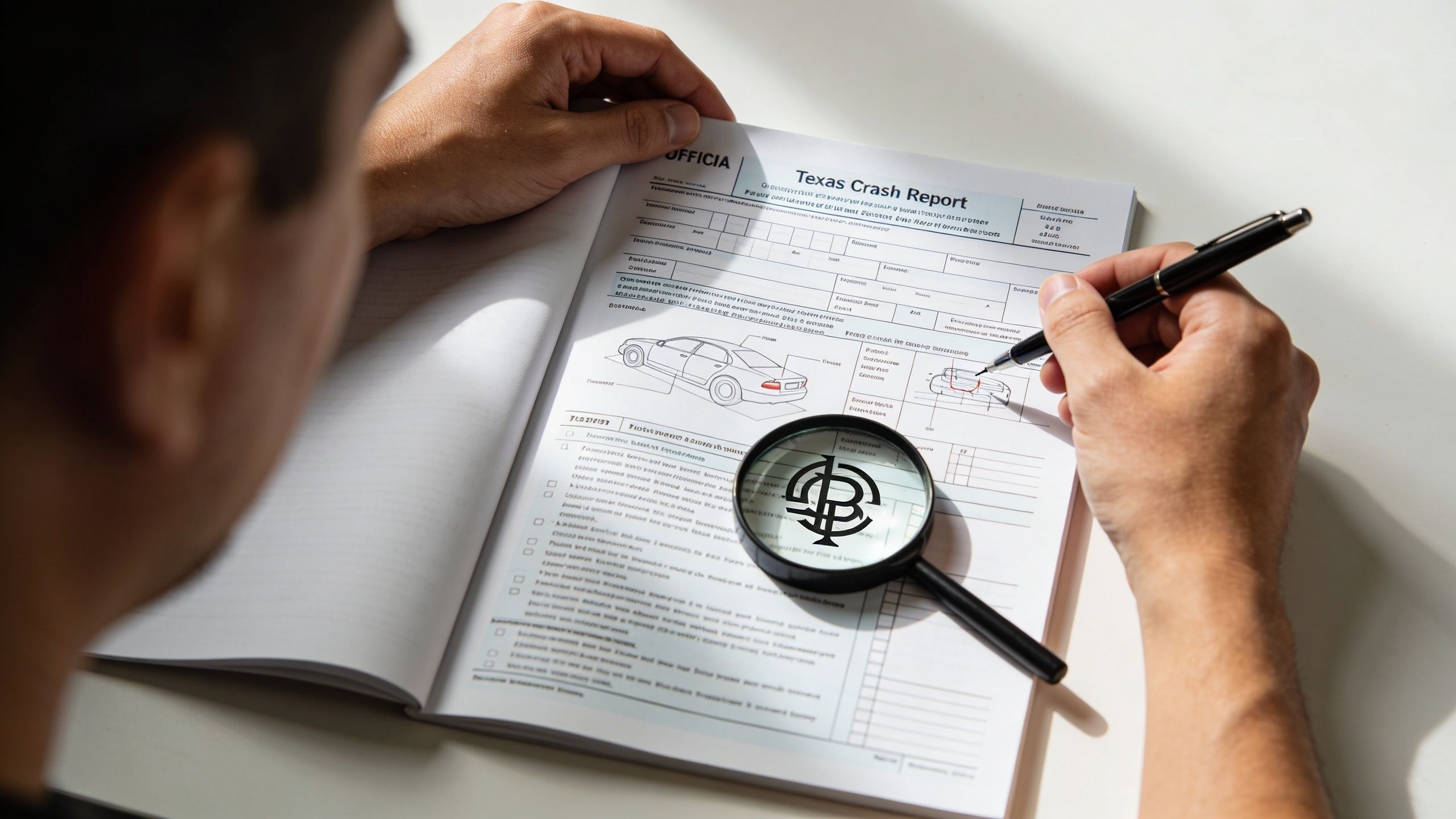
The most important sections are often the narrative, the diagram, the listed contributing factors, and the injury coding. Those four pieces can shape how the insurer values your claim long before a lawsuit is ever filed.
Read the narrative and compare it to the diagram
Start with the officer’s written description. Then compare it to the drawing.
If the narrative says your car was stopped but the diagram places your vehicle moving through the intersection, that inconsistency matters. If the report says the truck stayed in its lane but the point of impact suggests a merge, that matters too. A contradiction doesn’t automatically prove the report is wrong, but it gives your lawyer a reason to dig deeper.
After a multi-vehicle crash, physical damage can tell a more reliable story than a hurried summary. Tools and records that help in revealing hidden car damage can sometimes add useful context when impact locations or repair history become part of the dispute.
Watch the injury codes closely
One of the most overlooked issues on a Texas crash report is the KABCO injury rating. That code is assigned at the scene, often before your full symptoms appear and before imaging, specialist care, or follow-up treatment.
According to this discussion of the KABCO system on Texas crash reports, KABCO injury ratings are estimated to be inaccurate in up to 70% of cases, and a “C” or possible injury code can lead insurers to undervalue claims even when the person later needs substantial treatment for injuries such as concussions or soft tissue damage.
If your report says “possible injury” but your medical records show a real and ongoing condition, your medical records carry far more weight than the field estimate.
That’s why immediate medical care matters. Not just for health, but for proof.
A lawyer's reading method
This is the same basic order many lawyers use when reviewing a CR-3:
| Report section | Why it matters | Common problem |
|---|---|---|
| Driver and vehicle info | Confirms parties and coverage trail | Names, plate, or insurer errors |
| Narrative | Frames the event in plain language | Incomplete or one-sided summary |
| Diagram | Tests whether the story makes sense visually | Vehicle positions don’t match damage |
| Contributing factors | Influences fault arguments | Officer assumption presented like fact |
| Injury coding | Affects early claim value | Symptoms understated at the scene |
If you want help decoding abbreviations, symbols, and fields line by line, this guide on how to read a police accident report can make the form much easier to understand.
What to Do If Your Crash Report Contains Errors
A crash report can be wrong in small ways or damaging ways. A misspelled name is annoying. An incorrect contributing factor that blames you for the wreck can cost you money.
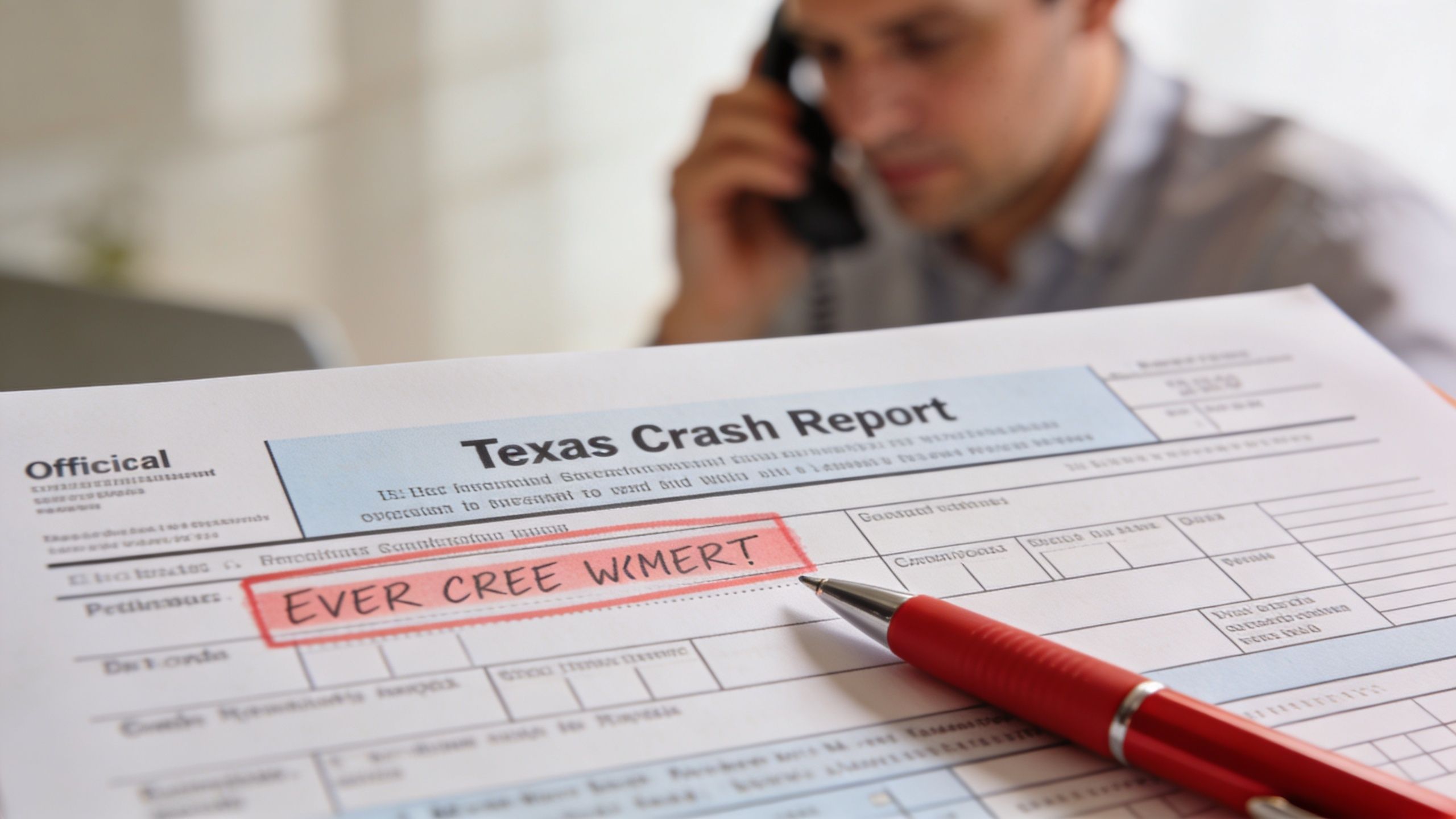
Texas crash reports often include officer-assigned contributing factors, and those entries can be subjective. According to guidance on disputing contributing factors in a Texas crash report, challenging those findings is important because lawyers can use counter-evidence like dashcam footage or black box data to dispute fault determinations with insurers or in court.
The first move is not an argument
Don’t call the adjuster and try to debate the report off the top of your head. Start by identifying exactly what is wrong.
Look for errors such as:
- Basic factual mistakes like wrong lane, wrong vehicle, or wrong direction of travel
- Fault-related assumptions where the officer chose a contributing factor that the physical evidence doesn’t support
- Missing evidence such as omitted witness information, video sources, or visible signs of impairment
- Medical understatement where the report minimizes what later medical records clearly show
How a report gets challenged in practice
After a Houston freeway crash, one common problem is an officer assigning “unsafe speed” before all video or traffic camera evidence is available. In truck wrecks, the report may fail to reflect braking distance, lane drift, or electronic data that later becomes important. In rideshare cases, the report may not fully capture app status or vehicle use.
A lawyer can respond by building a better record. That may include requesting a supplemental report, collecting witness statements, preserving dashcam footage, obtaining black box evidence, and presenting a fault analysis backed by documents rather than opinion.
The officer was not inside either vehicle. A report is evidence, but it is still open to challenge.
What works is acting early while video, scene evidence, and witnesses are still available. What doesn’t work is waiting until the insurer has built its entire position around a flawed report.
How Your Crash Report Builds Your Personal Injury Claim
You are hurt, the bills have started, and the insurance company is already looking for a way to limit what it pays. Your crash report often becomes the first document everyone points to. That is why this report can shape the entire claim before your medical treatment is even complete.
A strong claim answers two questions clearly. What happened, and how did it cause your losses? The crash report gives the insurer, the defense lawyer, and eventually a jury a starting version of that story. If the report says the other driver failed to stay in a lane, ran a light, followed too closely, or showed signs of intoxication, that helps frame fault early. If it assigns the wrong contributing factor or understates the severity of the crash, that mistake can follow your case unless someone corrects it with evidence.
In serious injury and wrongful death cases, small boxes on the report can carry outsized consequences. I pay close attention to contributing factors, diagram accuracy, witness entries, and injury coding, including KABCO classifications that may not match what later medical records show. An insurer may treat those entries as settled fact. A good lawyer treats them as the beginning of the investigation, not the end.
How the report supports fault, damages, and strategy
Texas uses a fault-based system, and proportionate responsibility can reduce your recovery if the other side persuades a jury that you were partly to blame. That makes the crash report more than paperwork. It is often the first framework the insurance company uses to argue liability percentages.
The report also helps organize the proof that comes next. Medical records show the injury. Wage records show lost income. Photos, video, vehicle damage, and expert analysis show force, mechanics, and timing. The report ties those pieces to a date, a location, the drivers involved, and the officer's initial findings.
That matters in claims involving:
- Medical expenses, from emergency care to future treatment
- Lost wages and reduced earning capacity
- Pain and suffering
- Wrongful death losses
- Long-term care or disability after a catastrophic injury
A report can also reveal where the defense will attack. If the officer checked a box suggesting you contributed to the wreck, expect the insurer to repeat that point. If the report omits a witness or lists the wrong lane of travel, expect a dispute over how the impact happened. Those problems are manageable, but only if they are identified early and answered with better proof.
Texas deadlines add pressure. Many personal injury claims must be filed within two years, and delay can do real damage long before that deadline arrives. Video disappears. vehicles get repaired. Witnesses stop answering unknown numbers. A flawed report becomes harder to overcome once the insurer has built its whole position around it.
The practical approach is to use the crash report as a foundation, then test every important entry against the evidence. The Law Office of Bryan Fagan, PLLC handles Texas vehicle injury claims by obtaining and analyzing crash reports, comparing them to medical records and scene evidence, and building a claim that reflects what occurred, not just what was written down in the first few minutes after the wreck.
You Are Not Alone Let Us Help You Take the Next Step
The days after a wreck are hard enough without having to guess what your report means or whether an insurance adjuster is using it against you.
A Texas crash report can support your case, but it can also contain mistakes that need attention. I have seen claims weakened by the wrong contributing factor, an understated injury code, or a report that leaves out a key witness. Those issues do not end a case. They tell you where the fight will be.
Your search for crash report texas should lead to answers you can use. That includes understanding what the officer recorded, spotting what is inaccurate or incomplete, and building proof that carries more weight than a checked box on a form. If you need help from a Texas personal injury lawyer, a Houston car accident attorney, a wrongful death lawyer Texas families can rely on, or a truck crash lawyer Houston residents call after a disputed collision, the goal is the same. Get the facts right and use them well.
The Law Office of Bryan Fagan, PLLC reviews crash reports with that purpose in mind. We examine the report against medical records, photographs, witness statements, vehicle damage, and scene evidence. If the report gets something wrong, we work to correct the record or prove why the insurer should not rely on the error.
If you were injured in a Texas crash or lost a loved one in a fatal collision, contact Law Office of Bryan Fagan, PLLC for a free consultation. We can review your crash report, explain your options, deal with the insurance company, and help you pursue compensation for medical bills, lost wages, pain and suffering, and other damages. You do not have to sort this out alone. Your next step can start with a clear review of the report and a plan built around the truth.