Skip to content

A serious accident can change your life in seconds, but you don't have to face it alone. If you're staring at medical bills, missing work, or trying to figure out who pays for the damage, the first few days can feel overwhelming. Texas car accident laws are built around fault, deadlines, and proof, and those three things can shape everything that happens next.
In a Houston freeway crash, a side-impact collision on a city street, or a hit-and-run in a parking lot, the same basic questions come up fast. Who caused it. How much fault can be placed on each driver. How long do you have to act before your rights begin to fade. The answers matter because Texas saw 4,150 traffic deaths and 251,977 injuries in 2024, with a reportable crash happening every 57 seconds statewide, according to Texas crash data (Texas car accident statistics).
That scale is more than a statistic. It means evidence disappears quickly, insurers argue hard about blame, and families often need help organizing medical records, wages, and repair estimates before the claim becomes harder to prove. A Texas personal injury lawyer can help you sort through those moving parts while you focus on healing.
Your First Questions After a Texas Car Accident
A serious accident can change your life in seconds, but you don't have to face it alone. Most injured people want the same basic answers right away. Will my medical bills be covered. What if I can't work. Do I have to accept what the insurance company says.
Those questions are normal, and they're the right ones to ask. In Texas, the claim often turns on who caused the wreck and how quickly you protect the evidence that proves it. That's why early photos, witness names, and medical documentation can matter so much when pain, lost income, and future care costs start stacking up.
After a crash, people also worry about whether the law treats them fairly if they made a small mistake too. Texas car accident laws don't ignore fault on your side, but they also don't take away your claim just because you were imperfect. The bigger issue is usually whether the other driver, or even another party, made the mistake that caused the harm.
If you're still sorting through what happened, a good starting point is understanding whether Texas follows a fault system. This guide explains that in plain language, along with the deadlines, damages, and practical steps that matter most. If you're trying to compare your options, the question of whether Texas is a no-fault state is answered in more detail in this Texas no-fault overview.
Understanding Texas's At-Fault System and Negligence
A Texas crash claim usually starts with one simple question, who caused the harm. Texas follows an at-fault system, so the driver who caused the wreck is generally the one responsible for the losses. If another driver runs a red light, turns without looking, or drives while distracted, the law asks whether that conduct led to your injuries and expenses.

What negligence really means
Texas personal injury claims usually turn on negligence. The concept is straightforward once it is broken into parts. A driver has a duty to act safely, the driver breaks that duty, the breach causes the crash, and the crash causes actual harm. If one of those pieces is missing, the claim can weaken even when the wreck felt obvious at the scene (Texas negligence elements in car crash cases).
After a Houston freeway crash, the proof may come from a police report, witness statements, traffic-law violations, or video. In a work-related wreck, an employer may also be responsible under respondeat superior if an employee was driving for work (Texas negligence and employer liability).
Practical rule: the person with the clearest paper trail usually has the easier claim. Photos, witness contact information, and a prompt medical exam can make a difficult case much stronger.
That is why the first days after a crash matter so much. Evidence fades, memories blur, and insurers begin shaping the story around whatever proof is available. A clean set of photos, an accurate accident report, and early treatment records can help show what happened before the other side tries to rewrite it.
If the crash involved a commercial vehicle, the stakes can rise quickly because the driver, the company, and the insurer may all become involved. If your wreck included a truck, it helps to speak with a truck crash lawyer Houston early, while the vehicle data and scene evidence are still available.
Texas car accident laws also connect to the bigger question of fault rules. If you want a plain-language explanation of how Texas assigns fault in injury claims, this Texas no-fault overview helps separate Texas from states that handle claims differently.
You may also see situations where the crash was not just a traffic case. Unsafe property conditions after a vehicle collision, like a dangerous parking lot or hidden hazard, can raise separate issues. For related injuries on unsafe property, Slip and Fall / Premises Liability in Texas addresses injuries caused by unsafe property conditions.
How Shared Fault Can Impact Your Compensation
Texas uses a modified comparative negligence system, often called the 51% bar rule. In plain terms, you can still recover damages if you are 50% or less at fault, but your compensation is reduced by your share of responsibility. If you are 51% or more at fault, Texas law cuts off recovery completely. That rule is explained in detail in Texas comparative negligence and the 51% bar.
That is where many insurance disputes begin. Adjusters know that every percentage point changes the money involved, so they often look for any fact that shifts blame toward you. A claim that seems straightforward at first can change once phone records, dashcam footage, intersection cameras, or witness statements are added to the file.
What the math looks like
If a jury values your case at $100,000, the fault split changes the payout in a very direct way. At 10% fault, your recovery would be $90,000. At 50% fault, your recovery would be $50,000. At 51% fault, Texas law bars recovery completely. A clear example of that rule appears in the infographic illustrating Texas modified comparative fault laws and the 51 percent bar rule for car accidents.

That is why fault allocation often decides the value of the case. A small shift in responsibility can mean a large change in what you take home, and insurers understand that pressure well. If you want a closer look at how shared blame affects settlement value, this explanation of Texas comparative fault and the 51% rule is a useful companion.
If the insurer is blaming you, don't answer with guesses. Answer with evidence.
The evidence can be simple or technical, but it has to be gathered quickly. A clear scene photo, a phone log, or a witness statement can move a fault dispute in your favor when the other driver tries to rewrite what happened.
Critical Deadlines for Filing a Texas Car Accident Claim
Texas law generally requires most car accident lawsuits to be filed within two years of the crash. If you miss that deadline, the court can dismiss the case even if the other driver was clearly at fault (Texas car accident statute of limitations).
That deadline matters because insurance companies often keep talking long after the clock starts running. They may ask for more paperwork, more time, or another recorded statement while your legal window gets smaller. The law doesn't wait for you to finish treatment, and it doesn't pause while the adjuster reviews the file.
The safest approach is to treat the deadline as a hard stop, not a loose guideline. If your crash caused serious injuries, wrongful death, or a disputed liability issue, waiting can make a strong case harder to file and harder to prove. Families are often dealing with grief, hospital stays, and financial strain at the same time, which is exactly why the clock matters so much.
One common point of confusion is the difference between a claim and a lawsuit. You may speak with an insurer first, but that doesn't extend the legal filing deadline in court. The two-year rule is about preserving your right to sue, and that right can disappear before the medical story is fully settled.
What Types of Damages Can You Recover?
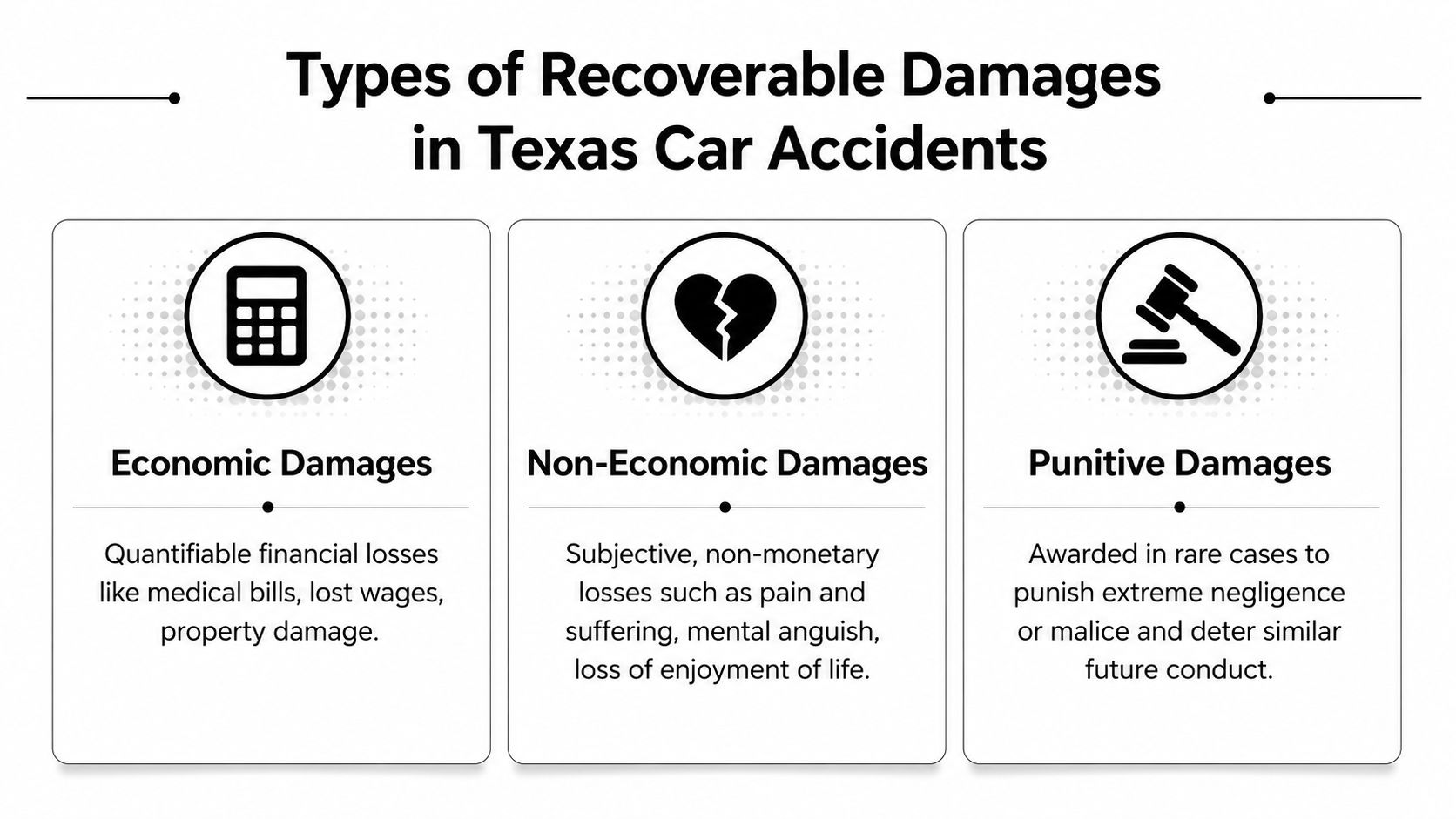
A crash can leave you with bills, missed work, and injuries that change daily life in ways that are hard to measure. Texas law separates recovery into economic, non-economic, and, in limited cases, exemplary damages. Economic damages cover losses you can document, while non-economic damages cover pain and suffering, as explained in Texas damages and minimum insurance requirements.
The two main damage categories
Economic damages are the losses you can prove with records. They can include emergency care, follow-up treatment, medication, lost wages, and future medical care if the injury will continue to affect you. Strong records make it easier to connect each cost to the crash and show the insurer why the amount belongs in your claim.
Non-economic damages cover the harm that does not come with a receipt. Pain, mental anguish, disfigurement, and loss of consortium can all matter in a serious injury case. These losses are real even though they do not fit neatly into a billing statement.
Texas also requires minimum auto liability coverage of 30/60/25, meaning $30,000 per injured person, $60,000 per accident for bodily injury, and $25,000 for property damage. For a severe crash, that coverage can disappear quickly, which is why uninsured and underinsured motorist coverage can become important. A claim may need to look beyond the at-fault driver's policy if the injuries and losses are larger than that policy can cover.
What to document right away
- Medical proof: Keep discharge papers, follow-up instructions, and treatment notes.
- Work losses: Save pay stubs, missed-shift notices, and employer records.
- Daily impact: Write down pain, sleep problems, missed activities, and family strain.
- Property damage: Keep repair estimates and photos of the vehicle.
Those records help show both current harm and future needs. If you are dealing with a fatal crash, a wrongful death lawyer Texas families trust can help preserve the damages story that the law allows survivors to pursue.
Practical Steps to Protect Your Rights After a Crash
Get medical care first
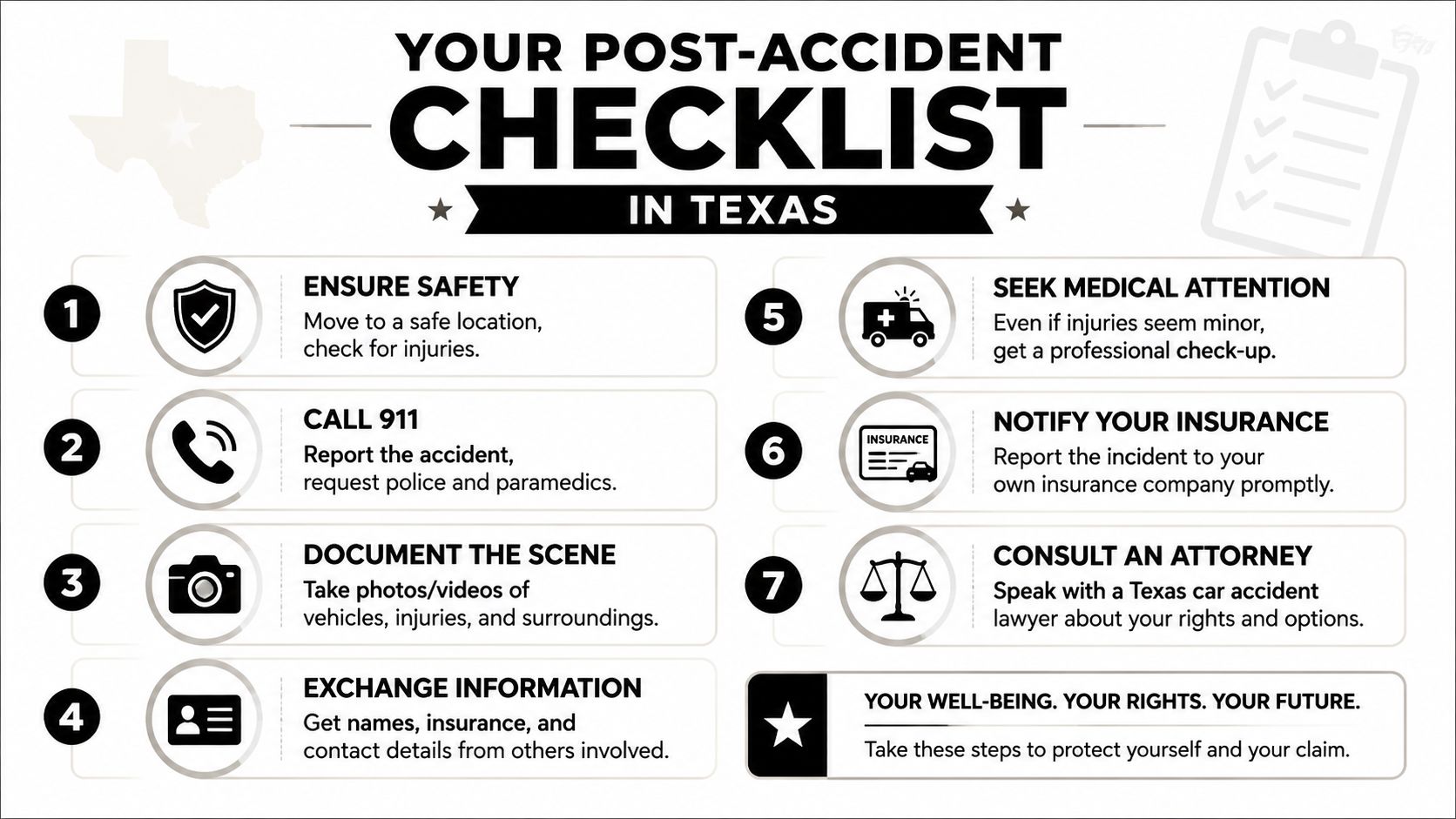
If you walk away thinking you're “just sore,” that feeling can be misleading. Some injuries show up only after the shock wears off, and a prompt medical visit creates a record that ties your symptoms to the crash. If pain, stiffness, headaches, or dizziness change in the hours or days after the wreck, go back for follow-up care instead of assuming it will pass.
Report the crash promptly
If police responded, write down the report number and the agency that handled the scene. Texas crash reports matter because they create an early record of what happened and who was involved, which can help later if the insurer questions the facts. If the crash was a hit-and-run and the driver was never found, the Texas Department of Insurance hit-and-run guidance says UM coverage will not pay unless the crash was reported to police, and it advises victims to notify their insurer as soon as possible because many policies have short claim deadlines.
Document everything
Take photos of the vehicles, the road, the weather, your injuries, and the scene before anything changes. If you can do so safely, get the names and contact information of witnesses while they are still nearby. If the other driver seemed distracted, impaired, or aggressive, write down those details while they are still fresh in your mind.
Be careful with insurers
Your own insurer may need notice, but the other driver's insurer is not on your side. A recorded statement can freeze your words before you know the full scope of the injury, and that can hurt a claim later if you guess wrong or leave out symptoms that appear afterward. If you are unsure what to say, keep the conversation short and factual.
Practical rule: if you do not know the answer, say you do not know. Do not guess about speed, distance, pain, or fault.
Track expenses and protect the claim
Keep every receipt tied to the crash, even the small ones. Towing, medication, mileage to appointments, and missed work can all become part of the claim file, and those costs often matter more than people expect once the insurer starts reviewing the numbers. For victims who need organized intake and document handling, some firms use systems to automate your legal client onboarding, which can help keep records from slipping through the cracks.
If the crash involved a rideshare vehicle, a delivery driver, or another commercial situation, evidence can move quickly and disappear just as fast. In that situation, a Houston car accident attorney can help secure records before they are lost, and the Houston auto accident attorney page is a good place to start if you want help close to home.
When to Contact a Houston Car Accident Attorney
If your injuries are serious, fault is disputed, or the insurer is already pushing for a fast settlement, it's time to talk to a Texas personal injury lawyer. That's especially true if the crash involved a truck, a commercial driver, a rideshare vehicle, or a fatality. Those cases tend to involve more evidence, more insurance layers, and more pressure to settle cheaply.
A lawyer can help by gathering records, speaking with adjusters, and building the liability story before evidence goes stale. That matters because the claim often rises or falls on details like camera footage, repair inspections, phone records, and witness interviews. The earlier that work starts, the more options you usually keep.
If you're still trying to pull your paperwork together, a structured intake process can help. That's one reason some firms use tools that help automate your legal client onboarding, so accident details, medical records, and insurance letters are easier to organize from the start.
If you want help close to home, the firm's Houston auto accident attorney page is a good place to start. The Law Office of Bryan Fagan, PLLC also handles car, truck, wrongful death, and catastrophic injury matters across Texas, so you don't have to sort through all of this alone. A free consultation can give you a clearer picture of your rights, your deadlines, and your next move.
If you've been hurt in a crash, don't wait for the insurance company to define your case for you. Contact Law Office of Bryan Fagan, PLLC for a free consultation, and get a clear plan for protecting your claim, your recovery, and your family's future.