
A serious accident can change your life in seconds, but you don't have to face it alone. If your baby was injured at birth, or you're only now realizing something seems wrong, the hardest part is often the silence. You may have left the hospital with no clear answers, then watched months pass before your child started missing milestones, feeding poorly, or moving one side of the body differently.
That delay matters. In Texas, birth injury claims turn on medical records, expert review, and strict deadlines, so waiting to “see how things go” can put your child's rights at risk. A seasoned Texas birth injury lawyer can help you sort out what happened, who may be responsible, and what evidence still exists before it disappears.
When Birth Injuries Aren't Immediately Obvious
A mother in Houston may notice nothing unusual at delivery, then months later hear a pediatric neurologist raise concerns after her baby struggles to hold up the head or feed normally. A family in Dallas may spend weeks bouncing between specialists before anyone says the words “possible birth injury.” That delay is common, and it makes the legal side harder because the injury is often discovered after the hospital stay is long over.

The symptoms often show up later
Birth injuries aren't always obvious in the delivery room. Some families first notice developmental delays, feeding problems, seizures, or limited movement, and only then start asking whether something went wrong during labor or delivery. That's why pediatric specialists are often the first people who point families toward a bigger problem.
Independent medical content notes that some birth injuries are only recognized after developmental delays become clear, which is exactly why parents need to keep a close timeline from the start. A useful outside resource on delayed harm and misdiagnosis is Momotaro Apotheca's discussion of medical misdiagnosis in women, because the same basic problem shows up here, symptoms are missed, minimized, or explained away until the picture becomes harder to reconstruct.
Why the clock can already be running
The legal issue is simple, even if the medicine isn't. Evidence gets weaker with time, and the delivery team's notes, monitor strips, and memory fade fast. If you're in Austin or San Antonio and you're only now connecting your child's symptoms to birth, you should act as if the case is already live, because that's how you protect the records that matter.
If your child's symptoms are growing clearer over time, treat that pattern like evidence, not reassurance.
A Texas personal injury lawyer handling birth trauma should look at the medical story as a timeline, not a one-day event. The question isn't only what happened during labor, it's whether the child's later diagnosis can be tied back to earlier care failures in a way Texas law will recognize.
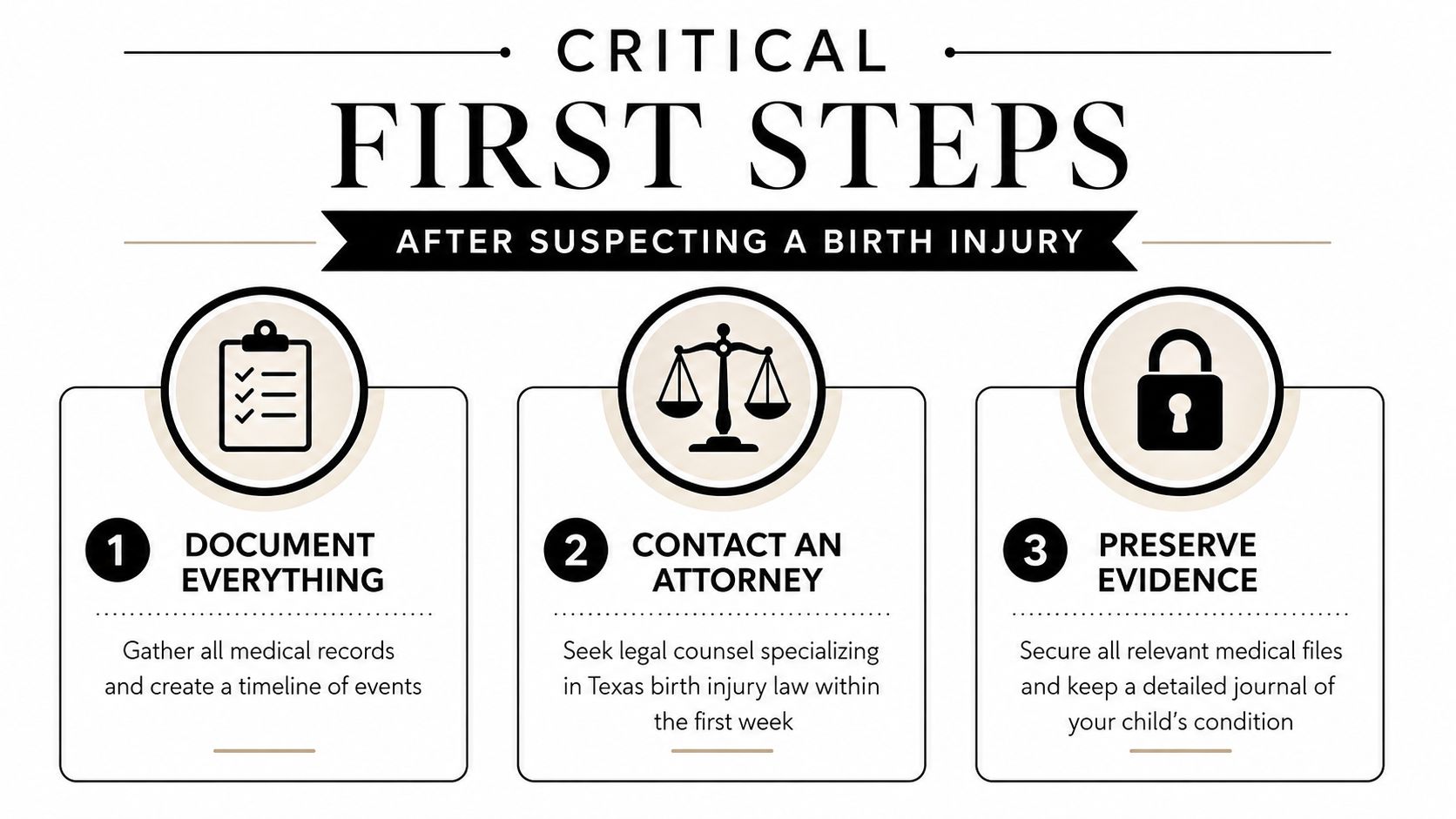
Critical First Steps After Suspecting a Birth Injury
The first days after suspicion matter more than most parents realize. Fetal monitoring strips can be lost, delivery notes can get buried in a chart, and staff members move on. Your job is to lock down the paper trail while the facts are still fresh.
Start with the records, not opinions
Request the full medical file from the hospital and every follow-up provider. The most important materials are fetal monitoring strips, delivery notes, NICU charts, and placental pathology reports. Those records are the backbone of a standard-of-care review, and they're the first thing a lawyer needs to see.
Use the internal guide on how medical records affect an injury claim in Texas if you want to understand why records control the case, not guesses or hallway conversations. The point is to preserve the facts before anyone starts editing the story.
Build a symptom journal that tells the truth
Write down what you see every day. Keep track of feeding issues, sleep patterns, seizures, stiff limbs, weak movement, missed milestones, and every specialist visit. A short note like “baby won't bear weight on left side” is far more useful than a vague memory a month later.
A good journal should include:
- Dates and times: Write down when you noticed each symptom.
- Who you spoke with: Note the doctor, nurse, or therapist.
- What changed: Record what got worse, what stayed the same, and what treatment was recommended.
- Documents you received: Save discharge papers, referral sheets, and test results.
Be careful with insurers and staff conversations
If an insurer calls, don't try to explain the whole case yourself. Use Dealing With Insurance Companies After a Texas Accident as a reminder that insurers often try to reduce payouts and shape the claim early. Keep your answers short, factual, and limited to basics until a lawyer reviews the situation.
Don't speculate about what caused the injury on a recorded call. If you don't know, say you don't know.
The video below is useful if you want a quick visual sense of how families should organize the early response.
The safest move is to contact a Texas birth injury lawyer while the file is still intact and before anyone has a chance to lose key evidence. In birth injury cases, speed protects the truth.
Understanding Texas Filing Deadlines and Why They Matter
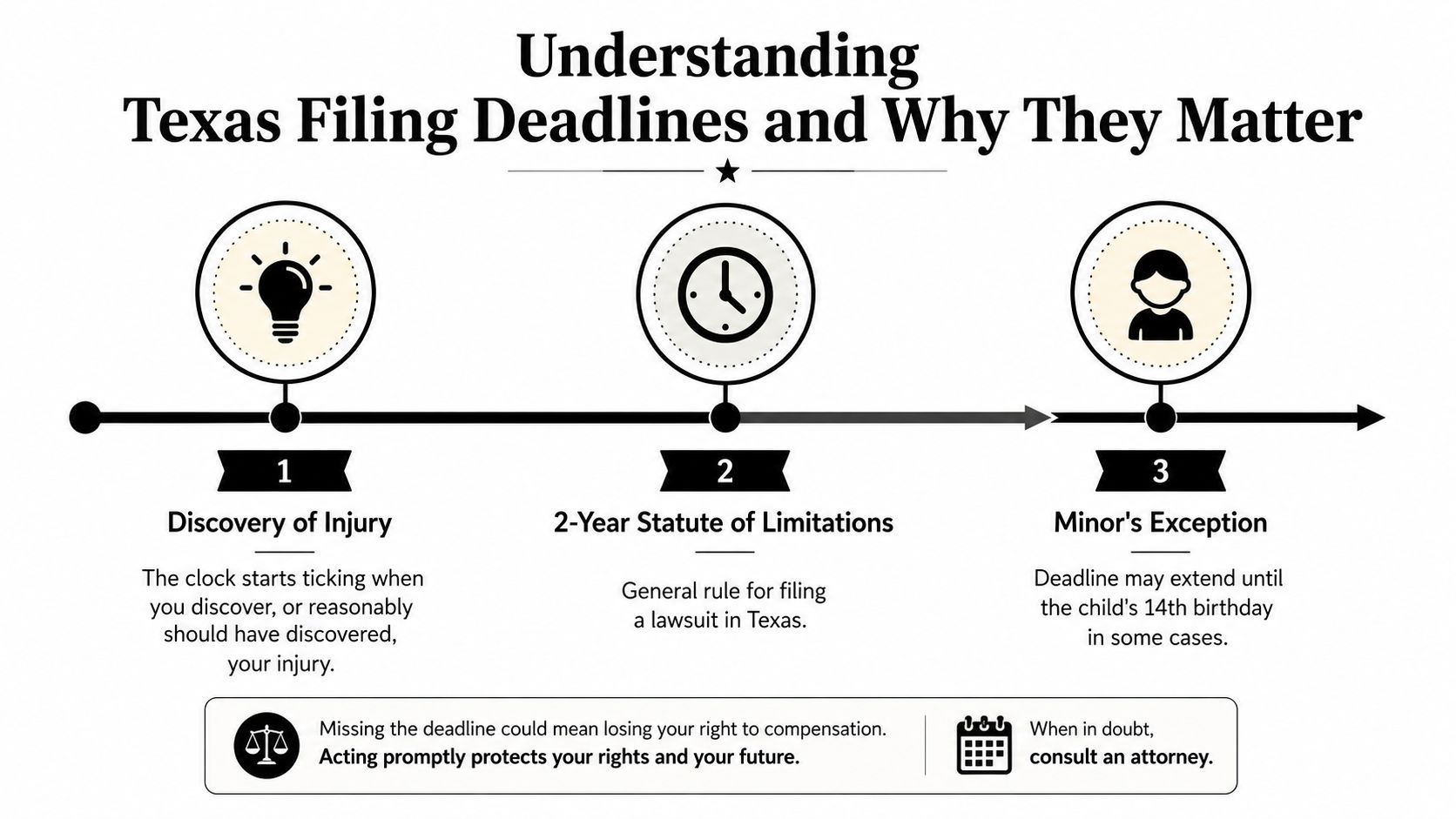
A birth injury can stay hidden for weeks, months, or longer, but Texas deadlines do not wait for a family to get answers. Texas medical-malpractice law usually gives most claims a two-year statute of limitations, and Texas reporting also explains that minors can sometimes get extra time depending on the claim and the child's age. That sounds straightforward until you sort out who may be responsible and what type of claim applies.
The deadline problem is bigger than most families think
A delayed diagnosis does not automatically reset the clock. Texas legal explainers say some minor-related rules can extend filing in certain situations, while other discussions still stress that some claims must be brought within two years of birth. That is why guessing at the deadline is a mistake.
The safer path is to follow Texas birth injury statute of limitations guidance and get the case evaluated early, before the defense can argue that the claim is stale. Waiting and hoping the law will stretch in your favor gives the other side more room to fight you.
Different defendants can mean different deadlines
An OB-GYN, a nurse, a hospital, and an anesthesia team may all appear in the same birth injury story, but they do not always face the same deadline issues. Texas reporting on birth injury deadlines explains that some claims turn on different rules depending on the defendant and the claim type. A case that looks simple from the outside can turn into a deadline trap once the file is reviewed carefully.
File early enough that you're not asking a judge for mercy later.
The practical consequence is easy to miss. A family in San Antonio may spend months waiting to see whether the child “catches up,” and that delay can cost them the chance to preserve testimony, review the fetal strip, or challenge hospital records before the window closes. The same lesson applies to birth injuries, delay helps the defense, not the family.
Retain counsel immediately, identify the exact deadline for each possible defendant, and move before records disappear.
Settlement Versus Trial: What Texas Families Should Expect
Most birth injury cases in Texas end in settlement, not trial. One Texas-focused source reports that approximately 90–95% of cases settle before trial, which means your lawyer's job is to build strength early, not just argue well in a courtroom. In a birth injury case, strength comes from records, experts, and a believable future-care picture.

Settlement gives certainty, trial gives pressure
Settlement usually means less public exposure and a faster path to resolution. Trial can bring higher compensation, but it also brings delay and uncertainty. Families need to understand that both paths are real, and smart lawyers prepare for both from the beginning.
Publicly reported Texas outcomes for severe neonatal brain injury and cerebral palsy cases have included $10.3 million, $10.1 million, $6.9 million, and $5.1 million recoveries cited by Texas birth-injury firms. Those figures matter because they show how future medical care, therapy, and lost earning capacity can drive value in high-severity cases. They also show why a weakly documented claim gets discounted fast.
What pushes a case toward settlement
Strong cases settle when the defense sees the future-cost evidence is solid. That usually means the lawyer has already lined up records, expert analysis, and a careful damage model. If the file is incomplete, the defense has room to deny responsibility or minimize harm.
A practical comparison looks like this:
| Path | What it usually means | Family impact |
|---|---|---|
| Settlement | Negotiated resolution with a defined outcome | More control, less uncertainty |
| Trial | Case is decided in court | More delay, more risk, possible larger recovery |
Mediation often sits between those two points. It forces each side to confront the evidence and the child's needs in a structured setting. A wrongful death lawyer Texas handles a different harm, but the same principle applies, the defense settles when the proof is hard to ignore.
Calculating Damages in Texas Birth Injury Cases
Texas birth injury compensation splits into two buckets, economic damages and non-economic damages. Economic damages cover things you can calculate, like medical care, therapy, and future treatment. Non-economic damages cover pain, suffering, and similar losses, but Texas law caps them in medical malpractice cases.
The key point is this. Damage modeling should start with the child's real needs, then separate the uncapped losses from the capped ones. If you blur them together, you'll understate the case and make settlement harder.
Use economic vs non-economic damages in Texas to understand the basic split if you're trying to make sense of what compensation can cover. A serious birth injury often involves lifelong care planning, so the numbers have to be grounded in actual treatment needs, not guesswork.
Texas Birth Injury Damage Categories
| Damage Type | Examples | Texas Cap |
|---|---|---|
| Economic damages | Medical expenses, therapy, long-term care, lost earning capacity | No cap stated in the verified data |
| Non-economic damages against individual providers | Pain, suffering, mental anguish, impairment, disfigurement | $250,000 per claimant against individual providers |
| Non-economic damages against institutions | Harm tied to hospitals or other healthcare institutions | $250,000 per institution, and some sources describe a combined maximum of $750,000 in multi-institution scenarios |
Why the early calculation matters
The defense will try to shrink the claim by isolating the injury from its long-term consequences. Your lawyer should answer that with a full care plan, backed by medical records and expert review. That means therapy costs, specialty equipment, follow-up treatment, and future support all get documented early.
The value of a birth injury case is usually driven by the child's lifetime needs, not the first hospital bill.
For a severe injury, accurate damage modeling can matter more than the first demand letter. That's why families need a lawyer who knows how to match the medical story with the legal categories Texas allows.
Why Specialized Birth Injury Representation Matters
Birth injury cases are not general negligence cases with a newborn added in. They require someone who understands obstetric medicine, hospital workflow, and how small chart details can change the outcome. A general Texas personal injury lawyer may be excellent in car wrecks, but birth cases demand a different level of medical reading.
One place where specialized legal help matters is identifying every possible defendant. A hospital may share responsibility with physicians, nurses, anesthesiologists, or administrators, especially when monitoring or escalation breaks down. That's more complicated than blaming one doctor, and it's exactly where inexperienced counsel can miss money on the table.
Expert work starts fast
Texas Chapter 74 makes expert proof part of the case very early. Independent birth injury guidance explains that the plaintiff must serve a written expert report within 120 days of each defendant's answer, and the report has to address standard of care, each breach, and causation. That requirement shapes the entire case strategy from day one.
A lawyer who handles these cases regularly knows how to spot omissions in fetal monitoring, delayed escalation, and incomplete documentation before the defense buries them. Those details often decide whether a case gets traction or gets dismissed as unsupported.
Special situations need special thinking
Some claims can also touch government entities, and when they do, notice deadlines may be shorter under the Texas Tort Claims Act. If a public hospital or public provider is involved, Suing a Government Entity: The Texas Tort Claims Act is the kind of issue that must be flagged immediately. Miss that notice window and the case can fail before the merits are even reached.
The Law Office of Bryan Fagan, PLLC is one option families can consider for Texas birth injury claims because the firm handles serious injury matters across the state and works on a contingency-fee basis. A birth injury case is too important to hand to someone who only glances at the chart and hopes for the best.
Taking the Next Step Your Free Consultation
A free consultation should give you clarity, not pressure. Bring whatever you have, discharge papers, NICU records, imaging reports, a timeline of symptoms, and any notes you kept about conversations with doctors. The goal is simple, let a lawyer tell you whether the facts point toward negligence and what deadline applies.
If you're worried about cost, stop worrying. A consultation does not commit you to a lawsuit, and contingency-fee representation means you don't pay unless you recover. If you want a practical example of how detailed child-safety solutions are explained to parents, the latch locks story shows how a small design choice can solve a real family problem, which is the same kind of clear thinking you should expect from your legal team.
Recovery is possible, and legal help is available. Speak with a lawyer who can review the records, explain your options in plain English, and move fast enough to protect your child's future.
If your child may have suffered a preventable birth injury, the Law Office of Bryan Fagan, PLLC can review the records, explain Texas deadlines, and help you decide what to do next. Visit Law Office of Bryan Fagan, PLLC to schedule a free consultation and get clear answers about your family's rights.