A serious accident can change your life in seconds, but you don't have to face it alone.
You may be dealing with this right now. After a Houston freeway crash, you went to the emergency room, answered a blur of questions, signed forms you barely remember, and focused on getting through the next day. Then, before your injury claim even gets moving, a hospital lien notice shows up in the mail.
That letter can feel like a second hit.
Most people don't expect a hospital to claim part of their settlement. They're already worried about pain, missed work, car repairs, and calls from insurance adjusters. If you've lost a loved one, the stress is even heavier. In that moment, words like “lien,” “release,” and “Chapter 55” don't sound like legal details. They sound like threats to money your family may need to recover.
A Serious Accident Can Change Your Life in Seconds
Texas law gives injured people important rights, but it also creates rules that affect how settlement money gets paid out. A hospital lien under Chapter 55 of the Texas Property Code is one of those rules. It can attach to money from a personal injury claim, and it can affect when a case settles cleanly and what you keep.
That doesn't mean the hospital gets whatever it wants.
Texas personal injury law still revolves around fault and negligence. If another driver caused the crash, you may have a claim for medical bills, lost income, pain and suffering, and other damages. If you were partly at fault, your recovery can be reduced under Texas comparative responsibility rules. If your share of fault is too high, recovery may be barred. You also have to act before the legal deadline expires. In many Texas injury cases, that deadline is discussed in The Two-Year Deadline for Texas Injury Claims.
A common real-life scenario
A driver is rear-ended on a Houston interstate and taken straight to the hospital. A few weeks later, the at-fault driver's insurer starts talking settlement. Then the hospital files a lien. The injured person assumes the lien will swallow the whole case.
Usually, it's not that simple.
Chapter 55 has timing rules, filing rules, and limits on what the hospital can claim. Those details matter. They can change how your lawyer values the case, how the release gets drafted, and whether settlement funds can be distributed right away.
A lien problem often feels overwhelming because it shows up in the middle of recovery, when you're least prepared to sort out legal paperwork.
If you're trying to make sense of the bigger picture around injury claims and law-firm resources, practical industry material like this 2026 SEO playbook for injury firms can also help you understand how legal information gets organized online and why some answers are clearer than others.
What you should be able to do after reading
By the end, you should know how a hospital lien Texas Property Code Chapter 55 settlement issue fits into your claim timeline, what makes a lien valid, what money it can reach, and what steps help protect your share of a settlement.
You should also know when it's time to call a Texas personal injury lawyer, a Houston car accident attorney, a truck crash lawyer Houston families trust, or a wrongful death lawyer Texas families can turn to for guidance.
What a Texas Hospital Lien Is and How Chapter 55 Works
A Texas hospital lien attaches to part of your injury recovery, not to everything you own. If you were admitted to a hospital within 72 hours after the accident, Chapter 55 can give the hospital a claim against certain money that comes from that injury case, including a settlement or judgment, under Texas Property Code Section 55.002.
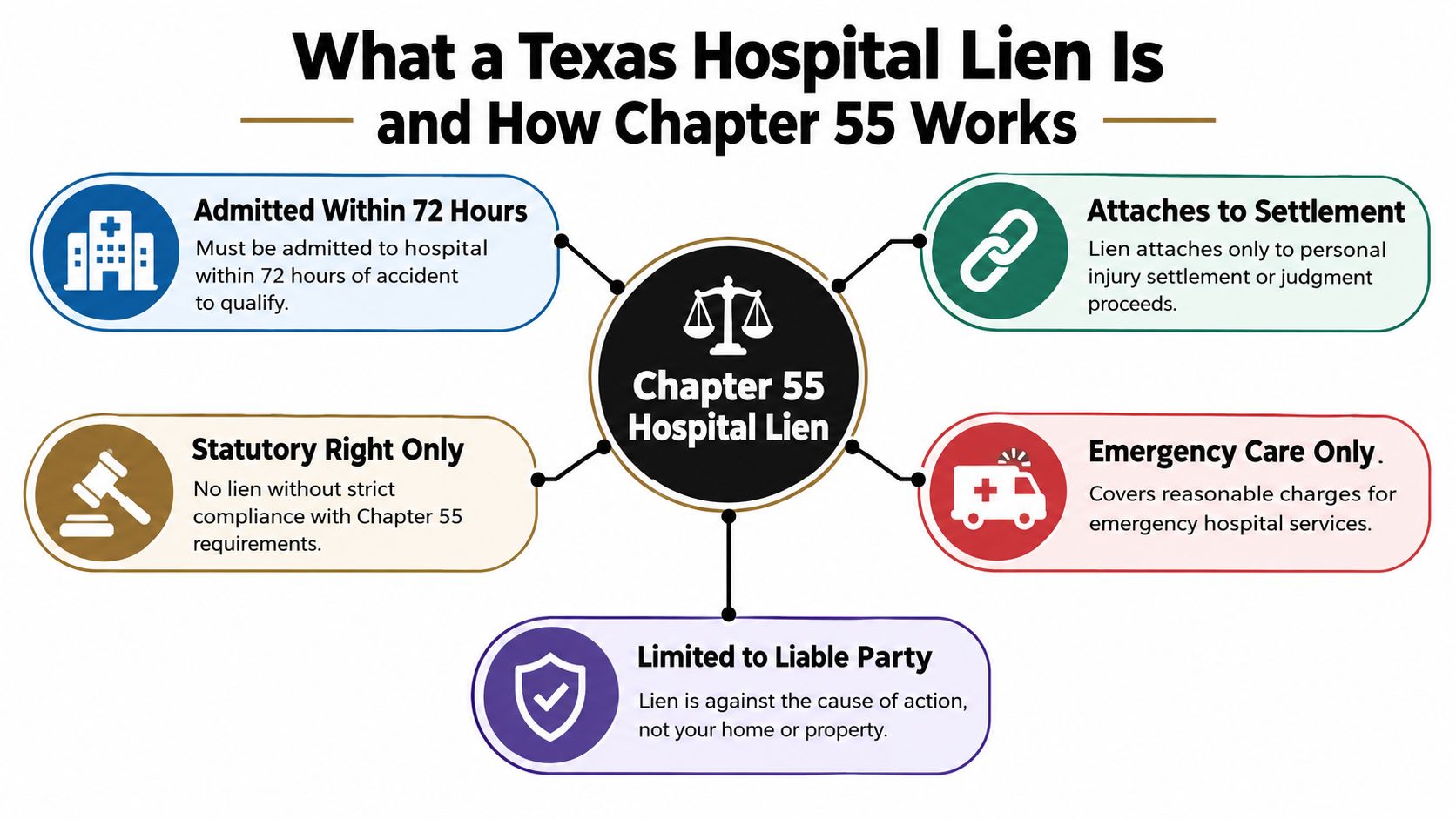
That distinction matters because many injured Texans hear the word "lien" and picture a claim on their house, car, or wages. Chapter 55 works more narrowly. It follows the injury claim like a tag attached to one source of money. If the case produces a recovery, the hospital may claim part of that recovery if the statute's requirements are met.
A helpful way to understand Chapter 55 is to place it on the settlement timeline.
First comes the accident. Then comes hospital admission. That admission timing matters right away. If there was no admission within the 72-hour window, the hospital may have a billing claim, but it may not have a valid Chapter 55 lien.
Next comes treatment and billing. Chapter 55 does not give the hospital an unlimited right to everything it charges. The statute limits the lien to the lesser of two amounts described in Texas Property Code Section 55.004. One amount is the hospital's charges for the first 100 days of hospitalization. The other is 50 percent of the amounts recovered.
That 100-day and 50 percent framework is where many settlement questions get clearer.
Your case can have different recovery buckets. For example, there may be a liability settlement from the at-fault driver's insurer, personal injury protection benefits, MedPay, or workers' compensation benefits. Chapter 55 does not reach all of those buckets the same way. The lien is aimed at qualifying recovery tied to the injury claim, and the statute excludes some proceeds while preserving lien rights against qualifying tort recoveries, as reflected in Chapter 55 of the Texas Property Code.
So the practical question is not just, "How much did the hospital bill?" The better question is, "Which recovery bucket is this lien trying to reach, and what is the statutory cap for that bucket?"
Here is why that matters in real life. If your settlement is modest, the 50 percent cap can become the controlling limit even when the hospital bill is much larger. If your recovery is larger, the first 100 days of hospital charges may become the controlling limit instead. Either way, Chapter 55 sets boundaries.
Releases matter too. A settlement release signed without dealing with a valid lien can create headaches because the lien may still attach to funds that should have been addressed before disbursement. On the other hand, a release does not magically make an invalid lien valid. The hospital still has to satisfy Chapter 55's rules before it can enforce that claim against settlement money.
Practical rule: To estimate what you may actually keep, line up the events in order. Admission within 72 hours, the first 100 days of hospital charges, the type of money being recovered, and whether the release accounts for a valid lien.
Fault still affects the math. A weaker liability case or a reduced settlement usually means a smaller recovery pool, which can change how much a hospital can claim under the 50 percent cap. If you want a plain-English explanation of how shared fault works, Texas Comparative Fault and the 51% Bar Rule explains how Chapter 33 can reduce or eliminate recovery.
For many clients, that is the biggest relief. A hospital lien Texas Property Code Chapter 55 settlement issue is not a blank check for the hospital. It is a rule-based claim tied to timing, capped by statute, and limited to certain proceeds from the case.
How to Verify If a Hospital Lien Is Valid and Properly Filed
Once you know a lien exists, the next step is not panic. It's verification.
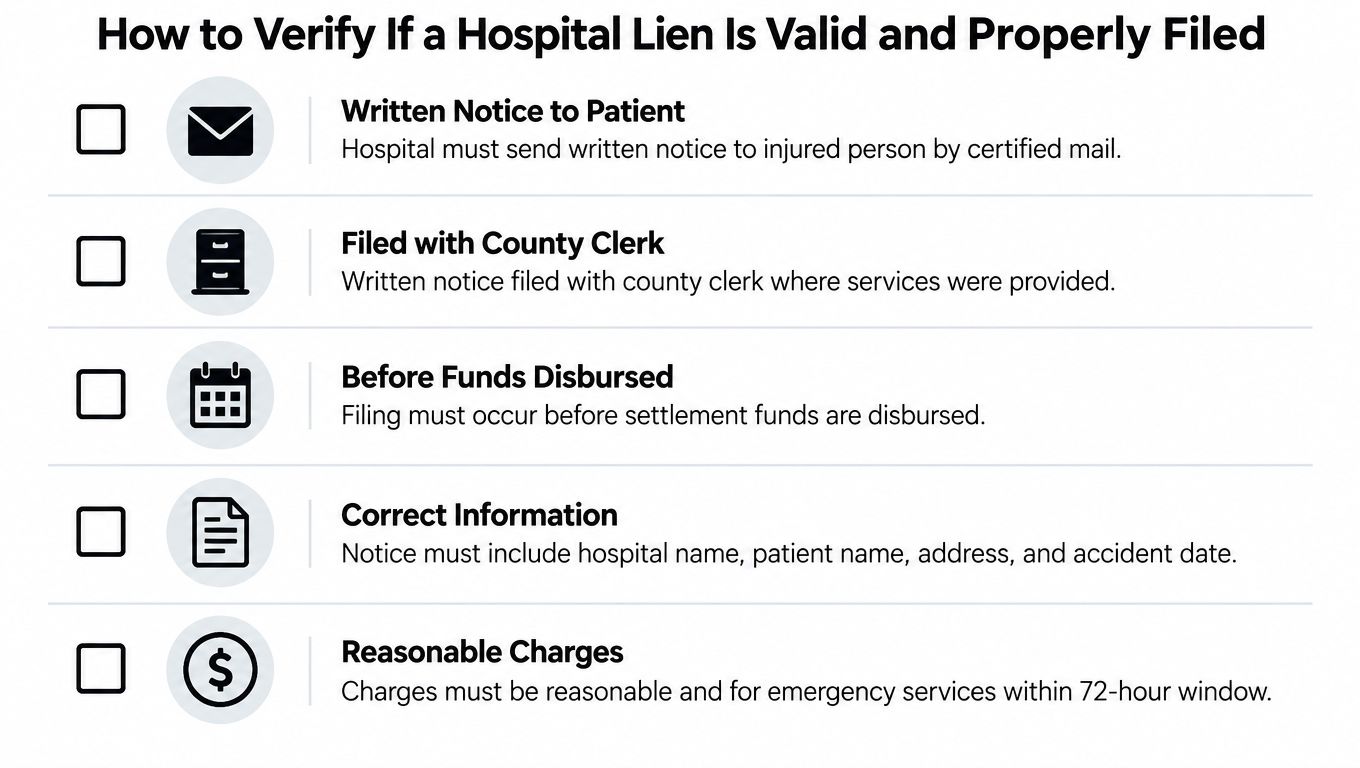
A Texas hospital lien isn't enforceable just because a hospital mailed a letter. Chapter 55 requires specific steps to perfect the lien. The hospital or emergency provider must give notice to the injured person and file written notice of the lien with the county clerk in the county where the services were provided before money is paid to the injured person because of the injury, as required by Texas Property Code Section 55.005.
Start with three documents
Ask for the lien notice itself, the itemized billing tied to the accident care, and proof of the county-clerk filing.
If you were treated in Houston, that usually means checking the county records where the services were provided. If treatment happened in another county, look there instead. Don't assume the correct filing location is where the crash happened. Chapter 55 focuses on where the services were provided for filing purposes.
Why emergency-room treatment can still count
Some people think no overnight stay means no lien. That's not always right.
Texas law later clarified that an injured person is considered admitted if allowed access to any hospital department for treatment, care, or service. That clarification appears in the Chapter 55 framework discussed in Texas Property Code Section 55.007 and related provisions. So, an emergency department visit may still trigger lien issues even when the patient's stay was brief.
A simple lien review checklist
Use this as a first-pass screening tool:
- Check the timing: Were you admitted within the statutory window after the accident?
- Check the filing county: Was the written lien notice filed with the county clerk where the hospital services were provided?
- Check the sequence: Was the lien filed before any settlement money was paid out?
- Check for patient notice: Did the provider send the required notice to you?
- Check the records: Do the bill and lien clearly match accident-related treatment?
A lien can still be disputed even if some paperwork exists. The point is to identify whether the hospital followed the statute closely enough to assert Chapter 55 rights against your settlement.
Red flags people often miss
A lien review gets more useful when you look for inconsistencies.
One common issue is a notice that arrives long after negotiations are underway, with little explanation of when it was filed. Another is a filing that doesn't line up with the county where treatment happened. A third is billing that appears broader than the accident-related hospital care at issue.
If the hospital wants settlement money, it has to follow the statute carefully. Close enough isn't always enough.
If the bill itself looks inflated or poorly supported, a separate billing challenge may matter too. For example, disputes about medical-charge proof often overlap with issues discussed in Chapter 18.001 counteraffidavit practice in Texas medical billing cases.
How to Handle a Hospital Lien During Your Settlement Process
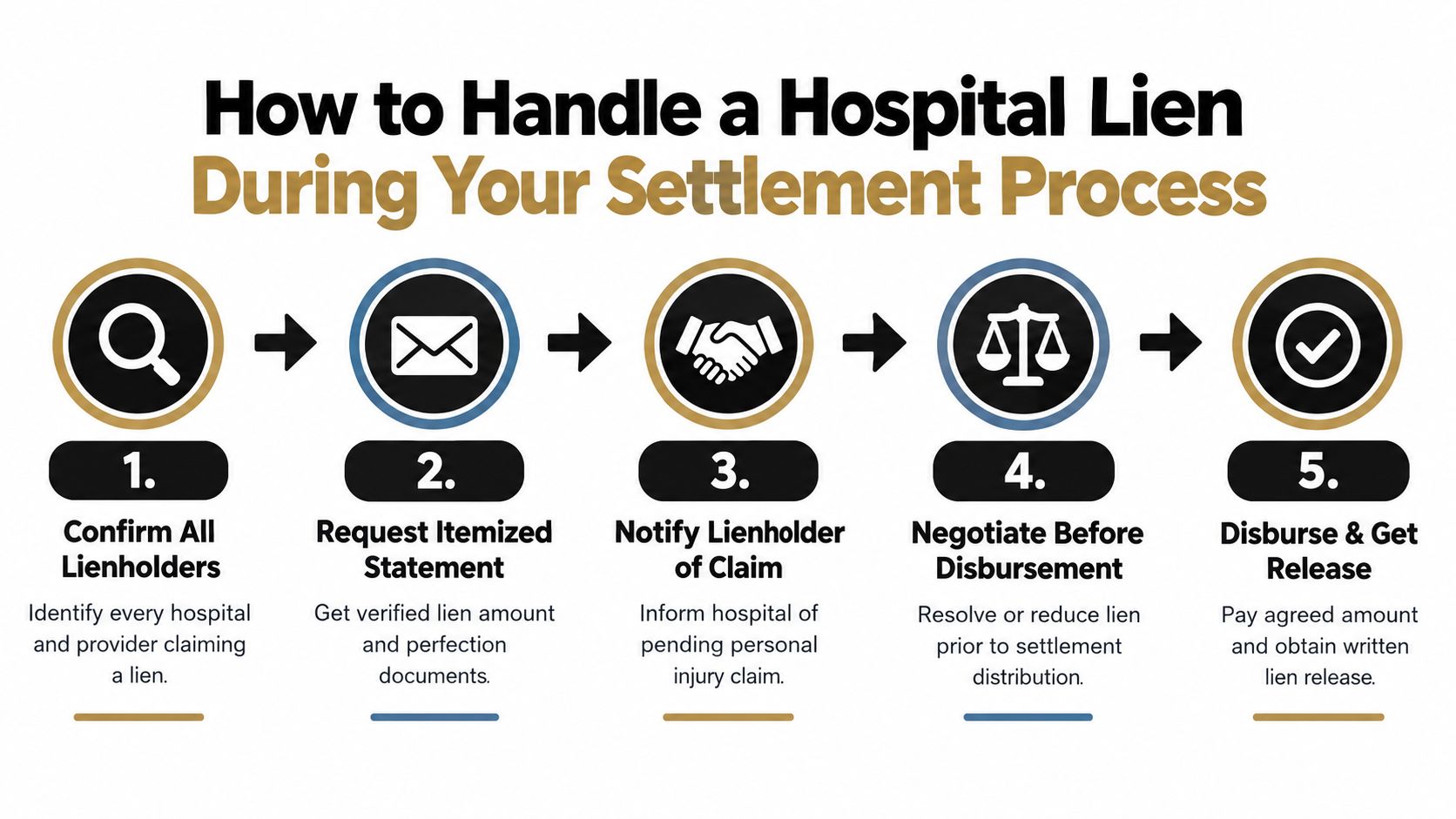
You settle a case, expect a check, and then learn the hospital says part of that money is already spoken for. That moment catches many injured people off guard. The best way to handle it is to tie the lien rules to the same timeline your settlement already follows, from treatment, to negotiation, to release, to disbursement.
A Chapter 55 lien affects different parts of the case at different times. Early on, the key question is whether the hospital treatment falls within the admission timing rules. As negotiations progress, the focus shifts to how much of each recovery bucket the lien can reach. At closing, the big issue becomes release validity and whether the lien has been paid, resolved, or formally addressed.
Match the lien review to the settlement timeline
A hospital lien works a lot like a claim check attached to specific settlement money. It does not automatically swallow every dollar that may come into the case. You need to sort the money into buckets and test each one.
At the start of the claim, gather the lien documents and itemized bills. During valuation, compare the claimed charges to the care that qualifies under Chapter 55 and to the amount the case is likely to resolve for. Before signing final papers, confirm how the release handles the lien. Before any money is distributed, get written proof showing what was paid or that the lien was released.
That sequence helps you answer the question clients usually ask first: What do I keep?
A practical workflow
Map out the treatment timeline.
Note the accident date, admission date, discharge date, and when the hospital filed notice. Timing shapes whether the lien applies at all and how strong the claim is.Separate the recovery buckets.
Liability settlement funds, MedPay or PIP, underinsured motorist benefits, and wrongful death recoveries may not be treated the same way. Keep them distinct from the beginning.Estimate the cap before settlement papers are signed.
Chapter 55 can limit what a hospital may collect from your recovery. In many cases, people focus on the total bill and miss the more important question, which is how the cap changes the amount that can be taken from a particular settlement bucket.Address the lien before the release is finalized.
If the insurer wants a release first and lien details later, that can create a closing problem. It is usually better to pin down the lien amount or resolution path before signatures are exchanged.Disburse only after the lien is resolved in writing.
A final settlement statement should match the lien payoff or release documents. Verbal assurances are not enough.
Here is a simple working checklist:
| Settlement Stage | What to Confirm |
|---|---|
| Early case review | Dates of admission, treatment, and lien filing |
| Case valuation | Which medical charges are tied to qualifying hospital care |
| Settlement negotiation | Which recovery funds are subject to the lien and how the cap affects each bucket |
| Release review | Whether outstanding hospital lien rights are paid, limited, or included in the release terms |
| Final disbursement | Whether you have a written release of lien or proof of payment |
Why timing changes what you keep
Chapter 55 becomes practical instead of abstract.
If a hospital claim is valid, it still may not attach to every source of money in the case. If the settlement is modest, the hospital may be limited by the statutory cap. If separate categories of damages or benefits are involved, one bucket may be exposed while another is not. That is why two people with similar hospital bills can keep very different amounts from their recoveries.
The same timing issue shows up in case valuation. If your claimed medical expenses are being reviewed under Texas damages rules, the numbers used in negotiations may differ from the face amount of the bills. For background on that issue, see paid or incurred medical damages under Texas law.
Why release language matters so much
Under Chapter 55, a release is not valid against the hospital lien unless the hospital's charges are paid in full before the release, paid to the extent of the consideration paid to the injured person, or the hospital is a party to the release, as stated in Texas Property Code Section 55.006.
In plain English, a signed settlement does not always end the lien problem.
If the carrier sends release papers before lien issues are pinned down, the case can look finished while money is still stuck. That often leads to preventable delays, especially when the adjuster, hospital, and injured person each assume someone else is handling the lien.
To see the process in a more visual format, this short video gives general context on handling injury claims and settlement issues:
What to say to the insurer and the hospital
Keep every request short, polite, and in writing.
Ask the hospital for the filed lien notice, itemized statements, and the exact amount it claims from settlement proceeds. Ask the insurer whether it has notice of the lien and whether the proposed release accounts for it. If multiple recovery sources are involved, ask each side to identify which funds they believe are subject to Chapter 55.
That paper trail matters. It helps expose disagreements early, before the settlement check arrives and everyone is arguing over who gets paid first.
Practical help while your case is pending
Many injured Texans also spend this period trying to choose the right lawyer. If you are comparing firms online, articles about local search for law firms can help explain why certain offices appear more often in search results.
One option some injured Texans consider is the Law Office of Bryan Fagan, PLLC, which handles Texas personal injury matters involving vehicle crashes, serious injuries, and wrongful death claims.
Proven Strategies to Reduce Your Hospital Lien and Keep More of Your Settlement
You settle your case and expect one final number. Then the lien changes what you take home.
That is why lien reduction works best when you map Chapter 55 onto the settlement timeline, not just the hospital bill. The date you were admitted can affect whether the lien attached in the first place. The statutory cap can limit how much the hospital can collect from certain recovery funds. The wording of the release can affect whether money gets distributed cleanly or tied up in a dispute.
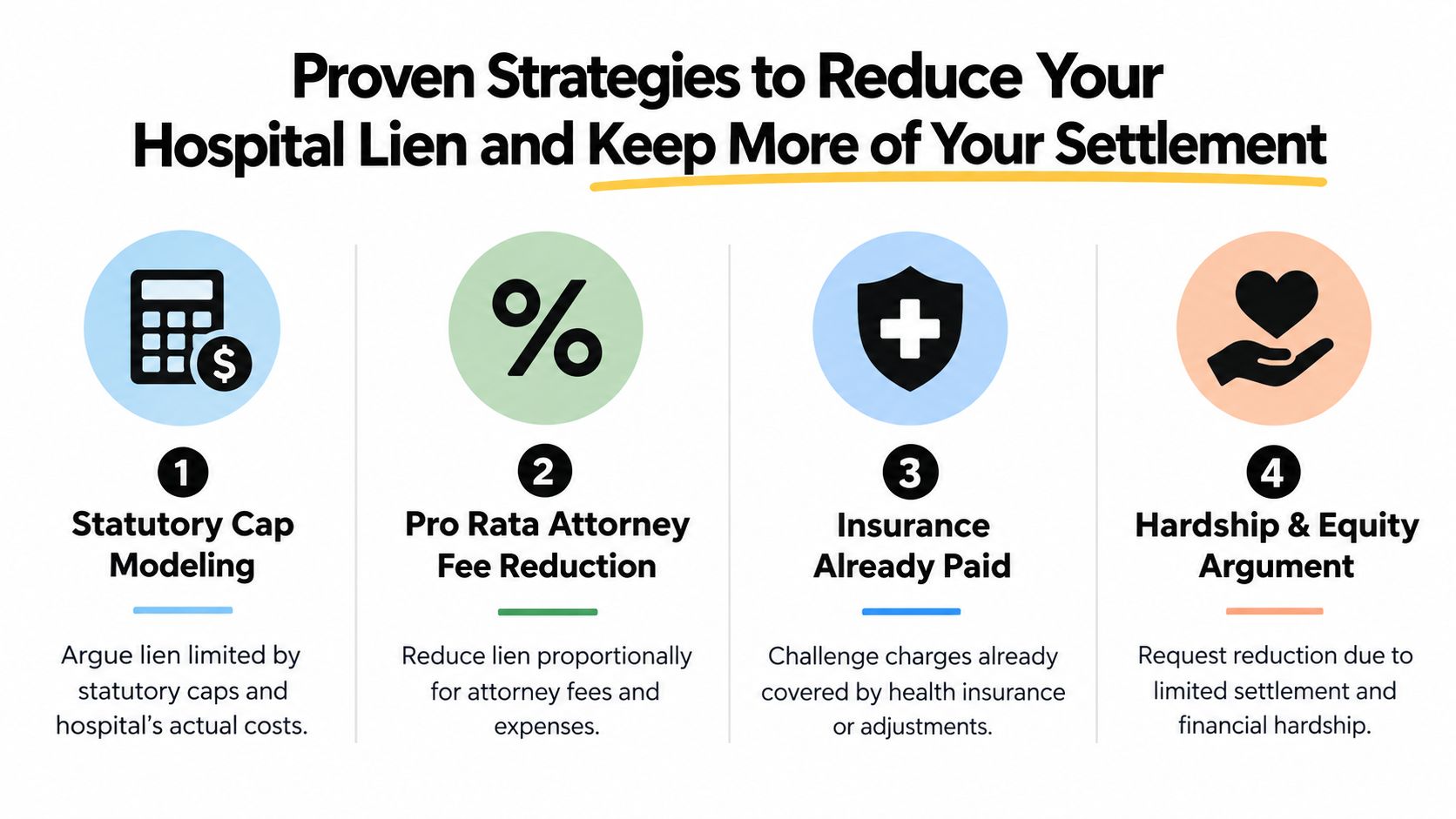
Strategy comparison
Some strategies challenge the amount as a matter of law. Others focus on separating funds correctly or persuading the hospital to accept less.
| Strategy | When it helps most | What you're looking for |
|---|---|---|
| Statutory cap review | When the bill looks larger than the settlement can support | Whether Chapter 55 limits the lien to the allowed share of that recovery bucket |
| Fee and expense allocation | When hospital charges were separately awarded by the factfinder | Whether the lien should be reduced by the injured person's pro rata attorney's fees and expenses |
| Recovery-bucket separation | When more than one source of money is involved | Whether some funds fall outside Chapter 55 or should be analyzed separately |
| Hardship compromise | When funds are tight and future care needs are serious | Whether the hospital will accept a lower amount to resolve the lien now |
The strongest statutory argument
The clearest pressure point is often the statute itself, applied to the right stage of the case.
For example, if hospital charges were separately awarded by the factfinder, the lien may have to be reduced by the injured person's share of attorney's fees and expenses, as noted earlier. That can change the math in a meaningful way. A lawyer should calculate the lien against the proper net recovery, not just glance at the gross settlement figure and assume the hospital's number is correct.
The cap matters too. Many clients hear “50 percent” and assume that means half of every dollar from every source. Chapter 55 is usually more specific than that. The better question is: half of which recovery, after applying which rules, at what point in the settlement process?
Separate each recovery bucket before you agree to pay
A good settlement breakdown works like labeled envelopes. One envelope may hold liability proceeds. Another may involve UM or UIM benefits. Others may involve PIP, MedPay, or claims tied to a death case.
That separation matters because Chapter 55 does not automatically reach every dollar the same way. If you mix all funds together too early, you can make the lien look larger than it is. If you sort each bucket first, you can ask much better questions: Which funds are subject to the lien? Which cap applies? Does the release describe the payment in a way that creates confusion later?
This is often where real savings appear.
Use timing to your advantage
Lien disputes are not only about amount. They are also about sequence.
Start with the admission date and the filing date. Then compare those dates to the date of the accident, the date treatment began, and the date any release is presented for signature. A timeline like that helps you spot whether the lien attached properly, whether the claimed amount fits within Chapter 55's limits, and whether the release tries to force resolution before those questions are answered.
A rushed release can shrink your room to object. A careful timeline can preserve it.
Hardship arguments still matter
Sometimes the legal position is solid, but the economics still call for compromise. A limited policy, severe injuries, future treatment needs, and lost income may justify asking the hospital to reduce the claim so the case can close.
That request is usually stronger when it follows legal analysis. Show the hospital the proper bucket of funds, the likely cap, any fee reductions that apply, and the practical limits of the settlement. Then ask for a sensible resolution.
For readers working through the practical side of post-settlement balances, this guide on negotiating medical bills after settlement may help.
Common mistakes that cost injured people money
One common mistake is treating the lien as one fixed debt attached to the whole case. It often is not. Another is skipping the timeline analysis and going straight to bargaining. A third is signing release language before everyone agrees which funds are being used to satisfy the lien.
The goal is simple. Match the lien rules to the settlement timeline, separate each recovery bucket, and calculate what Chapter 55 allows the hospital to claim. That is how many injured Texans keep more of what their settlement was meant to provide.
Get Clear Answers and Help With Your Texas Hospital Lien Today
You settle your case and expect relief. Then part of the money is suddenly in question because a hospital claims a lien. That moment feels overwhelming for many injured Texans, especially when no one has clearly explained which settlement funds the lien can touch, whether the filing was valid, or how a release might affect what you take home.
The good news is that Chapter 55 has rules. Those rules can be applied to your case step by step. A lawyer can line up the treatment dates, filing dates, settlement terms, and recovery sources on one timeline, then test the lien against each part of that timeline. That kind of review often answers the question that matters most: what portion of this settlement, if any, does the hospital have a right to claim?
That is especially helpful when your case has more than one recovery bucket. For example, the lien analysis may look different for liability insurance proceeds than for other funds. Admission timing matters. The 100 day hospital period matters. The 50 percent cap matters. Release language matters too. Small details can change what stays in your pocket.
When legal help makes sense
Consider calling a lawyer if any of these apply:
- You received a lien notice soon after treatment: Early review can catch filing or notice problems before settlement papers are signed.
- Your recovery may come from more than one source: Different buckets may need separate Chapter 55 analysis.
- An insurer wants a quick release: The wording can affect whether lien objections stay open or become harder to raise.
- The case involves a death claim or very serious injuries: These cases often raise harder questions about damages, disbursement, and future needs.
- You still are not sure what you will keep: A timeline review can turn a vague estimate into a clearer settlement picture.
Good legal help is not just about arguing over a bill. It is about protecting the structure of your settlement from the start. A Texas personal injury lawyer can review the lien, check whether it was properly perfected, communicate with the hospital and insurer, and help prevent release terms from creating new problems.
If you are dealing with a hospital lien after a Texas accident, the attorneys at Law Office of Bryan Fagan, PLLC can review the lien, explain how Chapter 55 applies to your settlement timeline, and help address release and disbursement issues before funds are paid out. A consultation can give you clear next steps, whether your case involves a car wreck, truck crash, wrongful death claim, or catastrophic injury.
You do not have to figure this out alone. Clear answers are available, and the right review can help you protect more of the recovery meant to help you rebuild.