Texas law requires written notice to the governmental unit within 6 months, or 180 days, of the incident under CPRC 101.101, and some cities require even less time, so waiting risks losing the claim before the 2-year lawsuit deadline. A serious accident can change your life in seconds, but you don't have to face the legal process alone.
After a Houston freeway crash, you may be focused on surgery, medical bills, missed work, or helping a family member recover. Then you learn that the other vehicle belonged to a city department, county, school district, or state agency. The claim may look like an ordinary car accident, but government-entity cases follow a different set of rules.
The Texas Tort Claims Act six month notice deadline is an early procedural requirement. It isn't the same as filing a lawsuit. You may have a longer period to file many personal injury claims, yet still lose the right to pursue the government if you fail to provide proper notice on time. Texas Civil Practice and Remedies Code § 101.101 establishes the six-month written-notice rule, while allowing local governments to impose shorter deadlines in charters or ordinances. Texas Civil Practice and Remedies Code § 101.101 explains the statutory framework.
This guide walks through the deadline, who must receive notice, what the notice should say, why actual notice may not protect you, and what you can do today. Recovery is still possible, and prompt legal guidance can help protect both your claim and your family's future.
When a Government Vehicle Changes Everything After Your Accident
A Houston driver leaves work on a busy freeway and slows in traffic. A city utility truck moves into the lane, strikes the driver's vehicle, and sends the car into a concrete barrier. The injured driver is taken for medical care, while a spouse begins calling the insurance company and arranging transportation for the children.
At first, this may seem like a standard collision claim. The driver may have been careless, the city vehicle may have been operated improperly, or a dangerous road condition may have contributed to the crash. But once a governmental unit becomes part of the facts, sovereign immunity and the Texas Tort Claims Act can affect whether a lawsuit may proceed.
A similar problem can arise after a collision with a city bus, a county vehicle, a school-district vehicle, or state-owned equipment. A road defect or dangerous condition on government property can also raise separate questions. The government isn't automatically responsible just because its vehicle or property was involved. You still must prove negligence or another legally recognized basis for liability, and the Texas Tort Claims Act limits when and how the government may be sued.
The earlier deadline is not the lawsuit deadline
Texas generally gives many injured people 2 years to file a personal injury lawsuit. That limitation period addresses when the court action must be filed. The government notice rule operates separately and begins much earlier.
For example, a person could still be within the ordinary two-year filing period but have already missed the required notice window. In that situation, the claim may be challenged before the court ever considers the full evidence of fault, injuries, or damages. Notice is the first gate. Filing a lawsuit later is another requirement.
The Texas Supreme Court recognized the importance of written notice and actual notice in Cathey v. Booth (1995). Later, Colquitt v. Brazoria County (2010) confirmed that the Act doesn't require pre-suit notice in every case, but the government must still receive required notice within the six-month period unless actual notice exists.
Practical rule: If a government vehicle, roadway, building, or employee may be involved, treat the claim as urgent from the first day.
The Law Office of Bryan Fagan, PLLC helps injured Texans understand these procedural issues while they focus on medical treatment and family responsibilities. If your accident involved public transportation, you can also review the firm's information about a Texas bus accident injury lawyer. You deserve a clear explanation of what happened, what deadlines apply, and what evidence may support your recovery.
Who Must Give Notice and How to Calculate Your Six Month Deadline
The notice requirement can apply when the potential defendant is a governmental unit, such as the State of Texas, a state agency, a city, a county, or a qualifying political subdivision. The facts may involve an employee acting within the scope of employment, a government vehicle, or a condition or use of government property.
The safest approach is to identify every possible government connection immediately. A public vehicle may be owned by one entity but operated for another. A school vehicle may involve a school district, while a road hazard may involve a city, county, or state agency. Sending notice to the wrong entity can create a serious problem even if the description of the accident is accurate.
Count from the incident, not from the day you hire a lawyer
The state rule gives a claimant 6 months, or 180 days, after the incident to provide notice to the governmental unit. The relevant event may be the injury-producing incident or, in a fatal case, the event connected to the death. Don't assume the clock starts when you receive a diagnosis, finish treatment, speak with an adjuster, or learn the government owned the vehicle.
Use this practical process:
- Write down the incident date. Use the date of the crash, fall, roadway event, or other injury-producing occurrence.
- Mark the 180-day point. Treat six calendar months as the state deadline and calculate the practical 180-day milestone.
- Check the local rule. A city charter or ordinance may require notice in 90 days or less, making the state period only an outside boundary.
- Leave delivery time. Notice must be properly delivered, not merely drafted or placed in your files.
- Act well before the deadline. Waiting until day 179 leaves little room to correct an address, delivery problem, or missing fact.
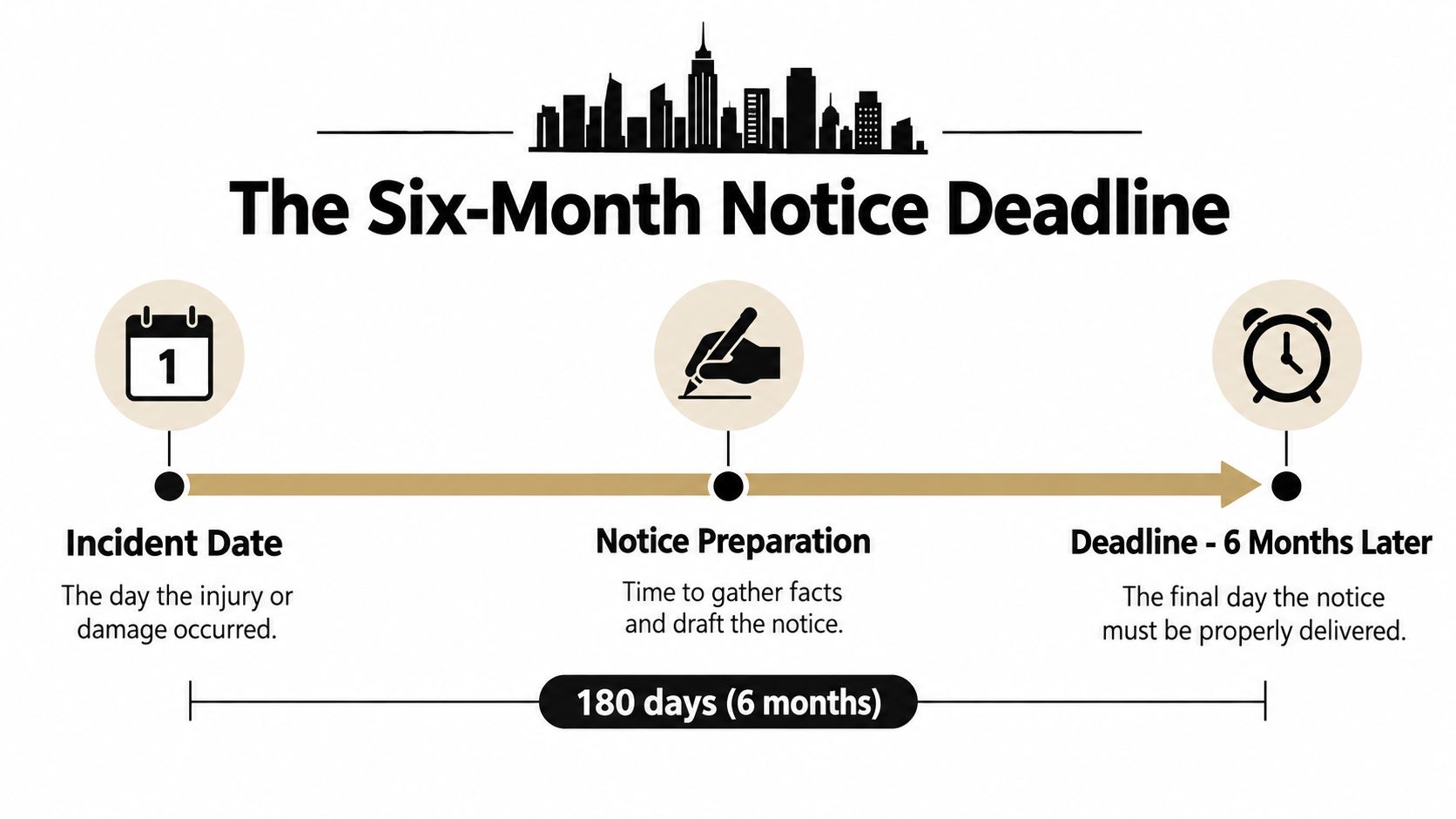
A Houston freeway crash with a city utility truck illustrates the danger. If the collision occurred on a date you can identify, the notice clock doesn't wait for the police investigation to finish. If the responsible municipality has a shorter local requirement, relying only on the state six-month period may be too late.
The six-month rule also matters for children. Texas courts and public-law guidance have treated the period as not tolled for minors, meaning a child must satisfy the same notice requirement as an adult under the Act. The reason for the rule is practical. Government entities need prompt information to investigate while witnesses remember events, vehicles remain available for inspection, and road or property conditions haven't changed. The government translation services offered by Translators USA, LLC may be useful when a family needs help communicating in another language, but translation support doesn't replace legal review or formal delivery.
For a broader explanation of filing periods, see how long you have to file an injury claim in Texas. You can also review Suing a Government Entity: The Texas Tort Claims Act for information about the shorter notice deadlines that apply to injury claims against the government.
What to Include in Your Notice and How to Deliver It Correctly
A valid notice should give the governmental unit enough information to understand the claim and begin investigating. Under Texas Civil Practice and Remedies Code § 101.101, the notice must reasonably describe the damage or injury claimed, the time and place of the incident, and the incident itself.
A vague statement such as “I was hurt in an accident involving your truck” may not provide enough detail. Your notice should identify the event clearly without guessing about facts you don't yet know. You can explain what happened, identify the location, describe the harm, and state that you believe the governmental unit or its employee may be responsible.
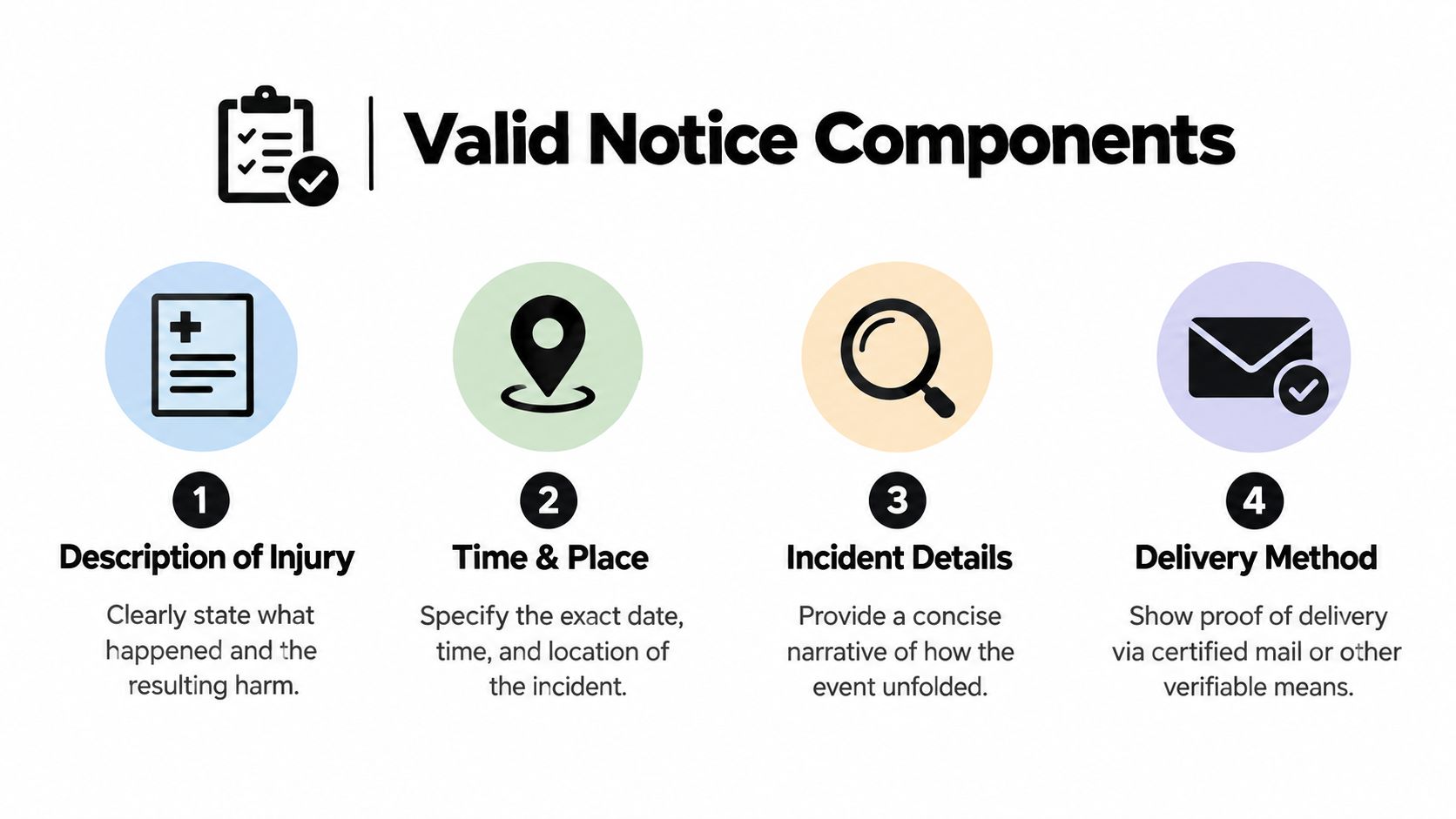
Build the notice around four facts
Include these core details:
- Description of injury or damage: Identify physical injuries, property damage, or a death connected to the event. You can explain that medical evaluation is ongoing if the full diagnosis isn't known.
- Time and place: State the date, approximate time if known, roadway, intersection, address, direction of travel, lane, or other location details.
- Incident description: Give a concise account of what occurred, including the government vehicle, employee, property, road condition, or equipment involved.
- Government connection: Name the city, county, school district, agency, or other unit you believe may be involved.
A notice isn't a substitute for a complete lawsuit or a final damages calculation. Its purpose is to provide timely, reasonably specific information. Local rules may require additional details, so a lawyer should review the applicable charter or ordinance whenever possible.
Use language that is clear and factual
You might adapt language like this:
On [date], at approximately [time], I was injured at [specific location] when [describe the event]. A vehicle, employee, roadway, or property associated with [governmental unit] was involved. I suffered [known injuries or damage] and continue to receive medical evaluation and treatment. This letter provides notice of my claim under the Texas Tort Claims Act. Please preserve all records, photographs, video, vehicle data, maintenance materials, and other evidence related to this incident.
Don't include unsupported conclusions, angry accusations, or details you aren't sure about. At the same time, don't minimize your injuries just because treatment is continuing. Keep the notice consistent with medical records, photographs, witness information, and the facts you can verify.
Deliver it to the correct recipient
Send the notice to the governmental unit and the official or office identified by the law, charter, ordinance, or claims procedure. A police officer, vehicle driver, or supervisor at the scene may not be the correct recipient. Check the entity's official instructions and preserve proof of delivery.
Certified mail with a return receipt can create a useful record, but the precise delivery method and recipient should be confirmed for the specific entity. Keep the signed letter, attachments, postal receipt, return receipt, tracking information, and a complete copy of everything sent. The general principles behind elements that make a contract binding can help explain why clear terms, identifiable parties, and proof of transmission matter in formal documents, although a tort notice has its own legal requirements.
Sending notice doesn't file your lawsuit, establish negligence, or guarantee compensation. You must still prove duty, breach, causation, and damages. If the government argues that you shared responsibility, Texas comparative responsibility rules may reduce recovery according to the portion of fault assigned to you, which makes accurate evidence especially important.
Exceptions Tolling Rules and Why Actual Notice Rarely Saves You
Many families hear that the government already knew about the accident because officers responded, an ambulance arrived, or an employee prepared a report. That knowledge may help investigate the facts, but it doesn't automatically replace formal written notice.
The six-month notice period is not tolled for minors under the Texas Tort Claims Act. A child who suffered an injury in a crash involving a public vehicle doesn't receive extra time solely because the child is underage. Parents and guardians should act promptly, even when doctors are still evaluating the injury.
The rule reflects the government's need to investigate promptly. Road conditions can change, vehicles can be repaired, surveillance footage can be overwritten, and witnesses can become difficult to locate. Those concerns explain why courts enforce the notice requirement strictly.

What actual notice requires
Actual notice can substitute for written notice in some cases, but Texas Supreme Court authority sets a demanding standard. The governmental unit must have knowledge of:
- A death, injury, or property damage.
- The governmental unit's alleged fault that produced or contributed to the harm.
- The identity of the parties involved.
The fault requirement causes many people to misunderstand this exception. A government employee may know that a crash occurred and may even investigate it, yet the governmental unit may not have subjective awareness that it may have caused or contributed to the injury. Knowledge of an event isn't necessarily knowledge of legal responsibility.
Cathey v. Booth (1995) recognized the actual-notice issue, and later Texas authority has continued to treat the fault element as important. Colquitt v. Brazoria County (2010) also clarified that pre-suit notice isn't required in every case when actual notice exists, but claimants shouldn't assume a routine incident report proves all required elements. The legal analysis is fact-specific and can depend on what the government knew, not merely what it could have discovered.
A police report can document a crash without proving that the governmental unit knew its own conduct may have caused the injury.
This is different from the analysis of a Texas statute of repose versus statute of limitations in an injury case. The key point here is simple. Don't plan your claim around an exception that may require difficult proof when you can provide formal notice on time.
What Happens If You Miss the Deadline and How to Protect Your Claim Now
Missing the notice deadline can bar a government claim even when the ordinary Texas personal injury filing period has not expired. The six-month notice requirement works independently from the longer 2-year limitations period that applies to many personal injury lawsuits, as explained in the statutory discussion above.
That distinction matters after a serious injury because treatment and grief can consume every day. A family may reasonably believe there is plenty of time to investigate, negotiate with insurance, and decide whether to sue. Government-entity claims require a faster legal check.
Take these steps immediately
- Identify every public connection: Determine whether a city bus, county truck, school vehicle, state agency, public roadway, or government-owned property was involved.
- Preserve visual evidence: Save scene photographs, vehicle images, property-condition photographs, dashcam footage, phone videos, and messages with witnesses.
- Protect medical records: Keep emergency records, imaging results, bills, prescriptions, work restrictions, and notes about how the injury affects daily life.
- Record witness information: Save names, phone numbers, social media messages, and any statements made soon after the incident.
- Control insurance communications: Don't give a recorded statement or sign a broad release before you understand the claim and the effect of the document.
- Send notice early: Confirm the correct governmental unit, deadline, recipient, contents, and delivery proof.
Texas negligence law generally requires proof that another party owed you a duty, breached that duty, and caused your injury. The government may raise immunity, statutory limits, causation issues, or comparative responsibility. If the evidence shows that your conduct contributed to the accident, a court may assign a percentage of responsibility and reduce damages accordingly. That doesn't mean you should assume you have no claim. It means the facts must be investigated carefully.
A claim may involve more than one responsible party. A private driver and a government vehicle could both have contributed to a Houston crash. A road defect may exist alongside negligent driving. An experienced lawyer can examine each potential source of fault instead of focusing only on the public entity.
Deadlines that should stay on your calendar
| Deadline Type | Time Limit | What It Controls |
|---|---|---|
| Texas Tort Claims Act notice | 6 months, or 180 days, under the state rule, unless a shorter local period applies | Written notice to the governmental unit |
| Local government notice | May be 90 days or less in some municipalities | Charter or ordinance notice requirements |
| Many Texas personal injury lawsuits | 2 years | Filing the lawsuit under the ordinary limitations period |
| Actual-notice analysis | Fact-specific | Whether formal written notice may be excused |
The table isn't a substitute for checking the specific entity's rules. A Texas personal injury lawyer should review the incident date and potential defendants as soon as possible. The Law Office of Bryan Fagan, PLLC offers free consultations and contingency-fee representation, so an injured person can ask about the claim without paying an upfront attorney fee. The firm can investigate the accident, preserve evidence, identify the correct governmental unit, and address related car, truck, catastrophic injury, or wrongful death issues.
You Do Not Have to Face This Alone Next Steps Toward Recovery
If a government vehicle or property may have caused your injury, start with three questions. Who was involved? When did the incident happen? Where must notice be sent? Answering those questions quickly can protect an opportunity that may otherwise disappear before the ordinary lawsuit deadline.
You generally need to provide written notice within 6 months, or 180 days, under the state rule, while some cities require notice in 90 days or less. The actual-notice exception may help in limited circumstances, but it requires more than proof that officials knew an accident occurred. It can require evidence that the government subjectively knew about the injury, its possible fault, and the parties involved.
You may have a negligence claim if the evidence shows that a government employee, vehicle, roadway, or property condition caused your harm. Depending on the facts, you may pursue compensation for medical expenses, lost wages, pain and suffering, and future care needs. In a fatal accident, a family may need guidance from a wrongful death lawyer in Texas, while a serious roadway collision may require a Houston car accident attorney or a truck crash lawyer in Houston.
Don't wait for an insurance adjuster, medical provider, or government office to tell you which deadline controls. Save your records, avoid signing away rights before receiving advice, and ask for help while evidence remains available. With the right support, you can focus on healing while your legal team works to protect your family's recovery.
The Law Office of Bryan Fagan, PLLC offers free consultations and contingency-fee representation for Texans injured in crashes and other serious incidents, including claims involving government entities. Contact the firm promptly to review your notice deadline, preserve evidence, and understand your options, because recovery is possible and legal help is available.