Skip to content
A serious accident can change your life in seconds, but you don't have to face it alone.
If you woke up after surgery feeling worse instead of better, or a loved one is now dealing with a complication nobody clearly explained, you're probably trying to sort out two questions at once, what happened, and what can you do about it. In Texas, that confusion is common after a surgical mistake, because the medical chart may not tell the full story, and the hospital won't volunteer the details that matter most. A Texas surgical error malpractice lawyer looks at the records, the timing, and the medical proof to decide whether you have a real claim, not just a bad outcome.
The first thing you need to know is this, not every surgical complication is malpractice. But when a surgeon, anesthesiologist, nurse, or hospital team falls below the accepted standard of care and that mistake causes harm, Texas law can hold them accountable. That accountability can include medical bills, lost income, rehabilitation, and future care, and in fatal cases, a family may have a wrongful death claim under Texas law.
When Surgery Goes Wrong and You Need Answers
A patient goes in for what should be routine surgery, then comes home with more pain, a new disability, or a corrective procedure nobody warned about. A spouse starts asking why the operative note doesn't match what the surgeon said afterward. A daughter notices her father's recovery isn't going the way the discharge instructions promised.
That's the moment individuals start searching for answers. They're not looking for drama. They want the truth, and they want to know whether someone can be held responsible.
Texas law gives injured patients a path forward, but it doesn't reward delay or guesswork. The claim has to be built on records, expert review, and a clear link between the mistake and the injury. That's why a Texas personal injury lawyer who handles surgical error cases focuses first on preservation, not pressure.
The fastest way to lose a valid claim is to wait until the record gets thin and the timeline gets fuzzy.
If you're comparing your situation with broader injury guidance, even The Two-Year Deadline for Texas Injury Claims makes the same core point, most Texas injury lawsuits are controlled by strict filing deadlines under CPRC 16.003. Surgical error claims are no different in that respect, except the medical proof can be harder to obtain and easier to lose.
One practical example helps. After a Houston freeway crash, people know to call police, take photos, and get medical care. After a surgery goes wrong, the same urgency applies, but the evidence is hidden in operating-room records, anesthesia charts, and follow-up notes. That's where legal help matters.
What Counts as a Surgical Error Under Texas Law
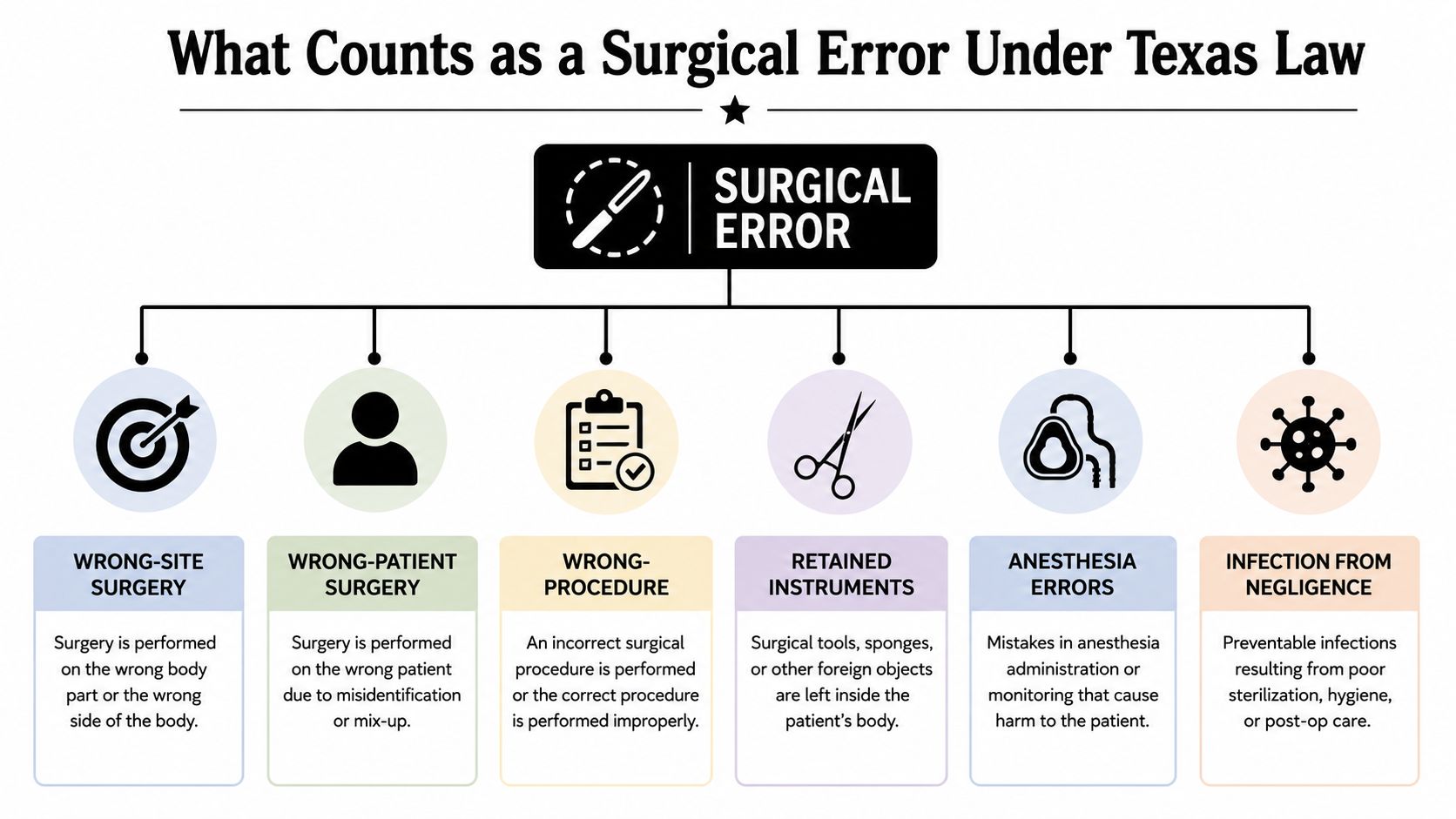
A surgical error is usually a preventable mistake that falls below accepted medical care. It's not just a poor result. It's a breakdown in judgment, technique, monitoring, identification, or safety procedure that should not have happened.
The most common kinds of mistakes
A wrong-site surgery is the obvious example. The surgeon operates on the wrong body part, or on the wrong side of the body. Wrong-procedure surgery is different, but just as serious, the team performs a procedure the patient never needed or consented to.
Retained instruments and sponges are another classic red flag. If a tool is left inside a patient, that's not a routine risk. It's the kind of mistake that can cause infection, pain, and more surgery. Anesthesia mistakes can be equally dangerous when the patient isn't monitored correctly or when medications are mishandled.
Nerve damage, organ perforation, and infection caused by negligent technique can also qualify, but only when the evidence shows the provider crossed the line from acceptable risk into preventable harm. The key distinction is this, a known risk is not automatically malpractice. A mistake becomes a legal claim when the provider ignored the standard of care and that failure caused injury.
Practical rule: if the injury came from a breakdown in basic surgical safety, not just an ordinary complication, the case deserves a close legal review.
That's why people looking at hospital negligence often discover that a surgical error claim is really a broader systems case. A missed count, a bad handoff, a charting failure, or a monitoring problem can all sit behind one injury.
The Four Elements You Must Prove to Win a Surgical Malpractice Case
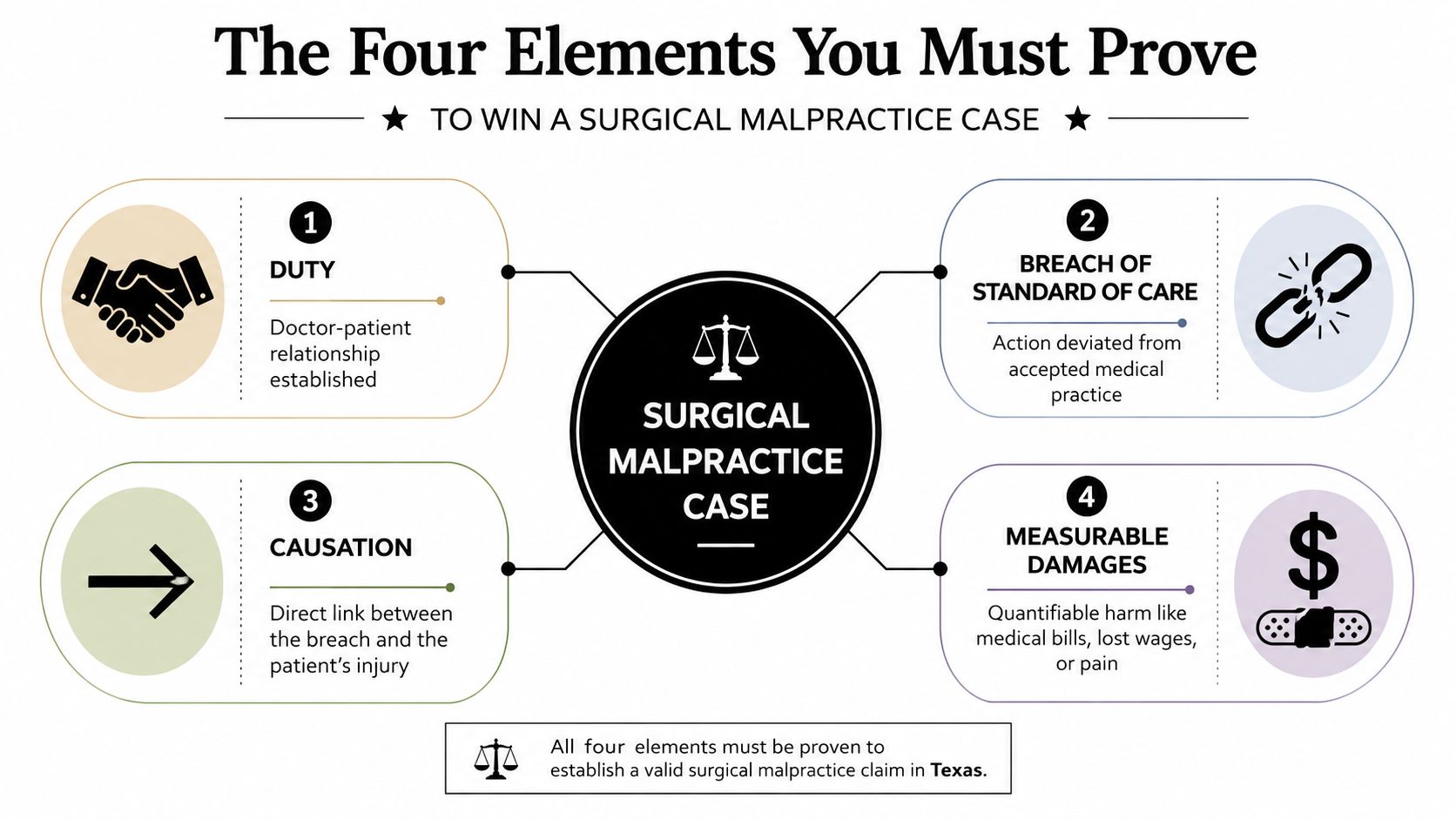
Texas surgical malpractice cases turn on four legal elements, duty, breach, causation, and damages. If one of them is missing, the case gets weaker fast. That's why an experienced Texas surgical error malpractice lawyer doesn't just ask whether something went wrong, but whether the proof supports every part of the claim.
Duty and breach
Duty usually exists because the doctor-patient relationship existed. Once the surgeon agrees to treat you, the law expects that provider to meet the applicable standard of care. Breach means the provider failed to do that, and the best proof often comes from a qualified medical expert in the same or a closely related specialty.
Causation and damages
Causation is where many cases rise or fall. You have to show that the mistake caused the injury, not just that the injury happened after surgery. Damages are the measurable losses, medical expenses, lost wages, rehabilitation, and the human cost of pain and reduced function.
Texas sources emphasize that expert medical proof is central in these cases. In plain terms, a judge or jury usually needs a doctor to explain why the surgery fell below the standard of care and how that failure caused the harm. That's why a bad outcome alone isn't enough.
The scale of surgical-error harm is one reason these cases matter. A Texas malpractice source notes the U.S. sees more than 4,000 surgical errors each year, with reported examples including roughly 20 wrong-body-part surgeries per week, 20 wrong-procedure surgeries per week, and about 39 weekend cases involving a surgical tool or sponge left inside a patient (Texas medical-malpractice overview). Those numbers don't prove a specific case, but they do show why surgical records deserve immediate scrutiny.
Critical Deadlines That Can End Your Texas Surgical Error Claim
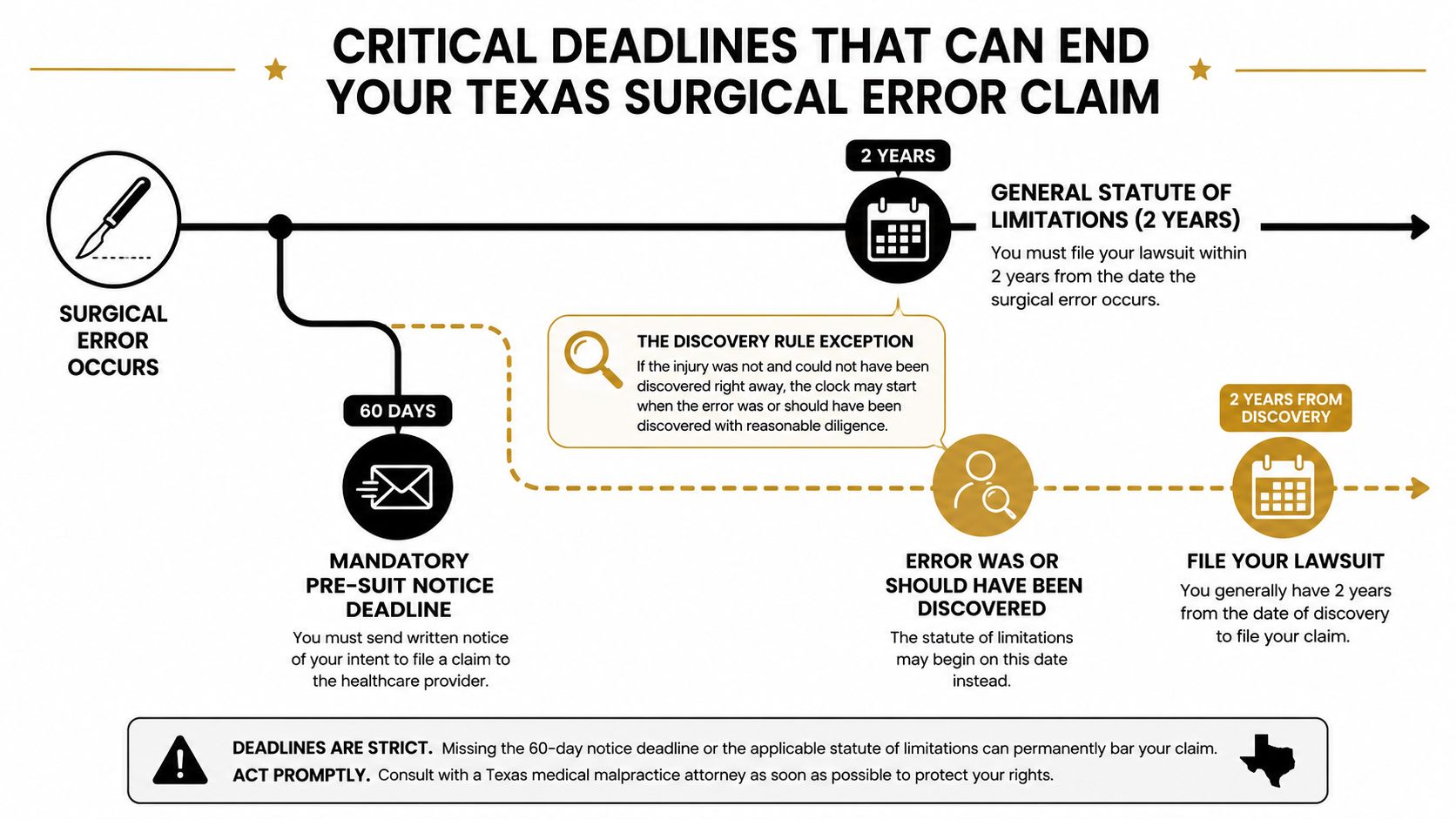
Texas deadlines are unforgiving. The general rule is that most surgical error claims must be filed within two years of the negligent act or when the injury should have been discovered, and Texas sources also describe a 10-year statute of repose that can bar very late-discovered claims. For a broader Texas overview of the filing window, Medical Malpractice Statute of Limitations in Texas is the kind of rule that can decide whether a case survives at all.
The 120-day expert report deadline
The deadline to be aware of is the expert report. In Texas medical malpractice cases, the plaintiff must serve an expert report within 120 days after each defendant answers. The report has to identify the standard of care, the breach, and how the breach caused the injury. If the report isn't timely served, dismissal can follow, and some Texas sources note that dismissal can be with prejudice, which means the case may be gone for good.
Discovery doesn't always save you
A lot of injured people assume the clock starts only when they fully understand the error. Texas law can be stricter than that. If the harm shows up later, or if the patient is still getting corrective treatment, the safest move is to preserve records and get legal review right away. The record, the timeline, and the first expert opinion often decide whether the case even reaches the merits.
If you want a real-world way to think about this, treat a surgical error like a wreck with hidden injuries. You wouldn't wait a year to photograph the damage or pull the crash report. You shouldn't wait to protect a medical claim either.
Pre-Suit Notice and Record Preservation Steps in Texas
Before a Texas medical-malpractice suit is filed, the claimant must give each potential defendant 60 days' written notice, and the notice has to go by certified mail with return receipt requested. Texas law also requires a HIPAA authorization with that notice so providers can release relevant records. That step matters because a claim can't be built on suspicion alone, it has to be built on records.
What to do immediately
Start with the records, not the arguments. Request the complete file, including operative notes, anesthesia charts, consent forms, discharge instructions, and follow-up records. Then keep a daily log of pain, mobility limits, missed work, sleep problems, and anything else that shows how the injury changed your life.
Keep every bill, every discharge paper, and every note about worsening symptoms. Small details often become the strongest proof later.
Avoid talking to the hospital's insurance company before you understand what you're signing or saying. Adjusters are trained to narrow claims. You don't need to help them do it.
A useful practical step is learning how record transfers work before the hospital drags its feet. A plain-English guide like patient records transfer how-to can help you understand what to request and how to track it, especially when you're trying to move quickly.
If your records seem incomplete, that's a warning sign, not a dead end. The chain of proof in surgical cases often depends on what gets preserved in the first few weeks. For a closer look at why documentation matters, the article on how medical records affect an injury claim in Texas fits this exact problem.
Types of Compensation Available After a Surgical Mistake
Texas law allows compensation for the harm a surgical mistake causes. The biggest mistake people make is thinking the only loss is the first hospital bill. In truth, a bad surgery can create a long tail of expenses and hardship.
| Types of Damages in Texas Surgical Error Claims | Examples | Subject to Texas Cap |
|---|---|---|
| Economic damages | Past and future medical bills, rehabilitation, prescription costs, lost wages, reduced earning ability | No |
| Non-economic damages | Pain and suffering, emotional distress, loss of enjoyment of life | Yes |
| Wrongful death-related damages | Funeral expenses, loss of companionship, loss of financial support | Depends on the claim and defendant setup |
Economic damages are the most straightforward, and they often become the most important over time. If you need more surgery, therapy, mobility aids, or ongoing care, those costs belong in the claim. If the injury affects your ability to work, that matters too.
Non-economic damages are more personal, but they're just as real. Pain, fear, sleep problems, and the loss of everyday life don't disappear because they're hard to measure. Texas medical-malpractice cases do face damage caps on non-economic losses, so the claim has to be built carefully and fully.
The U.S. malpractice scene also shows why these cases can be significant. One Texas source notes the Institute of Medicine estimated in 1999 that as many as 98,000 people die in U.S. hospitals each year from preventable medical errors, and the National Practitioner Data Bank reported 11,440 malpractice claims in 2023 (medical malpractice in the United States). Those figures don't decide a Texas case, but they show the size of the legal and patient-safety problem.
For families, wrongful death claims can cover the financial and personal loss left behind after a fatal surgical mistake. If you're already dealing with a catastrophic injury or loss, a wrongful death lawyer Texas families trust can help evaluate what the law allows.
How a Texas Surgical Error Malpractice Lawyer Fights for You
A surgical error case lives or dies on proof. A lawyer's first job is to secure the records, identify the right experts, and name every provider who may share fault before the evidence gets buried, changed, or explained away.
What the work usually looks like
An experienced lawyer starts with an independent medical review, usually from a specialist in the same field as the surgeon who made the mistake. The lawyer then preserves the operative file, the timeline, and the post-op records, and uses them to prepare the expert report Texas law requires. If the case involves hospitals, surgeons, anesthesiologists, or other providers, each one has to be evaluated on its own facts.
Texas procedure can kill a valid claim long before a jury ever hears it. The 120-day expert report deadline, pre-suit notice requirements, and the statute of repose all create traps that can end a case if they are missed or handled loosely. A lawyer who understands those deadlines keeps the claim alive and forces the defense to deal with the facts.
That work takes time and money, which is why contingency-fee representation matters. You should not have to pay upfront just to learn whether a surgical error claim has merit. Many Texas firms, including the Law Office of Bryan Fagan, PLLC, handle injury claims on a contingency-fee basis, so the financial burden stays lower while the case is being built.
A lawyer also shields your family from the grind of the claim. You stay focused on recovery while your attorney handles record requests, defense communications, expert coordination, and deadline tracking.
The right lawyer does not just ask whether the surgery went badly. The lawyer asks whether Texas law can prove it, on time, with the records still intact.
That same disciplined approach helps in other injury cases too, whether you are working with a Houston car accident attorney, a truck crash lawyer Houston residents rely on, or counsel handling catastrophic injury claims. The facts change from case to case, but the method stays the same, move fast, preserve proof, and build the claim around what the records show.
Your Next Steps Toward Recovery and Justice
A woman who suspects her colon surgery was botched doesn't need a lecture, she needs a checklist. The first steps are simple, but they matter. Get follow-up care, request the full record, write down every symptom, and don't wait to ask a lawyer whether the deadline clock has already started.
If you're recovering at home after a surgical mistake, practical support matters too. A resource like preparing your home for recovery can help you think through comfort, mobility, and daily care while you wait on the legal side to move.
The biggest mistake is trying to outwait the system. Texas medical-malpractice rules reward speed, documentation, and expert review, not hope. If your surgery left you with a new injury, a longer recovery, or a loved one you lost too soon, talk to a lawyer before the record gets cold.
You can still protect your rights, and you can still build a case that gets taken seriously. Recovery is possible, and the right legal help can make the next step clearer.
The Law Office of Bryan Fagan, PLLC helps injured patients and families evaluate surgical error claims, preserve records, and pursue compensation under Texas law. If you want a free consultation about a possible surgical mistake, visit Law Office of Bryan Fagan, PLLC and get your questions answered by a team that knows how Texas deadlines and expert requirements can affect your case.