A serious accident can change your life in seconds, but you don't have to face it alone. You may be recovering in a hospital bed, caring for an injured spouse, or grieving after a fatal crash when the defense sends papers blaming someone who isn't even part of your lawsuit. That filing can affect who appears responsible for your injuries and how much compensation you may recover.
A responsible third party designation under Texas Civil Practice and Remedies Code section 33.004 is a procedural step, not a final finding that another person caused your harm. But it can change the fault analysis in a car crash, truck collision, workplace injury, premises liability claim, product case, or wrongful-death lawsuit. The deadlines are strict, so understanding what the designation means is important.
When Someone Else Gets Blamed for Your Texas Injury
Maria was still wearing a neck brace when she opened an envelope at her Galveston home. The defense attorney in her injury lawsuit had filed a motion naming her former employer as a responsible third party. The defense claimed the employer's conduct contributed to Maria's fall from a loading platform.
Maria hadn't sued that employer. She had sued the company connected to the platform. Now she worried that the new filing would leave her with less money for medical care, lost income, and the life changes caused by her injury.
In plain English, a responsible third party designation lets a defendant point to someone who isn't currently a defendant and argue that person contributed to the harm. The named defendant might be a trucking company, store, hospital, contractor, manufacturer, or another driver. If the designation remains in the case, the third party may appear on the verdict form even without being joined as a defendant.
Texas Chapter 33 uses a proportionate-responsibility system. The fact finder considers the conduct of the claimant, defendants, settling persons, and properly designated responsible third parties when supported by the evidence. A defendant may therefore try to redirect part of the fault before trial, rather than accepting full responsibility for the event.
The practical concern: A designation doesn't prove fault, but it can give the defense another place to assign responsibility.
For an injured person or grieving family, the issue is concrete. If a jury assigns responsibility to a nonparty, the named defendant's share may be smaller. That can affect negotiations, trial strategy, and the resources available to cover treatment and future needs.
Section 33.004 creates deadlines intended to prevent surprise and piecemeal litigation. Those same deadlines can threaten the value of a claim if a plaintiff misses the opportunity to object or develop evidence. A Texas personal injury lawyer can review the motion, identify the allegations, and protect the record before the case moves forward.
How Section 33.004 Actually Works
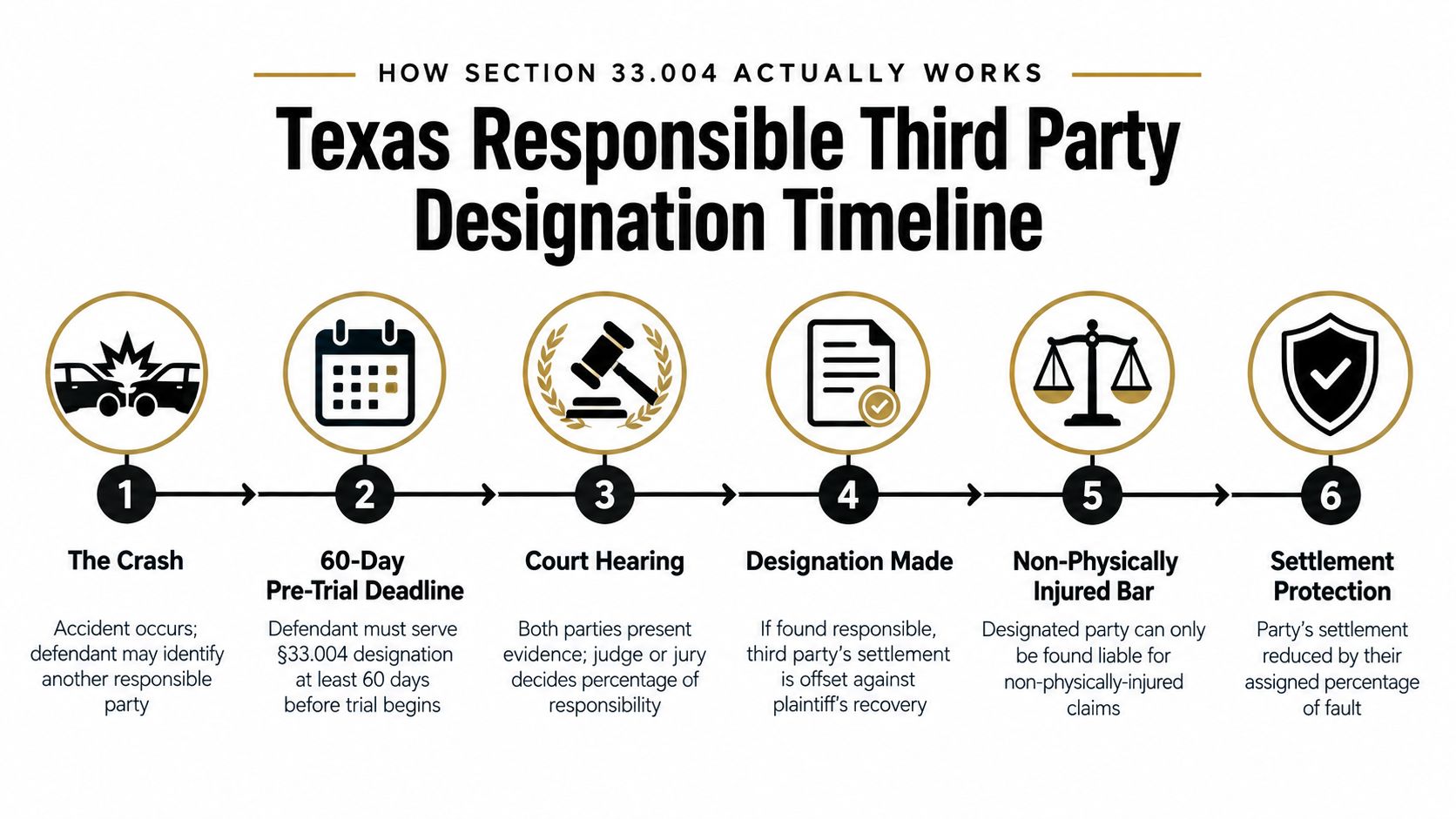
Think of the process as a timeline rather than a wall of legal language. A defendant generally must file a motion for leave to designate a responsible third party on or before the 60th day before trial, unless the court finds good cause for a later filing. Once the motion is served, the opposing party generally has 15 days to serve an objection. These deadlines appear in Texas Civil Practice and Remedies Code section 33.004.
The filing and objection window
The defendant's motion should identify the proposed third party and provide facts describing how that person or entity allegedly caused or contributed to the injury. Contact information may be included when known. The court generally must grant leave if no timely objection is filed. Even when a plaintiff objects, the objection usually must show that the pleading lacks sufficient facts and that the problem remained after an opportunity to replead.
If you join the designated person, that person becomes a full defendant in the lawsuit. That may allow formal claims, discovery, and defenses to proceed directly against the third party. If you do nothing, the nonparty can still remain part of the responsibility analysis and may appear on the verdict form if the evidence supports submitting the issue.
The statute also contains a post-discovery safeguard. After the parties have had adequate time for discovery, a court may strike the designation if there's no legally sufficient evidence that the designated person was responsible for any part of the injury. A later amendment generally requires court permission, particularly when the defendant could have identified the person earlier.
The process resembles an airline boarding window. Before the gate closes, a defendant may file within the ordinary deadline. Afterward, changing the passenger list requires the court's approval and a persuasive reason.
Questions families often ask
Yes, the procedure can matter in wrongful-death claims. It can also arise when the proposed third party is a product maker, subcontractor, employer, maintenance company, or another driver. In an on-the-job injury, Workplace Injury and Third-Party Claims in Texas addresses recovery options when you're hurt on the job in Texas.
This video provides another visual introduction to the litigation process:
Why Courts Read the Rule Broadly
Texas courts have historically read section 33.004 broadly because it works within Chapter 33's larger proportionate-responsibility system. The statute allows defendants to identify people who weren't sued and who may be outside the court's jurisdiction, unknown, or immune from suit. The central question is whether the person allegedly caused or contributed to the harm, not whether that person is already a named party.
That can include a subcontractor whose work affected a construction site, a supplier connected to a defective product, a successor employer, or an unidentified driver in a chain-reaction collision. The designation process gives the jury a fuller account of the alleged events, but it also creates a serious tactical issue for the injured person.
A court's permission to designate someone isn't a final ruling that the person caused the injury. It only allows the responsibility issue to proceed. The plaintiff still has the opportunity to challenge the allegations, obtain discovery, and argue that the evidence doesn't support placing the third party on the verdict form.
Breadth does not eliminate deadlines
The statute's broad reach works alongside a limitations-related restriction. A defendant generally may not designate a responsible third party after the applicable limitations period has expired as to that third party unless the designation was timely disclosed under the Texas Rules of Civil Procedure. The framework also includes a 60-day post-designation joinder period discussed in Texas case law. When a claimant seeks joinder within that period, limitations generally can't be used as a bar to that joinder.
The result is a balance. A defendant that knew about a possible third party from the beginning shouldn't wait until late discovery or expert analysis to identify that person without seeking proper court permission. A defendant that discovers new facts through discovery may have a stronger argument for a later amendment.
As explained in this federal court discussion of Texas responsible-third-party practice, the procedure can place a nonparty into the fault allocation even when that person isn't participating in the lawsuit. That possibility gives an experienced lawyer an important reason to investigate every actor involved.
How to Respond When You Are Named as a Responsible Third Party
Receiving a designation motion can feel like another crisis. Start by treating it as a deadline-driven legal document, not as an ordinary insurance letter. Read the allegations carefully and identify the exact conduct the defendant says caused or contributed to the injury.
Protect the evidence first
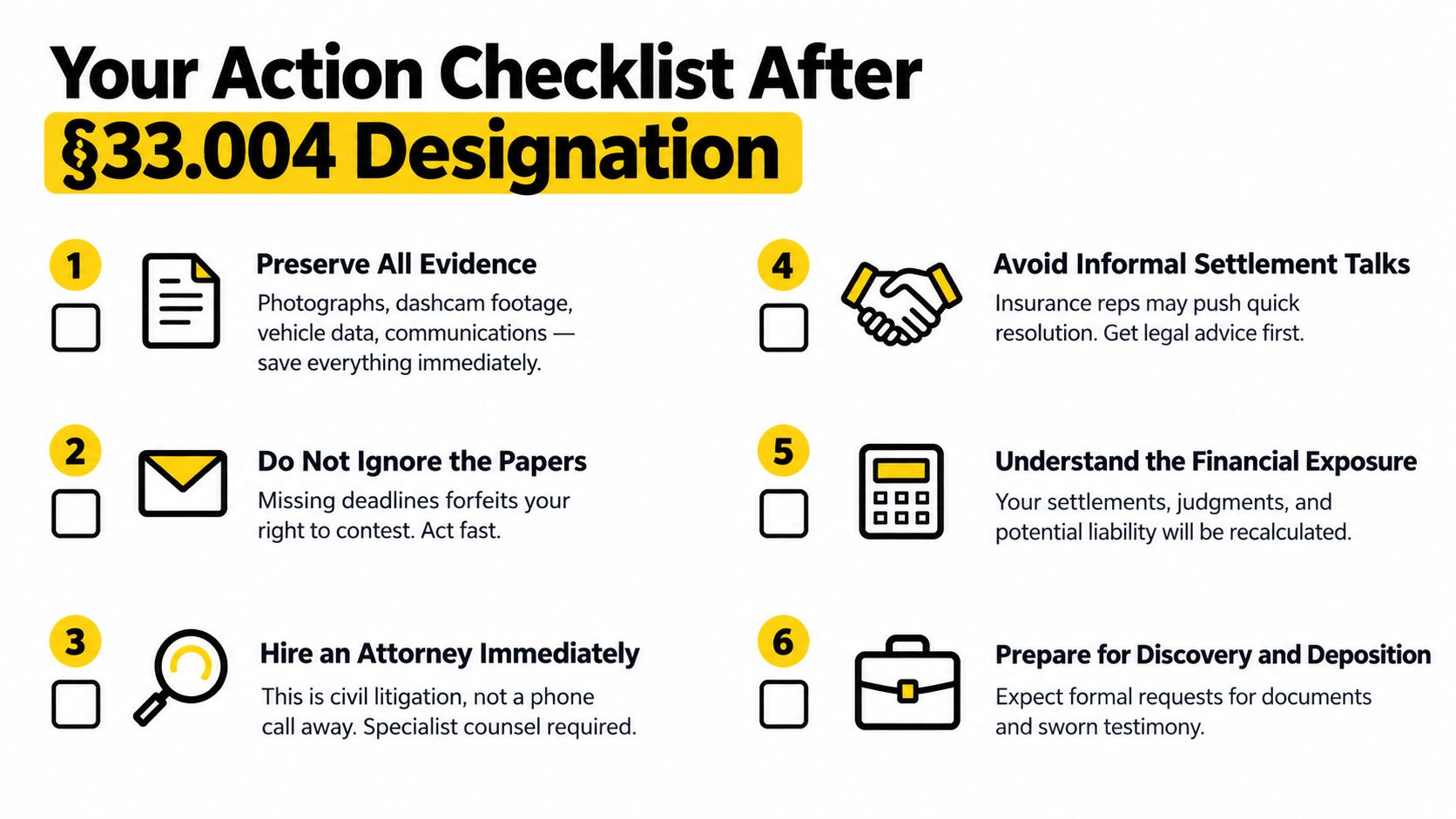
Preserve photographs, dashcam footage, vehicle data, employment records, text messages, emails, safety documents, and medical charts. In a commercial vehicle or worksite case, electronic information can be held by other businesses, so your attorney may need to send preservation demands or use formal discovery.
Write down what you remember while the details remain clear. Save the envelope and service information, because the date the motion was served can affect the 15-day objection deadline.
A written objection may challenge a designation that lacks sufficient facts or fails to connect the proposed third party's conduct to the injury. Your attorney can also examine whether the defendant delayed identifying the third party despite having the information earlier. Under section 33.004, that timing may matter when the defense seeks a late amendment.
Discovery and a possible motion to strike
Your lawyer may pursue targeted discovery, including depositions, subpoenas for insurance and maintenance records, workplace documents, scene inspections, or communications among the businesses involved. The purpose isn't to accept the defense theory. It's to test whether the alleged third party caused any part of the claimed injury.
After adequate discovery, a party may move to strike the designation when legally sufficient evidence doesn't support responsibility. Third-party claims in Texas can involve complicated relationships among employers, contractors, insurers, and other entities, so coordination with your existing attorney matters.
Do not negotiate casually: A quick statement to an adjuster or defense lawyer can be taken out of context. Get legal advice before discussing fault or settlement.
The process is manageable when someone tracks the dates, preserves proof, challenges weak allegations, and prepares the case for the next procedural step. You don't have to understand every rule before asking for help.
Real Texas Scenarios Where This Rule Matters
A Houston freeway crash can create a difficult designation problem when several vehicles collide. Suppose a driver is injured in a pileup on I-45, but the defendant claims an unidentified vehicle made an unsafe move and triggered the collision. The defense may try to designate that unknown driver. The plaintiff's attorney must examine traffic-camera footage, vehicle damage, eyewitness accounts, and available electronic data, then determine whether an objection is needed within the statutory window.
A designation isn't proof that the phantom driver caused the crash. If the defense serves the motion too close to trial, the timing may become important. If the designation survives, the plaintiff must still argue that the evidence doesn't support assigning responsibility to an unidentified person.
Worksite responsibility can involve several companies
On the Gulf Coast, a refinery worker may suffer serious injuries while working around a contractor and multiple subcontractors. If the employer didn't subscribe to workers' compensation coverage, the case may raise different questions about the employer's role and the claims available against other entities. A contractor may still point to a subcontractor that wasn't named in the original petition.
In that situation, attorneys examine contracts, safety policies, training records, supervisor communications, and the sequence of events. The important question is not merely who signed the employment paperwork. It's which conduct allegedly contributed to the specific injury.
Fatal truck crashes create painful layers of fault
After a fatal 18-wheeler crash near El Paso, a trucking company might designate a maintenance vendor or a bar that allegedly served alcohol to the driver. The surviving spouse may face a defense strategy that spreads responsibility across businesses that aren't defendants in the case.
The family's lawyer must investigate maintenance records, driver qualifications, dispatch communications, hours-of-service information, witness accounts, and available insurance. The designation can affect settlement discussions as well as trial preparation. Texas families pursuing a fatal-crash claim should also understand how joint and several liability in Texas may interact with the facts and applicable responsibility rules.
Fault, Damages, and the Power to Settle Your Case
Section 33.004 matters because fault allocation affects more than the final courtroom presentation. It can change the way insurers value a claim and the way defendants approach settlement. A carrier may argue that its insured should pay only the share assigned to that party, while pointing to a nonparty as another source of responsibility.
The injured person's own conduct may also become part of the analysis. Texas's proportionate-responsibility framework can reduce recovery when the claimant bears responsibility, and the statute bars recovery when the claimant's responsibility is greater than 50%, as described in Texas's comparative-negligence rules. The exact result depends on the evidence, the claims, and the court's application of the law.
Building leverage with evidence
A strong response doesn't rely on indignation. It relies on proof.
- Test the theory: Demand the factual basis for each allegation against the designated person.
- Trace the conduct: Connect safety failures, maintenance decisions, driver actions, or property conditions to the actual injury.
- Use discovery strategically: Take depositions and request documents from the nonparty when those materials can clarify responsibility.
- Challenge unsupported claims: After adequate discovery, seek to strike a designation that lacks legally sufficient evidence.
- Coordinate insurers: Settlement discussions may involve several carriers, policy limits, and competing arguments about who should pay.
A strategic counter-designation may sometimes be appropriate when other actors contributed to the harm. That decision requires careful analysis because adding more names doesn't automatically strengthen a claim. The purpose is to make the responsibility picture accurate and prevent one defendant from controlling the entire narrative.
For someone injured in a Houston collision, that may mean consulting a Houston car accident attorney before accepting an early offer. For a commercial vehicle case, a truck crash lawyer in Houston can investigate the companies and contractors behind the vehicle, not just the driver at the scene.
Common Myths Texas Families Should Not Believe
Families often receive conflicting explanations about responsible third party designations. The safest approach is to separate what the filing does from what it proves.
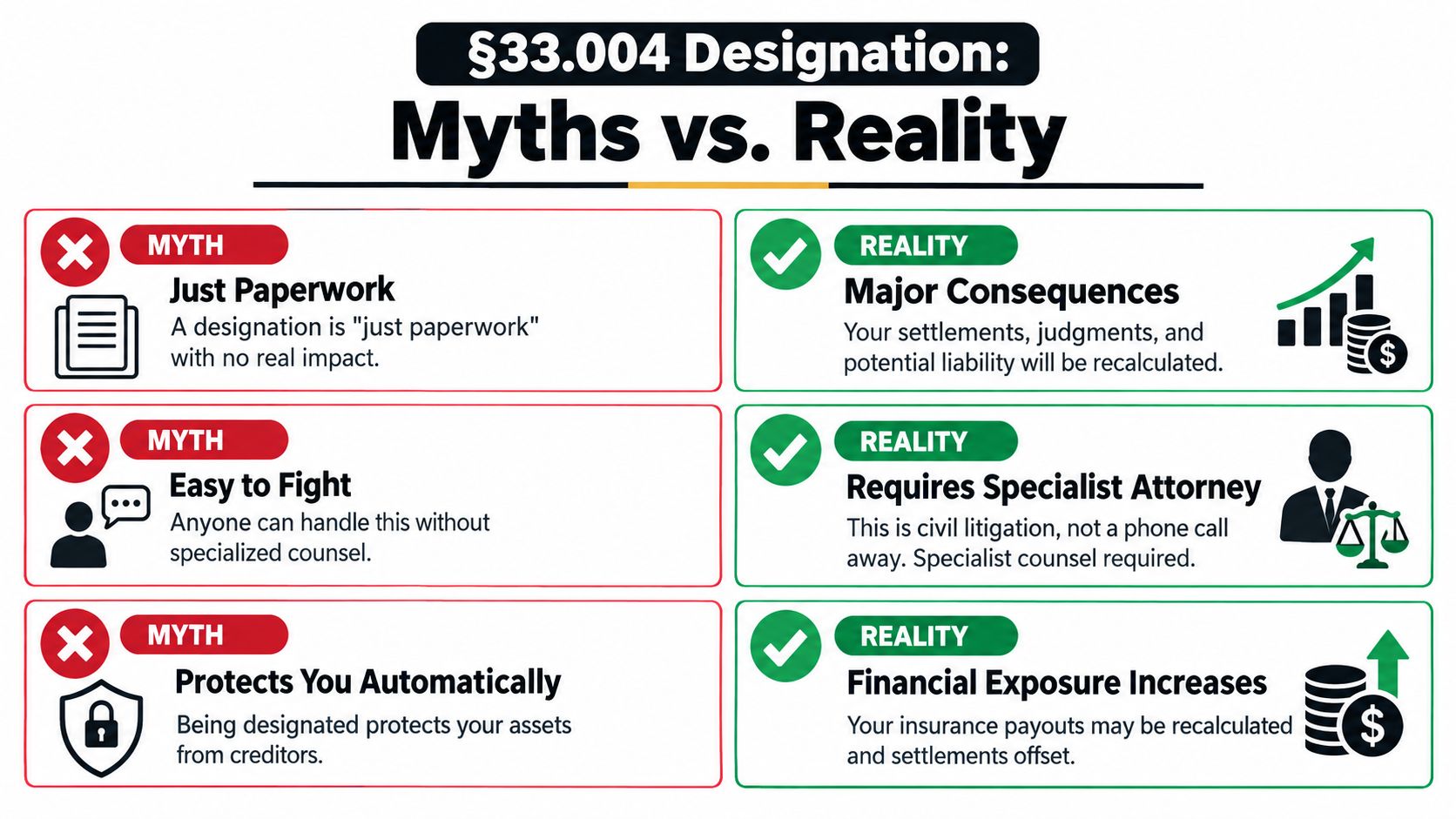
Myth one, it's just paperwork
A designation is not merely an administrative note. If it remains in the case and the evidence supports the issue, the nonparty may be considered when responsibility is allocated. That can affect the named defendant's exposure and the amount the injured person tries to recover through settlement or trial.
The filing still isn't a judgment against the third party. It's a procedural mechanism that can shape the evidence, discovery, and verdict questions.
Myth two, only sued parties count
Texas law can allow a defendant to designate someone who hasn't been sued. The proposed person may be unknown, outside the court's jurisdiction, or protected from suit in some circumstances. That's why reviewing every business, driver, contractor, and employer connected to the incident matters.
A plaintiff may seek to join the designated person, but that choice requires attention to the facts, claims, insurance, limitations issues, and litigation strategy.
Myth three, a nonsubscribing employer can never use section 33.004
That assumption is unsafe. A 2025 Texas Supreme Court-related development confirmed that a nonsubscriber may designate responsible third parties in an employee negligence case, according to this report on the Texas Supreme Court-related development. The development cuts against the belief that only traditional outside tortfeasors matter.
The lesson isn't that every designation will succeed. It's that injured workers and families need a lawyer who understands how the doctrine applies to the specific employment and negligence claims involved.
Your Next Steps and How We Can Help
Start with the facts you can control. Preserve the accident report, photographs, video, medical records, witness information, employment documents, and communications with insurers. Don't post about the incident or make recorded statements about fault before you understand how those statements may be used.
Then identify the procedural dates. Ask whether a designation motion has been filed, when it was served, and when the scheduled trial begins. Mark the 15-day objection period immediately, and ask counsel to calculate whether the defendant met the ordinary 60-day pre-trial filing deadline.
Questions to bring to your lawyer
- What specific conduct does the defendant attribute to the proposed third party?
- Did the defendant know about that person or company earlier?
- Should you object, seek joinder, or pursue targeted discovery?
- What records could show that the designation lacks factual support?
- Could a post-discovery motion to strike remove the third party from the responsibility question?
- How does the designation affect settlement discussions and available insurance?
A lawyer can review the motion, investigate the underlying facts, request documents, depose witnesses, negotiate with multiple insurers, and prepare a motion to strike when the evidence doesn't support the designation. The firm's broader practice may also include car and truck collisions, catastrophic injuries, workplace claims, and wrongful death matters.
If your loved one died in a crash, a wrongful death lawyer in Texas can help your family address both the designation issue and the damages connected to the loss. If you suffered a life-changing injury, early legal review can protect evidence and give you a clearer path forward. For most Texas injury claims, the general statute of limitations is a separate deadline, and the applicable period can depend on the claim and parties involved. The firm's overview of the two-year deadline for Texas injury claims offers additional context.
Recovery won't happen all at once, but the right legal support can make the next decision clearer. You deserve a careful review of the facts, a timely response to the designation, and an advocate who treats your family's future with respect.
The Law Office of Bryan Fagan, PLLC offers free consultations to review a responsible third party designation, protect your deadlines, investigate the accident, and pursue a fair resolution for your injury or wrongful-death claim. Visit Law Office of Bryan Fagan, PLLC to schedule a consultation and speak with a Texas personal injury attorney about your next step.