A serious accident can change your life in seconds, but you don't have to face it alone. After a Houston-area crash caused by a buckled joint, sudden drop-off, standing water, or missing warning, it's natural to ask whether the roadway itself is legally responsible. The answer may depend on a decision that looks technical but can control your entire case, whether the condition is an ordinary premises defect or a special defect under the Texas Tort Claims Act.
That classification affects the duty TxDOT owed you, the notice evidence you must prove, the defenses the government may raise, and the steps your lawyer should take immediately. The wrong approach can leave important roadway records unrecovered while the government argues that your case belongs on the weaker legal track.
When a Texas Road Becomes Someone Else's Fault
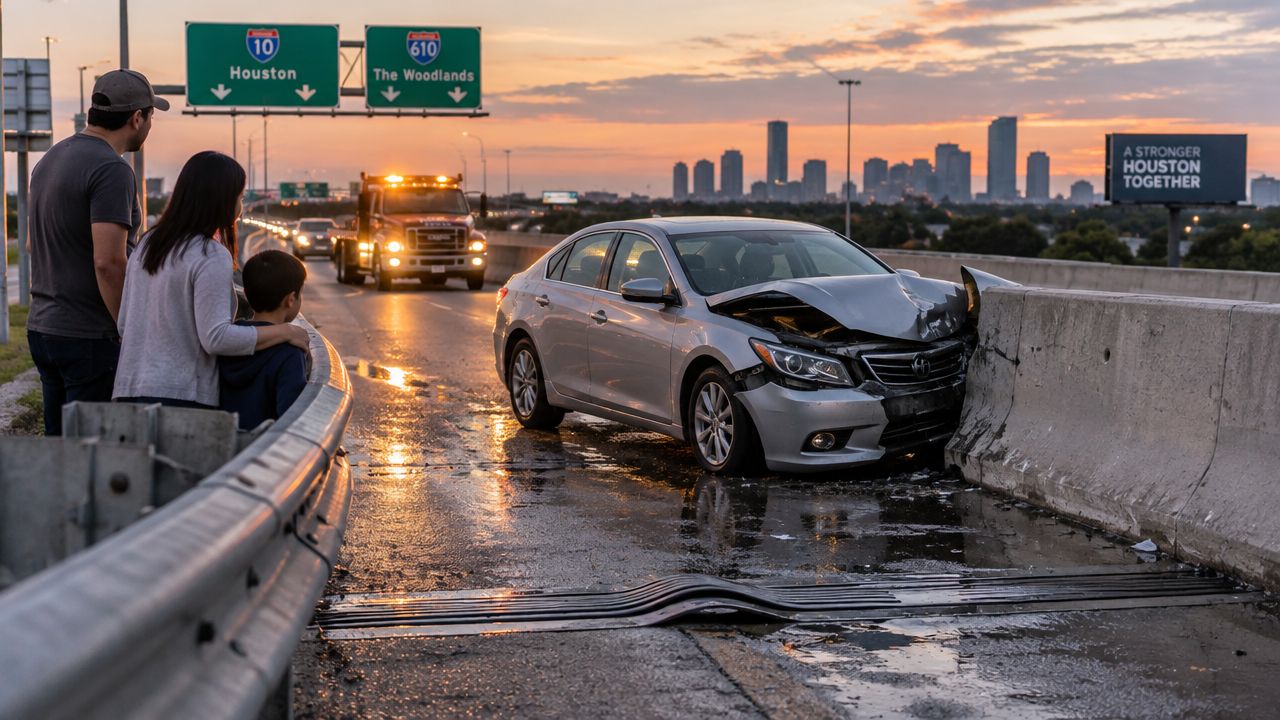
A Houston family stands beside a wrecked vehicle after the car hydroplanes across a buckled expansion joint and hits a concrete barrier. The driver is injured, the vehicle is badly damaged, and the immediate question is direct: does TxDOT bear responsibility when a roadway condition helps cause the crash?
Your claim starts with the Texas Tort Claims Act, the limited legal route for pursuing TxDOT and other governmental units. Texas generally protects government entities from lawsuits through sovereign immunity. The Act waives that protection in defined situations, including some injuries caused by dangerous roadway conditions.
A TxDOT claim therefore requires more than proof that the pavement was unsafe and someone was hurt. The facts must fit the Act, and the evidence must establish the duty that applied to that particular roadway condition. That classification changes the investigation, the notice evidence, and the defenses TxDOT can raise.
The classification is a strategic fork
Texas places dangerous road conditions on two legal tracks. An ordinary premises defect generally treats the injured person as a licensee. A special defect gives the person the stronger status of an invitee.
For an ordinary premises defect, the case usually turns on whether TxDOT had actual knowledge of the danger. Inspection reports, maintenance records, complaints, work orders, photographs, and evidence of earlier incidents can become central. Without proof of knowledge, a roadway may look dangerous while the claim still fails.
A special-defect claim focuses on a condition that is unusually dangerous and unexpectedly disrupts ordinary travel. Possible examples include an abrupt shoulder drop-off, an excavation or obstruction in the roadway, a missing warning sign in a construction zone, or a malfunctioning traffic signal. The label does not decide the issue. Courts examine the condition itself, how it affected travel, and whether it resembled the statutory examples.
That makes the first investigation decisive. Preserve photographs, vehicle data, dashcam footage, witness accounts, weather information, crash-scene measurements, and roadway records before the condition changes or relevant evidence disappears.
Practical rule: Treat the premises-versus-special-defect classification as a case strategy decision from the first investigation, not as paperwork after the evidence is gone.
The Two Legal Tracks Under the Texas Tort Claims Act
Sections 101.021 and 101.022 of the Texas Tort Claims Act create two different strategies for roadway injury claims. The legal classification affects TxDOT's duty, the notice evidence you need, and the defenses the agency is likely to raise. Do not treat the label as a technical detail. It can determine whether your claim has a viable path.
Ordinary premises defects
An ordinary premises-defect claim treats the injured person as a licensee. TxDOT generally must warn of a dangerous condition it knows about, or make the condition reasonably safe when the law requires it. The practical burden usually falls on proving that the agency had actual knowledge before the crash.
Possible roadway conditions include:
- Potholes: A recurring depression may support a claim when the evidence establishes the required legal elements.
- Uneven pavement: A sharp or hazardous surface transition can create an unreasonable risk of harm.
- Blocked sight lines: Overgrown vegetation may matter if it hides a roadway hazard or traffic control from drivers.
- Unsafe roadway conditions: A design or maintenance problem may be actionable when it creates an unreasonable risk, although design defenses can complicate the case.
The evidence must connect TxDOT to the condition before the collision. Inspection records, work orders, maintenance history, prior complaints, repair requests, and earlier incident reports may help establish notice. A dangerous roadway alone does not prove that TxDOT knew about it.
Special defects
A special defect is narrower. Section 101.022 identifies excavations or obstructions on highways, roads, or streets as examples. Courts may also consider abrupt pavement-edge drop-offs, unmarked standing water, malfunctioning traffic-control devices, and hazards in highway construction zones when the facts show an unusual peril that unexpectedly interferes with ordinary travel.
This classification gives the injured person the status of an invitee and imposes a higher duty. TxDOT generally must make the condition reasonably safe or provide an adequate warning. The notice analysis can differ from an ordinary premises-defect claim, so do not build your case around the wrong proof.
In Payne v. Texas Department of Transportation, Texas courts emphasized that a condition must be of the same kind or class as the statutory examples. A severe-looking photograph is not enough. The hazard must present an unexpected, physically impairing danger that disrupts roadway travel.
Your first investigation should preserve the exact condition and show what a reasonable driver encountered. Photograph the roadway from multiple approaches, document visibility and warnings, and preserve measurements before repairs or weather change the evidence. A condition that initially appears to be a routine pavement problem may support a special-defect argument if it unexpectedly blocks or disrupts ordinary travel.
Practical rule: Choose the legal track through the facts, not the label. Preserve evidence that proves both the roadway's condition and TxDOT's duty before the agency can repair or reclassify the hazard.
Premises Defect vs Special Defect Side by Side
The classification is a strategic fork, not a vocabulary choice. It affects the duty TxDOT owed, the notice theory available to you, the evidence worth pursuing, and the defenses the agency will raise.
| Element | Premises Defect (Sec. 101.021) | Special Defect (Sec. 101.022) |
|---|---|---|
| Legal status | Injured traveler is treated as a licensee | Injured traveler is treated as an invitee |
| Type of condition | An ordinary dangerous condition on government property | A narrow roadway peril comparable to an excavation or obstruction |
| Duty | Warn of the danger or make it reasonably safe under the licensee standard | Make the condition reasonably safe or provide an adequate warning under the invitee standard |
| Knowledge | Actual knowledge is a central issue | The claimant may argue TxDOT knew or reasonably should have known of the unusual peril |
| Main evidence | Complaints, inspections, work orders, repair history, and notice records | Photographs, measurements, roadway layout, visibility, warnings, and proof that travel was unexpectedly impaired |
| Likely defense | TxDOT lacked knowledge, or the condition was not unreasonably dangerous | The condition was not a special defect, or the driver should have avoided it |
| Notice | Governmental notice rules require prompt, precise review | The same rules may apply, while the classification changes the proof dispute |
| Damages | Recovery remains subject to the Act's limits and the facts | The Act's limits and the claimant's comparative responsibility also control recovery |
A premises-defect claim often turns on TxDOT's maintenance history. Repeated reports about a pothole or uneven surface can support actual knowledge when the agency failed to repair or warn. Inspection records showing no indication of the condition give TxDOT a direct argument that it lacked notice.
A special-defect claim depends more heavily on the hazard's physical character and its effect on ordinary travel. The question is whether the condition created an unusual roadway peril, rather than merely a common maintenance problem. Evidence should show what drivers encountered, whether the danger was visible, what warnings existed, and how the condition interfered with travel.
That distinction changes your investigation. For a premises theory, request complaint files, inspection records, work orders, repair history, and communications about the location. For a special-defect theory, preserve photographs from each approach, measurements, roadway layout, lighting and visibility conditions, warning signs, and evidence of how the hazard affected the vehicle's path. These records also help answer TxDOT's expected defenses before the agency repairs or changes the scene.
The Car Accident Lawyer in Texas service addresses Texas car-accident injuries, including claims requiring careful analysis of roadway conditions and government liability.
Severe injuries do not automatically establish a special defect. The seriousness of the harm affects damages, while the roadway condition determines the classification and duty. Build the claim around the facts, preserve proof for both legal tracks, and choose the stronger theory only after examining the hazard, TxDOT's knowledge, and the driver's conduct.
Filing Deadlines Every TxDOT Claimant Must Know
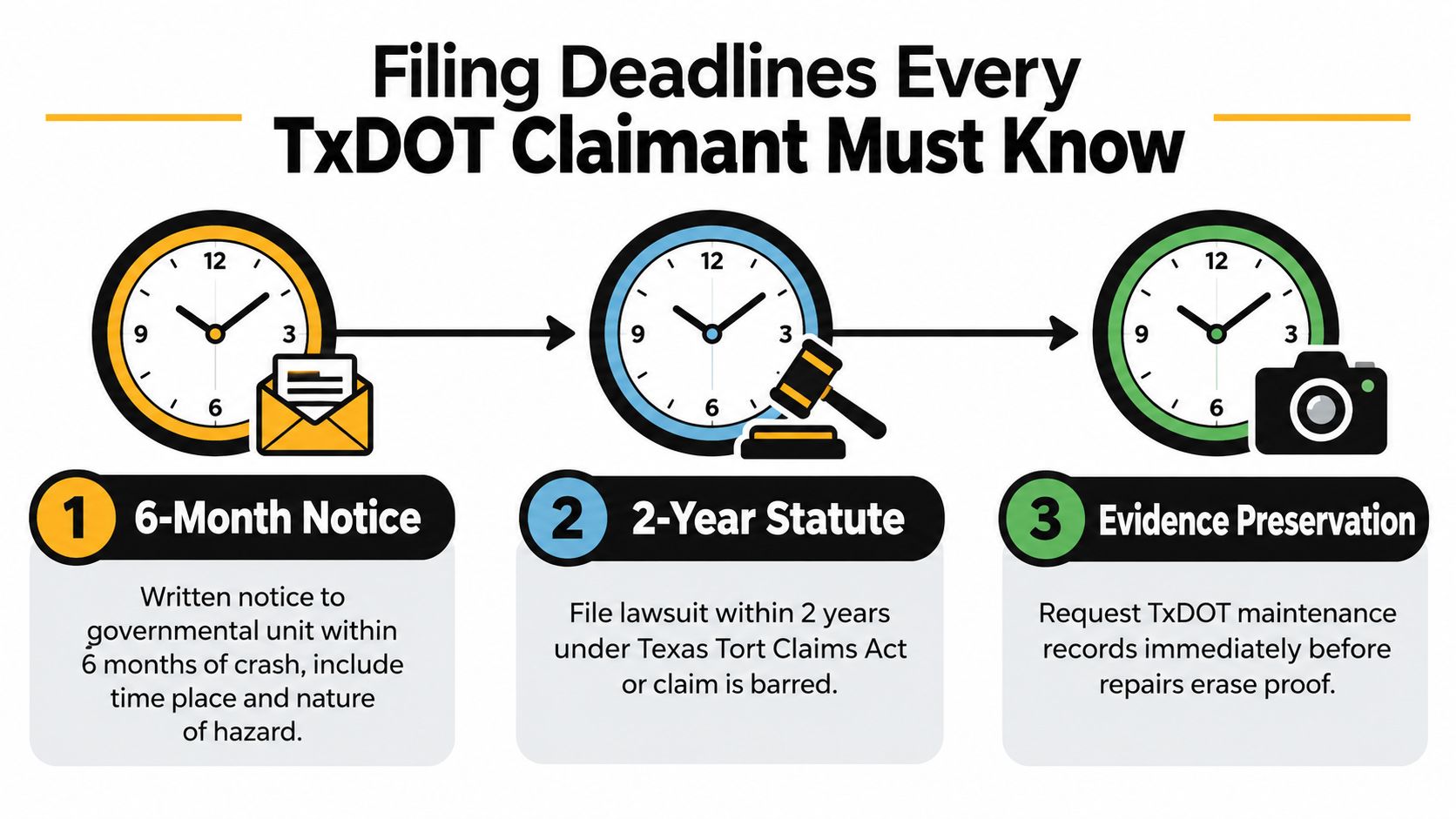
Government claims have deadlines that demand immediate attention. For most Texas personal injury claims, including many crash-related injury claims, the general filing deadline is two years from the date the cause of action accrues, usually the injury date. Texas personal injury statute-of-limitations guidance explains why waiting can bar an otherwise valid claim.
The notice clock
The Texas Tort Claims Act also includes a separate notice requirement. A written notice to the governmental unit generally must identify the injury, the time, and the place with reasonable specificity. Government entities may have their own notice procedures, so a letter sent to the wrong office or lacking important details can create a serious problem.
Families should not assume that a premises defect or special defect label eliminates the need to act. The classification may affect the evidence needed to prove notice, but it doesn't justify waiting to investigate or provide formal notice. A lawyer should identify the correct governmental entity, the applicable procedure, and any local requirements.
The lawsuit clock
Sending a notice letter isn't the same as filing a lawsuit. If TxDOT denies the claim or refuses to resolve it, you must preserve your right to bring suit before the applicable limitations deadline. The filing clock continues while an insurer investigates, requests records, or delays a meaningful response.
A Texas Tort Claims Act six-month notice deadline guide can help you understand the administrative timing, but a real claim still requires case-specific legal review.
Minor injuries, wrongful death claims, and claims involving an estate may involve additional rules. Those details can change the calculation, so families shouldn't rely on a general deadline without speaking with counsel.
Do this first: Write down the crash date, exact location, governmental agency involved, medical treatment, and every communication with an insurer or public agency. Bring that timeline to your lawyer.
Evidence That Wins a Roadway Hazard Claim
Roadway cases are evidence cases. The pavement may be repaired, water may drain away, vegetation may be cut, and construction devices may move before anyone fully investigates.
Preserve the scene
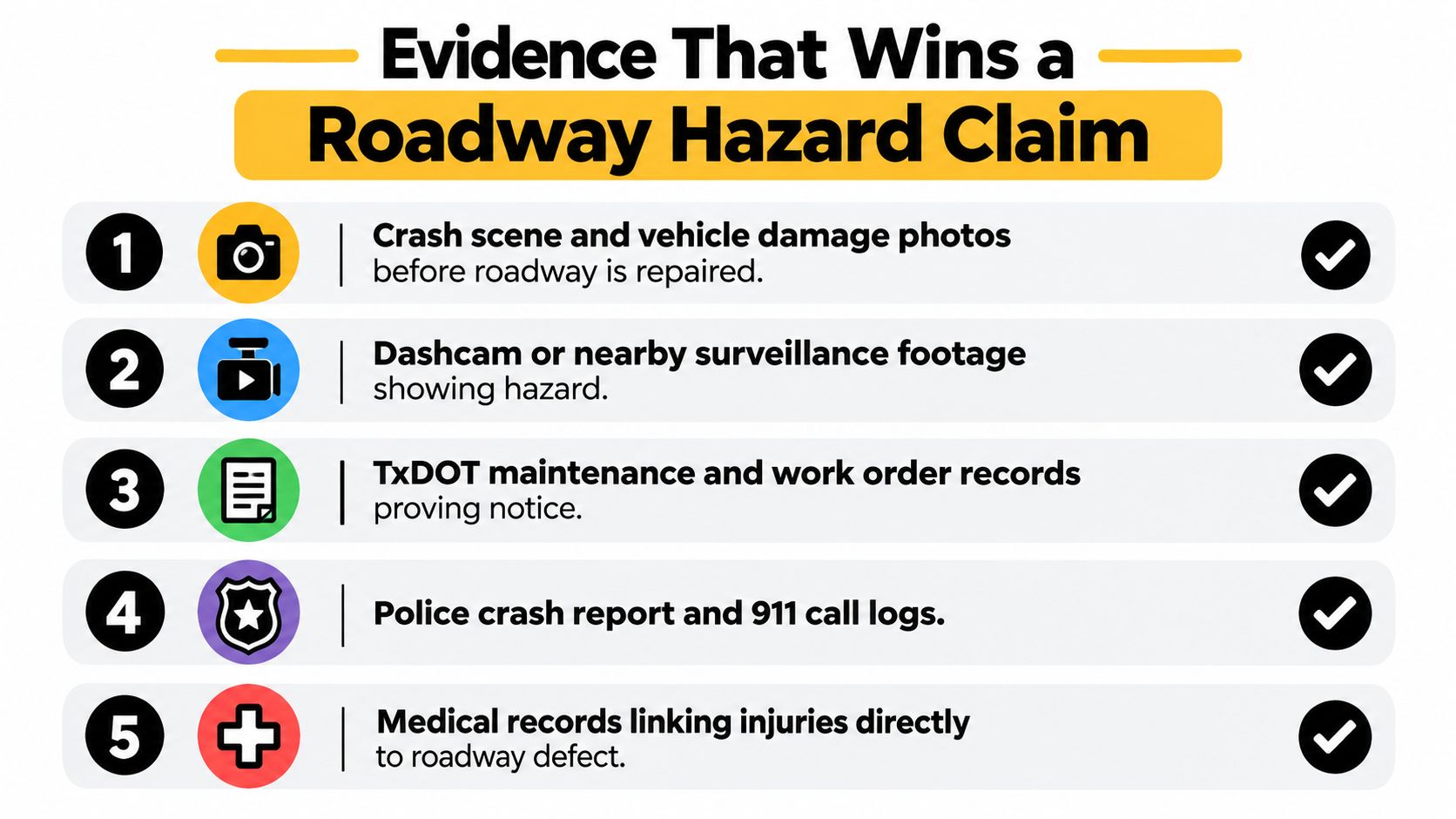
Take photographs only when it's safe. Capture the defect from the driver's approach, from the side, and from a distance that shows how a reasonable motorist would have encountered it. Record weather, lighting, lane configuration, signs, barriers, shoulder width, and any obstruction to visibility.
A useful first-week checklist includes:
- Crash photographs: Photograph the road, vehicle damage, debris, barrier impact, and surrounding signs before repairs alter the scene.
- Video sources: Save dashcam footage and identify nearby businesses, homes, traffic cameras, or vehicles that may have recorded the crash.
- Witness details: Obtain names and contact information, then write down what each person observed while memories are fresh.
- Official records: Request the crash report and preserve 911 information, dispatch details, and response timing.
- Medical proof: Keep records that connect the injury mechanism to the roadway event, including emergency treatment, diagnostic testing, and follow-up care.
Investigate what TxDOT knew
For an ordinary premises defect, maintenance logs and prior complaints may be decisive because actual knowledge is often disputed. For a special defect, records can help establish the condition's history, but photographs and roadway measurements may matter just as much in showing that the hazard unexpectedly impaired travel.
Ask counsel to preserve and pursue inspection records, repair orders, prior complaints, pavement-management information, construction plans, and communications about the location. Keep the vehicle available for an independent inspection. Damage patterns can help a reconstruction professional determine speed, direction, braking, and the mechanism of impact.
More practical guidance on preserving proof appears in this resource about evidence needed for an injury claim in Texas. Don't let an adjuster's early conclusion replace an independent investigation.
How Comparative Fault Can Shrink or Kill Your Recovery
TxDOT may argue that the roadway condition was not the cause of the crash. The defense may say you were speeding, distracted, following too closely, driving too fast for rain, or failed to take reasonable evasive action.
Texas permits comparative responsibility. Your recovery can be reduced by your percentage of fault, and a claimant found more than 50% responsible cannot recover damages under Texas's modified comparative-fault rule. Texas comparative-fault and civil limitations guidance explains the basic rule.
How the defense changes with classification
In a premises defect case, TxDOT may focus on whether you acted reasonably after encountering a condition that should have been visible or avoidable. The government may argue that your speed, attention, or lane position caused the crash even if the pavement was imperfect.
A special-defect defense often attacks the classification first. TxDOT may argue that the condition was ordinary, open, obvious, or not comparable to a statutory excavation or obstruction. It may then argue that a reasonable driver should have seen and avoided the hazard.
Those arguments make accident reconstruction essential. A driver may not have had a reasonable chance to react to standing water at night, a sudden edge drop, or a construction obstruction hidden by traffic and poor lighting.
Counter the blame narrative
Preserve the vehicle's event data when available. Retain a reconstruction professional when speed, braking, visibility, roadway geometry, or reaction time is disputed. Document weather and lighting conditions, and preserve photographs that show the driver's approach rather than only the defect after the crash.
Don't give a recorded statement to an insurer before a lawyer reviews the facts. An innocent estimate about speed or distance can later be presented as an admission. Families can find additional guidance about how comparative fault affects a Texas settlement.
Practical Steps After a Crash Caused by a Road Defect
Your first priority is safety and medical care. Call 911, accept emergency evaluation when offered, and follow up with a doctor even if pain seems manageable. Some crash injuries develop gradually, and gaps in treatment give insurers an opening to argue that the roadway did not cause your condition.
Protect the facts
If you can do so safely, take photographs before the roadway changes. Photograph the defect from multiple angles, the travel lane, nearby warnings, the vehicle, tire marks, debris, lighting, and weather. Don't put yourself or anyone else in traffic to obtain a better image.
Write down what you remember while the event is fresh:
- Record the approach: Note your lane, speed estimate, traffic, visibility, weather, and what you saw before impact.
- Preserve recordings: Save dashcam footage and ask about event data recorder preservation for the vehicle.
- Identify witnesses: Gather contact information from passengers, motorists, workers, and nearby property owners.
- Report the hazard: Notify the appropriate public authority when safe, and keep confirmation of the report. That creates a useful paper trail.
- Protect communications: Give insurers basic facts, but don't provide a recorded statement or sign a broad release before getting legal advice.
Get legal help before time works against you
A Texas personal injury lawyer can investigate the roadway, identify whether TxDOT or another governmental unit is involved, send the required notice, and pursue records before repairs erase the condition. The same review may uncover claims against another driver, a contractor, or a private party.
If a loved one died, a wrongful death lawyer in Texas can evaluate the family's claim and preserve the evidence needed to establish responsibility. If a commercial vehicle contributed to the collision, a truck crash lawyer in Houston can examine driver conduct, vehicle data, and roadway conditions together. For life-changing injuries, a catastrophic-injury attorney can help address ongoing medical care and future needs.
The Law Office of Bryan Fagan, PLLC can evaluate whether your roadway-hazard claim is an ordinary premises defect or a special defect, protect evidence, and handle communications with insurers and governmental entities. Visit Law Office of Bryan Fagan, PLLC to schedule a free consultation and discuss your next steps. Recovery is possible, and experienced legal help is available to guide you and your family through the process.