A serious accident can change your life in seconds, but you don't have to face it alone.
You may be reading this after a Houston freeway crash, a Dallas wreck, or a call from a hospital telling you someone you love has been badly hurt. The bills are growing. The other driver may have little or no coverage. Your own insurance company knows you paid for uninsured or underinsured motorist protection, but the answers still feel slippery.
That's where the rule from Brainard v. Trinity matters.
Many injured Texans assume this coverage works like a simple reimbursement system. You send records, make a demand, and your insurer pays what's fair. Texas law doesn't work that way. In a UM or UIM case, your own carrier may not owe benefits until you first prove that the other driver was legally responsible and that your damages justify payment.
For families searching online for Brainard v Trinity uninsured motorist liability first Texas, that rule is usually the source of the confusion. It sounds backward. You bought the coverage, but you may still have to fight to establish fault and damages before payment is due.
This guide breaks that down in plain English. It also explains how fault works in Texas, why negligence still matters even when you're dealing with your own policy, how the filing deadline can affect your rights, and what practical steps can protect your claim from the start.
If your injuries came from a passenger vehicle wreck, a commercial collision, or a fatal crash, the same core questions often apply. Families dealing with a car accident case or a truck collision often run into these issues when the at-fault driver doesn't have enough coverage. The same is true in wrongful death and catastrophic injury claims.
A Serious Crash Should Not Leave You Facing This Alone
A Houston family gets hit on the freeway by a driver who never should have been behind the wheel. The ambulance ride is over. The ER visit is over. The phone starts ringing. Bills arrive. Work is missed. A child needs a ride to school. If the crash was fatal, the grief sits in the house while practical decisions keep coming anyway.
Then your own insurance company enters the picture.
When your own policy becomes part of the dispute
If the driver who caused the crash has no insurance, or not enough insurance, you may turn to your uninsured or underinsured motorist coverage. That sounds simple. You paid for the coverage, so it should step in.
Texas law is harder than that.
In a UM or UIM claim, your insurer may dispute fault, the amount of your damages, or both. So the claim can start to feel less like asking for benefits and more like proving a case. The policy is still yours. The disagreement is real.
In a UM/UIM dispute, payment usually does not become owed just because you reported the crash, sent records, or made a demand. You still have to establish that the other driver was legally responsible and that your damages support recovery.
That point is the center of Brainard v. Trinity Universal Insurance Co. For many injured Texans, the confusion starts there. They expect a claim timeline that begins with notice and ends with payment. Brainard changes that timeline. It affects when payment is due, when a 30 day post judgment clock can start, and why early pressure on the insurer does not always create fee or interest exposure.
Why families need the timeline explained in plain English
Serious injury cases put pressure on every part of daily life. Mortgage payments do not pause. Medical treatment keeps going. If a loved one died, funeral costs and lost family income can hit at the same time.
What helps is a clear timeline.
First, the crash happens. Next, the claim is reported and evidence is gathered. If the insurer disputes fault or value, the case may need a settlement with the at fault driver, an agreement on damages, or a judgment that establishes what the uninsured or underinsured driver legally owed. Only then does the question of when UM/UIM benefits are payable come into focus.
That sequence often surprises people.
It also explains why these cases can feel stalled even when the injuries are obvious. The insurer may say it is still waiting for legal proof of liability and damages, not just more paperwork.
Several issues usually shape that fight:
- Negligence proof: You need evidence showing how the other driver caused the crash.
- Responsibility disputes: Texas fault rules can reduce or block recovery in some cases.
- Damages evidence: Medical records, lost income proof, and witness testimony often matter.
- Timing mistakes: Waiting too long can weaken the claim or cut it off.
For help after a major wreck, you probably want straight answers, not legal jargon. The first answer is this. You are not wrong to expect the coverage to help. But under Texas law, there is a difference between having UM/UIM coverage and reaching the point when payment is legally owed. Understanding that difference early can help your family make better decisions after the crash.
How Uninsured and Underinsured Motorist Coverage Works in Texas
After a bad crash, many families assume their own auto policy will step in right away if the other driver has little or no insurance. The coverage can help, but it helps in a very specific way.
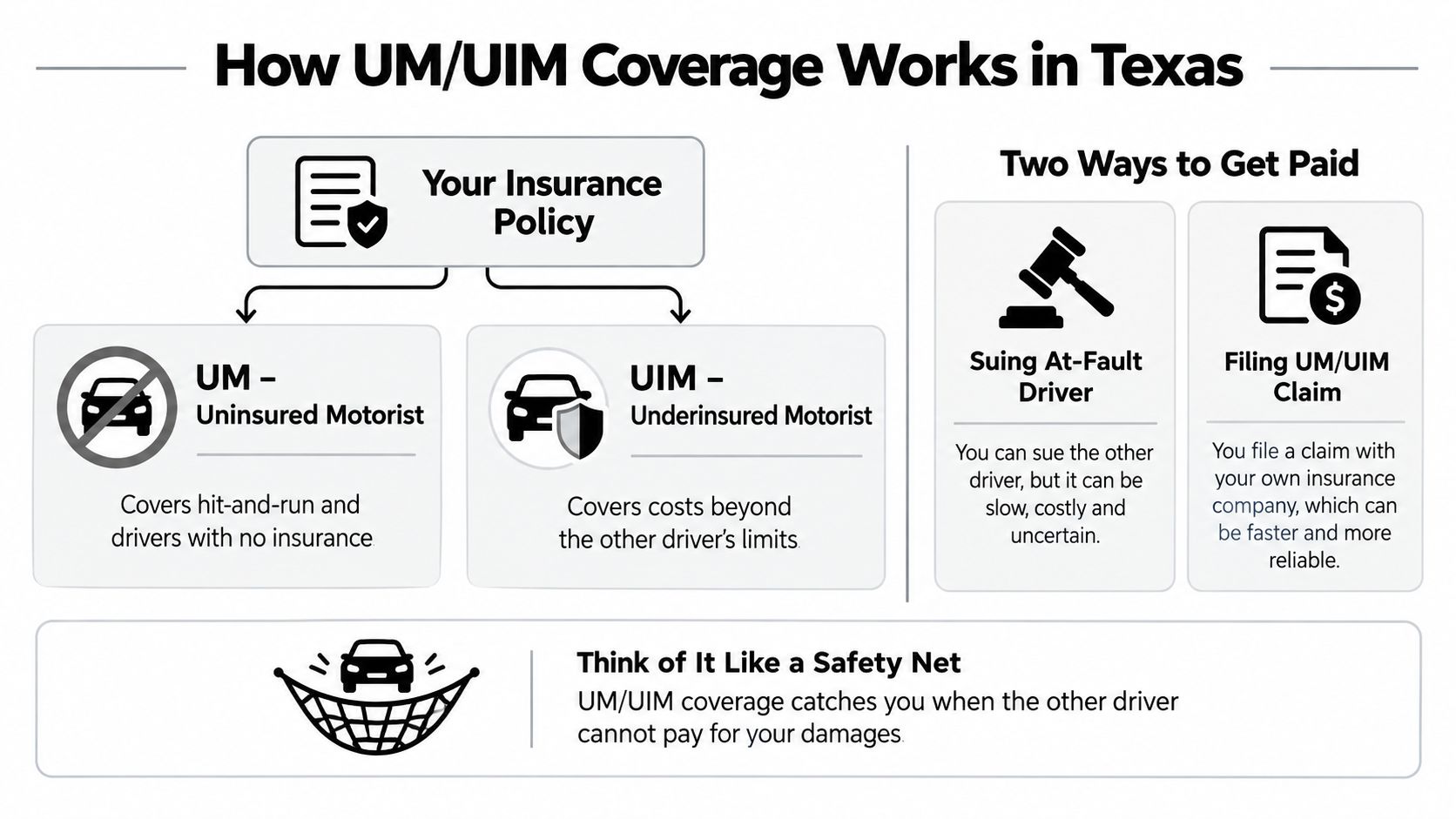
UM and UIM coverage works like a backup source of payment. The driver who caused the wreck is still the one legally responsible. Your policy may fill the gap when that driver cannot pay what the law says is owed.
UM and UIM are similar, but not the same
Uninsured motorist coverage usually applies when the at-fault driver has no liability insurance.
Underinsured motorist coverage usually applies when the at-fault driver has insurance, but the policy limits are too low for the losses caused by the crash.
A simple timeline helps:
- Crash happens
- Fault and damages are investigated
- The other driver's insurance situation becomes clear
- Your UM or UIM coverage may become part of the claim
- Payment issues depend on proof, not just notice
For a fuller explanation of how these claims fit into a Texas injury case, this guide to uninsured and underinsured coverage in Texas is a helpful starting point.
Why fault still matters in a first-party claim
This part confuses many injured drivers.
Because the claim is made under your own policy, it can sound like a benefits claim where the carrier checks the file and pays. Texas UM/UIM claims do not work that way. Your insurer stands in the shoes of the uninsured or underinsured driver for purposes of deciding liability and damages.
That means you still must prove the same core issues you would prove against the other driver:
- the other driver caused the crash
- the other driver was negligent
- your injuries came from the wreck
- your losses can be measured in dollars
So even though the policy is yours, the case still turns on evidence such as crash reports, photos, medical records, wage loss proof, and witness testimony.
Your policy can help, but it does not erase the legal fight
A UM/UIM claim is a contract claim under your own policy. It is also tied to what you were legally entitled to recover from the other driver. Those two ideas work together.
A practical example helps. If a Houston driver rear-ends you and carries no insurance, your UM coverage may be the place you look for payment. If that driver has some insurance, but your hospital bills, lost income, and pain and suffering go far beyond those limits, your UIM coverage may be the gap-filler.
That is why Uninsured and Underinsured Motorist Claims in Texas matter so much after serious injuries. The coverage may be available. The dispute is often whether fault, damages, and the amount owed have been proven under Texas law.
What the Texas Supreme Court Decided in Brainard v Trinity
A family can do everything they think they are supposed to do after a serious Houston crash. Report the wreck. Gather records. Send the insurer a demand. File a claim under the UM or UIM policy they paid for.
Brainard says those steps still do not make the carrier's payment obligation begin.
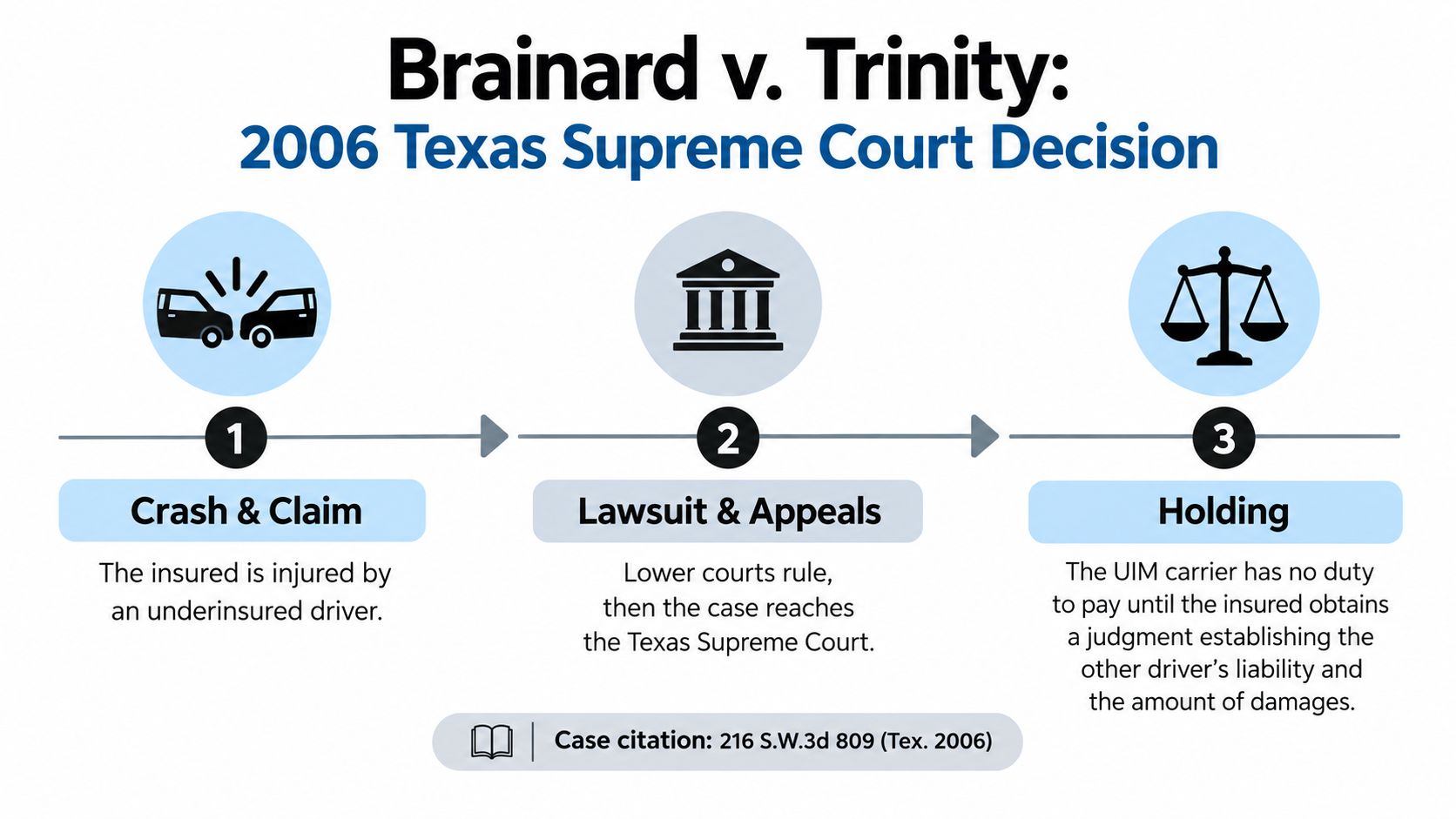
In 2006, the Texas Supreme Court decided Brainard v. Trinity Universal Insurance Co., reported at 216 S.W.3d 809, in an opinion available from the Texas Supreme Court record. The case answered one narrow question with very broad effects in Texas UM/UIM cases: When does the insurer owe benefits under the policy?
The core holding in plain English
The Court held that a UIM carrier has no contractual duty to pay benefits until the insured obtains a judgment establishing the other driver's liability and underinsured status.
That sentence carries a lot of weight, so it helps to slow it down.
A UM/UIM policy is often treated like a safety net. Under Brainard, it works more like a check that cannot be cashed until the legal amount is filled in. The missing amount is not just your medical bills. It is the amount you are legally entitled to recover from the other driver after fault and damages are established.
So the timeline looks like this:
- A court determines the other driver caused the crash.
- A court determines your damages.
- A court determines the other driver was uninsured or underinsured in relation to those damages.
- Then the insurer's contractual duty to pay arises.
That is the heart of the Brainard v Trinity uninsured motorist liability first Texas issue. Liability and damages must be fixed first. Payment comes after that.
Why this rule surprises injured Texans
Many policyholders reasonably assume their own insurer should pay once the claim is documented well enough. That feels fair. It also feels consistent with other kinds of insurance claims.
Brainard draws a different line for UM and UIM coverage. The Court treated this coverage as protection tied to what you could recover from the at-fault driver, not as a promise to pay as soon as you demand benefits.
That difference matters because it changes the calendar of the claim. The date of the crash is not the payment trigger. The date you submit records is not the payment trigger. The date suit is filed is not the payment trigger either.
The judgment is the event that changes the insurer's duty.
The case also gives injured people a path to get that judgment
Brainard did not leave policyholders stuck. The Court recognized that the insured may proceed directly against the insurer to establish liability and damages when those issues have not already been decided.
That point helps clear up a common worry. Suing your own insurer in a UM or UIM case does not automatically mean something unusual happened. In many Texas cases, it is the legal procedure required to reach the point where benefits are owed.
Why this decision matters in real life
After a freeway crash, families often want one practical answer: When does the clock for payment start?
Brainard answers that question. The payment clock does not start with a demand package or claim submission. It starts only after a judgment establishes what the other driver legally owes and that the available liability coverage is not enough.
That timing affects more than expectations. It can affect attorney's fees, interest issues, and settlement pressure once the judgment is in place. It also explains why a careful UM/UIM case is built early with liability evidence, medical proof, damages proof, and a close review of available coverage.
For injured Texans, Brainard is less confusing when you view it as a timeline. Before judgment, you are proving the case. After judgment, the insurer's payment duty is finally triggered.
When Payment Is Actually Owed and What Does Not Trigger It
A lot of injured families hear the same frustrating message after a crash: “We are still reviewing the claim.” Then they send records, bills, photos, and a demand letter, and they expect the carrier to either pay or clearly deny the claim.
Brainard draws the line later than many people expect.
Under this rule, those early claim steps matter for building your case, but they do not by themselves create the insurer's contractual duty to pay UM or UIM benefits. In plain English, the file can be active for months without the legal payment clock starting.
What does not start the payment clock
It helps to view Brainard as a timeline.
Reporting the crash starts the claim.
Sending medical records helps document injuries.
A demand letter tells the insurer what you are asking for.
Filing suit may be necessary to resolve fault and damages.
None of those events, standing alone, triggers payment under Brainard. The trigger is a judgment establishing the other driver's liability and the amount the insured is legally entitled to recover under the policy.
That distinction confuses people because it feels backward. If the insurer already has the records, why is payment not due yet? The short answer is that Texas treats UM and UIM benefits differently from an ordinary bill. The carrier does not owe policy benefits just because a claim was presented. It owes them after legal entitlement is established.
A plain-English timeline
| Action Taken | Does Payment Become Owed? | What It Means for Your Family |
|---|---|---|
| You report the crash to your insurer | No | The claim opens, but the legal duty to pay has not started |
| You send records, bills, and a demand package | No | The insurer can evaluate the claim, but Brainard says that alone is not enough |
| You file suit | No | Filing may be part of the process, but it is not the payment trigger |
| A court signs a judgment establishing liability and damages | Yes | This is the event that activates the insurer's duty to tender benefits |
| The insurer still does not tender after judgment | Yes, with added risk to the insurer | Attorney's fee exposure can begin, and delay can carry added consequences |
Why the post-judgment period matters
Once judgment is entered, the timeline changes in a practical way. Secondary summaries of Texas UM law explain that prejudgment interest may be part of the covered loss, while attorney's fees under Chapter 38 can become an issue if the insurer does not tender benefits within 30 days after judgment establishes liability and underinsured status, as summarized in this Texas UM paper.
That 30-day period matters because it changes your position. Before judgment, the insurer can keep disputing fault, damages, or whether the other driver was uninsured or underinsured. After judgment, the dispute is no longer about whether benefits are owed in the same way. The question becomes whether the insurer will tender on time.
Families often ask whether a strong demand package should still be sent if it does not trigger payment. Yes. It still matters. Good pre-suit proof can shape settlement talks, narrow disputes, and put you in a stronger position if the case has to be tried.
If you need a simpler overview of uninsured-driver claims before sorting through the Brainard timeline, this guide on what happens if someone hits you without insurance can help.
Real World Examples After a Houston Freeway Crash
A Houston freeway crash can set off two separate fights at once. One fight is about what happened on the road. The other is about when your own UM or UIM insurer has to pay.
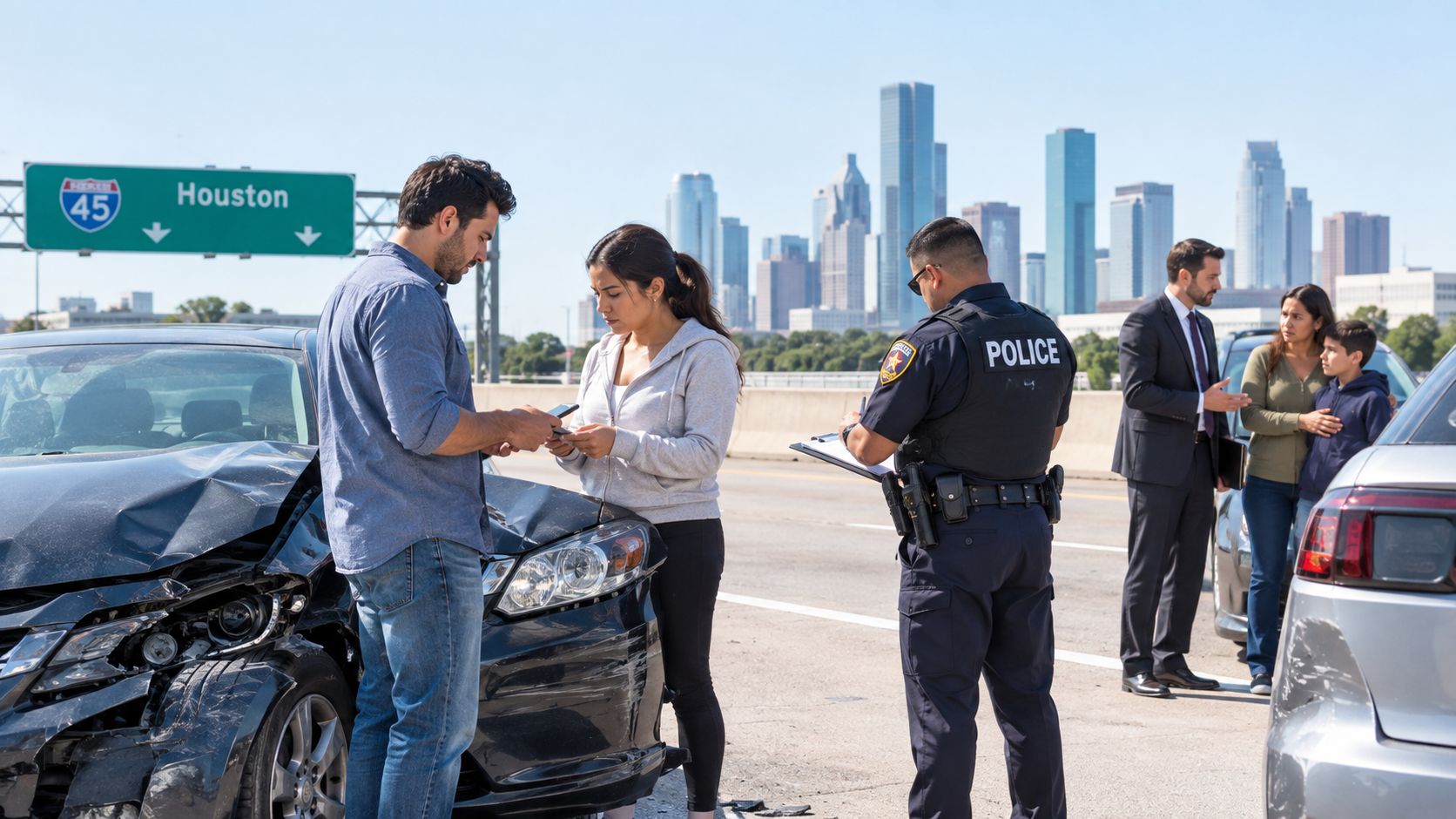
The easiest way to understand Brainard is to put it on a timeline. First, you gather proof. Then fault and damages are disputed or resolved. Only after legal entitlement is established does the payment clock change in a meaningful way. These examples show how that plays out for Texas families.
Houston example with an uninsured driver
You are hit on I-45 by a driver who darts across lanes and has no usable insurance. You report the crash, get treatment, and send your UM carrier photos, records, and witness information. The carrier still may argue about fault, your injuries, or both.
That surprises many families. They assume their own policy works like roadside assistance. It does not. UM coverage works more like a substitute for the at-fault driver's missing liability insurance, so you still have to prove the other driver caused the crash and the amount of your damages.
Fault disputes also affect value. Texas comparative responsibility rules can reduce recovery if the evidence shows you share blame, and they can bar recovery if a factfinder puts too much fault on you. In plain English, a lane-change argument or a distracted-driving allegation can make a major difference.
What this means on the timeline: your demand package matters early because it helps build the claim, but it does not by itself start a mandatory payment deadline under Brainard.
Example showing the UIM gap
Now change the facts. The other driver has insurance, but not enough to cover the harm. That is the classic UIM problem.
A simple way to picture it is a bucket with a hole in the side. Your total damages fill the bucket. The at-fault driver's policy pays first, but if that payment does not reach the full loss, UIM coverage may fill part of the remaining gap, up to the policy limits and subject to proof.
That is why a large injury case can still turn into a relatively small UIM dispute. The case is not about the full amount in the abstract. It is about the unpaid portion that remains after the other driver's coverage is credited.
What this means on the timeline: payment is tied to the proven shortfall, not just to the fact that you were badly hurt.
Catastrophic injury or wrongful death example
After a truck collision on the Katy Freeway, a family may be dealing with a brain injury, a spinal cord injury, or the loss of a loved one. These cases often involve more records, more expert opinions, and harder fights over causation and future losses.
The Brainard rule still works the same way. The size of the loss does not erase the need to establish liability and damages. It often makes those disputes sharper, because the financial stakes are higher.
Time matters here for another reason. Texas deadlines can cut off a claim if suit is not filed on time. Meanwhile, vehicle data can disappear, witnesses can become harder to find, and the story of the crash can get less clear instead of more clear.
What this means on the timeline: in a severe injury or death case, early legal planning helps preserve proof before the case reaches the stage where payment is owed.
The practical lesson after a Houston crash
Families often ask a fair question. If a pre-suit demand does not force payment, why put so much effort into it?
Because it still shapes the case. Good records, clear photos, witness statements, and careful damage proof can pressure the insurer to evaluate the claim seriously, narrow what is really disputed, and position the case for settlement or trial. Then, if a judgment becomes necessary, you are not starting from scratch.
The timeline is the key. Before legal entitlement is established, the insurer can keep contesting fault, damages, or underinsured status. After that point, the focus shifts to tender and the consequences of delay. For an injured Texas family, knowing where you are on that timeline can make the process feel far less confusing.
What to Do After a Crash to Protect Your UM/UIM Claim
A Houston driver gets hit on I-45 by someone who has no insurance. The ambulance leaves, the car is towed, and by that night the injured family is already getting calls from insurers. It is easy to feel behind. You are not behind. You just need to protect the proof that will matter later if your UM or UIM carrier disputes fault, the seriousness of the injuries, or the amount owed.
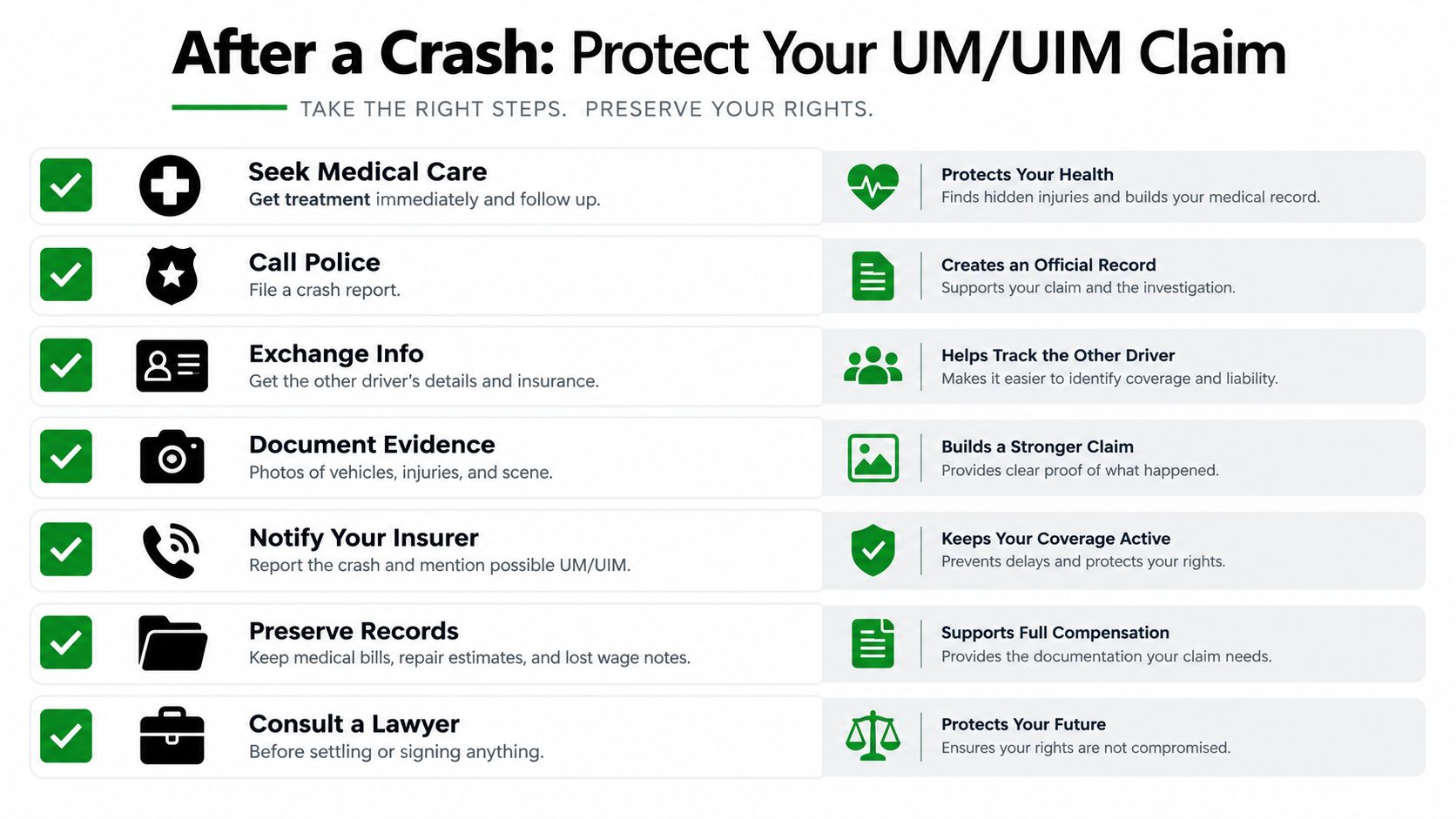
The steps that protect your claim position
Brainard makes timing matter. Payment is usually not owed just because you reported the crash or sent a demand. That means the early phase is about building the case carefully, piece by piece, so you can prove what happened and what it cost you.
Start with medical care. Your health comes first, and early treatment creates a clear record that connects the crash to your injuries.
Call police if you can and get the report number. In UM/UIM cases, that report often becomes the first draft of the liability story.
Take photos before the scene changes. Get the vehicles, license plates, skid marks, road layout, weather, debris, and visible injuries. A phone camera often preserves facts that disappear by the next morning.
Keep every paper and every email. Bills, discharge instructions, imaging reports, prescription receipts, missed-work notes, repair estimates, and health insurance notices all help show the full loss.
Notify your insurer, but stay careful and simple. Give the basic facts. Do not guess about speed, fault, or how long your recovery will take.
Pause before giving a recorded statement or signing broad medical releases if the injuries are serious. Those steps can shape the claim early, and once a version of events gets into the file, it can be hard to correct.
If you need a practical checklist, this guide on what to do after a car accident in Texas walks through the first steps in plain English.
Why these early steps matter under the Brainard timeline
A UM/UIM claim works a little like building a file for a future test. The grade does not come from how strongly you ask. It comes from the proof you can show.
That is why delay can hurt. Cars get repaired. Video gets overwritten. Witnesses stop answering unknown numbers. Medical gaps give insurers room to argue that something else caused the problem.
Fault rules matter too. If the insurer argues that you caused too much of the crash, your recovery can shrink or disappear. Early evidence helps keep the case tied to what happened instead of what gets assumed later.
When it makes sense to call a lawyer
Early legal help often matters most in cases with serious injuries, disputed fault, an uninsured or underinsured driver, or a death. A lawyer can help collect records, preserve evidence, deal with adjusters, and prepare the case for the point on the Brainard timeline where legal entitlement must be established.
If you are gathering materials on your own, even a resource with sample language for demand letter can help you understand how people organize medical treatment, lost wages, and liability facts into a clear presentation.
The Law Office of Bryan Fagan, PLLC is one option for Texans who want help with accident investigation, insurer communication, and contingency-fee representation, meaning attorney's fees are tied to recovery rather than paid up front.
You Deserve Answers and Help Recovering After a Texas Crash
A serious wreck can leave a family in a strange limbo. The injuries are real. The bills are coming. Yet under Brainard, the UM/UIM insurer may still say payment is not due yet because legal responsibility has not been established.
That rule feels backward to many people at first. The plain-English version is this: UM/UIM coverage is not like handing a receipt to a cashier and waiting for change. It works more like finishing the last step in a claim checklist. Until liability and the amount owed are legally established, the insurer can dispute payment.
That does not erase your rights. It changes the order of events.
For injured Texans, the timeline matters. First comes medical care, investigation, and proof of fault and damages. Then comes the work of showing what the uninsured or underinsured driver should legally owe. If a court enters judgment, the insurer's duty to pay is triggered under the policy and Texas law. That timing also affects when a carrier may face exposure for attorney's fees or interest after the post-judgment payment window closes.
Families dealing with a fatal crash, a commercial vehicle collision, or a serious Houston freeway wreck often need help because these cases mix grief, insurance rules, and hard deadlines. A lawyer can explain where the claim stands on the Brainard timeline, what evidence still needs to be gathered, and whether the insurer's position is a real legal dispute or simple delay.
You do not need to sort that out alone.
If you are facing a UM or UIM dispute after a serious Texas crash, the team at Law Office of Bryan Fagan, PLLC helps injured people and families understand when payment is owed, how Brainard affects the case timeline, and what evidence can protect recovery. You can schedule a free consultation to talk through your accident, your insurance issues, and the practical next steps available under Texas law.