A serious accident can change your life in seconds — but you don’t have to face it alone. One moment you're walking through a familiar Houston grocery store or crossing a parking lot, and the next, you're on the ground, disoriented and in sharp pain. A sudden slip and fall is not just an accident; it's a life-altering event that can leave you feeling overwhelmed, hurt, and unsure where to turn.
The Sudden Impact of a Slip and Fall
A sudden slip and fall can be embarrassing, and it's easy to want to brush it off or even blame yourself. But these incidents are rarely just simple "accidents."

More often than not, they happen because a property owner failed to keep their premises safe for visitors. This guide is here to help you understand your rights, what steps to take to protect your claim, and how to hold the negligent parties accountable. We are here to offer you clarity, trust, and hope.
Understanding the Dangers and Prevention
To truly understand how life-altering these incidents can be, it helps to consider some essential tips for safer living to prevent falls in the first place. A serious fall can cause a chain reaction of devastating injuries that impact your ability to work, provide for your family, and simply enjoy your life.
Common injuries we see from slip and fall cases include:
- Broken bones, especially in the hips, wrists, and ankles.
- Head injuries, from concussions to more severe traumatic brain injuries (TBIs).
- Spinal cord damage, which can lead to long-term or even permanent disability like a catastrophic injury.
- Deep cuts and severe bruising.
These injuries quickly lead to overwhelming medical bills and long, painful recovery periods. The financial and emotional stress can leave you and your family feeling lost, with no idea where to turn for help. You don't have to go through this alone. Knowing the right path forward is the first step toward getting justice and putting your life back together.
A fall can happen anywhere—from a restaurant in Dallas to an office building in Austin—but the consequences are always deeply personal. Your focus should be on getting better, not fighting with insurance adjusters.
An experienced Texas personal injury lawyer can take on the legal battle for you while you heal. At The Law Office of Bryan Fagan, PLLC, we’re here to provide clarity and hope. If you’re ready to talk about your case, our team is standing by for a free consultation to go over your options.
What Are Your Legal Rights Under Texas Law?
After a serious fall, it’s easy to feel overwhelmed and unsure of what to do next. Taking back control starts with understanding your legal rights. In Texas, these kinds of cases fall under a legal concept known as premises liability.
This principle means property owners have a legal responsibility, or a “duty of care,” to keep their property reasonably safe for visitors. But just how far that duty goes depends entirely on why you were on the property in the first place.
Your Visitor Status Determines the Duty of Care
Texas law separates visitors into three different groups, and the property owner's responsibility is different for each. Figuring out which category you fit into is the first critical step in any slip and fall claim.
To make it clear, here’s a breakdown of how Texas law views each type of visitor and what the property owner owes them.
Visitor Status and Property Owner's Duty of Care in Texas
| Visitor Status | Definition | Property Owner's Duty of Care |
|---|---|---|
| Invitee | Someone on the property for the owner's financial benefit, like a customer in a store or a client in an office. | The owner must protect you from dangers they know about or should have known about through reasonable inspection. This is the highest duty of care. |
| Licensee | A social guest with permission to be on the property but not for the owner's financial benefit, like a friend at a dinner party. | The owner only has a duty to warn you of dangers they actually know about. They do not have a duty to inspect the property for unknown hazards. |
| Trespasser | Someone on the property without any permission. | The owner generally only owes a duty not to intentionally injure the trespasser. The primary exception involves protecting children from known dangers like unsecured swimming pools. |
Most slip and fall claims involve an invitee. Let's say you slipped on a puddle in a Houston supermarket. Because you were a customer, the store owed you the highest duty of care. They had a responsibility to regularly check for spills and clean them up before someone got hurt.
The Four Elements of a Negligence Claim
To successfully pursue a slip and fall case, you and your attorney have to prove four key things. This is the core of proving negligence. Think of them as the four legs of a table—if even one is missing, the whole claim falls apart.
- Duty: The property owner had a legal duty to provide a reasonably safe environment for you.
- Breach: The owner failed to meet that duty, either by not fixing a dangerous condition or by not warning you about it.
- Causation: The owner's failure is what directly caused your fall and your injuries.
- Damages: As a result of the fall, you suffered real losses that can be compensated, like medical bills, lost income, and pain.
For example, imagine you fall on a broken, poorly lit staircase in a Dallas apartment complex. The landlord had a duty to maintain safe common areas for tenants. By failing to fix the step or replace the lightbulb, they breached that duty. That broken step caused you to fall and break your leg. The cost of your surgery, physical therapy, and time away from work are your damages.
Understanding Proportionate Responsibility in Texas
Texas operates under a rule called "proportionate responsibility," which you might also hear called comparative responsibility. This legal rule looks at whether your own actions played a part in the accident.
The law recognizes that sometimes, an accident isn't 100% one person's fault. If a jury decides you were partially to blame for your fall, any money you're awarded will be reduced by your percentage of fault.
For instance, if the court awarded you $100,000 in damages but found you were 20% at fault for looking at your phone when you tripped, your award would be cut by 20%, leaving you with $80,000.
Here’s the critical part: if you are found to be 51% or more at fault, you get nothing. Texas law bars you from recovering any compensation at all. Insurance companies love to use this rule to shift blame and deny claims, which is why having an experienced Texas personal injury lawyer is so crucial.
How Long Do You Have to File a Claim in Texas?
On top of all this, strict deadlines apply. You can learn more about how long you have to file a claim in our guide to the Texas statute of limitations for personal injury.
Critical First Steps After a Slip and Fall Accident
In the chaotic, painful moments after a fall, it’s easy to feel completely disoriented. But the steps you take right then and there are absolutely vital for protecting your health and your legal rights. What you do next lays the groundwork for a successful claim.
Your first priority is always your well-being. Even if you think you’re not badly hurt, you must seek prompt medical attention. Some devastating injuries, like internal bleeding or concussions, don't show obvious signs right away.
Going to an emergency room or your own doctor creates an official medical record. This document is the key to linking the fall directly to your injuries. Without it, you can bet the insurance company will argue your injuries happened somewhere else, at some other time.
Formally Report and Document the Incident
Once you’ve taken care of your immediate medical needs, you need to formally report what happened to the property manager, owner, or whoever is in charge. Politely insist on filing an official incident report and ask for a written copy before you leave. This piece of paper is critical—it’s proof the event occurred and that management knew about it.
Next, it’s time to be your own investigator. If you're physically able, pull out your smartphone and start documenting everything. Capturing clear evidence on the spot is essential because hazardous conditions are often cleaned up or repaired with stunning speed right after someone gets hurt.
Key things to photograph include:
- The Hazard: Take multiple pictures of whatever caused you to fall—the puddle, the broken tile, the icy patch. Get shots from different angles, both close-up and from a distance.
- The Surrounding Area: Capture wide shots of the aisle, walkway, or staircase. This shows the bigger picture, like a lack of warning signs.
- Your Injuries: Photograph any visible cuts, bruises, or swelling as soon as you can.
- Your Footwear: Snap a quick picture of the shoes you were wearing when you fell.
This visual evidence can be incredibly powerful in proving exactly what happened. This infographic breaks down the basic legal elements your evidence will need to support.
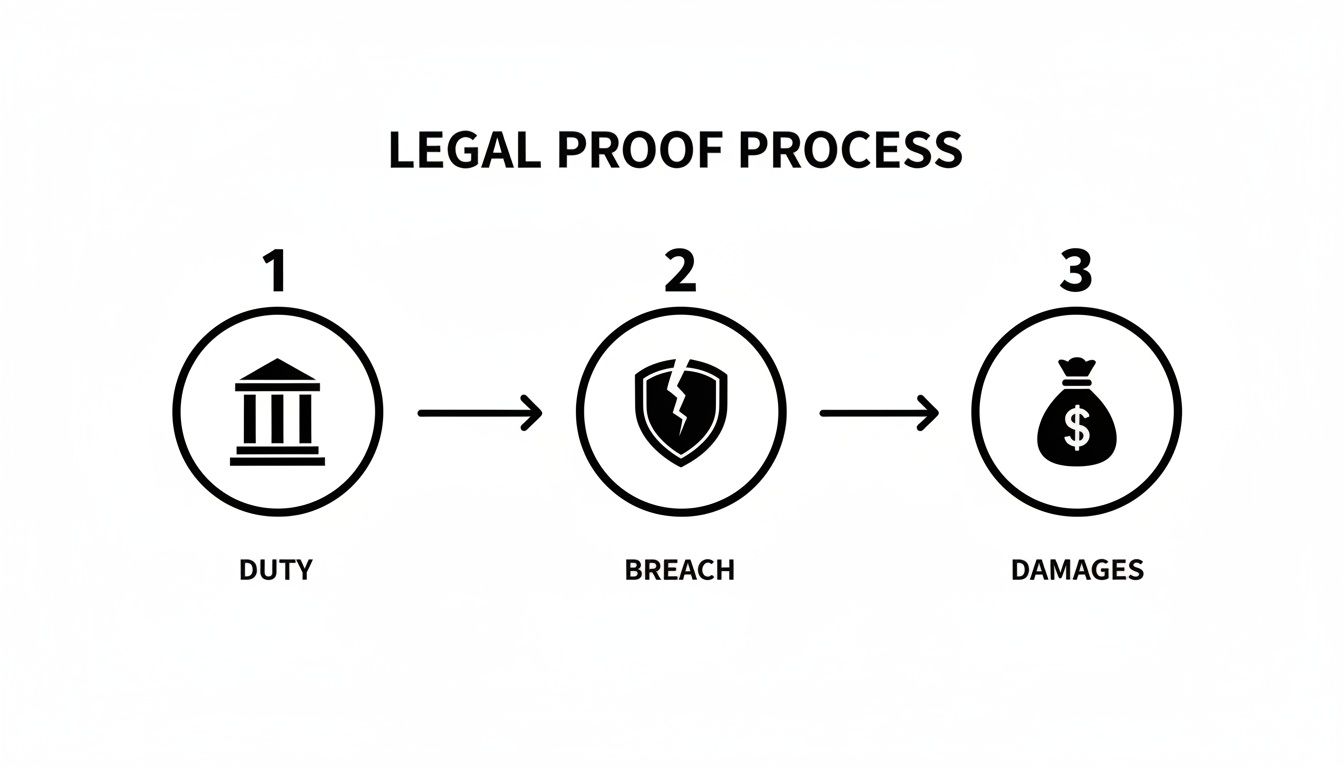
The photos and reports you gather help establish the property owner’s duty to keep you safe, their failure to do so, and the damages you suffered because of it.
Gather Witness Information
If anyone saw you fall, their testimony can be invaluable. A neutral third party can confirm your side of the story and shut down any attempts by the property owner to blame you for the accident.
Ask for their full name and contact information. If they seem willing, you might even ask them to jot down a quick note about what they saw while it’s still fresh in their mind. A witness might have noticed the hazard long before you fell, which helps prove the owner had more than enough time to fix it but simply failed to act.
It is crucial to gather evidence before it disappears. Property owners have been known to quickly repair a hazard or even destroy security footage after an accident occurs.
Failing to preserve evidence is a serious issue. You can learn more about the legal consequences when one party intentionally hides or destroys evidence in our article on what spoliation of evidence is. Taking these first steps helps create a solid record that can't be easily brushed aside by insurance adjusters.
A serious fall can throw your entire life into turmoil, but you don’t have to manage the aftermath alone. By taking these initial actions, you protect your ability to seek justice. The Law Office of Bryan Fagan, PLLC, is here to help you use this information to build a powerful case. Contact us today for a free, no-obligation consultation to discuss your situation and learn how we can help you recover.
How to Prove Negligence in Your Slip and Fall Case

Proving a property owner was negligent is the absolute heart of any successful Texas slip and fall claim. It’s a common misconception that if you fall on someone else's property, they are automatically responsible. That’s just not how Texas personal injury law works.
You and your attorney have to prove the owner failed in their legal duty to keep you reasonably safe.
The entire case hinges on showing the owner had what the law calls "actual or constructive notice" of the hazard. In plain English, this means we have to prove they either knew about the dangerous condition or should have known about it—and failed to fix it or warn you.
Actual Notice vs. Constructive Notice
Understanding the difference between these two concepts is make-or-break, as it shapes the entire strategy for gathering evidence.
Actual Notice: This is the straightforward one. It means the property owner or an employee was directly aware of the hazard. For example, if another customer tells a grocery store manager about a spill in Aisle 5, the store has actual notice. From that moment on, they have a duty to act.
Constructive Notice: This is far more common and usually requires more digging to prove. It means a dangerous condition was present for so long that any reasonably careful owner should have discovered it during normal operations.
Think of a leaky freezer in a Dallas supermarket. If it's been dripping for hours and created a large, hidden puddle, a court will likely agree that a responsible manager doing regular safety sweeps should have found it. That’s constructive notice.
On the flip side, if a shopper drops a jar of salsa and you slip on it ten seconds later, it's nearly impossible to argue the store had a reasonable chance to find and clean it up.
The Evidence We Use to Build Your Case
After a serious fall, you should be focused on one thing: your recovery. The last thing you need is the stress of chasing down evidence and battling an insurance company. That’s our job.
At The Law Office of Bryan Fagan, PLLC, our investigative team gets to work the moment you hire us. We know exactly what to look for and how to get our hands on it before it disappears. When piecing together what happened, we look at every angle, including the scope of security guard liability, as their actions—or inaction—can be a critical part of the puzzle.
In our experience, a thorough investigation often reveals a pattern of carelessness or a history of prior incidents. What looks like a simple "accident" to an insurer can be exposed as undeniable negligence when the right evidence is uncovered.
Key Investigative Strategies
Our attorneys don't just send a letter and hope for the best. We use proven methods to build a claim that the other side has to take seriously.
The evidence we routinely use to win these cases includes:
Sourcing Surveillance Footage: We immediately send legal notices to preserve any security camera footage before it’s erased. Video is often the most powerful proof of how long a hazard existed before your fall.
Reviewing Maintenance Logs: We demand to see sweep logs, cleaning schedules, and repair records. These documents often tell a story, revealing if a business was following its own safety rules or cutting corners. Gaps in the logs can be just as powerful as what’s written in them.
Interviewing Employees and Witnesses: We track down and talk to current and former employees. A statement from someone who knew about the unsafe condition—or a management team that ignored complaints—can completely change the course of a case.
Consulting with Safety Experts: We frequently bring in professional safety engineers to analyze the accident scene. Their expert testimony can confirm whether the property met industry safety standards, giving your claim immense credibility.
By weaving these elements together, we turn a tough "he said, she said" situation into a clear-cut case for liability. We handle the fight so you can focus on healing.
Calculating Fair Compensation for Your Injuries
After a serious fall, one of the first questions that races through your mind is, “What is my case actually worth?” It’s a completely natural question. But the answer isn't simple, because a fair settlement needs to cover far more than just your initial ER visit.
True compensation accounts for every single way the injury has turned your life upside down, both financially and personally. In Texas, this compensation is legally called "damages," and it's intended to put you back in the position you were in before the accident. To do that, we have to meticulously calculate every loss, which are broken down into two main types.
Understanding Your Economic Damages
First up are economic damages. The easiest way to think about these is as the tangible, out-of-pocket losses that come with a clear price tag. These are the straightforward costs tied directly to the slip and fall, and our job is to track and document every last penny.
A full accounting of economic damages always includes:
- All Past and Future Medical Bills: This goes way beyond the first ambulance ride. It covers everything from surgery and hospital stays to follow-up appointments, physical therapy, prescription drugs, and even medical gear like crutches or a wheelchair.
- Lost Wages: If your injuries forced you to miss weeks or even months of work, you have a right to be paid back for that lost income. We use your pay stubs and work records to prove exactly how much you lost.
- Diminished Earning Capacity: This is a big one. What happens if your injury is so bad you can never go back to your old job? If a construction worker suffers a permanent back injury and can no longer lift heavy materials, we calculate the difference in their earning potential over a lifetime. This is critical for anyone facing a long-term disability.
To prove these damages, we gather a mountain of paperwork—every bill, every receipt, every pay stub. We also bring in medical and financial experts who can testify about the cost of your future care and the full impact on your ability to provide for your family.
For example, let's say a Houston office manager slips on a freshly mopped but unmarked floor and suffers a severe spinal injury. Her economic damages would include $150,000 for her surgery and hospital stay, $45,000 in lost salary while she recovered for six months, and an expert-projected $250,000 for future physical therapy and pain management.
Valuing Your Non-Economic Damages
The second category, which is often the largest part of a claim, is non-economic damages. These are the profound human costs—the losses that don’t come with a receipt but are just as real and devastating. No amount of money can ever erase suffering, but the law provides a way to compensate you for it.
This category covers the immense personal toll of the accident:
- Pain and Suffering: This is for the physical pain of the injury itself, the discomfort during recovery, and any chronic pain that might never go away.
- Mental Anguish: This includes the emotional trauma that comes with a serious accident, like anxiety, depression, fear, or even PTSD.
- Physical Impairment: Compensation for the loss of function of a part of your body.
- Disfigurement: This is for scars or other permanent, visible changes to your appearance.
- Loss of Enjoyment of Life: This acknowledges that your injury has robbed you of the ability to enjoy your hobbies, daily activities, and time with the people you love.
Proving these damages means we have to tell your story in a powerful, compelling way. We use your medical records, personal journals, and testimony from you, your family, and your friends to paint a clear picture of how this fall has completely changed your life. Our goal is to make sure the insurance company—or a jury—understands the true human cost of the property owner's negligence.
To get a deeper understanding of how these damages work together, you can learn more about economic vs. non-economic damages in our detailed guide.
Why an Experienced Slip and Fall Lawyer Is Essential
Trying to take on a slip and fall claim by yourself means you’re walking into a battle against massive insurance companies and their armies of corporate lawyers. They have one job: protect their profits by paying you as little as they can get away with—or even better, nothing at all.
This is where having an experienced Texas personal injury lawyer in your corner becomes your single most important asset.
Handling complex legal paperwork and deadlines while trying to recover from a serious injury is a burden no one should have to carry alone. When you hire our firm, you’re not just getting a lawyer; you’re getting an advocate who levels the playing field. We step in and handle all the phone calls, negotiations, and legal filings, shielding you from the high-pressure tactics insurers use to bully victims into taking pennies on the dollar.
Your Advocate and Investigator
A winning claim is built on a foundation of solid evidence. From the moment you partner with us, The Law Office of Bryan Fagan, PLLC, launches a full-scale investigation into exactly what happened.
We move quickly to:
- Preserve Crucial Evidence: We immediately send legal notices to the property owner, demanding they preserve surveillance footage before it’s erased and turn over maintenance logs and incident reports.
- Interview Witnesses: Our team gets to work tracking down anyone who saw the accident, getting their statements locked in while memories are still fresh.
- Consult Experts: We have a network of forensic and medical experts we can call on to provide powerful, credible testimony about the owner’s negligence and the true cost of your injuries.
We also know the clock is ticking. In Texas, you generally have just two years from the date of the accident to file a lawsuit. This deadline is called the statute of limitations. If you miss it, your right to seek any compensation is gone forever. We make sure every deadline is met and your rights are protected.
Hiring a dedicated advocate isn't just a cost—it's an investment in your physical and financial recovery. We handle the fight so you can focus on healing.
You Pay Nothing Unless We Win
The last thing you need after getting hurt is another bill to worry about. That’s why we handle all slip and fall cases on a contingency-fee basis.
What does that mean for you? It’s simple: you pay zero upfront costs or attorney’s fees. We only get paid when we win your case and recover money for you.
This approach guarantees that everyone, regardless of their financial situation, can have access to top-tier legal representation. It also means our goals are perfectly aligned with yours—to get you the absolute maximum compensation possible for your injuries and losses.
Whether you’re dealing with a catastrophic injury, a wrongful death, a car accident, or a complex dispute over who was at fault, our team is ready to fight for you. You don’t have to face the insurance companies alone.
Common Questions After a Texas Slip and Fall
When you're recovering from a serious slip and fall, it’s natural to have a lot of questions weighing on your mind. Getting clear answers is the first step toward feeling in control again. Here are some of the most common concerns we hear from people just like you.
What if I Fell at Work?
If your fall happened on the clock, the situation is a bit different. Your claim will most likely go through the Texas workers' compensation system, not a typical personal injury lawsuit.
Workers' comp is designed to get you medical and wage benefits quickly, without having to prove who was at fault. But there are exceptions. If your employer doesn't carry workers' comp insurance (which isn't mandatory in Texas) or if a third party, like a careless contractor on-site, caused your fall, you might still have a personal injury claim.
How Long Do I Really Have to File a Lawsuit in Texas?
This is a critical deadline you absolutely cannot miss. In Texas, the statute of limitations for a slip and fall injury is two years from the day you got hurt.
There are very few exceptions to this rule. If you try to file a lawsuit even one day after that two-year window closes, the court will almost certainly throw out your case. You will lose your right to seek any compensation, no matter how strong your claim is.
What if They Say I Was Just Clumsy or on My Phone?
This is one of the oldest tricks in the book. Property owners and their insurance companies will almost always try to shift the blame onto you. They’ll argue you were distracted, not watching where you were going, or just plain clumsy.
In Texas, this is a serious defense strategy. Under our state’s proportionate responsibility rule, you cannot recover any money if a jury finds you 51% or more at fault for your own fall. An experienced Houston car accident attorney or personal injury lawyer is crucial here. We can fight back against these accusations by gathering evidence like security footage, maintenance logs, and witness statements to show the property owner’s negligence was the real reason you fell.
The insurance adjuster's job is not to be fair; it's to save their company money. They will use any excuse they can find to blame you and reduce or deny your claim. Having a strong legal advocate in your corner is your best defense.
How Much Does It Cost to Hire a Personal Injury Lawyer?
We know that the last thing you need after an injury is another bill. That's why we handle all slip and fall cases on a contingency-fee basis.
It’s simple: you pay absolutely nothing upfront. We cover all the costs of building and fighting your case. We only get paid if we win a settlement or verdict for you.
A sudden injury can throw your entire life off course, but you don’t have to go through this alone. Recovery is possible, and legal help is available. The team at The Law Office of Bryan Fagan, PLLC, is ready to stand up for you and fight for the justice you deserve. To get the support and guidance you need, schedule a free, no-obligation consultation by visiting our contact page.