A car crash on a busy Texas freeway can change your life in seconds. If you're dealing with the persistent, nagging pain of whiplash, you are not alone, and you don’t have to face it alone.
For most minor cases, whiplash settlements in Texas typically range from $8,000 to $24,000. However, that number can climb significantly depending on just how severe your injury is and the real-world impact it has on your daily life. Knowing what fair compensation actually looks like is the first step toward getting the resources you and your family need to start moving forward.
Your Guide to Fair Whiplash Compensation in Texas

Whether you were rear-ended in a Houston traffic jam or caught in a collision on a major highway like I-45 or the Katy Freeway, that sudden jolt can leave you with a painful whiplash injury. This kind of soft tissue damage to your neck is one of the most common outcomes of a car wreck, but it's also one of the most misunderstood and undervalued by insurance companies.
If you're dealing with that relentless neck pain, you're in the same boat as countless other Texans. Industry data consistently shows that minor whiplash cases, especially from rear-end collisions, often settle for between $8,000 and $24,000. That compensation is meant to cover things like your emergency room visit, follow-up chiropractic care, and the wages you lost while you were out of work recovering. You can read more about these personal injury claim averages to get a broader perspective.
This guide is here to give you clear, practical knowledge about your rights and what to expect. While the road to recovery can feel long and overwhelming, understanding how settlements are calculated is a critical first step toward taking control of your future.
What Does a Whiplash Settlement Cover?
A fair settlement goes far beyond just your first few medical bills. It should account for every single way the accident has turned your life upside down, both financially and personally.
A common mistake is accepting an insurance company's first offer. These initial offers almost never cover the full long-term cost of a whiplash injury. You have the right to claim compensation for all your losses, not just the ones that are easiest to put a number on.
To give you a clearer picture, here is a breakdown of what a complete whiplash settlement should include. This table breaks down the different types of damages you can claim in a whiplash settlement in Texas, helping you understand the full scope of potential compensation.
What Your Texas Whiplash Settlement Should Cover
| Type of Damage (Compensation) | What It Covers | Example |
|---|---|---|
| Medical Expenses (Past & Future) | All costs related to your medical care, from the ambulance ride to physical therapy and any anticipated future treatments. | ER bills, MRI scans, chiropractor visits, prescription pain medication, and physical therapy sessions. |
| Lost Wages & Earning Capacity | Income you lost while unable to work and compensation if the injury permanently affects your ability to earn money. | Missing a week of work for recovery or having to switch to a lower-paying job due to chronic pain. |
| Pain and Suffering | Compensation for the physical pain, emotional distress, and mental anguish caused by the injury and its aftermath. | The daily discomfort, anxiety from driving, and stress on your family caused by the injury. |
| Loss of Enjoyment of Life | Compensation for the inability to participate in hobbies, activities, or daily routines you enjoyed before the accident. | Being unable to play with your children, garden, or participate in a recreational sports league. |
Ultimately, a settlement is designed to make you "whole" again in the eyes of the law by providing financial resources to cover the harm you've suffered. Understanding these different categories is key to fighting for what you truly deserve.
What Goes Into a Fair Whiplash Settlement?
One of the first questions on your mind after a crash is, "What's a fair settlement for whiplash?" The honest answer is that there’s no magic number. A truly fair settlement is one that covers the entire impact the injury has had on your life—from the stack of medical bills on your kitchen table to the pain that keeps you up at night.
The value of a whiplash claim can swing wildly. A minor neck strain that gets better in a few weeks with some ice and rest is going to have a much different value than a severe injury that demands months of physical therapy, painful injections, and leaves you with chronic pain. The second scenario could easily be worth tens of thousands of dollars or more.
Our job as your Texas personal injury lawyer is to cut through the noise and give you a realistic idea of what a fair outcome actually looks like for your specific situation.
The Foundation of Every Claim: Negligence in Texas
At the core of every personal injury claim in Texas is one simple idea: negligence. To get compensated, you have to prove that someone else was careless, and their carelessness is the direct reason you got hurt.
Picture this: you're stopped in traffic on a busy Houston freeway. The driver behind you is texting, completely oblivious to the sea of red brake lights. They slam into you. In that moment, the other driver was negligent. They failed in their basic duty to drive safely, and that failure caused the collision and your whiplash.
Proving this negligence is the first and most critical step. It’s what establishes that the other driver is legally "at fault" for the harm you've suffered.
What If They Say I Was Partially to Blame?
It's a common tactic. The other driver's insurance company might try to argue that you were also partly responsible for the accident. When this happens, Texas law applies a rule called modified comparative fault, or proportionate responsibility.
This rule says you can still recover money even if you share some of the blame, as long as your percentage of fault is 50% or less. Your final settlement, however, will be reduced by whatever percentage of fault is assigned to you.
Let's say a jury decides your total damages are $40,000, but they also find you were 10% at fault because one of your taillights was out. Under Texas law, your award would be cut by that 10% ($4,000), meaning you’d walk away with $36,000. But if the jury decided you were 51% or more at fault, you would get nothing at all.
Insurance adjusters love to use this rule to unfairly reduce what they owe. An experienced Houston car accident attorney can fight back against these attempts to shift blame and protect the full value of your claim.
Tallying Up the Full Cost: Economic and Non-Economic Damages
A fair settlement is built from two distinct types of compensation, known as damages. To understand the real value of your case, you have to account for both.
- Economic Damages: These are the clear, calculable financial losses you’ve incurred because of the accident. Think medical bills, receipts for prescriptions, and lost pay stubs. They have a paper trail.
- Non-Economic Damages: These are the intangible losses—the human cost of the injury. There’s no price tag for pain, anxiety, or the inability to enjoy your hobbies, but you deserve to be compensated for it.
These two categories work together to make sure a settlement doesn’t just cover your out-of-pocket expenses, but also acknowledges what you’ve had to endure. To get a deeper look at how these are calculated, check out our guide to economic vs. non-economic damages in Texas. A complete whiplash settlement must include both to truly make you whole again.
Key Factors That Drive Your Settlement Value

Insurance adjusters don't just pull settlement numbers out of thin air. They have a checklist of factors they analyze to figure out what your claim is worth to them—which is often far less than what it's truly worth to you.
Understanding these factors is the first step toward building a case that reflects the real impact the injury has had on your life. Think of it like building a house. Every part of your claim—from medical care to your personal suffering—needs a solid foundation of evidence. A seasoned Texas personal injury lawyer knows exactly how to gather that proof and present it in a way that tells your complete story.
The Severity and Duration of Your Injury
The single biggest driver of your settlement value is how badly you were hurt. A minor neck strain that resolves in a few weeks is going to command a much smaller settlement than a severe injury that leads to chronic pain, daily headaches, or numbness that radiates down your arm for months.
The specific diagnosis matters, too. A lasting pinched nerve in your neck is a much more serious issue than simple muscle soreness, and your settlement should reflect that. Insurance companies want objective proof of how severe your injury is and how long it's affecting you.
This proof usually comes from:
- Diagnostic Imaging: X-rays, MRIs, or CT scans are hard evidence that can show damage to your discs, ligaments, or vertebrae.
- Treatment Duration: The longer you need consistent medical care, like physical therapy or chiropractic adjustments, the more seriously the insurer has to take your injury.
- Medical Expert Opinions: Your doctor's notes are critical. They detail your prognosis and document whether you're facing long-term or even permanent limitations.
An injury requiring months of treatment isn't just an inconvenience; it's a significant disruption to your life, and that's what drives a higher settlement.
Your Total Medical Bills and Future Costs
Your medical bills are the starting point for almost every settlement negotiation. We call these "economic damages," and they include every single cost tied to your medical treatment. It's absolutely critical to keep a detailed record of every expense.
This includes everything from:
- The ambulance ride and emergency room visit
- Appointments with specialists like orthopedists or neurologists
- Physical therapy and rehabilitation sessions
- Prescription medications for pain and inflammation
- Medical devices like a cervical collar
But it doesn't stop with the bills you already have. A fair settlement must also cover your future medical needs. If your doctor says you'll need ongoing care, pain management injections, or even surgery down the line, we have to calculate those projected costs and include them in your demand.
Lost Wages and Impact on Your Earning Ability
Whiplash doesn't just hurt; it can stop you from earning a paycheck. If your injury forces you to miss work, that lost income is a key part of your claim. We calculate this using your pay stubs, W-2s, or other proof of what you would have earned.
Think about a construction worker in Houston who can't lift anything for six weeks because of neck stiffness. Or an office worker in Austin who gets such debilitating headaches that staring at a computer screen is impossible. In both scenarios, the lost income is a direct result of the crash and must be repaid.
In more serious cases, whiplash can permanently change your ability to do your job. If you have to take a lower-paying position or can't work full-time anymore, your settlement must include compensation for this loss of future earning capacity.
Calculating Your Pain and Suffering
This is often the largest piece of a whiplash settlement, but it's also the trickiest to put a number on. "Pain and suffering" is the legal term for the human cost of the injury—the physical pain, the emotional distress, the anxiety, and the loss of enjoyment of life you've been forced to endure.
Because there’s no receipt for pain, attorneys and insurance companies often use a "multiplier method" to estimate its value. They take the total of your medical bills and multiply it by a number (typically between 1.5 and 5) based on the severity of your injury and its impact on your life.
For example, someone with $10,000 in medical bills who makes a full recovery might get a 2x multiplier, adding $20,000 for pain and suffering. But another person with the same $10,000 in bills who is left with chronic pain and can no longer play with their kids might warrant a 4x multiplier, adding $40,000.
To see how this plays out in the real world, picture a driver on a Dallas-Fort Worth freeway who gets rear-ended by someone texting. The whiplash requires months of physical therapy and triggers chronic headaches. While recent data shows the average whiplash settlement is around $18,950, a case like this could easily reach $50,000 or more, especially for an injury that lasts 6-9 months with documented therapy. When medical bills climb over $10,000 and the injury severely impacts family life or work, multipliers of 3-5x can push settlements into the six-figure range, especially when other injuries like back strains are involved.
Building a Strong Foundation with Critical Evidence
A successful whiplash claim isn't built on luck; it's built on a foundation of solid, undeniable proof. After a crash, your head is spinning and you feel completely overwhelmed. But taking a few key steps right away can protect your rights and set the stage for the fair settlement you deserve.
Think of it like a detective gathering clues at a crime scene. Each piece of evidence helps paint a clear, undeniable picture of what happened, who was at fault, and how this injury has turned your life upside down.
The at-fault driver's insurance company will be looking for any crack in your story—any reason to downplay your pain, question your injuries, or shift the blame. A strong collection of evidence shuts those arguments down before they even start. It replaces their assumptions with hard facts.
Your Immediate Post-Accident Checklist
What you do in the first few hours and days after an accident can make or break your ability to recover compensation. The groundwork for your entire whiplash settlement starts right at the scene of the crash. If you've Been In A Car Accident Bell District Spine And Rehab Can Help, getting the right medical care is the first critical step.
Here are the most important pieces of evidence you need to lock down:
- Seek Immediate Medical Care: This is the #1 most important step for both your health and your claim. Adrenaline is a powerful painkiller and can easily mask serious injuries right after a collision. Going to a doctor creates an official record that ties your whiplash directly to the accident, making it incredibly difficult for an insurer to argue it happened some other time.
- Obtain the Official Police Report: A police report is an objective, third-party account of what happened. It often includes the officer's initial assessment of who was at fault, contact information for witnesses, and a diagram of the crash scene. This document can be invaluable for proving the other driver’s negligence.
- Take Photos and Videos: If you're able to, use your smartphone to document everything. Snap pictures of the damage to both vehicles from every angle, the position of the cars on the road, any skid marks, and the surrounding area, including traffic lights or stop signs. These images can powerfully reconstruct the moments leading up to the impact.
Telling Your Story with Supporting Evidence
Once you've secured the immediate evidence from the scene, you need proof that tells the rest of the story—the story of your pain, your losses, and the day-to-day impact this injury has had on you.
Keeping a simple daily journal is one of the most powerful tools you have. Jot down your pain levels, where you feel discomfort, any new symptoms like headaches or dizziness, and how the injury is stopping you from doing normal things like working, exercising, or even just sleeping through the night.
Witness statements can also be incredibly persuasive. If anyone saw the crash, get their name and phone number. An independent account of a driver blowing through a red light or looking down at their phone can completely dismantle any attempt by the other party to deny fault. Unfortunately, evidence can sometimes be "lost" or even intentionally destroyed. If you suspect this is happening, it's critical to understand your rights regarding the spoliation of evidence in Texas personal injury cases.
Let's put it all together. Imagine a delivery truck runs a stop sign on a busy San Antonio road and T-bones your car. Your immediate actions—calling 911, getting a police report that clearly notes the truck driver’s fault, and taking photos of the intersection and the mangled vehicles—establish clear liability. Your follow-up actions—seeing a doctor who diagnoses whiplash and keeping a pain journal—document the severity and real-world impact of your injury. Together, these pieces create a foundation of proof that leaves the insurance adjuster with very little room to argue.
Navigating Insurance Company Tactics and Claim Timelines
Dealing with an insurance company can quickly become the most frustrating part of getting a fair whiplash settlement. After an accident that wasn't your fault, you naturally expect them to do the right thing. But the hard truth is, their primary goal is to protect their profits by paying you as little as they possibly can.
This means you need to be ready for the road ahead. Understanding their playbook and the legal deadlines that control your claim is the only way to protect your rights and get the compensation you're owed. Knowing what's coming empowers you to stand firm against their pressure tactics.
Common Tactics Used by Insurance Adjusters
Insurance adjusters are skilled negotiators, trained to use specific strategies designed to chip away at your claim's value. Just being aware of these moves is the first step in beating them.
A few of their go-to tactics include:
- Quick, Lowball Offers: They might call you right after the crash with a fast settlement offer. This is a calculated move to get you to accept before you even know how bad your injuries are or what your medical bills will look like. If you take it, you lose your right to ask for more money later.
- Requesting a Recorded Statement: An adjuster will often ask for a recorded statement about the accident. They can then twist your words or use innocent comments out of context to argue you were partly at fault or that your injuries aren't as severe as you say.
- Downplaying Your Injury: Whiplash is a classic target for this tactic. Adjusters love to call it a "minor" sprain that should heal in a few weeks, completely ignoring the potential for chronic pain, debilitating headaches, and long-term complications.
It is absolutely crucial to be careful in every conversation. For more in-depth advice, you can learn how to deal with insurance adjusters in our dedicated guide.
How Long Do You Have to File a Claim in Texas?
In Texas, the law puts a strict clock on your right to file a personal injury lawsuit. This deadline is called the statute of limitations, and it’s non-negotiable.
For most personal injury claims, including whiplash from a car wreck, you have two years from the date of the accident to file a lawsuit. If you miss this deadline, you will almost certainly lose your right to recover any compensation through the courts—forever.
This two-year window is precisely why you can't afford to wait. Evidence gets lost, witnesses’ memories fade, and the insurance company will use any delay as an excuse to question how serious your claim really is.
The Claim Timeline from Start to Finish
The infographic below shows the critical first things you need to do to start building your case.
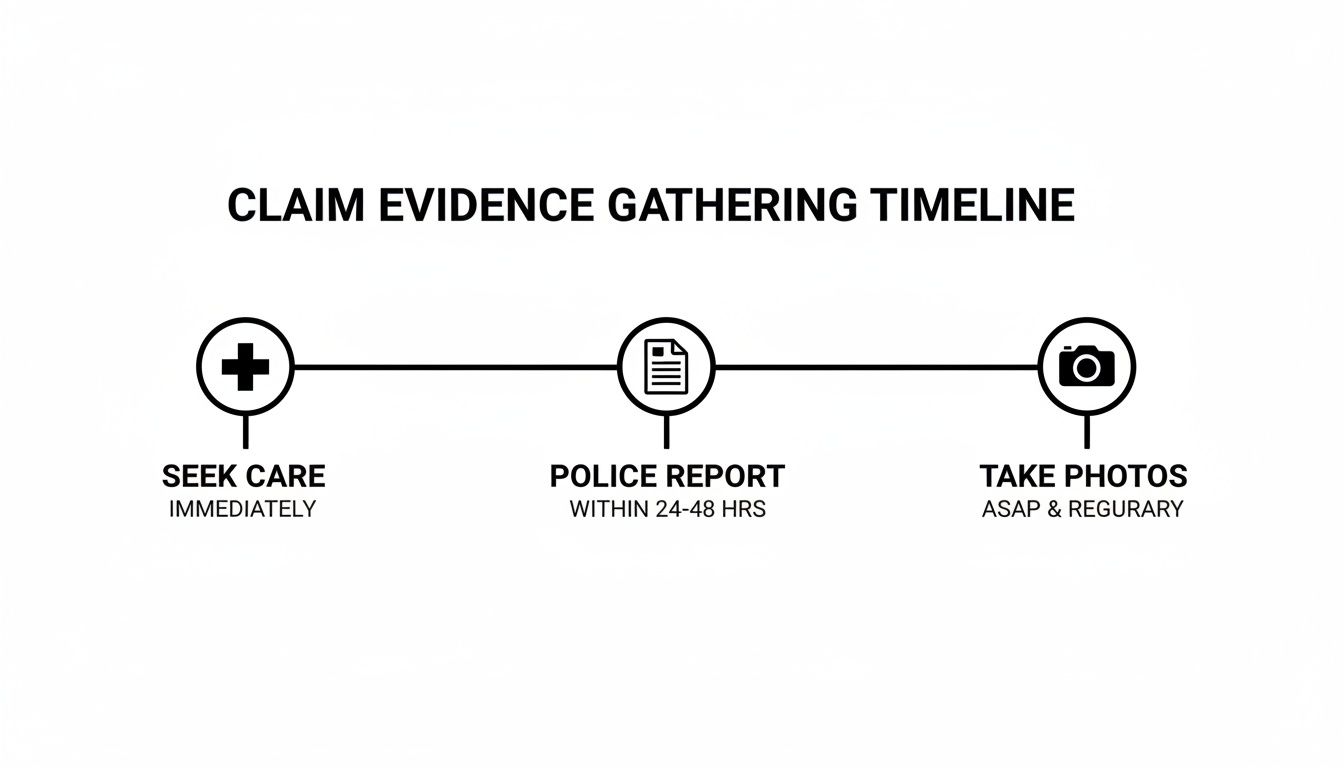
This initial evidence-gathering is the bedrock of your claim, giving you the proof needed to establish who was at fault and document your injuries. While a straightforward claim might settle in a few months, a more complex case with severe whiplash or a fight over liability could easily take a year or more, especially if a lawsuit is needed. An experienced Houston car accident attorney can manage this timeline, handle the insurance company, and fight for the fair settlement you are owed.
How a Texas Personal Injury Lawyer Protects Your Claim

After an accident, the last thing you should have to worry about is fighting an insurance company. You don’t have to face them alone. Hiring an experienced attorney from The Law Office of Bryan Fagan, PLLC, is the single most powerful step you can take to protect your rights and secure a fair settlement.
Our role is to immediately take the legal burden off your shoulders so you can focus on what's important: healing. From the moment you hire us, we handle every single call, email, and letter from the insurance companies. You won't have to deal with another adjuster trying to pressure you into a lowball offer.
Building a Case for Maximum Compensation
A strong whiplash claim is built on much more than just your first emergency room bill. We meticulously calculate the full, true value of your damages, making sure nothing gets overlooked.
This includes:
- Total Medical Costs: We gather every bill, from your MRI scans and physical therapy sessions to prescription costs and any medical care you’ll need in the future.
- Lost Wages and Future Earnings: We document every dollar of income you lost while recovering and, if your injuries are severe, calculate the impact on your long-term earning ability.
- Pain and Suffering: This is where we build a powerful case to show the true human cost of your injury—the daily pain, the emotional distress, and the loss of enjoyment in your life.
When necessary, we bring in medical experts to prove the severity of your injuries and gather all the evidence—police reports, witness statements, and medical records—to build a case that's hard to deny.
A common misconception is that hiring a lawyer is too expensive. We work on a contingency fee basis, which means you pay absolutely nothing unless we win your case. Our fee comes from the settlement we recover for you, so there is zero financial risk to get expert legal help.
We Are Your Advocates In and Out of Court
Our negotiators have seen every trick in the book that insurance adjusters use, and we know how to counter them. We will relentlessly pursue a settlement that covers all your losses. But if the insurance company refuses to be reasonable, we are always prepared to take your case to trial.
Whether it was a minor rear-end collision, a catastrophic truck crash in Houston, or a wrongful death case, our commitment to you is the same. We are here to fight for the compensation you rightfully deserve. Let our team handle the legal complexities while you concentrate on your recovery.
A serious accident can change your life in an instant—but you don’t have to face the aftermath alone. Recovery is possible, and expert legal help is available right now.
Questions We Hear All the Time About Texas Whiplash Claims
A serious accident can change your life in seconds — but you don’t have to face it alone. After a crash, it's completely normal to have a million questions running through your head. We've put together some clear, straight-to-the-point answers to the concerns we hear most often from clients dealing with whiplash injuries across Texas.
How Long Does It Take to Get a Whiplash Settlement in Texas?
The timeline for a whiplash settlement can be anywhere from a few months to more than a year. It really depends on the specifics of your case.
Simple, clear-cut cases where fault is obvious and the injuries are minor tend to settle much faster. But when you're dealing with a complex claim—think severe injuries, a fight over who's to blame, or an insurance company that just won't cooperate—things can drag on, especially if we have to file a lawsuit to get them to do the right thing.
Should I Accept the First Offer from the Insurance Company?
It is almost never a good idea to take the first offer. Think of it as the insurance company's opening bid, and it's always low. These initial offers are designed to close your case quickly and cheaply, often before you even know the true extent of your injuries and what your recovery will look like.
Always talk to a personal injury lawyer before you even think about accepting an offer. We can help you understand what your claim is actually worth so you don't leave money on the table.
In Texas, we have what's called the 'eggshell skull' rule. This means if an accident makes a pre-existing condition worse, the at-fault driver is on the hook for all the harm they caused. Having a prior neck issue doesn't disqualify you from getting compensation, but it makes having solid medical evidence absolutely critical to your case.
At The Law Office of Bryan Fagan, PLLC, we're here to give you the clear answers and strong representation you need to get back on your feet. Your recovery is possible, and legal help is available. If you're struggling with a whiplash injury after a car or truck crash, reach out to us today for a free, no-pressure consultation to talk about your case and see how we can help. Schedule your free consultation now.