A serious accident can change your life in seconds—but you don’t have to face it alone. After a motorcycle crash, you’re not just dealing with physical pain. You’re hit with a wave of confusion, stress, and a million questions. When tricky issues like lane splitting are involved, it’s easy to feel lost about your rights and next steps.
Navigating Your Rights After a Texas Motorcycle Crash
This guide is here to cut through the confusion and give you some solid ground to stand on. We'll break down Texas's laws on lane splitting and explain exactly what they mean for you and any potential injury claim. We want to provide you with clear answers, empowering you to move forward.

So, what exactly is lane splitting? Lane splitting is when a motorcyclist rides between two lanes of traffic moving in the same direction. It’s a common sight on congested highways. You might also hear the term lane filtering, which is similar but usually refers to moving between lanes of stopped or slow-moving cars, like at a red light.
While they sound alike, the law treats them differently, and insurance companies are notorious for using a rider’s actions to try and deny a claim.
Our goal is simple: to give you straightforward, practical advice. Even if you were riding between lanes when the collision happened on a Houston freeway, you still have rights. You’re not in this alone, and the first step toward getting your life back is understanding where you stand legally. A dedicated Texas personal injury lawyer can help you take that step.
Understanding Why Lane Splitting Matters in a Texas Injury Claim
To protect your rights after a crash, you first need to know exactly where Texas stands on lane splitting. The short answer? It’s not legally permitted. Unlike a handful of states that have given it the green light, Texas law does not explicitly allow motorcycles to ride between lanes of traffic.
This single fact is often the first and most powerful weapon an insurance adjuster will use against you.
Imagine you're inching along a packed Houston freeway—say, I-10 during rush hour. Suddenly, a car drifts into your lane without a signal and clips your bike. The insurer’s opening move will almost certainly be to declare you 100% at fault for being where you shouldn’t have been. But that’s far from the end of the story.
It's Not an Automatic Fault Game
Texas law doesn't operate on an all-or-nothing basis. Instead, our courts use a system of comparative responsibility, which is a legal way of saying fault can be shared between everyone involved. This is a critical concept because it means the other driver’s carelessness—their negligence—is still a huge piece of the puzzle. Did they fail to check their blind spot? Were they texting? Were they speeding? These actions don't just disappear because you were splitting lanes. For a deeper dive into how legal requirements vary for two-wheeled vehicles, consult a guide on electric scooter laws by state.
A skilled Houston car accident attorney knows how to shift the focus back to the other driver's mistakes. You can learn more about the complexities of a motorcycle accident claim to understand just how we fight back against these automatic blame games, which are especially common in truck crash lawyer Houston cases.
How Comparative Fault Works When Lane Splitting Is Involved
This is where the real legal fight begins. An insurance company will almost always point to the fact that you were lane splitting and argue you are automatically at fault. They love to use legal terms like negligence per se, claiming that since you technically broke a traffic rule, the case is closed and they owe you nothing.
But it’s not that simple. Texas law requires a look at the whole picture, not just one piece of it. What was the other driver doing? Were they texting, speeding, or throwing their car into your lane without a signal or a glance in their mirror? Those actions are critical parts of the puzzle.
Our state operates under a modified comparative fault rule (also known as proportionate responsibility). This means a jury gets to assign a percentage of blame to every person involved in the crash.
For instance, a jury might decide your lane splitting contributed 20% to the collision, but the other driver’s sudden, reckless lane change was 80% of the problem. Here’s the key: as long as you are found 50% or less at fault, you can still recover money for your injuries and losses. This decision tree gives a quick visual of how Texas law compares to a permissive state like California.
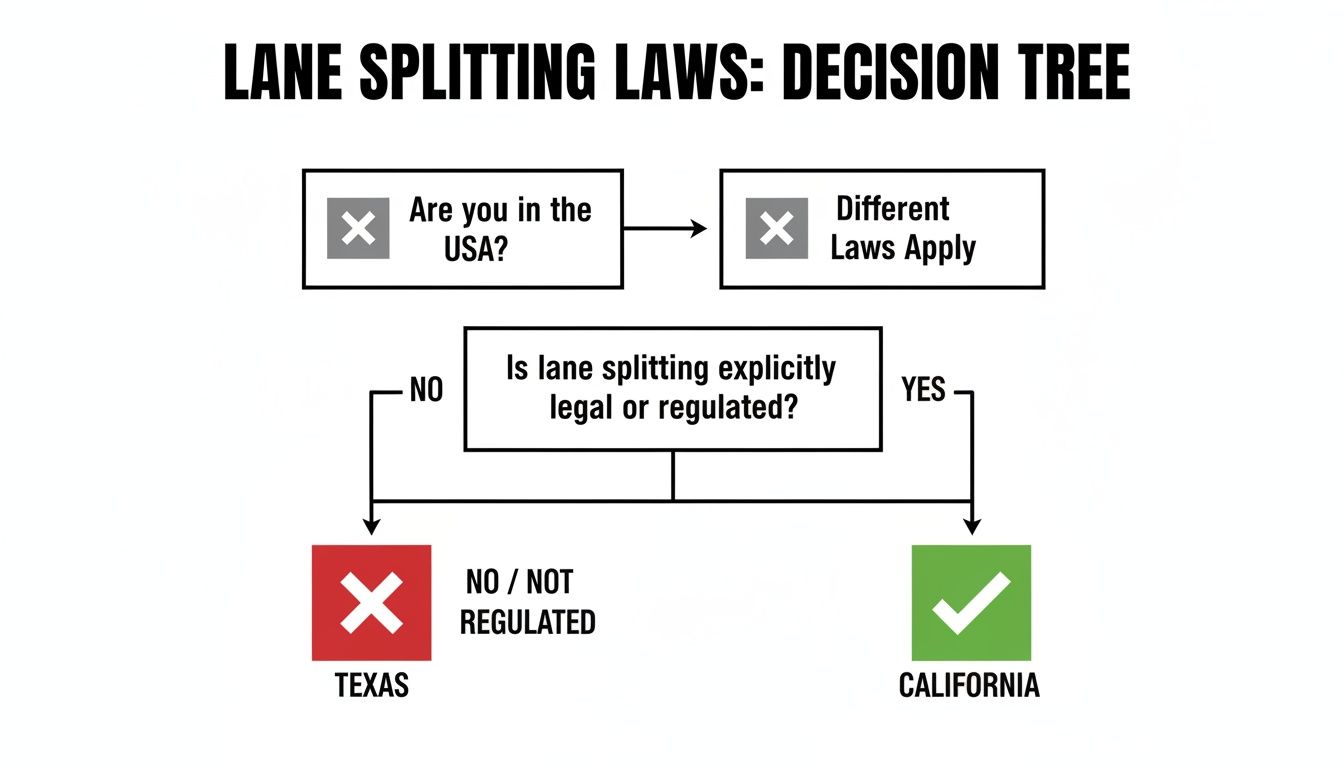
As the chart clearly shows, lane splitting is not permitted in Texas, and that's the hurdle insurance adjusters will try to use against you. Proving the other driver holds the lion's share of the blame often requires a deep, professional investigation. Sometimes, an accident reconstruction expert witness is essential to scientifically prove how the crash happened and who was truly negligent.
A skilled personal injury lawyer knows how to build this kind of compelling case, pushing back against the insurance company's tactics to minimize your assigned fault and fight for the maximum financial recovery you deserve.
Fighting the Insurance Company’s Automatic Denial

You can bet that after a crash, the other driver’s insurance adjuster will be on the phone quickly. Their job is simple: protect their company’s bottom line by paying you as little as possible—or nothing at all.
One of their go-to moves is to tell you, “Since you were lane splitting, you don’t have a case.” They say it with authority, hoping you’ll believe them and just walk away. It’s a classic tactic designed to shut down your claim before it even starts.
We refuse to let them get away with it. We don't just take their first "no" for an answer. Instead, our team launches its own independent investigation to find out what really happened. We dig for the crucial evidence they want to ignore—things like dashcam footage, cell phone records that prove distracted driving, and eyewitness accounts that tell the true story of the other driver's carelessness.
We also come armed with hard data. Many safety studies completely dismantle the myth that lane splitting is inherently reckless. In fact, one key analysis found that motorcyclists who split lanes at safe speeds actually suffered fewer fatal injuries than riders stuck in regular traffic.
Knowing how to appeal a denied insurance claim is your first and most powerful step toward fighting back. You can also explore the data on motorcycle safety statistics to see for yourself how the facts often contradict what insurers want you to believe.
What to Do After a Motorcycle Accident

The moments right after a motorcycle crash are chaotic and confusing. But the actions you take can make or break your ability to recover—both physically and financially. Here is some practical advice on how to protect your rights from the very start.
First, always seek medical attention. It doesn't matter if you think you’re “just banged up a bit.” Adrenaline is a powerful painkiller that can hide serious internal injuries. Delaying treatment is not only bad for your health; it also gives insurance adjusters an excuse to claim your injuries aren’t that severe or weren't caused by the crash.
Next, while you're at the scene and if you're able, document everything. Your smartphone is your best friend here. Snap photos of the damage to your bike, the other vehicle, your injuries, and the entire accident scene from different angles. If there are people who saw what happened, get their names and phone numbers. Witnesses can be invaluable down the road.
Finally, be incredibly careful about what you say. Don't apologize or admit any fault to the other driver—even a simple "I'm sorry" can be twisted and used against you. When their insurance company calls, politely decline to give a recorded statement until you’ve spoken with a lawyer. These initial steps are your first line of defense in preserving the evidence needed for a strong claim.
Of course, the single most important step you can take is to contact a Houston car accident attorney. An experienced lawyer can take over from day one, guiding you through the process and protecting you from the insurance company's tactics.
How Long Do You Have to File a Claim in Texas?
In Texas, the law that sets a deadline for filing a lawsuit is called the statute of limitations. For most personal injury claims, including motorcycle accidents, you have two years from the date of the crash to file a lawsuit. If you miss this deadline, you will likely lose your right to seek compensation forever. This is why it’s so important to speak with an attorney as soon as possible.
You Don’t Have to Face This Fight Alone
Trying to piece your life back together after a motorcycle crash is tough enough without having to fight an insurance company by yourself. Here’s what it boils down to: lane splitting in Texas can make your claim more complicated, but it absolutely does not mean you lose your right to compensation. The real issue is proving the other driver was negligent, and that’s where having a dedicated lawyer in your corner can change everything.
At The Law Office of Bryan Fagan, PLLC, we’re here to cut through the confusion and give you the support, clarity, and hope you need. We invite you to schedule a free, no-obligation consultation to go over your case. Let us hear your side of the story, explain your rights in plain English, and show you how we can fight for the justice you and your family deserve. Recovery is possible, and legal help is available.
Whether you’re recovering from a life-altering catastrophic injury or need a compassionate wrongful death lawyer Texas after losing a loved one, our team is ready to stand with you. Call us today.
Common Questions About Lane Splitting Accident Claims
After a crash, you’re bound to have questions. We’ve put together straightforward answers to some of the most common concerns we hear from riders who were hurt in a lane splitting accident in Texas. Understanding your rights is the first step toward recovery.