A serious accident can change your life in seconds, but you don’t have to face it alone.
You may be reading this from a hospital room, your living room couch, or beside a family member who can’t yet explain what happened. One moment you were crossing a street, walking to work, or heading back to your car. The next, everything became about pain, confusion, bills, calls from insurance adjusters, and questions no one seems to answer clearly.
If you’re looking for a houston pedestrian accident lawyer, you probably don’t want legal jargon. You want to know what to do, what your rights are, how fault works in Texas, and how a lawyer proves your case. That’s what this guide is for.
Struck by a Car in Houston? You Are Not Alone
A pedestrian crash often begins with an ordinary day. A parent crosses near a school. A worker walks from a parking lot. A neighbor heads down the block at dusk. Then a driver turns without looking, speeds through an intersection, or fails to yield.
What follows is rarely simple. Injuries can be severe because pedestrians have no metal frame, seat belt, or airbag protecting them. Families suddenly have to juggle medical treatment, missed work, transportation problems, and fear about what comes next.
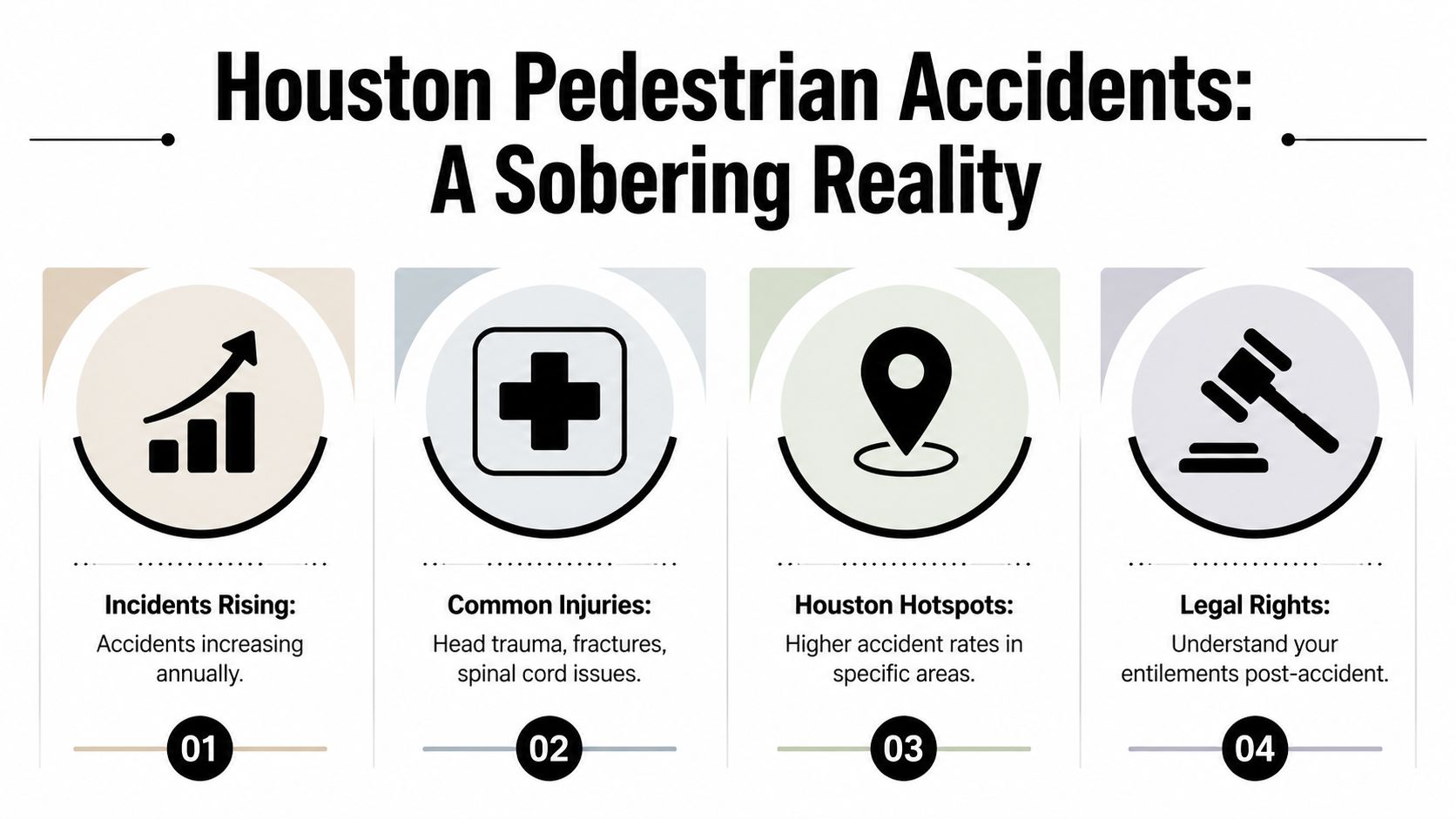
Houston has seen how serious this problem is. In 2022, Houston recorded 115 pedestrian deaths, which accounted for 36% of all traffic fatalities in the city. Across Texas, there were 5,766 pedestrian accidents and 830 deaths that year. The same source reports a 30% increase in pedestrian fatalities from 2018 to 2022, with pedestrians now involved in 1 in 5 roadway deaths in Texas, according to Houston and Texas pedestrian fatality data.
Why these numbers matter to your case
These aren’t just statistics. They explain why insurers, police investigators, doctors, and lawyers take pedestrian claims seriously. A crash involving someone on foot often leads to disputes about visibility, crossing location, speed, traffic signals, and reaction time.
That means your claim may depend on details that seem small at first, such as where your shoes landed, what the traffic light showed, or whether a nearby business camera caught the impact.
Practical rule: If you were hit while walking, assume the facts need to be preserved quickly, even if fault feels obvious.
The emotional side matters too
Many people focus on broken bones, scans, and surgery. They don’t always expect the sleeplessness, panic near traffic, or fear of crossing a street again. Emotional trauma is real, and getting support early can help. If you’re struggling after the crash, specialized trauma healing support may be a useful resource alongside your medical care.
A good lawyer understands both parts of the case. The visible injuries and the private aftermath.
What a lawyer’s role really is
A strong pedestrian claim isn’t built by sending one demand letter and waiting. It’s built by proving what happened, protecting you from blame-shifting, and showing the full cost of the harm.
That’s especially important in Houston, where road design, traffic volume, and fast-moving intersections can turn a simple walk into a life-changing event. If you feel overwhelmed, that reaction makes sense. The legal process can feel unfamiliar. But when it’s broken into steps, it becomes manageable.
Critical First Steps to Protect Your Health and Your Claim
The first hours after a pedestrian accident matter. What you do during that window can affect both your recovery and your legal claim.
Start with your body, not your case. Adrenaline can hide serious injuries. A person may say, “I think I’m okay,” then develop worsening pain, dizziness, or mobility problems later that day.
Get medical care right away
Call 911 if there’s any chance of head injury, severe pain, bleeding, loss of consciousness, confusion, or inability to stand safely. Even if injuries seem less severe, get checked promptly. Early records help your treatment team and create documentation that links your injuries to the crash.
Some people aren’t sure whether they need an emergency room or urgent care. A plain-language comparison like Carter's guide to urgent care can help you understand where to go, but if symptoms are serious or worsening, emergency care comes first.
Report the crash and make sure it’s documented
A police report can become one of the first anchors of your case. It may identify the driver, note witness names, describe the scene, and record what people said immediately after impact.
If you’re physically able, ask the responding officer how to obtain the report later. If you need help tracking it down, information about how to access Houston accident reports can make that step easier.
Preserve what you can before it disappears
Busy intersections don’t hold evidence for long. Tire marks fade. debris gets swept away. Video gets recorded over. Witnesses leave.
If you can do so safely, collect:
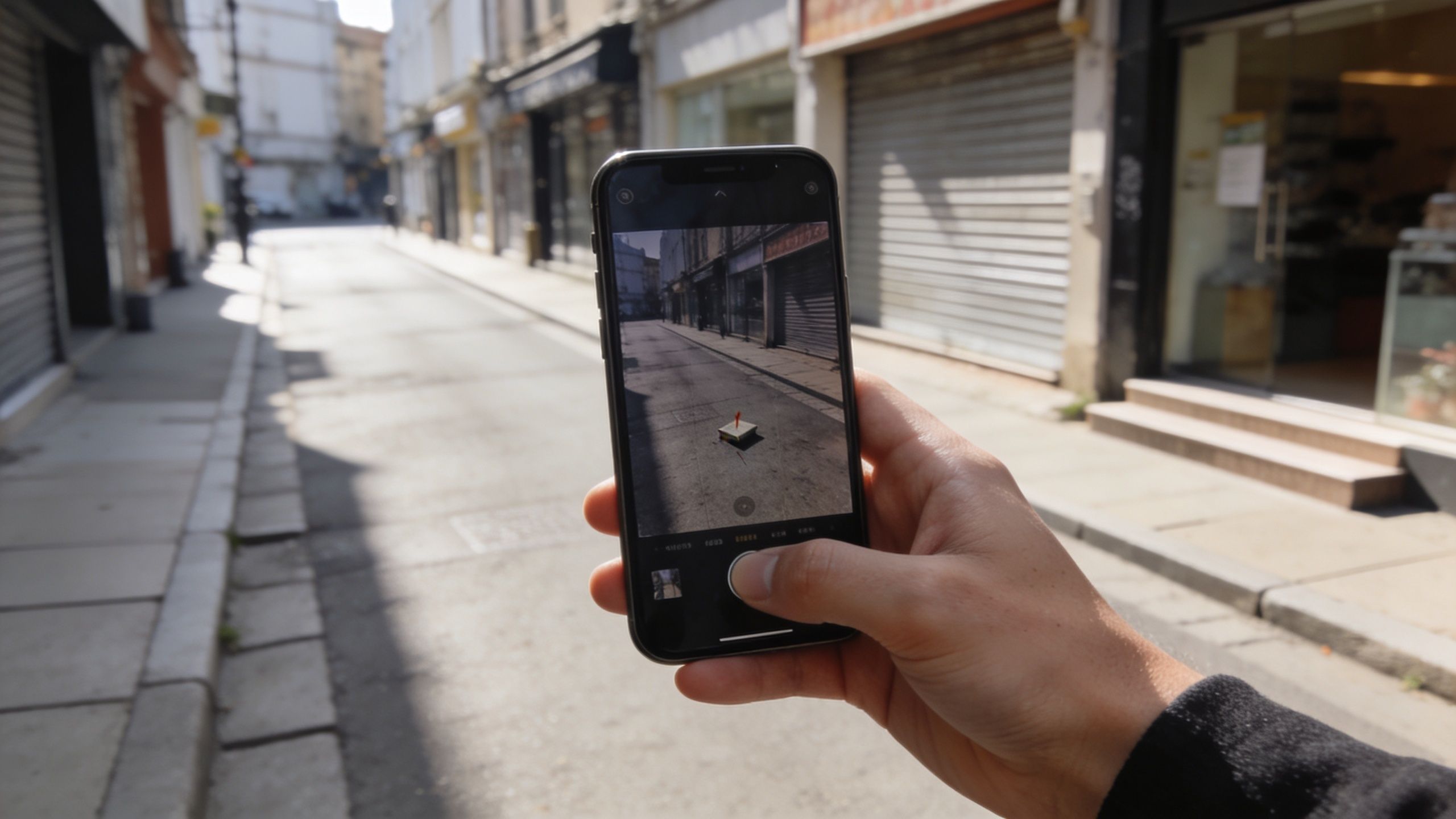
- Photos of the scene: Include crosswalks, signals, curb cuts, lane markings, vehicle position, skid marks, debris, and lighting conditions.
- Photos of your injuries and clothing: Torn fabric, blood, shoe damage, and bruising can later help show force and point of impact.
- Driver details: Name, insurance information, plate number, and the vehicle make and model.
- Witness contact information: Names and phone numbers matter more than a quick verbal summary.
- Your own memory: Write down everything you remember as soon as possible. Which direction were you walking? What signal did you have? Did the driver say “I didn’t see you”?
Go to your follow-up appointments. Gaps in treatment give insurers room to argue that you weren’t hurt badly or that something else caused your symptoms.
What not to do after a pedestrian crash
People often hurt their claims by trying to sound reasonable. They apologize. They tell the driver, “I came out of nowhere.” They speak to an adjuster before they know the extent of their injuries.
Avoid these mistakes:
- Don’t give a recorded statement early. Insurance companies listen for anything they can use to reduce payment.
- Don’t post about the accident online. Even harmless-looking photos can be misread.
- Don’t accept the first check without review. Early offers usually come before your long-term needs are clear.
- Don’t skip care because you’re worried about cost. Your health comes first, and treatment records matter.
A short overview can also help if you want to hear these ideas explained aloud:
A simple example
After a Houston freeway feeder-road crash, a pedestrian may remember only the impact and ambulance ride. But a family member can still help by photographing the location, securing the damaged clothing, and writing down the names of businesses nearby that may have cameras. Small steps like that often become important later.
Who Is at Fault? Understanding Texas Comparative Responsibility
Many injured pedestrians assume fault is obvious. A car hit a person walking. End of story. But that’s not how many claims are handled.
In Texas, fault can be divided between people involved in the crash. This is called comparative responsibility or proportionate responsibility. The basic idea is simple. Picture a scale. If the evidence tips too far against the injured pedestrian, recovery can be reduced, and in some situations barred altogether under Texas law.
Why this issue confuses people
Pedestrians often hear two statements that seem to conflict:
- Drivers must watch for pedestrians.
- Pedestrians also have duties to act with reasonable care.
Both can be true at the same time. A driver may have failed to yield while the insurance company argues the pedestrian crossed outside a marked crosswalk, wasn’t visible enough, or was distracted.
That’s where many claims are won or lost. Not in broad statements, but in evidence.

How insurers try to shift blame
Insurance companies don’t need to prove you caused everything. They often just need enough uncertainty to argue that you share blame. According to analysis of Houston pedestrian liability disputes and Texas Transportation Code §552, insurers systematically try to shift blame onto pedestrians by claiming they were jaywalking or distracted. That same source notes that an experienced lawyer can use Texas pedestrian right-of-way protections and traffic data analysis to refute those arguments.
Here’s what that looks like in practice:
| Insurance argument | What the evidence may show |
|---|---|
| “The pedestrian darted out” | The driver had a clear line of sight and enough time to react |
| “They weren’t in a crosswalk” | The intersection design, signal timing, and vehicle path still show driver negligence |
| “They were distracted” | The driver was speeding, turning without yielding, or looking away |
| “It was too dark to see them” | Lighting, headlights, camera footage, and witness observations tell a fuller story |
The scale analogy helps
Think of your claim like a scale with facts on both sides. The insurance company adds blame to your side. Your lawyer adds proof to the driver’s side.
That proof may include witness statements, scene photos, impact damage, signal sequencing, body position, medical records, and nearby camera footage. In serious cases, lawyers may also use expert review to explain reaction time, visibility, and roadway design.
If you want a plain-language explanation of the rule itself, this guide to Texas comparative fault is a helpful starting point.
The question usually isn’t “Was anyone else partly at fault?” The real question is “What can actually be proved?”
Real-world example
Take a common Houston scenario. A driver turns right at an intersection while watching for oncoming traffic from the left. The driver never checks the crosswalk carefully enough and hits a pedestrian crossing with the signal. The insurer may still argue the pedestrian should have noticed the turning car and moved faster.
A lawyer pushes back by rebuilding the sequence. What signal was displayed? Where was the pedestrian when the vehicle began its turn? How long was the person visible? Did the driver stop? Those details turn a vague blame argument into something measurable.
Why legal help matters here
Comparative responsibility is one of the hardest parts of a pedestrian case because it sounds fair in theory but often gets used unfairly in practice. The person with the worse injuries is often the one least able to gather evidence, answer adjuster questions, or challenge a technical blame argument.
That’s why a houston pedestrian accident lawyer doesn’t just “file paperwork.” The lawyer protects the story of what happened before the insurer rewrites it.
Calculating the True Value of Your Pedestrian Accident Claim
The first offer from an insurance company usually focuses on what’s easiest to count right now. Ambulance bill. ER visit. A few missed paychecks. Maybe a short period of pain.
That approach misses the full cost of many pedestrian injuries.
A person hit by a vehicle may face surgery, rehabilitation, follow-up imaging, chronic pain, job limitations, emotional trauma, and future treatment that isn’t obvious in the first few weeks. If you settle too early, you usually don’t get to reopen the case later because your recovery turned out to be harder than expected.
What compensation is supposed to cover
A pedestrian injury claim generally includes two broad categories.
Economic losses
These are the financial harms that can be documented more directly.
- Medical expenses: emergency care, hospital stays, surgery, medication, therapy, and future treatment
- Lost income: missed work during recovery
- Reduced earning ability: when injuries affect the kind of work you can do or how long you can do it
- Out-of-pocket costs: transportation to appointments, medical equipment, and other practical expenses tied to the injury
Non-economic losses
These are personal harms that don’t come with a simple receipt.
- Pain and suffering
- Emotional distress
- Physical impairment
- Loss of enjoyment of daily life
- Changes to relationships and independence
A parent who can’t pick up a child. A construction worker who can’t stand long enough to return to the same job. A retiree who becomes fearful of leaving the house. Those losses matter even though they aren’t neatly printed on an invoice.
The biggest mistake is looking only at today
One of the most important truths in severe pedestrian cases is that future damages are often undervalued at the start. According to discussion of lifetime care planning in Houston pedestrian injury cases, many initial consultations overlook long-term disability and lifetime care costs. That source explains that victims may need life care planners and economists to quantify future medical needs and lost future earnings, and that failing to project these costs can lead to a settlement that’s far too small.
A settlement should fit the life you’ll have to live after the crash, not just the bills sitting on your kitchen table this month.
Why quick offers are risky
Insurance companies often move fast for a reason. Early in the case:
- you may not yet know whether surgery is needed
- your doctor may not know if symptoms will become chronic
- your work restrictions may still be unclear
- the emotional effects may just be starting
That means the value of the claim is still developing.
If someone suffered a traumatic brain injury, spinal trauma, or another catastrophic injury, the gap between an early offer and a fair result can be enormous in real terms, even if no one can responsibly put a number on it at the beginning.
A simple example
Suppose a pedestrian is struck in a downtown crosswalk and initially believes the injuries are limited to fractures. Weeks later, balance problems and cognitive symptoms appear. The person can’t return to the same work. Daily tasks require help. The case is no longer about one ER bill and a few lost paychecks.
That’s why lawyers often wait until the medical picture is clearer before serious settlement discussions. You can learn more about the categories involved in pedestrian hit by car compensation.
In wrongful death and catastrophic injury cases
If a family loses a loved one, the claim may include wrongful death and related losses under Texas law. If the survivor has life-changing injuries, the case may overlap with catastrophic injury issues that require deeper medical and financial analysis.
That’s also why pedestrian cases sometimes connect with other practice areas. A turning driver may have been in a company vehicle, raising issues a truck crash lawyer Houston may handle. A fatal pedestrian case may require a wrongful death lawyer Texas families can trust. And if the crash began with a chain-reaction collision, a Houston car accident attorney may investigate the larger event.
How Our Lawyers Investigate and Build a Winning Case
When people hire a lawyer after a pedestrian crash, they often think the next step is a demand letter. In reality, the first phase is usually investigation.
The stronger cases are built from the ground up. Facts first. Pressure later.
The early hours are often decisive
At a busy Houston intersection, evidence can vanish fast. A business owner may overwrite security footage. Witnesses may become hard to find. The roadway changes. Vehicles get repaired. Memories soften.
According to Houston pedestrian accident reconstruction practices, effective attorneys use accident reconstruction that combines crash data, forensic expert testimony, and surveillance footage from multiple sources to build a detailed timeline. That same source emphasizes that evidence at busy intersections can disappear within hours, which is why immediate investigation matters.

What a lawyer actually does after being hired
A houston pedestrian accident lawyer usually begins with a sequence that looks something like this:
Secure the basic records
Police reports, EMS records, hospital records, and photographs are gathered first.Preserve outside evidence
Letters or calls may go out quickly to businesses, property owners, or agencies that might hold video footage.Inspect the scene
Lane layout, signal placement, visibility, signage, and crossing paths can matter a great deal.Talk to witnesses
Early witness statements often carry more weight because they are closer in time to the event.Review injury mechanics
The location and pattern of injury may help confirm how the impact happened.
How reconstruction helps
Accident reconstruction sounds technical because it is. But the purpose is straightforward. It answers, as clearly as possible, how the collision happened.
A reconstruction expert may look at:
- Vehicle movement: speed, braking, turning path
- Pedestrian position: where the person likely was before and at impact
- Timing: traffic light sequence, perception and reaction time
- Visibility: sight lines, lighting, obstructions
- Physical evidence: damage patterns, debris, road markings
Sometimes the best evidence in a pedestrian case is not one dramatic piece. It’s a chain of smaller facts that all point to the same conclusion.
Negotiation starts long before settlement talks
Insurance companies pay attention to preparation. If they see a thin file and a rushed presentation, they often push harder. If they see a case built with records, scene analysis, medical support, and a clear liability theory, the conversation changes.
That doesn’t mean every case goes to trial. It means the file is prepared as if trial may be necessary.
A practical example
After a Houston intersection crash, a lawyer may discover that a nearby restaurant camera captured the vehicle’s turn, while a city camera showed the signal phase. A witness confirms the pedestrian had begun crossing normally. Medical records match the angle of impact. Suddenly, what started as “he said, she said” becomes a timeline.
That’s how a disputed claim becomes a persuasive one.
The lawyer also becomes your buffer
During this process, your lawyer handles adjuster calls, document requests, settlement pressure, and arguments about fault. That gives you space to focus on treatment.
For many clients, this part brings the first real relief. They no longer have to answer every call, guess what to say, or worry that one misstep will damage the case.
Frequently Asked Questions About Pedestrian Accident Claims
Many families ask the same urgent questions after a crash. That makes sense. You may be dealing with pain, work problems, insurance confusion, and a deadline you didn’t know existed.
Houston remains a dangerous place for pedestrians. One source reports that pedestrian fatalities in Houston have risen 125% over the last decade, and that an average of three pedestrian accidents occur daily. The same source says Houston ranks among the more dangerous U.S. cities for walkers and Texas is the 10th deadliest state, according to Houston pedestrian danger trends. In that kind of environment, clear answers matter.
Your pedestrian accident claim at a glance
| Legal Aspect | Key Information for Victims |
|---|---|
| Fault | Texas uses comparative responsibility, so fault may be shared and strongly disputed |
| Evidence | Early photos, witness names, reports, and video can make a major difference |
| Medical care | Prompt treatment protects both your health and the claim record |
| Compensation | A fair claim should consider current losses and future needs |
| Insurance | Adjusters may seek recorded statements or push early settlement offers |
| Deadlines | Texas claims are subject to legal filing deadlines, including the general two-year rule in many injury cases |
| Legal fees | Many personal injury cases are handled on a contingency-fee basis |
| Serious cases | Wrongful death, catastrophic injury, and uninsured-driver issues can make a claim more complex |
How can I afford a lawyer if I’m already missing work
Most pedestrian injury lawyers handle cases on a contingency fee. That means the attorney’s fee is tied to a recovery, not paid upfront at the start of the case.
For injured people, that matters. After a crash, cash flow is often tight. You may be paying co-pays, replacing transportation, and losing wages at the same time. A contingency arrangement lets you pursue the case without paying hourly legal bills while you’re trying to heal.
You should still ask practical questions during a consultation:
- Who pays case expenses up front
- How medical records and expert costs are handled
- What happens if the case doesn’t resolve successfully
- How the fee is explained in writing
A good lawyer should answer those questions directly, in plain English.
How long do you have to file a claim in Texas
In many Texas personal injury cases, the general statute of limitations is two years from the date of the injury. That deadline often applies to pedestrian accident lawsuits as well.
But there’s an important warning. Some situations can involve different notice requirements or exceptions, especially if a government vehicle, roadway defect, or public entity may be involved. Families handling a wrongful death claim may also have specific timing concerns tied to the facts of the case.
The safest approach is simple: talk to a lawyer early. Waiting can create avoidable problems, especially when video evidence and witness recollections are already fading.
Waiting hurts pedestrian cases in two ways. It risks the legal deadline, and it gives key evidence time to disappear.
What if the driver who hit me had no insurance or fled the scene
This is one of the most stressful situations for victims, but it isn’t always the end of the road.
A lawyer will often look at several possible sources of recovery, depending on the facts:
- The driver’s liability policy, if one exists
- Uninsured or underinsured motorist coverage
- Coverage connected to a vehicle owner or employer
- Other policies that may apply under Texas law
Hit-and-run cases can also become evidence-heavy very quickly. A lawyer may search for surveillance footage, nearby witnesses, business cameras, vehicle fragments, 911 records, and police follow-up information.
What if I was crossing outside a crosswalk
That does not automatically destroy your case.
Texas negligence law usually turns on the full picture, not one fact in isolation. A driver may still be responsible if they were speeding, distracted, failed to keep a proper lookout, or ignored conditions that made a collision foreseeable. The legal issue is how fault is allocated and what can be proved.
This is where comparative responsibility becomes so important. The insurer will likely focus hard on your location and movement. Your lawyer will focus on the driver’s conduct, reaction time, visibility, and legal duties.
Should I talk to the driver’s insurance adjuster
In most cases, you should be very careful.
Adjusters are trained to gather statements that help the insurance company evaluate and limit the claim. Even ordinary answers can be used later. If you say, “I’m doing better,” they may argue your injuries were minor. If you estimate your speed or location imprecisely, they may use that to challenge fault.
You don’t have to be hostile. You do need to be cautious. Once you have counsel, the lawyer can usually handle those communications for you.
What if my injuries didn’t seem serious at first
That’s common in pedestrian cases. Adrenaline, shock, and delayed symptoms can hide the true extent of an injury.
Head injuries, back injuries, soft tissue damage, and emotional trauma may become clearer days or weeks later. That’s one reason early settlement offers are risky. The case may be worth far more than anyone can know in the first few days.
When should I call a lawyer
Sooner is usually better, especially if:
- You suffered serious injuries
- The driver disputes fault
- There were witnesses or possible video sources
- The crash involved a commercial vehicle
- The driver was uninsured or fled
- A loved one died from the injuries
A lawyer can also help identify whether your case overlaps with a broader motor vehicle claim, a catastrophic injury case, or a wrongful death lawsuit.
Do I really need a lawyer if the driver was clearly at fault
Sometimes people ask this because they want to keep things simple. That’s understandable. But pedestrian claims are rarely simple once the insurer reviews them.
Medical records have to be organized. Fault arguments have to be answered. Future damages may need expert support. Settlement language has to be reviewed carefully. If injuries are substantial, legal help often protects far more than convenience. It protects the value and stability of the claim itself.
If you or someone you love was hit while walking, you don’t have to sort this out on your own. The Law Office of Bryan Fagan, PLLC helps injured Texans understand their rights, deal with insurance companies, and pursue compensation for medical care, lost income, pain and suffering, and future needs. Whether your case involves a pedestrian collision, a car wreck, a commercial vehicle claim, catastrophic injuries, or a wrongful death matter, help is available. Schedule a free consultation to speak with a Texas personal injury lawyer who will listen, explain your options clearly, and help you move forward with confidence.