Skip to content
A serious accident can change your life in seconds, but you don't have to face it alone.
If you're reading this after a crash, you may be juggling doctor visits, car repairs, missed work, calls from insurance adjusters, and the stress of not knowing what happens next. Many people ask the same urgent question: How long after a car accident can I sue in Texas?
The short answer is that Texas usually gives you a limited window to file a lawsuit. But the complete answer depends on more than a calendar. The type of claim matters. The person or entity involved matters. Your age, your injuries, and whether a government vehicle played a role can change the timeline in important ways.
What works is getting clear on the deadline early, while evidence is still available and your options are still open. What doesn't work is assuming insurance negotiations protect your rights or waiting until treatment is over before speaking with counsel. If you're unsure when to get legal advice, this guide on when to contact a lawyer after a Texas accident can help you think through the timing.
Your Life After a Crash and The Question of Time
The days after a wreck rarely feel orderly. You may have pain that wasn't obvious at the scene. Your family may be asking how bills will get paid. The other driver's insurer may already be calling, acting helpful while evaluating how little they can pay.

A lot of injured Texans delay because they think they should wait until they feel better, finish treatment, or hear a final offer from the insurance company. That instinct is understandable. It can also create risk.
Why timing becomes a legal issue fast
After a Houston freeway crash, for example, the first weeks often determine what evidence survives. Vehicles get repaired or sold. Witnesses stop answering calls. Video from nearby businesses can disappear. Medical records become harder to connect to the wreck if there are long gaps in care.
That's why time matters even before anyone files suit. The legal system puts deadlines on claims, and courts usually expect those deadlines to be followed closely. Missing one can change a strong case into a lost opportunity.
Waiting feels harmless when you're focused on healing. Legally, it often isn't.
The question you need answered now
You don't need a law school explanation. You need practical guidance. You need to know the default rule, the exceptions, and the mistakes that cause people to lose claims they otherwise could have pursued.
The most important thing to understand is this: the deadline to sue is not always the same as the time to work with an insurance company, and some cases have much shorter notice requirements than people expect.
The Two-Year Deadline to Sue for a Texas Car Accident
For most Texas car accident cases, the main rule is straightforward. Texas generally gives an injured person 2 years from the date of a car accident to file a personal injury lawsuit under Texas Civil Practice & Remedies Code § 16.003. The same two-year deadline generally applies to most property-damage claims and many wrongful-death claims tied to a crash.
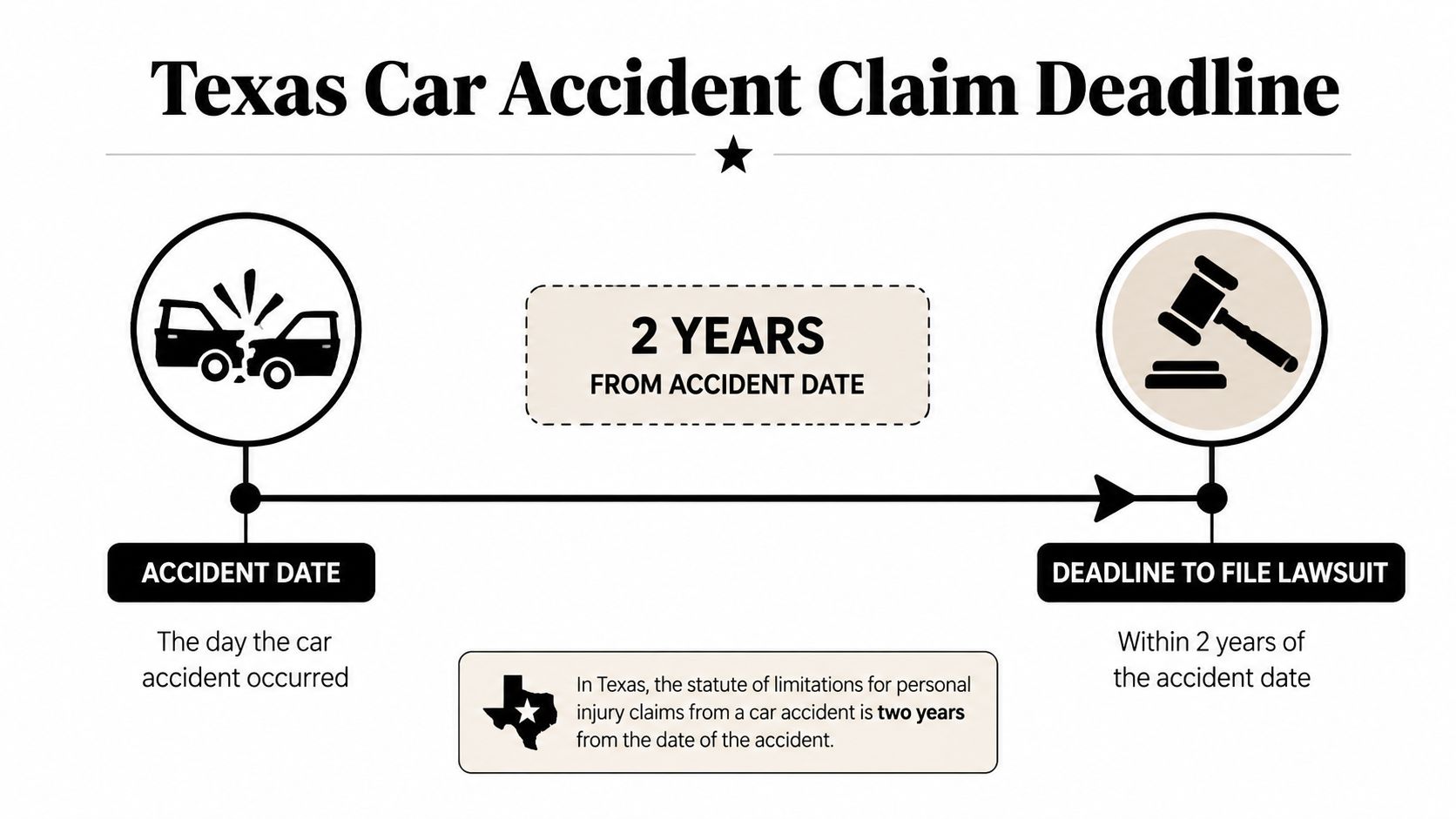
In plain English, this legal deadline is called the statute of limitations. It is the filing cutoff for getting your case into court. If the deadline passes and no lawsuit has been filed, the court will usually dismiss the case.
What the two-year rule looks like in real life
The easiest way to understand it is with a date example. If a collision happened on January 1, 2024, the lawsuit deadline would ordinarily fall on January 1, 2026, as explained in this discussion of the Texas car accident statute of limitations.
That sounds like a long time. In practice, it often isn't.
Medical treatment can stretch on. Insurance negotiations can stall. Fault disputes can take months to sort out. By the time people realize settlement isn't happening, the filing deadline may be much closer than they thought.
Why the statute matters even when fault seems obvious
People often assume they can always sue later if the other driver was clearly to blame. Texas law doesn't work that way. A strong liability case does not erase a missed deadline.
Practical rule: If you think there's any chance you may need to sue, treat the filing deadline as a hard stop, not a suggestion.
That is why early case review matters. A lawyer can identify the proper defendant, preserve evidence, and decide whether a lawsuit should be filed before negotiations run out the clock.
Here is a plain breakdown of the standard rule:
- Personal injury claims: Usually must be filed within the two-year period tied to the crash date.
- Property damage claims: Usually follow the same two-year period.
- Wrongful death claims: Many also fall under that same two-year framework.
- Missed deadline: The right to sue for compensation is generally lost.
If you need legal help evaluating a crash case, a Car Accident Lawyer in Texas handles representation for drivers and passengers injured in Texas car accidents.
A quick visual can help if you prefer the timeline format.
What this deadline does not mean
The two-year rule is the default starting point. It is not the full answer in every case. Some claims involve exceptions. Others involve extra procedural steps. A crash with a city vehicle, a school bus, or a young injured child can change the analysis quickly.
That's why broad advice from friends or online forums usually misses the details that control the case.
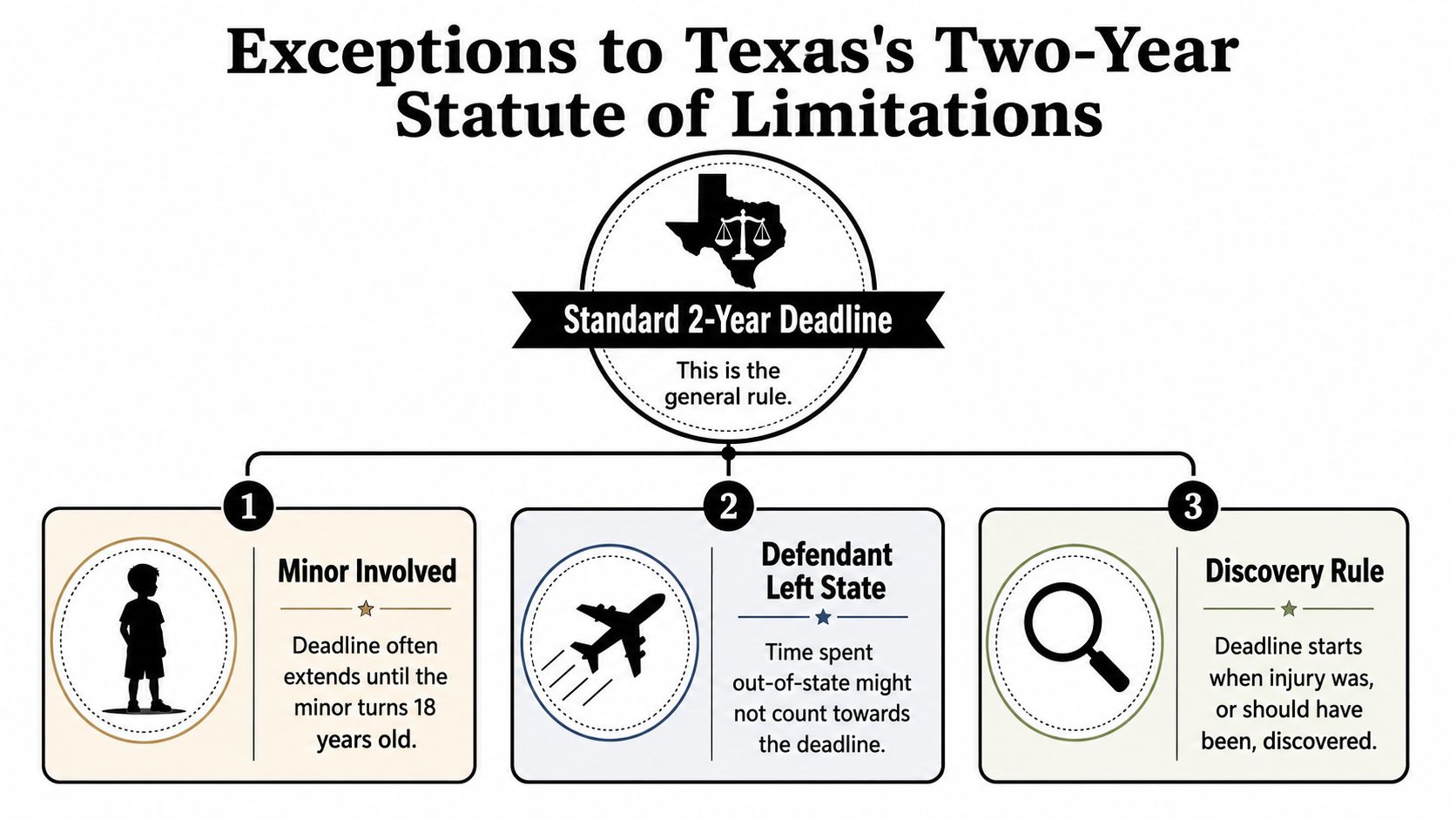
Important Exceptions That Can Change the Deadline
The two-year filing period is the default rule. It is not the whole rule.
If a child was hurt, if the at-fault vehicle belonged to a public entity, or if the injury and the legal right to sue did not line up in the usual way, the deadline analysis can change. That is where people get into trouble. They rely on a general answer when their case needs a specific one.
When a minor is injured
Texas law may pause the limitations period for an injured child in some situations. In practice, that can mean the child's personal injury claim is treated differently from an adult's claim arising from the same crash.
Parents often miss the trade-off here. The child may have more time to bring a personal injury claim, but the parents' own claims may still be on the ordinary schedule. Medical expense issues, property damage, and a parent's separate injury claim should be reviewed on their own timeline, not folded into the child's.
A family crash can leave two very different deadlines in the same file.
Claims involving wrongful death
Fatal collision cases also need careful deadline review. The family is dealing with grief, funeral arrangements, and sudden financial pressure. Meanwhile, evidence can disappear, witness memories can fade, and disputes over fault can harden quickly.
The legal analysis may also be more complicated than a standard injury case. Questions about who has the right to sue, when the claim accrued, and whether related survival claims are involved should be sorted out early. If your family is dealing with a fatal collision, speaking with a wrongful death lawyer Texas resource early can help you understand what deadlines and decisions apply to your situation.
Government-related crashes are different
A wreck involving a city vehicle, county truck, school district bus, or other public unit should never be treated like an ordinary claim against a private driver. The usual two-year lawsuit deadline may still matter, but there can also be much earlier notice requirements that affect whether the claim survives at all.
That is one of the most commonly missed exceptions in Texas car accident cases.
Other situations that need a closer look
Some timing problems are less obvious but still important:
- Delayed injury recognition: A brain injury, spinal injury, or internal injury may not be fully understood right after the crash.
- Hit-and-run collisions: An unidentified driver can complicate both the liability investigation and uninsured motorist issues.
- Rideshare or work-vehicle crashes: More than one potentially responsible party can change how the claim is evaluated and when action should be taken.
- Capacity issues: If the injured person cannot manage legal affairs, the limitations analysis may require a separate review.
I tell clients the same thing in these cases. Do not guess which clock applies.
Early review matters because the deadline for suing the driver is not always the same as the timing for dealing with insurance, and an exception that helps one claimant may do nothing for another. A child passenger case, for example, may have one limitations analysis for the child, another for the parents, and a separate insurance deadline under the policy.
That is why broad advice like “you always have two years” causes real damage. In Texas, the right answer depends on who was injured, who may be responsible, and whether any special rule changes the ordinary filing period.
Special Deadlines When Suing a Government Entity
A collision with a city bus, county vehicle, school district vehicle, or other public unit is not just another car accident case. These claims often involve a separate notice of claim requirement before a lawsuit can move forward, and the timing can be much shorter than people expect.
That's the trap. People assume they still have plenty of time because they've heard about the ordinary filing period. Meanwhile, the earlier notice deadline may be approaching fast.
Why these cases move faster
When a government entity may be responsible, the first issue is often not “When can I sue?” It is “What notice had to be given, to whom, and by when?” Some claims against government entities can require notice in as little as 180 days, and some local deadlines may be even shorter.
A crash with a city bus in Houston or a municipal truck in San Antonio can trigger these rules. So can a wreck involving a public works vehicle, a school transportation vehicle, or another government-operated unit.
Texas accident claim deadlines at a glance
| Type of Claim | Typical Deadline to Act |
|---|---|
| Standard car accident lawsuit against a private driver | Usually 2 years from the date the cause of action accrues, which is often the crash date |
| Property damage claim tied to a private-driver crash | Usually follows the same 2-year filing period |
| Many wrongful death claims tied to a crash | Often follow the same 2-year framework |
| Claim involving a government entity | Notice may be required in as little as 180 days, and some local deadlines may be shorter |
Practical example
Suppose you're hurt when a city-operated bus turns into your lane. You start medical treatment and open an insurance claim. That may feel like the right first step, but it may not satisfy the separate notice requirement that applies to public entities.
That's why these cases need immediate review. The question is not only who caused the crash. The question is whether the proper notice has been prepared and delivered in time.
Government cases are often lost on procedure, not on the facts of the crash.
If the wreck involved a large public vehicle or commercial-type fleet vehicle, it can also help to understand how truck and heavy vehicle cases are handled. A truck crash lawyer Houston resource can be useful when the vehicle size, employer issues, or maintenance records are part of the investigation.
Lawsuits vs Insurance Claims A Key Timing Difference
Many people are often misled. The deadline to sue the at-fault driver is one timeline. Your dealings with an insurance company may follow another. They are related, but they are not the same thing.
Many people confuse the deadline to sue a driver with the time they have to resolve an insurance claim. However, the two-year lawsuit clock keeps running even while you negotiate a settlement. In addition, a breach-of-contract claim against an insurer may have a different deadline, and separate bad faith claims under the Insurance Code may have their own two-year period, as explained in this overview of Texas car wreck limitation issues and insurer claims.
Settlement talks do not stop the lawsuit clock
This is one of the most common and costly misunderstandings. An adjuster may tell you the claim is under review. They may ask for more records. They may say they're waiting on authority or still evaluating treatment.
None of that pauses the lawsuit deadline by itself.
A person can spend months going back and forth, only to learn that the filing window is nearly closed. If the insurer then disputes fault, disputes medical causation, or drags its feet, the claimant can be left with very little room to act.
Insurance issues often branch into separate claims
Some post-crash disputes are not just negligence claims against the other driver. They can become coverage disputes with an insurance company. That may involve your own policy, especially if the other driver is uninsured or underinsured.
Here are the timing problems people often miss:
- Suing the driver: This follows the court filing deadline that applies to the crash claim.
- Pursuing UM or UIM benefits: The policy language may affect what has to happen and when.
- Breach of contract issues: A claim against the insurer can involve a different deadline.
- Bad faith allegations: Insurance Code claims may have their own separate period.
If you're dealing with coverage trouble, this resource on navigating a denied car insurance claim gives a helpful consumer-level overview of the practical issues that can arise when an insurer refuses to pay.
Reporting is not the same as preserving
People also confuse reporting a crash with preserving a legal claim. Reporting to your insurer matters. It just doesn't answer the larger question of whether your legal rights are protected.
If you're unsure how quickly an accident should be reported to insurance, this explanation of how long to report an accident to insurance can help you avoid another timing mistake.
A Houston car accident attorney will usually look at both tracks at once: the negligence case and the insurance timeline. That approach works better than treating them as separate problems after one has already gone off course.
How to Protect Your Claim Before Time Runs Out
Waiting is rarely neutral in an injury case. Evidence weakens. Deadlines get closer. Insurance positions harden. If you want to protect your rights, the best step is usually the simplest one. Start early.
A practical checklist after a Texas crash
You do not need to do everything perfectly on day one. You do need to avoid the mistakes that are hardest to fix later.
- Get medical care promptly: Early treatment creates a record of what you felt, when you felt it, and how the crash affected you.
- Save evidence now: Keep photos, names of witnesses, repair estimates, discharge papers, and every insurance letter or email.
- Report the collision carefully: Notify the proper insurer, but don't assume that reporting alone protects your lawsuit rights.
- Be cautious with recorded statements: The other driver's insurer is not there to protect your claim.
- Review the timeline early: If the crash involved a child, a public vehicle, or a coverage dispute, don't guess about the deadline.
What legal help changes
A Texas personal injury lawyer can identify the controlling deadline, preserve proof, communicate with insurers, and decide when filing suit makes sense even if talks are still ongoing. A lawyer can also send a letter of representation after an accident so insurers know communications should go through counsel rather than directly through you.
For some families, especially when an older adult was injured or depends on relatives for care, legal planning goes beyond the crash claim itself. In those situations, an essential guide to elder law may help you think through broader issues involving support, decision-making, and long-term needs.
The bottom line
If you've been asking, “How long after a car accident can I sue in Texas?” the safest answer is this: find out early, based on your exact facts, and don't rely on assumptions. The law gives many people a path forward, but deadlines can close that path quickly.
You deserve clear information, not pressure. You deserve time to heal, but you also deserve to know what must be done now to protect your future.
If you were hurt in a wreck or lost a loved one in a fatal crash, Law Office of Bryan Fagan, PLLC is one option for reviewing your situation, explaining the deadlines that apply, and discussing next steps in a free consultation. Recovery is possible, and legal help is available when you're ready.