A serious accident can change your life in seconds—but you don’t have to face it alone. The invoices for medical care and the pay stubs you've lost are concrete, but what about the physical pain, the sleepless nights, and the emotional trauma that follow?
In Texas law, these very real, human losses are known as “pain and suffering.” This isn't just a vague concept; it's a specific category of damages you have the right to claim when someone else’s negligence causes you harm. It recognizes that the true cost of an injury goes far beyond just the financial fallout.

Economic vs. Non-Economic Damages: What’s the Difference?
To understand what a pain and suffering claim covers, it helps to know how personal injury damages are categorized in Texas. Think of it in two main buckets.
First, you have economic damages. These are the straightforward, calculable costs tied directly to your accident. This includes things like hospital bills, physical therapy costs, lost income from being unable to work, and any future earnings you’ll lose because of your injuries.
The second bucket is for non-economic damages. This is where pain and suffering lives. These damages are designed to compensate you for the intangible, personal losses that don’t come with a neat price tag.
To put these two categories into perspective, we've summarized what they cover below.
Types of Pain and Suffering Damages
| Type of Damage | What It Covers |
|---|---|
| Physical Pain and Suffering | This covers the actual physical pain from the initial injury, ongoing chronic pain, discomfort from treatment and recovery, and any permanent physical limitations or disfigurement. |
| Mental Anguish | This includes the emotional and psychological toll, such as fear, anxiety, depression, shock, grief, loss of enjoyment of life, and post-traumatic stress disorder (PTSD). |
Understanding both is key to building a complete claim that reflects the full scope of your losses.
Let’s use a real-world example. Imagine you were in a wreck on a Houston freeway and ended up with $50,000 in medical bills. Those bills are your economic damages. But what about the chronic back pain that now keeps you from playing with your kids? Or the anxiety that grips you every time you get behind the wheel? Those losses are just as real, and they fall under pain and suffering.
The legal system acknowledges that an accident's true cost goes far beyond what you can add up on a calculator. At The Law Office of Bryan Fagan, PLLC, our job as experienced Texas personal injury lawyers is to make sure your claim reflects all of your losses, not just the ones with obvious dollar signs. You can learn more about the different types of damages in a Texas injury case to see how a comprehensive claim is built to secure the justice you deserve.
What Does Pain and Suffering Actually Include?
When lawyers talk about “pain and suffering,” we’re not using some abstract legal term. We’re talking about the real, human cost of an accident—the toll it takes on your life long after the wreckage is cleared and the initial medical bills are paid.
In Texas law, this is what’s known as non-economic damages. It’s the legal system’s way of acknowledging how an injury has personally shattered your well-being. To really grasp what this covers, it helps to look at its two main parts.

Physical Pain and Impairment
The most straightforward part of a pain and suffering claim is the physical damage. This goes far beyond the immediate agony at the scene of the crash. It covers the entire spectrum of physical hardship you’re forced to endure.
Think about the aftermath of a catastrophic accident. You could be facing:
- Initial Injury Pain: The severe, sharp pain from broken bones, burns, or deep lacerations.
- Chronic Discomfort: A constant, dull ache, nerve pain, or stiffness that just won’t go away, sometimes for years.
- Surgical and Recovery Pain: The unavoidable discomfort that comes with operations, skin grafts, and grueling physical therapy sessions.
- Permanent Disfigurement: The scars, burns, or amputations that act as a daily, physical reminder of your trauma.
This also includes physical impairment—the loss of your ability to do things you once took for granted. It’s the dedicated construction worker who can no longer lift his own child, or the passionate gardener whose severe back injury now keeps her from her flowerbeds.
Mental and Emotional Anguish
Just as real, and often more debilitating, are the invisible wounds. Mental anguish is the legal term for the emotional and psychological fallout from a traumatic event. This suffering is deeply personal and can show up in many ways, from generalized anxiety to specific discomforts like TMJ pain triggered by stress.
Mental anguish recognizes that your emotional well-being has value. It provides a legal path to hold negligent parties accountable for the fear, anxiety, and profound sense of loss they have caused you.
Some common examples of mental anguish include:
- Emotional Distress: Overwhelming feelings of fear, anxiety, depression, or humiliation following the event.
- Post-Traumatic Stress Disorder (PTSD): Experiencing flashbacks, nightmares, and crippling anxiety triggered by reminders of the accident.
- Loss of Enjoyment of Life: A deep-seated inability to find joy in hobbies, relationships, or daily activities that once brought you happiness.
- Grief and Loss: The profound sorrow that families must navigate after losing a loved one in a wrongful death, for which a compassionate wrongful death lawyer in Texas can provide guidance.
Sadly, this kind of suffering is incredibly common. Globally, 1 in 5 adults—that's 20% of the population—suffers from pain. In 2021 alone, more than 51 million U.S. adults were living with chronic pain, and for 17.1 million of them, the pain was so severe it dramatically limited their daily lives.
At The Law Office of Bryan Fagan, PLLC, we know these aren't just entries on a claim form; they are life-altering realities. We’re here to make sure your story is heard and your suffering is fully accounted for.
How Insurance Companies Calculate Your Settlement
After a serious accident, trying to put a dollar value on something as personal as your pain is one of the most confusing parts of the process. While no check can ever erase what you’ve been through, Texas law recognizes that you deserve compensation for your suffering.
Insurance companies, however, are businesses. Their goal is to protect their bottom line, so they lean on formulas to turn your very human experience into a cold, hard number. Understanding how they do this is your first step toward fighting back for what's fair. They don't have one single, legally required formula, but adjusters almost always use two common methods as a starting point for their first offer.
The Multiplier Method
The most common approach you'll see is the multiplier method. It’s pretty straightforward. The insurance adjuster adds up all your concrete financial losses—what we call economic damages, like medical bills and lost wages—and multiplies that total by a number, usually between 1.5 and 5.
- A low multiplier (like 1.5 or 2) is what they’ll try to use for injuries they see as minor, where you made a quick and full recovery. Think minor whiplash that just needed a few weeks of physical therapy.
- A high multiplier (a 4 or 5) is supposed to be for severe, life-changing injuries. This would be for cases involving a permanent disability, significant scarring, or chronic pain after a catastrophic injury.
Real-World Example:
Let's say you were caught in a multi-car pile-up on I-35 in Austin. Your medical bills and lost income add up to $50,000. You suffered a broken leg that needed surgery and will leave you with a permanent limp. A good lawyer will immediately argue for a high multiplier, like a 4.
- Calculation: $50,000 (Economic Damages) x 4 (Multiplier) = $200,000 (Pain and Suffering Value)
That brings the starting point for negotiations to $250,000 ($50,000 for your bills + $200,000 for your suffering). The insurance adjuster, however, will likely come back with a multiplier of 2, offering only $100,000 for your pain. This is exactly where the fight begins, and why having an experienced attorney is so important.
The Per Diem Method
Another method they sometimes use is the “per diem” method. Per diem is just Latin for "per day." With this approach, a dollar amount is assigned to each day you live with pain and suffering, from the day of the accident until your doctor says you've reached "maximum medical improvement" (MMI).
The daily rate is often tied to what you earn in a day at your job. The logic is that having to endure your injuries is at least as hard as going to work every day.
The Per Diem method tries to quantify daily suffering. It asks a simple but powerful question: what is one day of enduring this pain worth?
For example, if you were hit by a commercial truck in Houston and couldn't work for six months (about 180 days), and you earned $200 a day, the calculation might look like this:
- Calculation: 180 (Days of Suffering) x $200 (Daily Rate) = $36,000 (Pain and Suffering Value)
This method can make sense for injuries with a clear end date for recovery, but it completely fails to capture the reality of permanent or long-term injuries.
Why These Formulas Are Just a Starting Point
You have to remember that these methods are just tools. They are tools that insurance companies use to standardize claims and, more often than not, minimize what they have to pay you. A skilled Texas personal injury lawyer knows your story is so much more than a formula.
We don’t just punch numbers into a calculator. We build a powerful case that tells the full story of your suffering—the family holidays you missed, the hobbies you can no longer enjoy, the anxiety that follows you every day. We use real evidence like personal journals, testimony from friends and family, and expert medical opinions to show the true, devastating impact the accident has had on your life.
From there, we argue for a value that actually reflects everything you have been forced to endure.
How to Prove Your Pain and Suffering Claim
Because pain and suffering aren't something you can point to on an x-ray, proving your claim is about much more than just telling an insurance adjuster you're hurting. They—and juries—need to see real, tangible evidence that shows the true impact the injury has had on every corner of your life. Building a strong case is an active process. The steps you take right after an accident are absolutely critical to protecting your right to fair compensation.
You can take control by carefully documenting your experience from day one. This evidence will become the backbone of your claim, turning your personal suffering into a legal argument that is powerful and undeniable.
Seek and Follow Medical Advice Consistently
The single most important thing you can do is get medical attention immediately and consistently follow your doctor's orders. This isn't just about your physical recovery; it creates an official, professional record of your injuries.
Every missed appointment or failure to stick to a treatment plan gives the insurance company an opening. They'll argue that your injuries aren't as bad as you claim or that you made things worse by not taking care of yourself.
Following these medical steps is vital:
- Go to the Doctor Immediately: After an accident, see a doctor right away, even if you feel okay. Adrenaline is a powerful painkiller and can easily mask serious injuries.
- Attend All Follow-Up Appointments: Keep every single visit with your doctors, specialists, and physical therapists. This shows you're serious about your recovery.
- Follow Treatment Plans: Do exactly what your doctor recommends, whether it’s taking medication, going to therapy, or simply resting.
Document Everything in a Daily Journal
Your own words are one of the most powerful tools you have. Start a daily journal as soon as you can after the accident to create a detailed, day-by-day record of what you're going through.
Think of this journal as your personal testimony. In it, you should track:
- Physical Symptoms: Describe your pain levels (on a scale of 1-10), where you feel the pain, and how it changes throughout the day.
- Emotional State: Make notes about your feelings. Are you anxious, depressed, scared, frustrated? Are you having trouble sleeping?
- Daily Limitations: Write down every single activity you can't do anymore or that has become a struggle—from working and doing chores to playing with your kids or enjoying a hobby you once loved.
For example, after a tragic wrongful death in Fort Worth, a surviving spouse's journal was the most powerful evidence we presented. It showed the profound, daily emptiness and emotional anguish in a way no medical bill ever could. You can learn more about how to document your experience in our detailed guide on proving pain and suffering.
This flowchart shows how the hard numbers—like your medical bills—become the foundation for calculating a settlement that includes the intangible value of your pain and suffering.
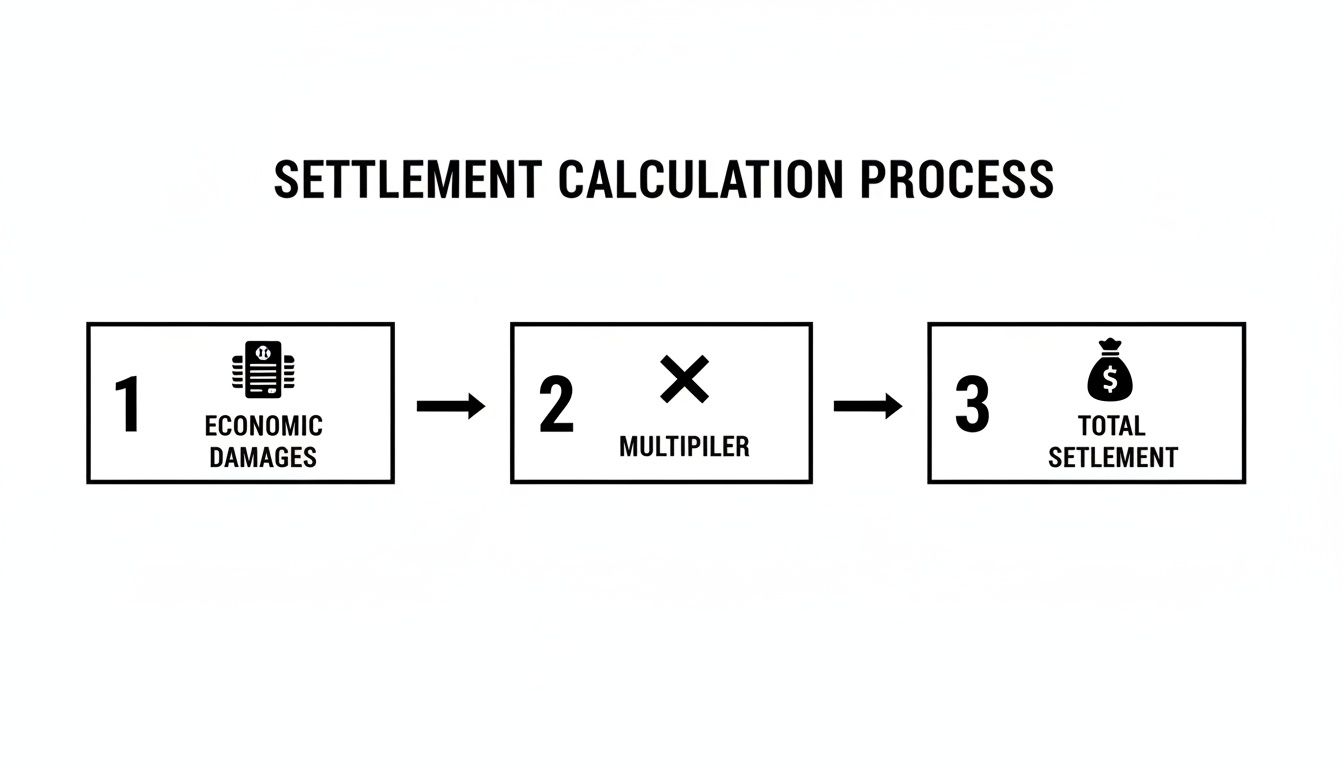
As you can see, the more solid evidence you have for your economic damages, the stronger your starting point is for negotiating the full value of your suffering.
Gather Statements from Others
What other people have seen can dramatically strengthen your claim. Testimony from your family, friends, and coworkers can back up your story and paint a vivid picture of how the accident has changed you.
Ask them to describe the "before and after"—what you were like before the injury compared to now. These outside perspectives provide an objective view of your suffering that is very difficult for an insurance company to ignore.
Chronic pain is a devastating and often invisible crisis. The World Health Organization estimates that 80% of people worldwide don't have access to proper treatment for moderate to severe pain. Here in the U.S., a recent CDC report found that high-impact chronic pain kept 17.1 million adults from living their normal lives in 2021—a statistic that reflects the life-altering consequences we see in so many injury cases.
How Long Do You Have to File a Claim in Texas?
A serious accident can change your life in a heartbeat—but you don’t have to navigate the legal maze alone. While you have the right to seek money for your pain and suffering, Texas has specific laws that can directly impact how much you’re able to recover. Knowing these rules is critical for protecting your claim.
An experienced Texas personal injury lawyer will be your guide through these complexities, but understanding the basics is the first step. Let’s break down the key laws that will shape your case.
The Statute of Limitations: A Strict Deadline
In Texas, you only have a limited amount of time to file a personal injury lawsuit. This deadline is known as the statute of limitations. For most personal injury claims, like those from car and truck accidents, you must file your case within two years from the date of the accident.
This isn't a suggestion—it's a hard deadline. If you try to file a lawsuit even one day after that two-year window closes, the court will almost certainly throw your case out. You will lose your right to seek any compensation, forever. This is why it is so important to speak with an attorney as soon as possible after an accident.
Modified Comparative Responsibility: The 51% Bar Rule
Texas uses a legal doctrine called modified comparative responsibility, which most people know as the 51% Bar Rule. This rule is a form of comparative negligence that becomes very important if the insurance company tries to argue that you were also partially to blame for the accident that hurt you.
Here’s how it works in the real world:
- If you are found 50% or less at fault: You can still get paid, but your final compensation will be reduced by your percentage of fault. For example, if a jury awards you $100,000 but finds you were 20% at fault, you would receive $80,000.
- If you are found 51% or more at fault: You are blocked from recovering any money. If a jury decides you were mostly to blame for what happened, you get nothing, no matter how severe your injuries are.
Insurance adjusters love to use this rule to shift blame onto you, hoping to reduce or completely deny your claim. A skilled Houston car accident attorney will build a strong case to fight these tactics and prove the other party was the one primarily at fault.
Damage Caps in Texas Injury Cases
You may have heard about "caps" on the amount of money you can get in a personal injury case. For most standard accident claims, like a truck crash or a typical car wreck, there are no caps on compensation. There is no limit on what you can receive for your pain and suffering in these situations.
The big exception is in medical malpractice cases. Texas law puts strict caps on non-economic damages (like pain and suffering) in lawsuits against doctors and hospitals. For the vast majority of injury victims, however, these caps won't be a factor.
Trying to understand these laws can feel overwhelming, and one small mistake can put your entire claim at risk. You don’t have to figure it all out by yourself. The compassionate attorneys at The Law Office of Bryan Fagan, PLLC, are here to provide clarity and fight for your rights.
How a Lawyer Maximizes Your Injury Claim
After a serious accident, the last thing you want to do is battle an insurance company. It’s overwhelming. This is where an experienced personal injury attorney comes in, taking the legal weight off your shoulders so you can focus on healing.Hiring a lawyer is about more than just getting an advocate. It’s about leveling the playing field. You’re up against massive insurance corporations that have teams trained to protect their bottom line—not your well-being.
The team at The Law Office of Bryan Fagan, PLLC, starts fighting for you right away. We launch our own thorough investigation into the accident to prove who was at fault. We then gather every piece of evidence needed to build a powerful story of your pain and suffering. This isn't just about collecting bills and reports; it's about showing the true human cost of your injuries.
Building Your Case Beyond the Formulas
To an insurance company, you’re just a claim number. They use cold, hard formulas to spit out a settlement offer. We see you as a person whose life has been turned upside down, and our job is to make them see it, too.
We show them the full picture by:
- Engaging Experts: We bring in respected medical professionals, life care planners, and economists. Their expert testimony can paint a clear picture of the true, long-term impact of your injuries, from the cost of future medical care to your lost earning potential.
- Documenting Everything: We guide you in collecting all the evidence that proves your suffering. This includes your medical records, notes from therapy sessions, and even personal journals that detail your day-to-day struggles.
- Interviewing Witnesses: Sometimes the most powerful evidence comes from the people who know you best. Statements from family, friends, and coworkers about the "before and after" can provide undeniable proof of how much your life has changed.
The physical and emotional toll of a major injury is devastating. A World Health Organization survey found that about 28% of adults reported moderate to extreme pain that interfered with their daily lives. This statistic reflects exactly what we see in accident victims across Houston, Dallas, and San Antonio. Texas law allows juries to award significant damages for this very real agony, and you can learn more about the global impact of chronic pain from the full research findings on pmc.ncbi.nlm.nih.gov.
Aggressively Negotiating and Litigating on Your Behalf
One of the most critical roles a truck crash lawyer in Houston plays is handling every single communication with the insurance adjuster. Adjusters are trained negotiators whose goal is to convince you to accept the lowest settlement possible. We know their tactics inside and out and won't let them lowball you.
We handle every phone call, email, and negotiation, shielding you from the stress and pressure tactics insurance companies often use. Our team aggressively pushes for a settlement that reflects the true value of your case.
If the insurance company refuses to make a fair offer, we are always prepared to take your fight to court. Our trial-ready approach is often enough to convince insurers to negotiate in good faith because they know we won’t back down.
Best of all, you don't have to worry about the cost. We work on a contingency fee basis, which means you pay absolutely no attorney’s fees unless we win your case. This promise ensures that everyone, regardless of their financial situation, can get the justice they deserve.
Frequently Asked Questions About Texas Injury Claims
After a serious accident, it's completely normal to have a flood of questions about your rights and what the future holds. This is a confusing and emotional time, but getting clear answers can give you the power to make the best choices for yourself and your family.
We've put together some of the most common questions our clients ask about pain and suffering claims in Texas, based on our years of experience helping people just like you.
Is There a Cap on Pain and Suffering Damages in Texas?
For most personal injury cases, like those from a car accident or a commercial truck crash, the answer is simple: there is no cap on compensation for pain and suffering in Texas. Juries have the freedom to award an amount they believe is fair and just based on the specific evidence of your case.
There is one major exception to this rule, however: medical malpractice claims. These specific types of cases are subject to strict statutory caps on non-economic damages. An experienced attorney can quickly clarify which rules apply to your unique situation.
Do I Have to Pay Taxes on My Pain and Suffering Settlement?
No. The Internal Revenue Service (IRS) is very clear on this. Any compensation you receive for physical injuries and the direct emotional distress or pain and suffering that results from them is not considered taxable income.
This is a critical point. It means the money awarded to you for these damages is yours to keep, tax-free.
The tax-free status applies specifically to compensation meant to help make you whole again after a physical injury or sickness. It's not treated as income because its purpose is recovery, not profit.
Can I Claim Pain and Suffering if I Was Partially at Fault?
Yes, you absolutely can, but with an important condition: you cannot be found to be the person mostly responsible for the accident. Texas operates under a "modified comparative fault" system, which is sometimes called the 51% Bar Rule.
Here’s how it works in practice:
- Your final compensation will be reduced by your percentage of fault. For instance, if you're awarded $100,000 but a jury decides you were 20% to blame for the incident, you would receive $80,000.
- If you are found to be 51% or more at fault, you are legally barred from recovering any money at all. You get nothing.
Insurance adjusters love to use this rule to their advantage. They will often try to shift as much blame as possible onto you to lower their payout or deny your claim outright. A skilled Texas personal injury lawyer knows these tactics and will fight back to prove the other party was primarily responsible and protect your right to full compensation.
The legal system is complicated and can feel overwhelming, but you don’t have to go through it alone. At The Law Office of Bryan Fagan, PLLC, we are here to offer the clarity, support, and aggressive representation you need to move forward.
Recovery is possible, and getting expert legal help is just a phone call away. For a free, no-obligation consultation to discuss your case and understand all your options, contact us today.