A serious accident can change your life in seconds — but you don’t have to face it alone. You're focused on healing, supporting your family, and figuring out what comes next. But while you're recovering, a hidden legal deadline could be silently ticking away, threatening to end your right to seek justice before you even know you have a case.
Most people have heard of the statute of limitations—the standard two-year deadline for most Texas personal injury claims. What you might not know about is a far more unforgiving rule: the statute of repose. Understanding this rule is critical to protecting your rights.
The Hidden Deadline That Can End Your Injury Claim
Think of the statute of repose as a final, non-negotiable expiration date on your right to file a lawsuit. It’s not based on when you were hurt or when you discovered your injury. Instead, it starts counting down from a specific event, often one you have no knowledge of, like the day a product was first sold.
Imagine a safety seal on a product with a hard "use by" date. It doesn't matter if you just opened the package today; if that date has passed, the product is considered expired. A statute of repose works the same way for your legal claim. It sets an absolute cutoff that might start from the day a car was first sold or the day construction on a building was finished.
Why This Deadline Is So Strict
This is what makes the statute of repose so different—and so dangerous—for you and your family. The clock can run out on your claim before you're even injured. Legal analysis shows these deadlines are enforced with absolute finality, making them essentially non-negotiable. To dig deeper into how these statutes are applied, you can review these legal resources from USLegalForms.com.
Let’s put this into a real-world context. After a Houston freeway crash, you discover that a defective part in a commercial truck caused the devastating collision. While your two-year statute of limitations would start on the day of the crash, the statute of repose for a claim against the part's manufacturer started ticking the day that truck rolled off the dealership lot years earlier.
If that hidden deadline has passed, your right to seek justice could be gone forever. This is why you cannot afford to wait to speak with an experienced Texas personal injury lawyer.
How Long Do You Have to File a Claim in Texas?
When you're dealing with a personal injury claim, there are two very different legal clocks ticking, and confusing them can be a devastating mistake that costs you your right to ever seek justice. These two clocks are the statute of limitations and the statute of repose.
While they both put a time limit on your ability to file a lawsuit, they start running based on completely different events.
The statute of limitations is the one most people have heard of. For most personal injury cases in Texas, it’s a two-year deadline. That clock usually starts ticking on the day you were actually hurt or, in some cases, the day you reasonably should have discovered you were injured. This is based on the legal principles of negligence, where you must prove another party’s carelessness caused your harm.
The statute of repose, however, is a much stricter, absolute deadline. This clock starts ticking from a specific, fixed date that has nothing to do with when you got hurt. It could be the day a car was first sold, the date a defective product was manufactured, or the day construction on a building was finished. It’s a hard cutoff, plain and simple.
Key Differences at a Glance
Let’s put this into another real-world scenario. Imagine you’re in a minor fender-bender on a Houston freeway, but a defective airbag in your car deploys with way too much force, causing a catastrophic injury.
The two-year statute of limitations for your injury claim would start on the date of that crash. But here's the catch: the statute of repose for a product liability claim against the car manufacturer might have started running 15 years earlier when the car was first sold. If that 15-year repose period is over, your claim is gone for good—even if the accident just happened yesterday.
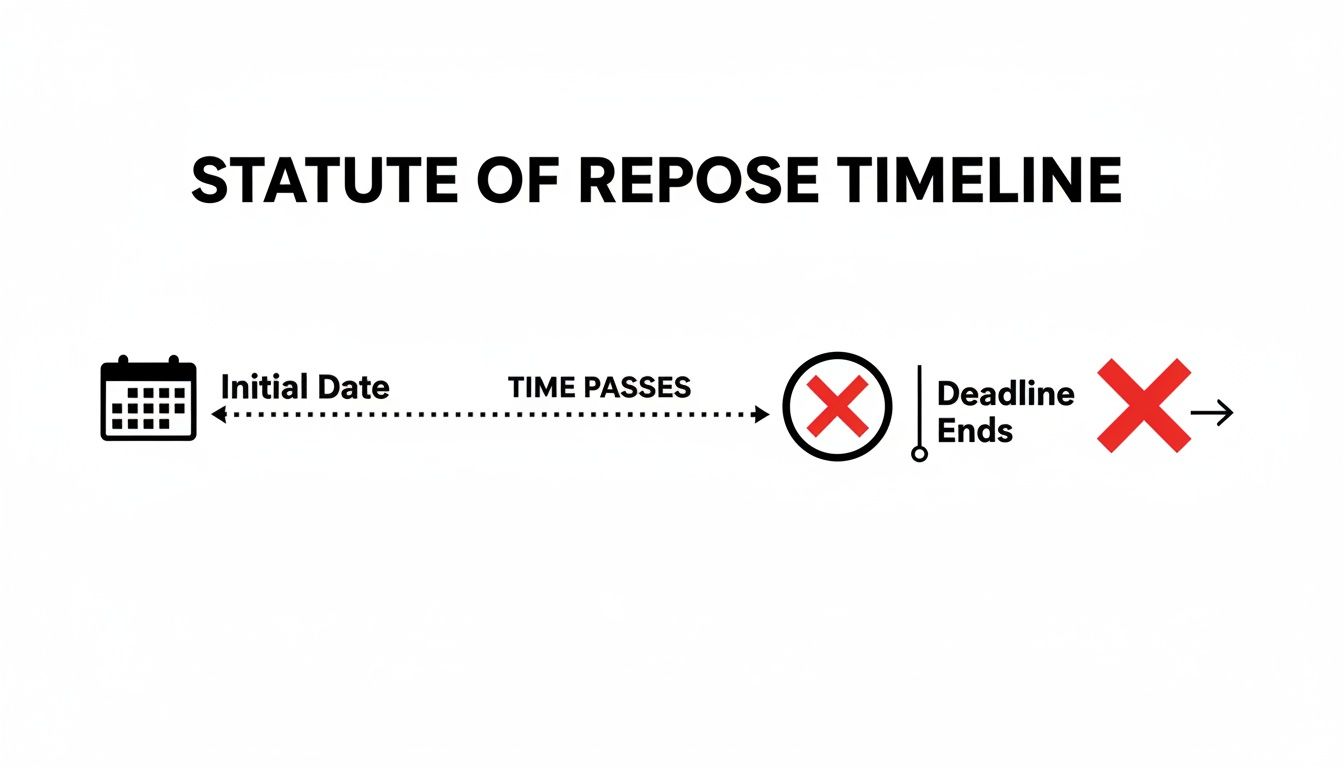
As you can see, the statute of repose acts like a final backstop. Once that initial event happens, the clock starts, and it doesn't pause for anything until it hits that immovable end date.
To make it even clearer, here is a side-by-side comparison of these two critical legal deadlines that can make or break your personal injury claim.
Statute of Repose vs. Statute of Limitations in Texas
| Feature | Statute of Limitations | Statute of Repose |
|---|---|---|
| When It Starts | On the date of injury or when the injury is discovered. | On a fixed date, like the sale of a product or completion of construction. |
| Flexibility | Can sometimes be paused or "tolled" under specific circumstances (e.g., the victim is a minor). | Almost always absolute and inflexible. It is not paused for any reason. |
| Purpose | To encourage timely filing of known claims and ensure evidence remains fresh. | To provide a final end date for a defendant's potential liability, regardless of when harm occurs. |
Understanding these differences is absolutely vital because a statute of repose can end your case before you even knew you had one. While the standard deadline is important, this hidden one is far more unforgiving.
You can learn more about the specifics of the standard timeline in our detailed guide on the statute of limitations for Texas car accidents. Because every case is unique, it's crucial to act fast to figure out which of these deadlines applies to your situation.
How Statutes of Repose Affect Different Injury Cases
While a statute of repose is an unforgiving deadline, it doesn't apply to every single personal injury claim. But in the specific cases where it does apply, its impact is absolute. It’s critical to understand how this legal principle connects to real-life situations you might face here in Texas.
Statutes of repose are most common in cases involving product liability, construction defects, and certain types of medical malpractice. Lawmakers created them with the idea that, after a certain number of years, defendants should be free from the threat of a lawsuit. It’s a major policy choice, balancing an injured person's right to justice against the need for manufacturers and builders to have eventual closure. For a deeper look at this legal balancing act, you can explore this analysis from Vanderbilt Law Review.

Products Liability Claims
Imagine a faulty tire on an 18-wheeler leads to a catastrophic truck accident on I-10 near Houston. Your injury happened today, but the statute of repose clock started ticking years ago when that tire was first sold. In Texas, the statute of repose for product liability claims is 15 years from the date the product was first sold.
Once those 15 years are up, your right to file a claim against the manufacturer is extinguished, regardless of how severe your injuries are or how clear the defect was.
This rule applies to all kinds of defective products, from auto parts and medical devices to everyday household appliances. A dedicated truck crash lawyer in Houston can investigate the manufacturing and sales history of a defective part to determine if this deadline applies to your case.
Construction and Real Estate Defects
Statutes of repose also play a huge role in cases involving defects in the design or construction of a building. If a poorly constructed balcony collapses and causes a catastrophic injury or even a wrongful death, that clock didn't start ticking on the day of the collapse.
In Texas, the statute of repose for claims against architects, engineers, and builders is 10 years from the date the construction was substantially completed. This means if a hidden defect causes harm 11 years after a building was finished, it is likely too late to seek justice from those responsible for the flawed work.
These examples show just how complex these deadlines can be. You should never make assumptions about the time you have to file a claim. The specific facts of your case determine which clock is ticking, and the only way to protect yourself is to speak with a knowledgeable Texas personal injury lawyer who can immediately investigate the unique details of your situation.
Why the Discovery Rule Offers No Protection
It's a common and perfectly understandable belief: you have the right to file a claim whenever you discover your injury. This idea is known as the "discovery rule," and it often applies to the standard statute of limitations, giving you a fighting chance if an injury doesn't show up right away. But when a statute of repose is in play, relying on this rule is a dangerously false assumption.
The statute of repose is absolute. It's inflexible. It doesn't care when you found out you were hurt.
A Vault with an Unstoppable Timer
Think of a statute of repose like a massive bank vault with an electronic timer that’s set for ten years. The moment that vault is sealed—say, when a new building is completed or a product is sold—that timer starts its relentless countdown. Nothing can stop it.
Once that timer hits zero, the vault door locks forever. It makes no difference if you only found the key (discovered your injury) the day after it sealed. The door will not open again.
This gets to the harsh reality of these laws. The discovery rule is useless here because the law’s focus isn't on what’s fair in your specific situation. Its purpose is to create a final, non-negotiable cutoff point for liability, period.
The Law Is Unforgiving
This might sound incredibly unfair, and in many cases, it is. But despite the devastating impact on injured victims, courts have consistently upheld statutes of repose as legally binding. The discovery rule simply cannot override this powerful deadline because once a statute of repose expires, your legal right to file a claim isn't just blocked—it ceases to exist entirely. You can explore more about how courts view these absolute deadlines on TrustwellLaw.com.
Here’s a real-world example. Imagine a construction defect in a Dallas office building goes unnoticed for years. Twelve years after it was built, a ceiling collapses and injures someone. Even if the evidence of the contractor's negligence is crystal clear, the 10-year statute of repose for construction claims in Texas has already run out. Your right to seek justice was lost two full years before you were even hurt.
This is exactly why you cannot afford to wait and assume the law will be on your side later. You must act immediately to find out what deadlines apply to your case.
What to Do After an Accident to Protect Your Rights
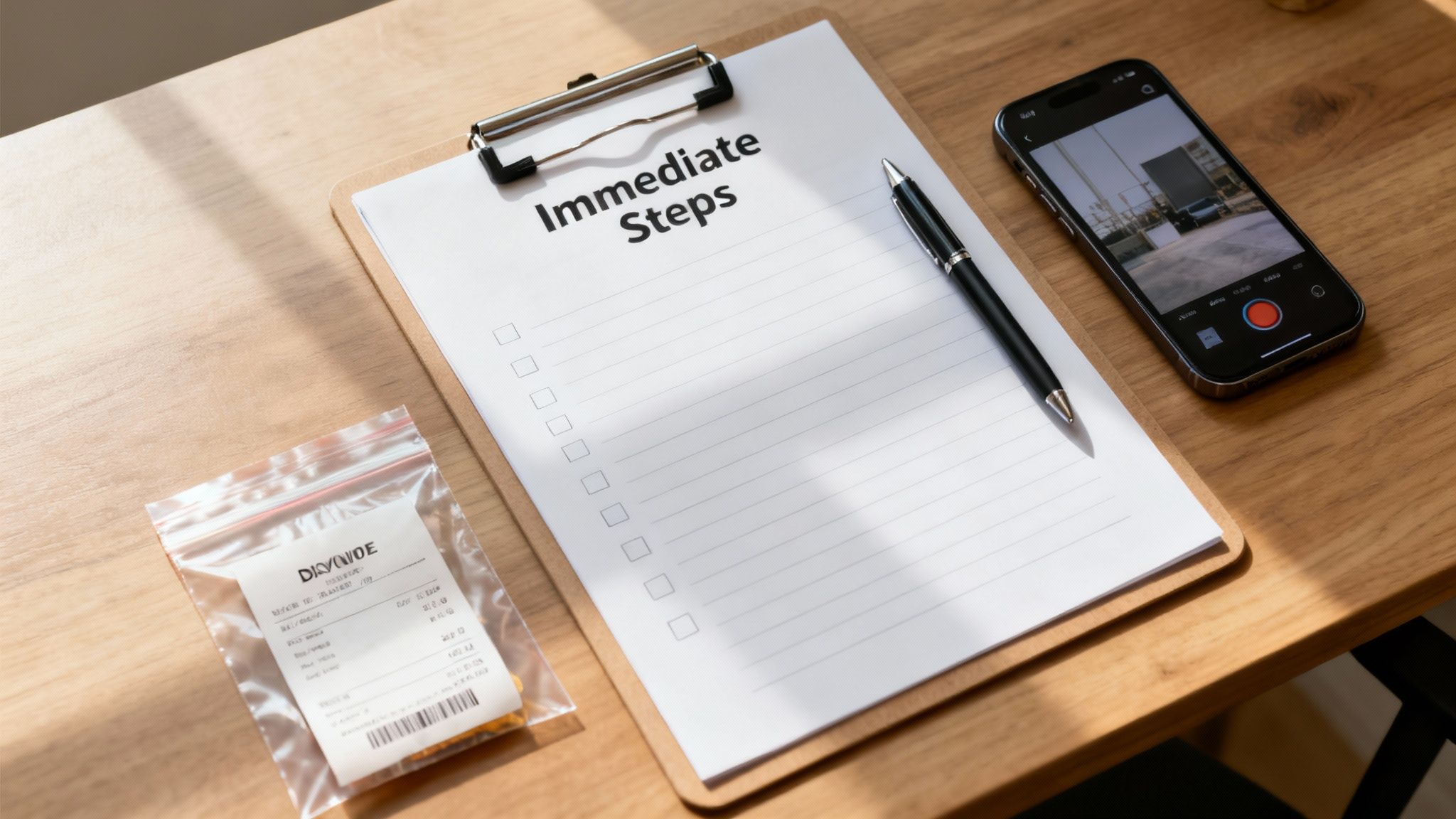
Knowing what a statute of repose is and how it can completely shut down your claim is the first step. Taking action is the next. With these unforgiving deadlines in play, you simply can't afford to wait. The things you do right now can make all the difference in protecting your family’s future.
The single most critical step you can take is to talk to an experienced Texas personal injury lawyer immediately. Figuring out which deadlines apply to your specific situation involves digging into complex facts—the last thing you should be worrying about while trying to recover from a serious injury.
Your Action Plan to Preserve Your Claim
While getting an attorney on your side is priority number one, there are other crucial things you can do to strengthen your potential claim. Each of these steps helps build a solid foundation for your case before any deadlines can put it in jeopardy. Taking control of these elements is a key part of the proactive legal risk management a skilled legal team will use to protect your interests.
Here’s a practical checklist of what you should do:
- Preserve All Evidence: Whatever you do, hold onto any defective product, broken vehicle parts, or other physical evidence from the accident. Do not let it get repaired, thrown out, or taken by an insurance company. For example, if a faulty tire caused your crash on a Houston freeway, that tire becomes the most important piece of evidence you have.
- Document Everything: Start a journal. Write down details about your medical treatments, your pain levels, and how the injury is impacting your daily life. Keep careful records of every medical bill, paycheck you’ve missed, and any other expense related to the accident.
- Never Give a Recorded Statement to the Other Party's Insurance: Insurance adjusters are trained to ask questions that can hurt your claim. Their goal is to pay out as little as possible. Politely decline to give any recorded statements or sign any documents until you’ve spoken with your own lawyer. Anything you say can and will be used against you.
The whole process of filing a claim can feel overwhelming, but taking these first steps puts you in a position of power. Protecting your rights starts this very moment, and you don’t have to do it by yourself.
How an Experienced Attorney Can Safeguard Your Claim
You shouldn't have to navigate these complex and unforgiving deadlines all on your own. After a serious accident, your entire focus needs to be on getting better, not trying to decipher confusing legal timelines. This is where an experienced Houston personal injury attorney becomes your most important ally, stepping in to protect your rights before the clock runs out.
A skilled lawyer gets to work immediately. We will launch a full investigation to pin down the exact date a defective product was sold or when construction on a building was “substantially completed.” This deep dive is critical for identifying every single statute of repose and statute of limitations that could apply to your case.
Taking Decisive Legal Action on Your Behalf
Your legal team will take over all the complex filings, making sure every document is submitted correctly and on time. We handle all communications with insurance companies and the lawyers on the other side, shielding you from their tactics while we build a powerful case to secure the full compensation you deserve.
The value of having a legal expert in your corner can't be overstated. We work to level the playing field, ensuring large corporations and their insurance companies can’t use confusing deadlines to unfairly deny your claim.
An experienced attorney doesn’t just understand personal injury law; they also stay current on developments across various domains of law, including AI Governance, to protect your claim from every angle. We know the moments after an injury are confusing, and many people wonder about when to hire a personal injury lawyer. The answer is always as soon as you possibly can, especially when a statute of repose may be involved.
Whether it’s investigating a Houston freeway crash caused by a faulty part or analyzing a catastrophic construction accident, our team is ready to fight for you. We’re committed to making sure your voice is heard and your right to seek justice is preserved.
Common Questions About Texas Statutes of Repose
When you’re trying to recover from a serious accident, the last thing on your mind should be legal deadlines. But these timelines are critical, and it's completely normal to feel confused or overwhelmed by them. Let's clear up some of the most common questions we hear about the statute of repose in Texas personal injury cases.
Are There Any Exceptions to a Statute of Repose?
Honestly, exceptions are incredibly rare. Unlike a statute of limitations, which can sometimes be paused or "tolled," a statute of repose is designed to be a hard and fast deadline. It's meant to be absolute.
In some very specific, limited situations—like when a defendant actively and fraudulently hides a defect—a narrow exception might be argued. But proving this in court is an uphill battle. You should never assume an exception applies to your case. The only safe bet is to talk to an experienced attorney who can determine the exact deadline for your specific claim.
What Happens if I Miss the Deadline?
This is where it gets serious. If the deadline set by a statute of repose passes, your legal right to file a lawsuit is gone. Permanently. It doesn't matter if you have crystal-clear proof that someone else's negligence caused your injuries.
A court will have no choice but to dismiss your case. This leaves you with no legal path to recover compensation for your medical bills, lost wages, or pain and suffering. This finality is why it's one of the most unforgiving deadlines in Texas personal injury law.
How Can I Find Out Which Deadline Applies?
Figuring out the correct statute of repose isn't a simple Google search. It requires a deep dive into the unique facts of your case. The deadline depends entirely on what kind of claim you have (like product liability or a construction defect), the specific date a product was sold or work was finished, and which Texas laws apply.
An experienced Houston car accident attorney or wrongful death lawyer in Texas has the knowledge and resources to analyze your situation. They can pinpoint exactly when that clock started ticking and ensure your claim is filed long before this unforgiving deadline slams the door on your right to justice.
A serious injury shouldn't cost you your future. At The Law Office of Bryan Fagan, PLLC, our dedicated team is here to help you understand your rights and fight for the recovery you deserve. We will investigate every deadline and build a strong case while you focus on healing, knowing that your legal rights are protected.
We want you to know that recovery is possible, and powerful legal help is available. Your path to justice starts with a conversation. Schedule your free, no-obligation consultation today to get clear answers and discover your next steps. Contact us online or call us now.