Skip to content
A serious accident can change your life in seconds, but you don't have to face it alone.
If you've been told your injury case may go to trial, you're probably feeling two things at once. Relief that someone is finally taking your losses seriously, and fear about what comes next. That reaction is normal. Few individuals ever plan to learn how a Texas courtroom works, how juries decide fault, or why a verdict doesn't always mean immediate payment.
When clients ask about what happens if a case goes to trial in a Texas injury claim, they usually aren't asking for legal theory. They want plain answers. Will I have to testify? How long will this take? What if the insurance company still won't be fair? If we win, when do I get the money?
You Are Not Alone on the Path to Trial
Many clients first hear the words “your case may go to trial” after months of medical treatment, calls with insurance adjusters, and growing financial pressure. A common example is a Houston freeway crash where the injured driver expected the insurer to pay medical bills and lost income, only to learn the company is disputing fault or minimizing the injury.
That doesn't mean the case is falling apart. Often, it means the dispute is serious enough that your lawyer has to show the other side you're ready to prove the case in court.
Trial preparation is not a failure
When a Texas personal injury lawyer prepares for trial, the message is simple. Your injuries matter, your evidence matters, and your claim won't be valued on the insurance company's terms alone. In practice, serious preparation often improves negotiation because the defense can see the case won't disappear just because they delay.
Practical rule: A case headed toward trial is usually a case where the insurer hasn't offered fair value, accepted responsibility, or taken the harm seriously.
People are often surprised by how much of the process happens outside the courtroom. Good trial preparation means gathering records, lining up witnesses, preparing exhibits, and anticipating the defense's arguments before a jury ever hears a word. It also means helping you understand each step so you can make informed decisions instead of reacting out of fear.
Clear information helps you regain control
One reason trial feels so intimidating is that people hear fragments. A deposition here, a mediation there, then suddenly talk of jury selection. The process feels less overwhelming when you can see the whole path in order.
For people interested in how law firms build a steady intake system around trust, responsiveness, and education, this discussion of predictable law firm lead generation gives useful context on why clear communication matters so much in injury practice. It reflects something clients already know from experience. The firms that explain things well tend to serve people well.
Why Most Injury Cases Settle and Some Go to Trial
Most Texas injury claims never reach a jury. According to Daniel Stark's discussion of Texas personal injury trials, roughly 95% to 99% of personal injury claims settle before a jury decides the case, and in Texas less than 5% go to trial.
That's an important reality. Trial is the exception, not the routine ending.
Why settlement is so common
Settlement gives both sides more control. The injured person avoids the uncertainty of a jury decision. The insurance company avoids the risk of a public verdict and the cost of putting on a defense. In straightforward cases, that can be a reasonable outcome.
A fair settlement usually depends on three things:
- Clear fault: If the crash report, photos, witness statements, and medical records point in one direction, settlement is easier.
- Well-documented losses: Bills, wage records, treatment notes, and future care opinions give both sides something concrete to evaluate.
- Realistic negotiation: Cases often move when both sides understand what a jury might do if the dispute continues.
If you want a practical overview of that path, settlement vs. trial in Texas personal injury cases is a useful comparison. So is The Texas Personal Injury Settlement Process, which outlines what to expect from demand through settlement or trial.
Why some cases still need a courtroom
Some cases don't settle because the fight is real. After a multi-vehicle truck crash on I-10, one insurer may blame another driver, the trucking company may deny responsibility, and the injured person may be accused of causing part of the wreck. In that situation, no amount of polite letter-writing fixes the problem if the defense won't fairly evaluate the evidence.
Other cases head toward trial because damages are disputed. That happens when the insurer says your treatment was excessive, your ongoing pain isn't related to the wreck, or your future limitations aren't as serious as your doctors say they are.
A trial date often changes the tone of the case. Deadlines harden positions, and weak arguments get exposed.
What works and what usually doesn't
Some approaches help. Organized records help. Credible medical treatment helps. Honest testimony helps. Trial readiness helps.
What doesn't help is exaggeration, gaps in treatment without explanation, social media posts that contradict your claimed limitations, or waiting too long to take the case seriously. Defense lawyers look for inconsistencies. Jurors do too.
The Pre-Trial Roadmap What Happens Before Court
Long before anyone walks into a courtroom, the case goes through a detailed build-out. During this process, facts get tested, records get exchanged, and weak claims or defenses start to show themselves.
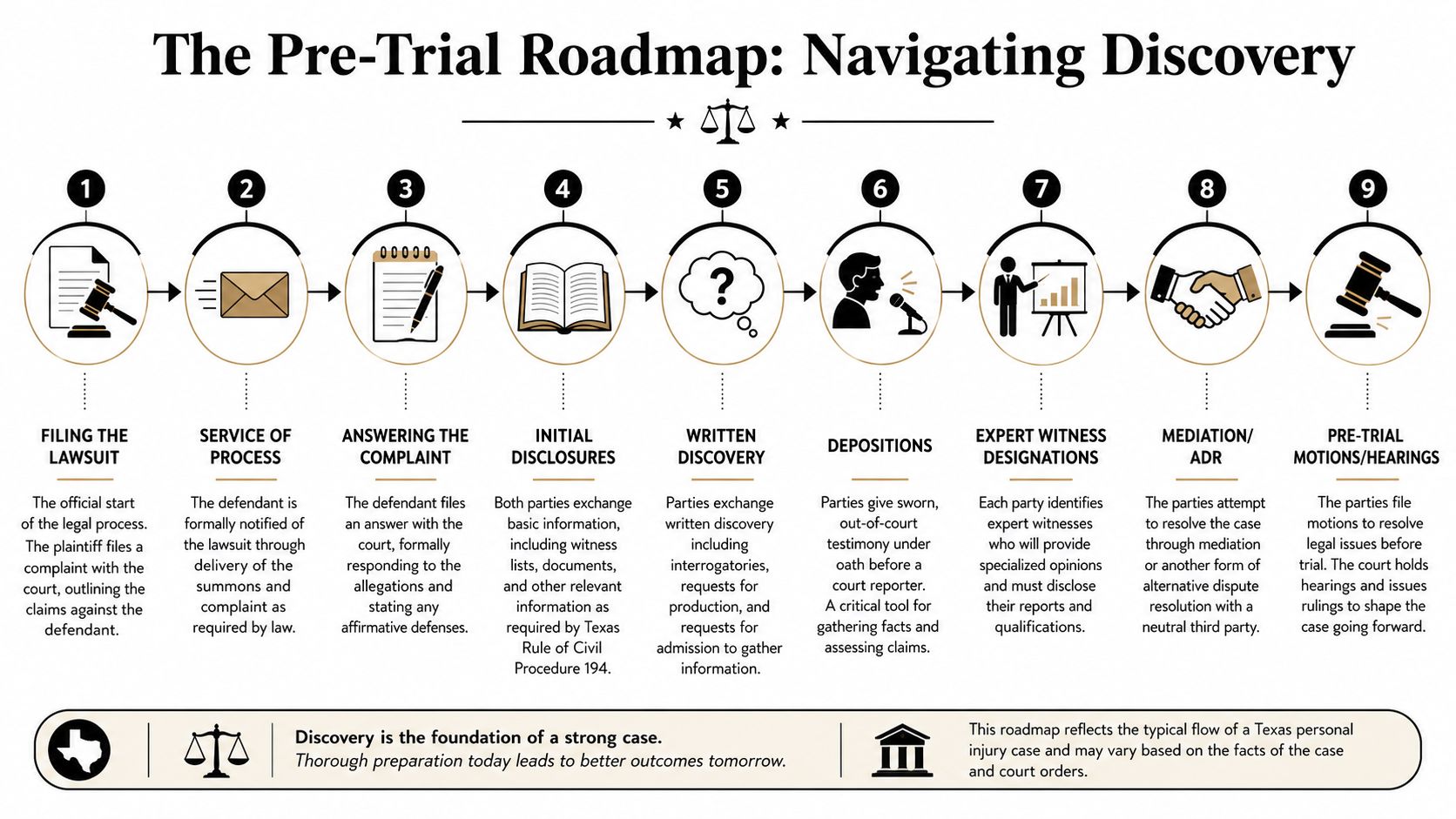
According to Ledger Law's explanation of personal injury trial timing, typical injury settlements take about 6 to 9 months, while cases that go to trial can take 12 to 18 months or longer. That same discussion notes that about 25% of cases that didn't settle earlier reach agreement during the late pre-trial phase.
Filing, service, and the defendant's response
The formal process starts when your lawyer files a lawsuit. Then the defendant must be served and given a chance to answer. That answer usually denies some or all allegations and raises defenses.
This part feels procedural, but it matters. It sets the legal boundaries of the case and starts the schedule the court will enforce. If you're trying to understand the broader timeline, how long a Texas injury lawsuit can take gives a fuller picture.
Discovery is where the case gets built
Discovery is the information exchange phase. It often includes:
- Written questions: The parties answer formal interrogatories under oath.
- Document requests: Medical records, billing records, wage records, photos, repair materials, and insurance documents may be exchanged.
- Requests for admission: One side asks the other to admit or deny specific facts.
- Depositions: Witnesses, parties, doctors, and experts answer questions under oath before trial.
Depositions matter more than many clients expect. They let both sides assess how witnesses present, how consistent the story is, and what themes may persuade a jury.
Client-centered advice: The best deposition testimony is usually careful, truthful, and direct. Trying to “win” the deposition often backfires.
Experts, motions, and settlement pressure
In more serious cases, experts can become central. A crash reconstruction specialist may explain how impact happened. A treating doctor may explain why symptoms continue. A vocational or life-care witness may address future limitations and care needs.
That's one reason a client may look for a Texas Personal Injury Lawyer. Representation for injury victims across Texas on a no-fee-unless-we-win basis often includes coordinating these litigation steps and preparing the case for either mediation or trial.
Courts also hear pre-trial motions. Some ask the judge to exclude evidence. Others challenge expert opinions or seek rulings on legal issues before jurors are seated. Many cases still resolve during mediation or right before trial because by then both sides can see the evidence more clearly.
Inside the Courtroom A Step by Step Guide to the Trial
The first morning of trial often feels like a long wait followed by a fast start. You may be sitting in the hallway outside the courtroom, dressed carefully, wondering when you will speak, where to look, and how formal everything will feel once the judge takes the bench.
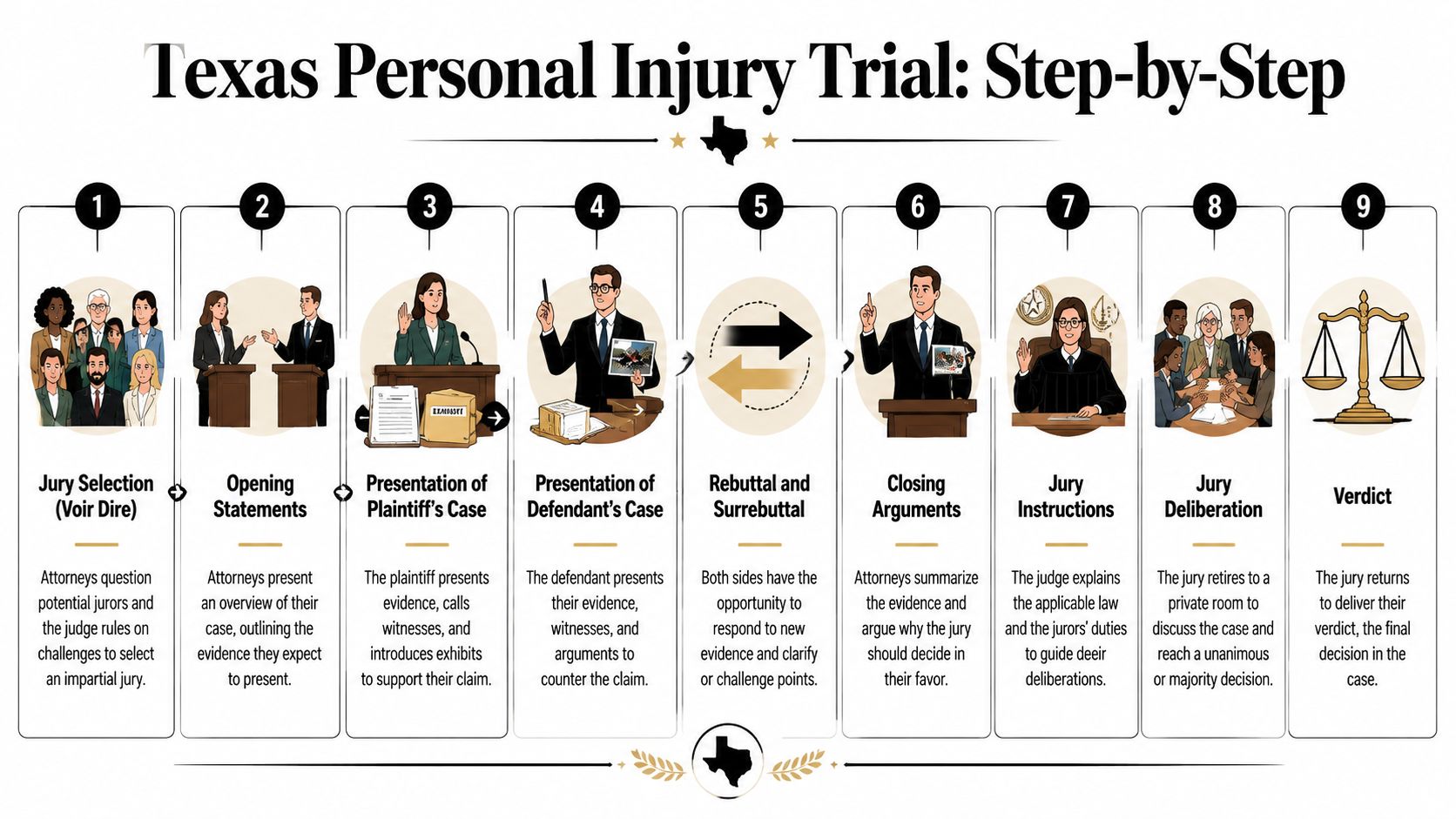
The good news is that trial follows a sequence. Once you understand that sequence, the courtroom becomes easier to handle.
Jury selection and opening statements
Trial usually begins with jury selection, also called voir dire. The lawyers and judge question potential jurors to find out whether anyone brings strong opinions or personal experiences that could affect fairness. In a car wreck case, that may include past claims, attitudes about lawsuits, views on pain treatment, or assumptions about why someone did or did not go to the doctor right away.
Clients are often surprised by how much effort goes into this stage. A strong case can still struggle with the wrong jury, especially if the defense plans to argue that the injury is exaggerated or that the crash was minor.
After the jury is chosen, each side gives an opening statement. This is the first clear story the jurors hear. Your lawyer lays out what happened, what the evidence will show, and what the case is really about from a human standpoint, not just a legal one.
Presenting the evidence
Once openings finish, the evidence begins. In many Texas injury trials, the jury must first decide fault before it considers how much money should be awarded. Because of that two-step process, proving liability is the first and most important hurdle.
In a disputed intersection collision, that may mean using scene photos, eyewitness testimony, vehicle data, and an accident reconstruction expert witness to explain the mechanics of the crash in a way jurors can follow.
The proof usually comes in a predictable order, even though each case has its own rhythm:
- Your testimony: How the incident happened, what you felt, what treatment followed, and how daily life changed afterward.
- Medical evidence: Records and testimony that connect the injury to the event and explain what recovery has looked like.
- Other witnesses: Passengers, family members, coworkers, bystanders, or anyone else who can confirm key facts or describe changes they personally observed.
- Defense witnesses: The other side may dispute fault, minimize the injury, or argue that some condition existed before the incident.
Cross-examination is often the most tense part for clients to watch. It is also normal. Defense lawyers test memory, point out gaps, and press on records they believe help their side. Good preparation matters here because clear, honest answers usually carry more weight than polished ones.
A short courtroom overview can also help before trial day:
Closing arguments and deliberation
After all witnesses have testified and the exhibits are in, the lawyers give closing arguments, bringing the trial themes together. Your attorney shows the jury how the testimony, records, and common-sense inferences fit into one clear conclusion.
The judge then reads the jury charge, which is the written set of legal questions and instructions the jurors must follow. In Texas injury cases, jurors do not solely announce a winner. They answer specific questions about conduct, causation, and sometimes separate categories of damages.
Then everyone waits.
Some deliberations are short. Others take time, especially when jurors are working through conflicting testimony or trying to assign responsibility among several people or companies. That waiting can feel harder than testifying.
What matters is that a trial is not only about telling your story. It is about presenting it in a form jurors can use to reach a verdict. And if the jury rules in your favor, the next question becomes the one clients ask me all the time: when does the money arrive?
Understanding the Verdict and Your Financial Award
When the jury comes back into the courtroom, clients often expect one simple answer. What they usually get is a series of findings that decide fault, damages, and whether the final number will match what they heard read aloud.
How Texas's 51 Percent Bar Rule Affects Your Award
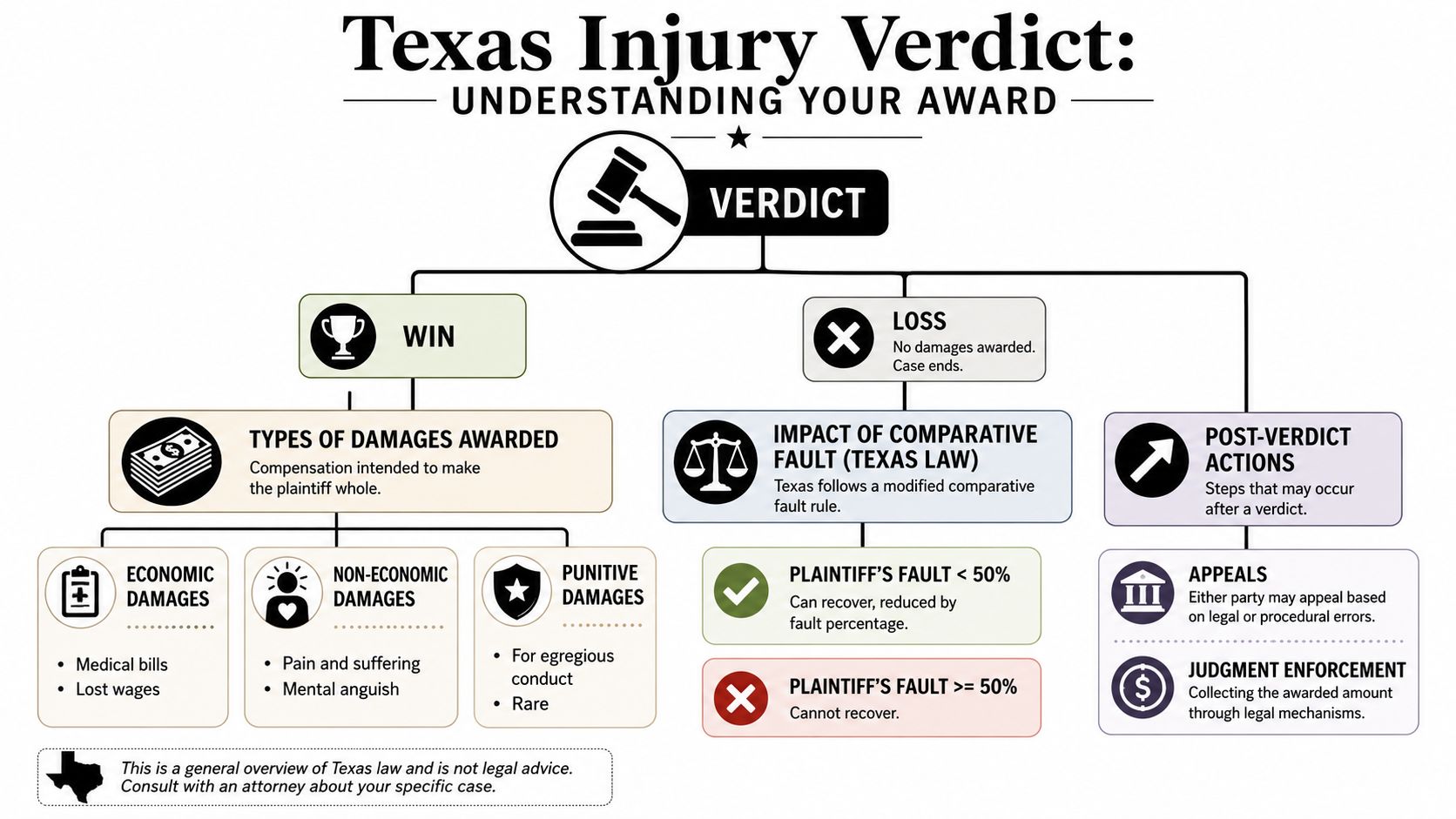
Texas uses a modified comparative fault rule. The jury can assign a percentage of responsibility to each person or company involved, including the injured person. If the jury finds you 51 percent or more responsible, you do not recover damages. If your share is 50 percent or less, your recovery is reduced by that percentage.
That issue can decide the case.
A chain-reaction crash is a good example. One driver follows too closely. Another is speeding. A third changes lanes without enough room. You may have done something the defense says contributed to the wreck, such as braking late or driving distracted. In that setting, the verdict is not only about whether someone hurt you. It is also about how the jury divides blame, and that allocation directly affects how much money you can receive.
What the jury can award
Texas juries usually answer separate questions about different kinds of damages. Those may include:
- Medical expenses: Past treatment and, if supported by the evidence, future medical care
- Lost income: Wages already lost and reduced earning capacity going forward
- Physical pain and mental anguish: The human cost of the injury
- Physical impairment or disfigurement: Limits on daily life and lasting visible harm
- Exemplary damages in rare cases: Reserved for especially serious misconduct and subject to additional legal limits
Some categories are easier to prove than others. Bills, payroll records, and tax documents give jurors something concrete to measure. Pain, limitations, and future losses require a clearer story. Jurors need to understand how your life changed, why those changes are real, and why they are likely to continue.
That is why verdicts can surprise people. A jury may believe the crash happened exactly as you described it and still award less than expected if the proof of future treatment or long-term work loss is thin.
How jurors sort out contested fault and damages
Hard cases usually involve competing explanations, not one obvious version of events. Defense lawyers often argue that the injury was preexisting, that treatment was excessive, or that someone else caused the crash. Jurors have to sort through all of it and decide what is reliable.
The evidence that tends to help most is the evidence that makes the case easier to follow:
| Evidence type | Why it matters |
|---|---|
| Dashcam or video | Shows vehicle movement, timing, and impact sequence |
| Phone records | Can support or weaken a distracted driving claim |
| Crash reconstruction | Helps explain speed, force, visibility, and angles |
| Consistent medical proof | Connects the collision to the injury and shows its progression |
In serious injury cases, the strongest verdicts usually come from evidence that fits together cleanly. The liability proof, medical records, witness testimony, and damages story should all point in the same direction. If one piece is weak, the defense will press on it.
The other practical point clients need to know is this. The verdict amount is an important milestone, but it is still not the same as money in hand. The number can change based on fault findings, legal caps in certain claims, offsets, liens, and later court rulings.
After the Verdict The Journey to Receiving Your Compensation
One of the biggest misunderstandings in injury cases is this. A verdict is not a check.
According to Ramos Law's discussion of what happens after a personal injury case goes to trial, the process of collecting money includes turning the verdict into a formal judgment, dealing with post-trial motions, handling possible appeals, and then enforcing the judgment against insurance coverage or assets.
From verdict to judgment
After the jury speaks, the court enters a judgment based on the verdict. The losing side may ask the judge to change part of the outcome, reduce the award, or order a new trial. Those requests don't always succeed, but they can slow the process.
At this stage, clients often need the most reassurance. Winning at trial is significant, but the legal system still gives the other side procedural tools to challenge the result.
What can delay payment
Several practical issues can affect timing:
- Post-trial motions: The defense may ask the court to revisit parts of the verdict.
- Appeal risk: A notice of appeal can extend the process.
- Insurance handling: Even with coverage, payment may involve internal review and paperwork.
- Liens and case expenses: Medical liens, reimbursement claims, and litigation costs may need to be resolved before final disbursement.
The key question after trial is no longer only “What did the jury award?” It becomes “What amount is collectible, when, and through what process?”
Collection is its own phase
If insurance applies and the case resolves cleanly after judgment, payment may move more smoothly. If the defendant contests payment or available coverage is limited, collection can become more complicated.
In some cases, your lawyer may need to pursue the insurer directly within the bounds of the policy. In others, enforcement against assets becomes part of the discussion. Clients deserve honest advice here. A large verdict can still face delay, reduction, or collection challenges, especially if the defendant can't pay quickly.
That's why trial strategy should always include post-verdict planning. It's not enough to ask whether you can win. You also have to ask how recovery will reach your family.
Let Us Stand With You in Court and in Your Recovery
The night before trial is often the moment clients feel the weight of everything at once. They are thinking about what to wear, what the defense lawyer will ask, whether the jury will understand their pain, and what happens to their family if the case still does not end quickly. That pressure is real. Good preparation lowers it.
By the time your case reaches trial, your role is clear. Tell the truth. Listen carefully. Stay grounded. My job is to prepare you for the hard parts, protect the record, and keep the case focused on what happened, how it changed your life, and what recovery should look like in practical terms.
Practical ways to prepare
Clients usually do best when they keep the process simple:
- Review your prior statements carefully: Your deposition, medical history, and timeline should feel familiar before you testify.
- Speak in your own words: Honest testimony is more persuasive than polished answers.
- Answer only what is asked: Short, accurate answers prevent confusion.
- Stay off social media: A single post can create a distraction the defense will try to use.
- Keep us updated: Changes in treatment, work, symptoms, or family strain matter, especially close to trial.
For those evaluating law firms, operational systems such as an AI receptionist for personal injury attorneys demonstrate the importance of responsive communication when clients are under pressure and court deadlines are approaching.
Trial is never only about one day in court. It is part of a longer path that starts with preparation and continues through judgment, post-trial issues, and the work of getting money into a client's hands. That is why clients need honest advice about both risk and recovery. A strong courtroom presentation matters. So does a clear plan for what happens after the verdict.
For someone living with a serious crash injury or grieving a wrongful death, being heard matters. So does having counsel who can explain each step without talking over you.
Law Office of Bryan Fagan, PLLC helps injured Texans understand their options, prepare for trial, and work through the recovery process after a verdict. We handle car accident, truck wreck, wrongful death, and catastrophic injury claims across Texas, and we offer free consultations for people who need clear answers before deciding what to do next.