Under Texas law, the exemplary damages cap is generally the greater of two times economic damages plus noneconomic damages up to $750,000, or $200,000. The cap can disappear if the defendant's conduct qualifies as certain felonies, including intoxication assault or intoxication manslaughter.
A serious accident can change your life in seconds, but you don't have to face it alone. After a Houston freeway crash, you may be dealing with emergency treatment, lost income, painful rehabilitation, and questions about whether the other driver's conduct was more than ordinary carelessness. If alcohol, extreme recklessness, or another form of egregious misconduct played a role, exemplary damages may become part of your claim.
This guide explains how the exemplary damages cap 41.008 Texas injury case rules work, how the calculation changes when several defendants share responsibility, and when the statutory cap may not apply. It also covers the evidence you should protect, the effect of comparative responsibility, and the deadlines that can affect your right to sue.
Understanding Your Rights After a Serious Texas Accident
After a Houston freeway collision, the first concerns are usually immediate. You may need surgery, transportation, help caring for children, or time away from work. Your family may also be trying to understand why the crash happened and whether the driver or a company should be held accountable.
Texas personal injury law separates compensation for your losses from damages intended to punish especially wrongful conduct. Medical bills, lost wages, future care, pain, and emotional harm generally fall within compensatory damages. Exemplary damages serve a different purpose. They may be available when the defendant's conduct was so reckless or blameworthy that ordinary compensation doesn't fully address the need for punishment and deterrence.

Your underlying injury claim still depends on proving the required elements of negligence or another legal theory. That usually means showing that the defendant owed you a duty, failed to act reasonably, and caused your injuries. If you were partly responsible, Texas proportionate-responsibility rules can reduce your recovery, and a finding that you were more than 50% responsible can bar recovery entirely under Texas proportionate-responsibility law.
A serious case may involve several categories of losses. The available categories are summarized in What Damages Can You Recover in a Texas Injury Case?. Exemplary damages are separate from those compensatory categories and require a distinct legal and evidentiary analysis.
Practical point: A large injury alone doesn't automatically create an exemplary-damages claim. The defendant's conduct matters just as much as the severity of your harm.
The rest of the analysis turns on two questions. First, does the conduct qualify for exemplary damages under Texas law? Second, if it does, does the ordinary cap apply, or does a statutory felony exception remove it? Those answers can affect settlement discussions, trial preparation, and the evidence your lawyer needs to preserve.
What Are Exemplary Damages Under Texas Law
Exemplary damages, sometimes called punitive damages, are damages awarded as a penalty or punishment rather than as direct reimbursement for a bill or other loss. They're intended for conduct that goes beyond ordinary negligence, such as conduct involving fraud, malice, or gross negligence under the requirements of Texas law.
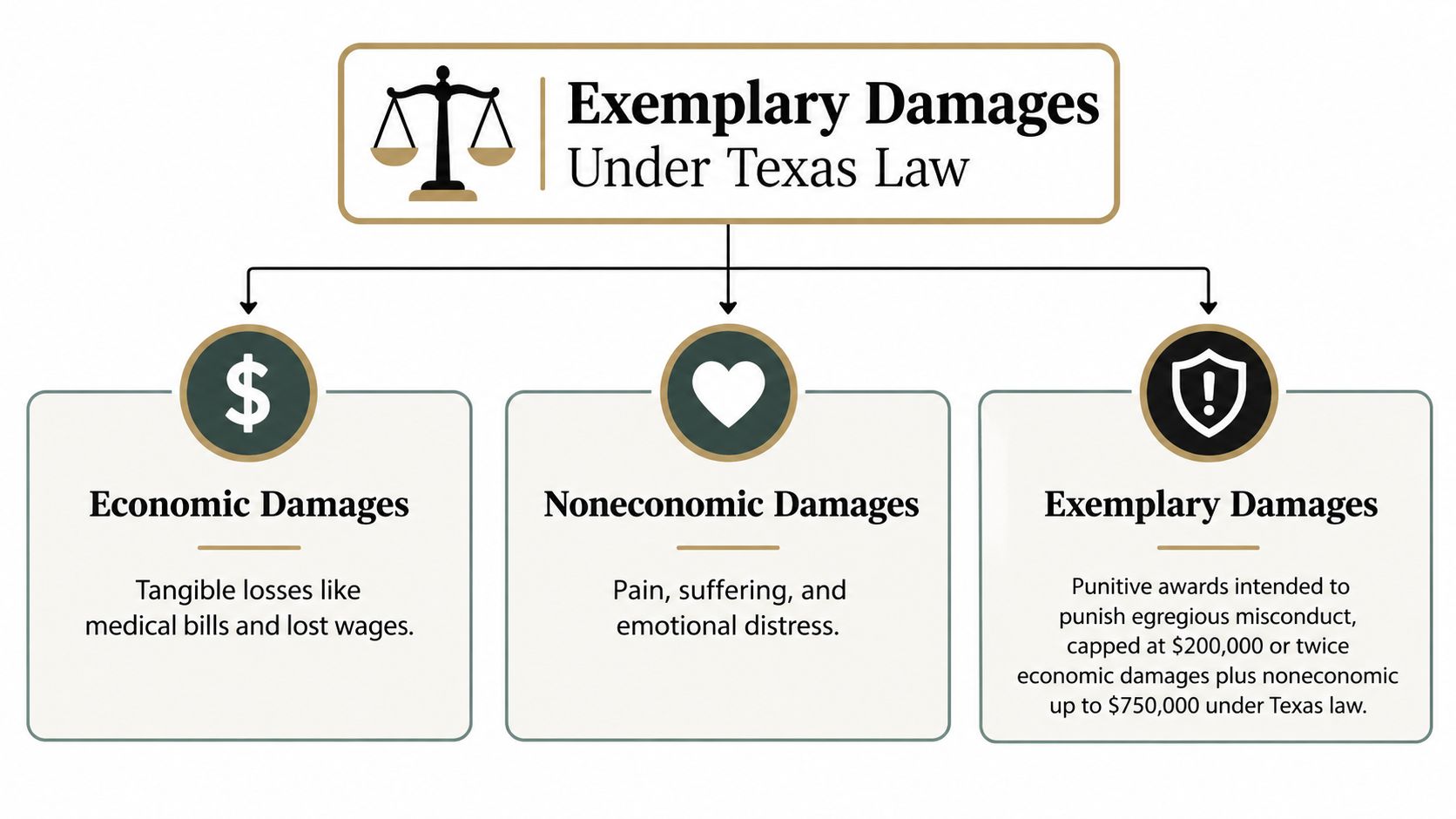
That makes them different from the compensation that pays for the consequences of an accident. Economic damages may include medical expenses, lost wages, and future care needs. Noneconomic damages may include pain, suffering, emotional distress, and other human effects that don't come with a simple invoice. You can review the distinction between these categories in this explanation of economic and noneconomic damages in Texas.
Applying the statutory formula
Section 41.008(b) establishes the ordinary ceiling using a greater-of formula:
- First calculation: Two times the amount of economic damages, plus an amount equal to noneconomic damages found by the jury, with the noneconomic component capped at $750,000.
- Second calculation: $200,000.
- Result: The applicable exemplary-damages cap is whichever calculation is greater.
Consider a catastrophic collision that produces $300,000 in economic damages and $400,000 in noneconomic damages. The first calculation would be $1,000,000, because two times $300,000 is $600,000, and adding $400,000 produces $1,000,000. That amount is greater than $200,000, so the ordinary statutory ceiling would be $1,000,000, assuming exemplary damages are legally available and the noneconomic award qualifies under the statute.
This calculation doesn't mean a jury must award exemplary damages or that a plaintiff automatically receives the maximum. First, the plaintiff must establish the required misconduct by the applicable heightened proof. Then the factfinder determines whether exemplary damages should be awarded and in what amount, subject to the statutory limit unless an exception applies.
Why the damage categories matter
The formula depends on the economic-damages figure, so records supporting medical treatment, wage loss, and future care can affect the calculation. The jury must determine economic damages separately from other compensatory damages. That separation is important because exemplary damages aren't just added to one blended total.
A Texas personal injury lawyer can also evaluate how the exemplary claim fits alongside the rest of your recovery. The categories and calculation may differ in a car crash, trucking collision, catastrophic injury case, or wrongful-death claim, especially when several parties share responsibility.
How the Cap Is Calculated and When It Disappears
The ordinary formula becomes more complicated when more than one defendant contributed to the crash. Texas Supreme Court guidance addresses a point that many simplified explanations miss: the economic-damages base isn't automatically the entire case-wide economic award. Instead, the relevant economic damages are tied to the portion attributable to each defendant's responsibility, as explained in the Texas Supreme Court guidance on defendant-specific allocation.
Multiple defendants require separate analysis
Suppose a multi-vehicle crash involves two drivers and a trucking company. The plaintiff may present one overall injury claim with medical bills, lost income, and future care needs. But the cap analysis can be performed separately for each liable defendant based on that defendant's proportionate responsibility.
That means a larger total verdict doesn't automatically create one single punitive-damages ceiling for the entire case. The court must examine the economic-damages base attributable to each defendant. A truck crash lawyer Houston victims trust will need to investigate not only how the collision happened, but also whether a driver, employer, carrier, or another entity bears responsibility for distinct conduct.
A multi-defendant verdict and a defendant-specific cap are different questions.
This rule matters in layered insurance disputes. A plaintiff could have a substantial overall compensatory award, yet the exemplary-damages calculation may differ from one defendant to another. Fault allocation therefore affects both liability and the potential cap.
The felony exception
Section 41.008(c) creates an important exception. The cap doesn't apply to certain conduct that constitutes listed felonies, including intoxication assault and intoxication manslaughter, as explained in this discussion of Texas punitive-damages caps and felony conduct.
A drunk-driving crash causing serious injury may involve intoxication assault. A crash causing death may involve intoxication manslaughter. The exception is narrow, so intoxication by itself isn't enough. The evidence must support the applicable statutory offense and the civil claim's requirements.
Preserve police reports, BAC or toxicology results, criminal charging documents, witness accounts, video, and photographs as early as possible. A criminal case and a civil case are separate proceedings, but records from the investigation may be important when evaluating whether the felony exception applies.
Medical expense documentation also matters to the ordinary calculation. Records concerning charges, treatment, and care should be gathered carefully, including issues addressed under Texas paid-or-incurred medical damages rules.
Standard Cap Versus Felony Exception Comparison
The difference between the ordinary rule and the felony exception is easiest to understand when placed side by side. The standard path uses the statutory formula. The exception removes that cap when the conduct fits the listed felony requirements.
| Scenario | Cap Applies | Key Requirement |
|---|---|---|
| Ordinary qualifying exemplary-damages claim | Yes | The award is subject to the greater of two times economic damages plus qualifying noneconomic damages up to $750,000, or $200,000 |
| Qualifying claim involving intoxication assault | No, if the statutory exception applies | Evidence must support the listed felony conduct and the underlying civil claim |
| Qualifying claim involving intoxication manslaughter | No, if the statutory exception applies | Evidence must support the listed felony conduct involving death and the underlying civil claim |
| Multi-defendant claim | Usually, defendant-specific analysis applies | The economic-damages base is tied to each defendant's responsibility, not automatically the total case-wide award |
The standard cap scales with proven economic losses. A catastrophic injury with extensive treatment, wage loss, and future care can produce a different ceiling from a claim with limited economic damages. The noneconomic part of the formula remains subject to the statutory $750,000 limit.
The felony exception changes the negotiation because the defendant may no longer rely on the ordinary statutory ceiling. That doesn't guarantee a particular award. You still need evidence connecting the defendant's conduct to the listed felony and proving the civil claim.
The distinction also changes trial preparation. In a standard claim, your lawyer must build the economic-damages record and calculate the defendant-specific base. In a felony-exception claim, early preservation of toxicology, police evidence, charging documents, and witness testimony can become especially important.
A wrongful death lawyer Texas families contact should examine both the death claim and the conduct evidence. The question is not just whether the crash was fatal. It's whether the facts satisfy the narrow statutory exception.
Steps to Preserve Your Exemplary Damages Claim
Evidence can disappear quickly after a crash. Vehicles get repaired, surveillance footage may be overwritten, witnesses forget details, and insurance representatives may ask for statements before you understand the full extent of your injuries.

Protect the evidence
Start with the records that may show what happened and how serious the conduct was:
- Request investigation records: Preserve the police report, crash information, citations, and any available criminal charging documents.
- Identify intoxication evidence: Ask your lawyer to pursue BAC or toxicology results when alcohol or drugs may have contributed.
- Locate witnesses: Write down names and contact information, and preserve what each person observed without coaching or embellishing testimony.
- Save physical and digital evidence: Keep photographs, video, vehicle information, damaged property, dash-camera files, and relevant messages.
- Document treatment and losses: Maintain medical records, appointment information, work records, wage documentation, and information about future care.
Don't post about the accident or your recovery on social media. A casual statement or photograph can be taken out of context and used to challenge your injuries or your account of events.
This video may help you think through the importance of documenting an accident and protecting information while the facts are still fresh.
Protect your position in the claim
Insurance companies may request a recorded statement or propose an early settlement. You don't have to decide whether an offer is fair before your injuries, future care, fault allocation, and exemplary-damages issues are understood. Signing a release can end claims you haven't yet valued, so have the proposed documents reviewed before signing.
Texas proportionate responsibility adds another reason to act carefully. Under Texas law, a claimant who is found more than 50% responsible for the accident may be barred from recovering damages. If an insurer argues that you were speeding, distracted, or otherwise at fault, the assigned percentage can determine whether you recover anything.
Contact a lawyer promptly if the crash involved intoxication, a commercial vehicle, a fatality, disputed fault, or severe injuries. Early legal review can help preserve evidence and identify all potentially responsible defendants before positions harden.
Settlement Strategy and Trial Implications
The cap is one factor in settlement, not the entire value of your case. A defendant or insurer may point to the ordinary ceiling and argue that your exemplary-damages claim has limited potential. That position may overlook the defendant-specific allocation rule, the possibility of a felony exception, or weaknesses in the evidence about fault.
A strong settlement evaluation begins with the compensatory claim. Your legal team should understand the medical treatment, lost income, pain, future needs, and responsibility of each party. The exemplary claim then adds a separate question: does the evidence show conduct that justifies punishment under Texas law?
Questions that shape negotiation
A Houston car accident attorney may evaluate:
- Conduct evidence: Does the record show more than ordinary negligence?
- Fault allocation: Which driver, employer, carrier, or other defendant caused which part of the harm?
- Exception evidence: Do police, toxicology, witness, or charging records support a listed felony?
- Economic foundation: Are medical bills, wage loss, and future care documented well enough to support the calculation?
- Release language: Would accepting the offer waive exemplary, injury, property, or other claims?
Settlement can provide certainty and avoid trial risk, but a quick offer isn't automatically a fair offer. You should understand what rights you're giving up and whether the offer reflects the full scope of your losses.
Trial may become more important when the defendant disputes intoxication, minimizes the seriousness of the conduct, blames you for the crash, or refuses to recognize the felony exception. A jury may consider the evidence, but no exemplary award is automatic. The claim still requires careful proof, and the applicable cap must be addressed in the case strategy.
Insurance coverage also requires attention. Liability coverage may address compensatory losses, but the availability and collection of exemplary damages can involve separate legal questions. Your lawyer should identify the responsible parties, available policies, assets, and any claims involving uninsured or underinsured motorists rather than assuming one policy resolves the case.
The right strategy depends on evidence, not pressure. A careful evaluation can show whether negotiation protects your interests or whether preparing for trial creates a stronger position.
Get Help Recovering What You Deserve
After a serious crash, you may not know whether to focus first on treatment, insurance, work, or legal deadlines. You can take those concerns one at a time. Get medical care, keep your records, avoid giving a detailed recorded statement before getting advice, and preserve every document connected to the collision.
At The Law Office of Bryan Fagan, PLLC, the firm handles Texas personal injury matters involving car crashes, truck collisions, catastrophic injuries, and wrongful death claims. The team can investigate the crash, gather records, interview witnesses, assess comparative responsibility, and evaluate whether the ordinary exemplary-damages cap or a felony exception may apply.
Time limits also matter. Texas generally gives injured people and families two years to file personal-injury or wrongful-death lawsuits under Section 16.003, as explained in this guide to the Texas injury statute of limitations. For wrongful death, the period runs from the date of death. Waiting while an insurer delays negotiations can put your legal rights at risk.

A free consultation can help you understand the available paths without requiring you to make an immediate decision. Whether you need a Texas personal injury lawyer after a vehicle collision, a truck crash lawyer Houston families can contact, or a wrongful death lawyer Texas families need after a fatal crash, early guidance can protect evidence and clarify your options.
The Law Office of Bryan Fagan, PLLC offers free consultations to discuss the exemplary damages cap, felony exceptions, fault disputes, and deadlines in your Texas injury case. Visit Law Office of Bryan Fagan, PLLC to schedule a consultation and learn how the firm can help investigate your claim and pursue the compensation the law allows. Recovery is possible, and you don't have to handle the process alone.