 Skip to content
Under Texas Civil Practice and Remedies Code § 41.0105, recoverable past medical damages are limited to the amount the injured person paid or incurred, not the full amount originally billed. That distinction matters for almost every Texas crash victim because insurance contracts, government programs, and write-offs can make the number used in a claim very different from the first hospital bill.
A serious accident can change your life in seconds, but you don't have to face it alone. If you're looking at an emergency-room statement, calls from an adjuster, and medical debt you never expected, the difference between “billed” and “paid or incurred” can feel unfair and confusing. As a Texas personal injury lawyer, I want to walk you through what the rule means, what evidence matters, how a jury may evaluate the bills, and why liens or subrogation claims can reduce the money you ultimately receive.
A Houston Crash, a Big Hospital Bill, and a Smaller Number
After a Houston driver is rear-ended on the Katy Freeway, an ambulance may carry that person to a hospital for urgent treatment. In a serious collision, the patient may need extensive testing, emergency procedures, or an airlift before the family has time to understand what happened. Later, a hospital statement may show a $92,000 bill, while the insurance records show that only a few thousand dollars became the actual payment obligation.
That victim may reasonably ask, “Why are there two numbers? Which one belongs in my injury claim?” The answer affects settlement discussions, trial evidence, and the amount a jury may consider as past medical damages. The larger number is the provider's original charge. The smaller figure may reflect insurance payments, contractual write-offs, or the patient's remaining responsibility.
Texas law addresses this problem through Civil Practice and Remedies Code § 41.0105. The statute limits past medical or health care expenses to the amount paid or incurred by or for the injured person. In plain language, you generally can't recover a charge that nobody ever had a legal obligation to pay.
Why the smaller number matters
This rule doesn't decide whether you were injured or whether another driver caused the crash. It controls how the medical-expense portion of the claim is measured. Your case may still include other damages, such as lost income, physical pain, emotional harm, impairment, or future care, when the evidence supports them.
The practical questions are often more complicated:
- Which entity paid the provider?
- What amount did the insurance contract require?
- Was a balance written off?
- Did you sign a medical lien?
- Does Medicare, Medicaid, workers' compensation, or a private plan have reimbursement rights?
- What records can prove the amount that was paid or owed?
A hospital bill can look overwhelming, but the headline charge isn't automatically the legal value of the medical claim. This guide explains the rule in everyday language, including write-offs, payor differences, jury evidence, liens, subrogation, and documentation steps that can protect your recovery.
What Texas Law 41.0105 Actually Says
Section 41.0105 was enacted in 2003 as part of a broad Texas tort-reform package. It limits recovery of medical or health care expenses to the amount “actually paid or incurred” by or on behalf of the claimant, rather than the provider's original gross charge. The statutory language and its application are discussed in the Texas Civil Practice and Remedies Code.
The simplest way to understand the rule is to compare medical billing to a car's sticker price. A dealership may place a high price on a vehicle, but the transaction is measured by the amount the buyer agrees to pay. If a negotiated discount removes part of the price and no one can later demand that amount, the discount isn't a debt owed by the buyer.
Medical billing can work in a similar way. A provider may list a gross charge, then enter a contractual adjustment with a private insurer. The insurer pays the negotiated amount, and the provider accepts that amount under the agreement. The written-off difference generally isn't an expense the patient incurred.
Four questions to ask about any bill
- What was originally billed? This is the provider's initial charge and may be called the gross charge.
- What was reduced or written off? A contractual adjustment may eliminate an amount the provider can't legally collect.
- What was paid? This may include payments from an insurer, government program, or the patient.
- What remains legally owed? A deductible, co-insurance amount, lien balance, or other valid obligation may be part of what was incurred.
The rule measures damages. It doesn't mean your injury wasn't serious, and it doesn't prevent you from seeking compensation for properly supported medical care. It means the medical-expense evidence must reflect the payment obligation rather than a number that includes charges no one had to pay.
The Texas Supreme Court made the rule especially important in 2011, when it decided Haygood v. Garza de Escabedo. The Court held that a claimant couldn't recover, or even present to the jury, medical bills that had been written off and never had to be paid. That decision made Section 41.0105 a practical trial rule, not merely a billing principle.
Billed vs Paid Why the Number Changes
The difference between a billed amount and a recoverable amount usually develops through several billing stages. Each stage answers a different question, and confusing them can lead to an overstated or understated claim.
A provider's gross charge is the amount first placed on the statement. It may reflect the hospital's standard pricing system, but it doesn't necessarily show what the provider accepted as payment. A private insurer may then apply a contractual write-off, which is the amount the provider agreed not to collect under its contract.
The insurer's payment and the patient's responsibility form the remaining financial picture. Patient responsibility may include deductibles or co-insurance, but the records must show that the amount was owed. A provider's statement alone may not answer that question.
| Billing Stage | What It Means | Effect Under 41.0105 |
|---|---|---|
| Original billed charge | The provider's initial gross statement | Doesn't automatically establish recoverable damages |
| Contractual write-off | An amount eliminated under a payor agreement | Generally excluded because it wasn't owed |
| Payor payment | Money paid by insurance or another third-party payor | Supports the paid portion of the claim |
| Patient responsibility | A legally enforceable amount assigned to the patient | May support the incurred portion if documented |
The Texas Supreme Court explained that Section 41.0105 limits recovery and trial evidence to expenses the provider had a legal right to be paid. That is why an explanation of benefits, payment ledger, and provider statement can be more important than the first bill you received. A lawyer evaluating how medical bills are paid after an accident in Texas will usually want to trace the account from the original charge through every adjustment and payment.
Why the full bill can create a problem
Suppose a hospital lists a substantial charge, but an insurance contract reduces it and the provider accepts the lower amount. Showing the full charge as though it were a debt can invite an objection. The defense may argue that the larger figure includes amounts the patient never owed and that the jury shouldn't use it to calculate medical damages.
That doesn't mean the defense automatically wins. The plaintiff still has the opportunity to present competent evidence of the amounts paid or incurred and to prove the medical care was connected to the accident. It does mean your legal team needs accurate records before discussing settlement or preparing for trial.
Insurance companies often examine these records closely. A resource such as Dealing With Insurance Companies After a Texas Accident addresses how insurers try to reduce payouts and how claimants can protect their claims. Don't assume the adjuster's interpretation of a bill is complete or favorable to you.
How Insurance and Government Payors Change the Picture
The same medical treatment can produce different recoverable figures depending on who paid the provider and what payment rules applied. That's why two people with similar injuries may have different medical-damage evidence even when both received care at the same facility.
Private insurance
A private health plan commonly negotiates rates with hospitals and doctors. The provider may accept the plan's payment and write off the difference between the gross charge and the contractual rate. The patient may still have a documented responsibility under the plan, and that amount can matter when determining what was incurred.
Self-funded ERISA plans can create additional reimbursement concerns. The plan documents may give the plan rights to seek repayment from a settlement, so the recoverable medical figure and the amount you ultimately keep aren't always the same question.
Medicare, Medicaid, and workers' compensation
Medicare uses federal reimbursement rules, including rights connected to accident-related payments. Medicare may make conditional payments and later seek repayment from a recovery. Medicaid has its own Texas recovery rules and may assert rights against certain settlements. Workers' compensation can apply when the crash happened during work-related activity, with reimbursement issues that require separate review.
The statutory benchmark remains the amount paid or incurred, but the records and reimbursement process differ by payor. You should preserve every notice, statement, and benefits explanation.
No insurance or underinsured care
An uninsured patient may face a provider balance, a lien arrangement, or another payment agreement. The billed charge still isn't automatically the amount recoverable. The key question is what the provider had a legal right to collect and what the patient paid or remained obligated to pay.
| Payor Type | Billed Amount | Discount / Write-Off | Recoverable Past Medical |
|---|---|---|---|
| Private health insurance | Provider's gross charge | Contractual reduction may apply | Paid amount and valid patient obligation |
| Medicare | Provider's gross charge | Federal payment rules may apply | Amount actually paid or incurred under applicable records |
| Medicaid | Provider's gross charge | Regulated payment rules may apply | Amount supported by payment and legal-obligation records |
| Workers' compensation | Provider's gross charge | Workers' compensation rates may apply | Amount paid or incurred under the applicable arrangement |
| No insurance | Provider's gross charge | May involve negotiation or lien terms | Amount legally owed or actually paid |
The table shows why you shouldn't judge your claim by the first statement alone. Health insurance coverage for auto accidents in Texas can affect both the billing history and the reimbursement questions that must be resolved before a settlement is finalized.
What the Jury Gets to See and Hear
The medical-bill dispute often becomes an evidence fight. Under Section 41.0105, the jury generally shouldn't calculate past medical damages from amounts that were written off and never had to be paid. The Texas Supreme Court's decision in Haygood v. Garza de Escabedo confirmed that the limitation applies to what can be presented to the jury, not only to the final award.
A defense lawyer may use an explanation of benefits, payment ledger, or negotiated-rate documentation to challenge a large gross charge. If a hospital statement lists a major amount but the records show that the provider accepted a much smaller payment, the defense may argue that the larger number exaggerates the actual economic loss.
What “incurred” means in practice
“Actually incurred” doesn't mean that a document exists. It points to a real legal obligation. A patient may have incurred a valid balance even if payment is delayed, arranged through a lien, or assigned to another payor. On the other hand, a contractual write-off usually isn't recoverable because the provider gave up the right to collect it.
Consider a hypothetical hospital stay with a $90,000 billed charge. If the evidence shows a legally enforceable obligation for $9,000, the defense may argue that the jury should consider the lower figure. If the records instead establish that the patient or an authorized payor owed the full charge, the argument may look different. The outcome depends on the payment arrangement and admissible evidence, not the appearance of the first statement.
Practical rule: Keep the bill, but don't stop there. The explanation of benefits and complete account ledger often tell the more important story.
Plaintiff's counsel may also address the collateral source rule and arguments about the reasonable value of medical care. Those issues can become technical quickly. A judge may decide what evidence is admissible, limit testimony, and instruct the jury on the proper measure of damages.
That preparation matters before trial. Your lawyer may need provider testimony, billing records, payor documents, and focused motions addressing excluded write-offs. A Houston car accident attorney should be prepared to explain not only why treatment was necessary, but also how each payment or adjustment affects the legally recoverable figure.
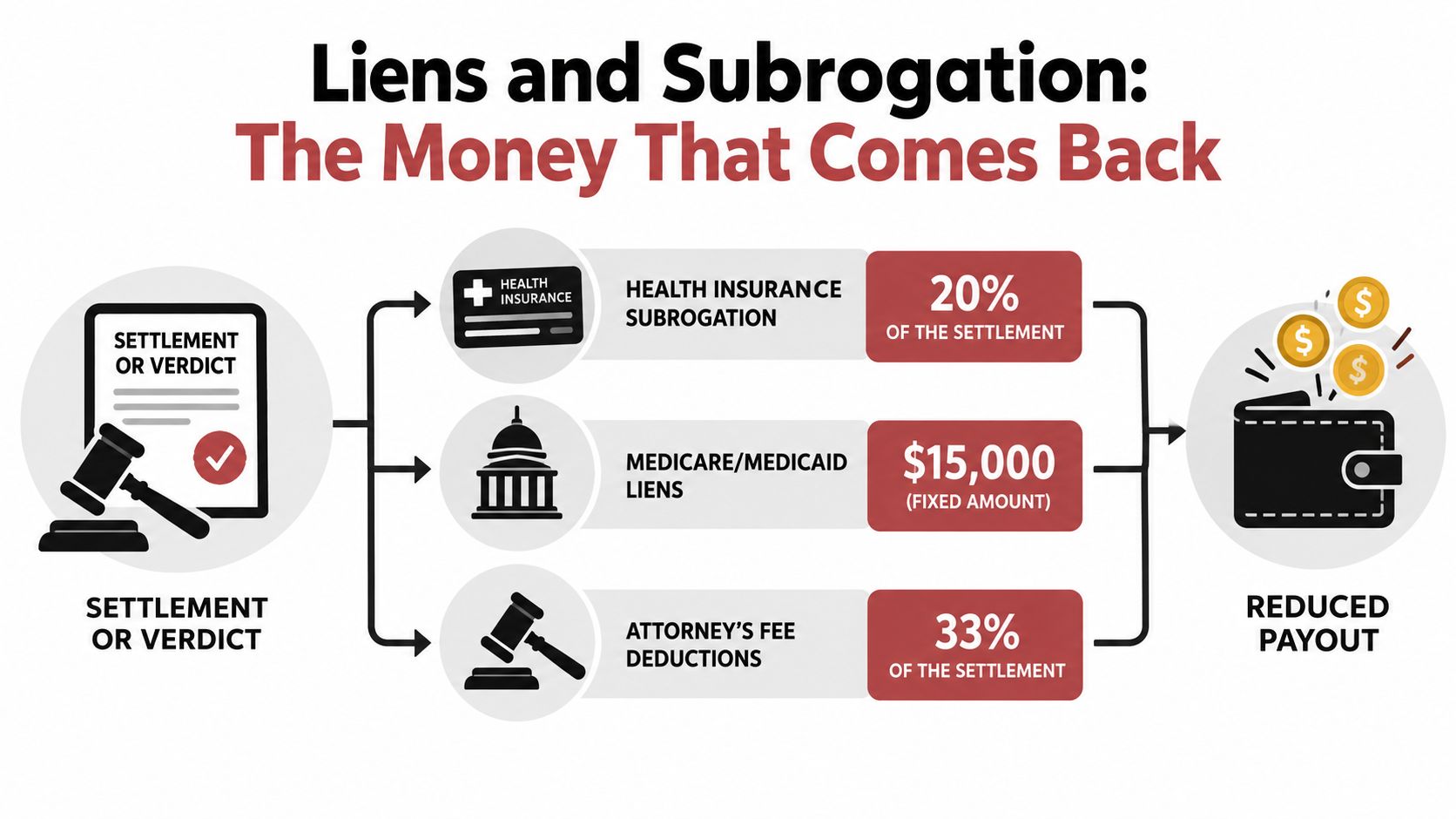
Liens and Subrogation The Money That Comes Back
A settlement or verdict doesn't always mean the entire gross recovery goes directly into your pocket. A lien is a claim for payment tied to a recovery or property. Subrogation is a reimbursement right that may allow an insurer or benefit plan to seek repayment for amounts it paid because of the accident.
Private health plans may assert reimbursement rights under the plan contract. Self-funded ERISA plans can be especially important because the plan language may control the repayment demand. Medicare may seek recovery for conditional payments under federal rules, and Texas Medicaid may have separate recovery rights. A hospital may also file a lien under Texas Property Code Chapter 55, depending on the circumstances.
Why the net recovery needs its own review
The medical-damages figure used in court and the repayment amount demanded after settlement are related, but they aren't identical. A plan may seek reimbursement for what it paid, while a hospital lien may involve charges or statutory limits that require separate analysis. Workers' compensation may also assert a reimbursement interest when it paid treatment related to a work-connected crash.
Before funds are distributed, your lawyer should identify every potential claim and confirm its legal basis. Counsel may request final payment figures, challenge unsupported demands, and negotiate reductions. Depending on the facts, common-fund or made-whole arguments may also matter.
You should also ask whether a provider has a financial-assistance or hardship process. Resolving a provider balance can improve the amount you keep, especially when the original account contains disputed charges or a lien that has not been reviewed carefully. The goal is a settlement that accounts for the recovery, attorney fees, case expenses, and valid reimbursement claims before you sign a release.
A Texas attorney handling subrogation in personal injury cases can help trace these demands and address them as part of the broader claim. Don't wait until after settlement to ask about liens. Early investigation gives your lawyer more time to protect the net result.
Practical Steps to Protect Your Medical Damages
Your records can determine whether your claim reflects a complete, accurate payment history or only a confusing stack of statements. Start organizing documents as soon as you can, even if you're still receiving treatment.

Build the record
Create one physical or digital folder for every medical document. Include itemized bills, explanations of benefits, provider ledgers, prescription receipts, mileage records, and notices from insurers or government payors.
- Request itemized statements: Ask each provider to identify the services, charges, adjustments, payments, and remaining balance.
- Save every EOB: An explanation of benefits can show what the insurer paid, what it reduced, and what it assigned to you.
- Track out-of-pocket costs: Record prescriptions, transportation to appointments, assistive devices, and other accident-related expenses.
- Keep treatment notes: Write down pain, physical limits, missed work, sleep problems, and changes in daily activities.
Continue reasonable treatment recommended by your medical providers. Gaps can make it harder to explain your recovery, but you also shouldn't pursue unnecessary care to increase a claim. Tell your providers about the accident and give them a clear history so the records accurately connect treatment to the injury.
Protect yourself from avoidable mistakes
Insurance adjusters may ask for a recorded statement or send a release while you're still hurt and worried about bills. Don't guess about medical history, minimize symptoms, or sign a settlement document before a lawyer reviews it. Send calls, letters, lien notices, and settlement drafts to your attorney.
A Car Accident Lawyer in Texas can review the billing file and help identify what remains unresolved. The Law Office of Bryan Fagan, PLLC handles motor-vehicle injury claims, including cases involving drivers, passengers, and families dealing with serious crash injuries.
Finally, remember that Texas generally gives an injured person two years to file a personal injury lawsuit under Civil Practice and Remedies Code § 16.003. The deadline runs from the date the cause of action accrues, and an insurer's promise to keep discussing the claim doesn't necessarily extend it. Speak with counsel promptly so records, witnesses, fault evidence, and filing deadlines receive attention.
A Path Forward and a Free Conversation
Section 41.0105 is technical, but its central question is understandable: What amount did someone pay, or what amount did the injured person legally have to pay? The answer requires more than a hospital's first statement. It may require payment ledgers, explanations of benefits, plan documents, lien notices, and provider records.
Fault remains just as important. Texas uses modified comparative responsibility under Section 33.001. If your percentage of responsibility is greater than 50 percent, the statute bars recovery. If you're 50 percent or less responsible, your recovery is reduced by your percentage of fault. The statute and rule are available through the Texas Civil Practice and Remedies Code provisions on comparative responsibility.
If a loved one died in a collision, speak with a wrongful death lawyer in Texas about the family's potential claims and the estate's rights. If your injuries involve permanent limitations, brain trauma, spinal damage, or another life-changing condition, a catastrophic injury lawyer can help evaluate future care and long-term losses. A truck crash lawyer in Houston can also investigate driver conduct, company records, and other evidence that may not be available to you without legal process.
The Law Office of Bryan Fagan, PLLC represents injured Texans and families after motor-vehicle crashes and serious injuries. A free, no-obligation consultation can give you a clearer picture of the medical records, insurance coverage, liens, subrogation demands, and filing deadline affecting your claim. You don't have to solve the billing puzzle while trying to heal.
The Law Office of Bryan Fagan, PLLC can review your paid or incurred medical damages, insurance records, liens, and settlement offer during a free consultation. Visit Law Office of Bryan Fagan, PLLC to discuss your Texas injury claim and take a practical next step toward recovery and justice.


