A serious accident can change your life in seconds — but you don’t have to face it alone. When another driver fails to yield the right of way, they're not just breaking a traffic rule—they're creating a recipe for disaster. This single act of negligence is behind some of the most devastating T-bone, head-on, and intersection crashes across Texas, leaving innocent people to deal with the consequences.
When a Simple Drive Turns Into a Life-Changing Accident
One moment, you're driving through a familiar Houston intersection. The next, you're surrounded by the sickening crunch of metal and the explosion of glass. When another driver blows through a yield sign or makes a reckless left turn right into your path, the consequences can be catastrophic.
The shock and confusion in the moments that follow are overwhelming. You're left trying to process physical pain, emotional trauma, and a mountain of medical bills that seems to grow by the day—all because someone else couldn't be bothered to follow a basic rule of the road. It’s an experience that can leave you feeling powerless and deeply uncertain about what the future holds for you and your family.
Understanding Your Situation and Your Rights
Here at The Law Office of Bryan Fagan, PLLC, we understand what you are going through. This wasn't just an "accident"—it was the direct result of another driver's negligence. Our job is to help you understand your rights and light a clear path forward. We know the legal concept of "right of way" can seem complicated, but it’s the cornerstone for figuring out who is at fault and holding them accountable.
Here’s what you need to understand right now:
- You are not alone. Thousands of Texans are injured every single year in crashes caused by a driver's failure to yield.
- Negligence has consequences. The person who caused your injuries can and should be held responsible for the damage they've done.
- Justice is within your reach. You have a legal right to seek compensation for your medical treatments, the wages you've lost, and the pain and suffering you've been forced to endure.
We are here to cut through the legal jargon and show you that recovery is possible. This guide will walk you through Texas right-of-way laws, explain how fault is proven, and outline the practical steps you can take to protect your claim. You deserve answers, and our experienced team is here to provide them.
Understanding Texas Right of Way Laws in Practice
Texas traffic laws can seem confusing, but getting a handle on the core rules of right of way is absolutely critical after a crash. These rules aren't about who gets to "take" the road; they're about who has the legal duty to yield right of way to keep everyone safe and prevent a collision.
When another driver ignores this basic responsibility, they create a dangerous, often devastating, situation. Let's walk through some of the most common right of way scenarios you'll encounter on Texas roads.
Who Must Yield at Intersections
Intersections are notorious hotspots for accidents, usually because of confusion or a blatant disregard for who has the right of way. The Texas Transportation Code is crystal clear on how these situations should be handled.
- Four-Way Stops: The rule is simple: the first vehicle to get there has the right of way. If two cars show up at the exact same time, the driver on the left must yield to the driver on the right.
- Uncontrolled Intersections: When you come to an intersection with no stop signs or traffic signals, the same principle applies. You have to yield to any vehicle that's already in the intersection or is coming up from your right.
- Left Turns: This is a major cause of collisions. When you're making a left turn, you must yield to oncoming traffic that's going straight. After a Houston freeway crash, we often find that an illegal left turn was the primary cause.
Ignoring these rules isn’t just a small mistake; it's a clear act of negligence. In fact, human error is a factor in a staggering 94% of all crashes, with failure to yield being a top offender. This single mistake is responsible for 7.9% of driver-related factors in fatal wrecks, making it a tragically common element in the most serious collisions. You can discover more insights about the role of human error in accidents and why it is a critical factor in personal injury cases.
Navigating Merges and Pedestrian Crossings
Right of way rules aren't just for traditional intersections. They are designed to create a predictable flow of traffic and, most importantly, protect the most vulnerable people sharing our roads. Understanding these rules is often the key to proving who was at fault in your accident.
For instance, when you're merging onto a highway from an on-ramp, you are required to yield to the traffic already cruising in the main lanes. Drivers already on the freeway don't have a legal duty to move over for you, even though it's a courteous and safe thing to do.
The same logic applies when you pull out of a private driveway or an unpaved road onto a paved one—you must yield to all approaching vehicles.
The core concept is straightforward: the driver entering a new flow of traffic is almost always the one responsible for yielding. This responsibility extends to pedestrians in crosswalks and cyclists in designated bike lanes. Your vehicle is a powerful machine, and Texas law places the burden on you to operate it with care for others' safety.
This decision-making process is critical in the moments before a potential crash.
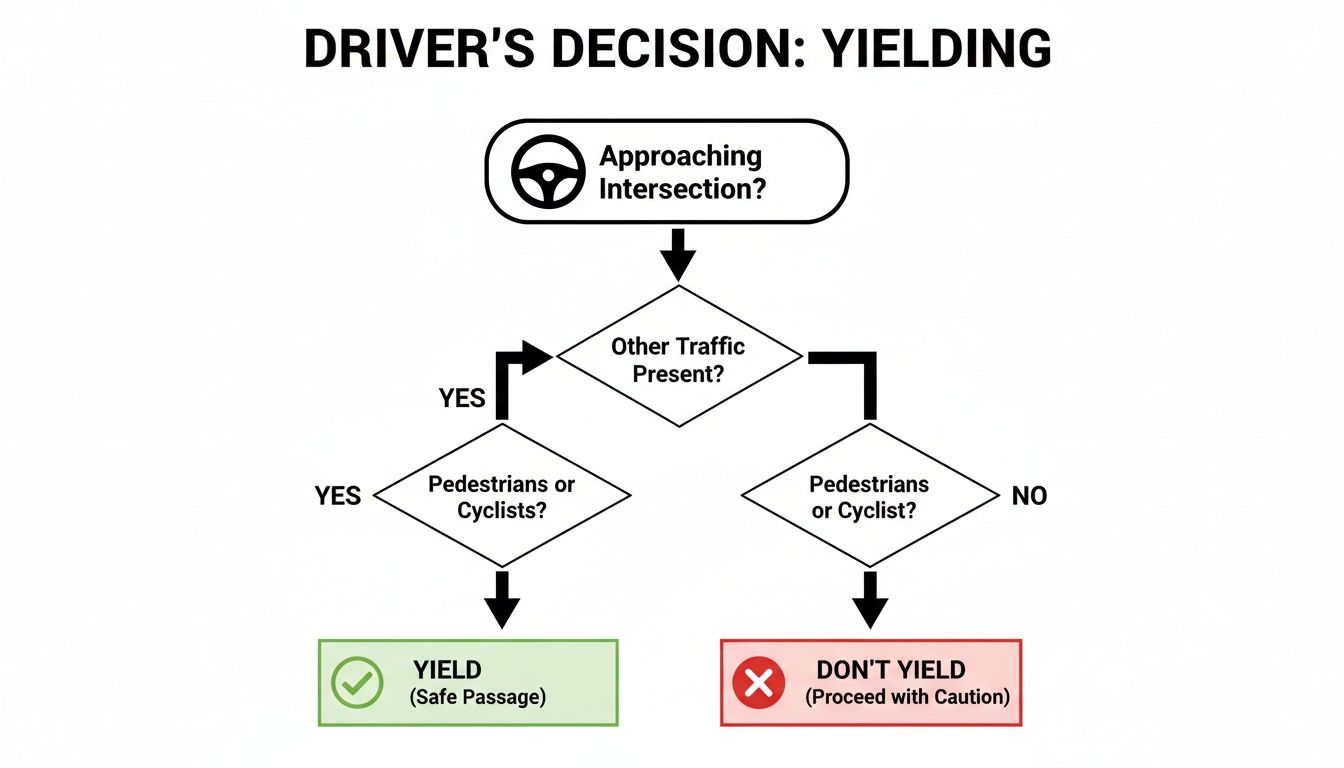
As the flowchart shows, the safe and legally correct choice is always to yield when required. Failing to do so puts you on a direct path to causing an accident and being held liable for all the damage that follows.
For a quick reference, here's a breakdown of common right of way situations in Texas.
Common Right of Way Scenarios in Texas
| Situation | Who Must Yield the Right of Way | Common Type of Crash if Violated |
|---|---|---|
| Four-Way Stop | The driver who arrives last. If arriving simultaneously, the driver on the left yields to the driver on the right. | T-bone or intersection collision. |
| Making a Left Turn | The driver turning left must yield to all oncoming traffic. | Head-on or T-bone collision. |
| Merging onto Highway | The driver entering the highway must yield to traffic already on the freeway. | Sideswipe or rear-end collision. |
| Pedestrian Crosswalk | All vehicles must yield to pedestrians in a marked or unmarked crosswalk. | Pedestrian-vehicle collision. |
| Entering from Driveway | The driver leaving the private drive or unpaved road must yield to all traffic on the main road. | T-bone or sideswipe collision. |
This table covers the basics, but remember that every accident is unique. The specific circumstances always matter when determining fault.
How Failing to Yield Causes Catastrophic Injuries
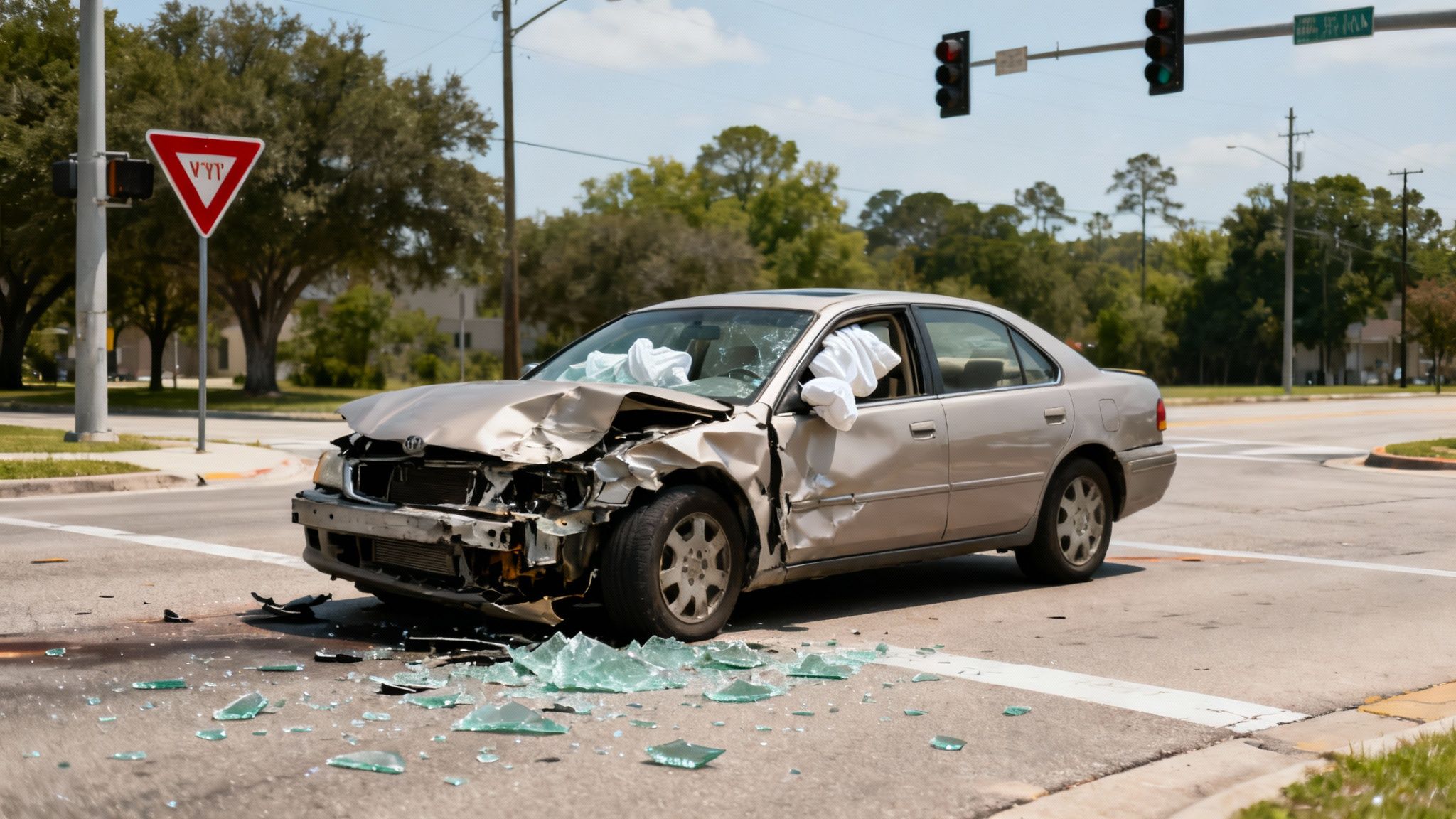
A failure to yield right of way isn't just a simple traffic ticket—it's a direct cause of some of the most violent collisions on Texas roads. When a driver ignores their duty to yield, they turn their vehicle into an unpredictable weapon. This isn't just a mistake; it's negligence with devastating human consequences.
Imagine a driver in Houston making an unprotected left turn. They misjudge the speed of an oncoming car or, worse, just don't look carefully enough. In that split second, they pull directly into the path of a vehicle moving at full speed. The result is often a brutal head-on or T-bone collision, unleashing an incredible amount of force where the car has the least protection.
This is the grim reality for countless accident victims. The physics of these crashes are unforgiving, often leading to severe and permanent harm.
The True Human Cost of a Right of Way Violation
The injuries from these high-impact crashes are rarely minor. The sudden, violent transfer of energy can cause damage that requires months, years, or even a lifetime of medical care. You may be left unable to work, provide for your family, or enjoy the life you once knew.
Some of the most common injuries we see in these cases include:
- Traumatic Brain Injuries (TBIs): The jolt of a T-bone crash can slam the brain against the skull, leading to concussions, brain bleeds, and long-term cognitive damage.
- Spinal Cord Injuries: Immense force can fracture vertebrae or damage the spinal cord, causing partial or complete paralysis.
- Internal Organ Damage: Broken ribs can puncture lungs, and the sheer impact can damage vital organs like the spleen, liver, and kidneys, often requiring emergency surgery.
- Multiple Bone Fractures: Victims frequently suffer complex fractures in their legs, arms, and pelvis, which may mean multiple surgeries and extensive physical therapy.
These are life-altering events that send ripples through families and entire communities. When the worst happens and a loved one is lost, the case becomes a wrongful death claim, leaving a family to grieve while facing an uncertain financial future. A dedicated wrongful death lawyer in Texas can help you navigate this painful process.
The Sobering Statistics Behind These Accidents
These tragic outcomes are not rare. National Safety Council data reveals that failure to yield right of way is the third-leading driver-related cause of fatal crashes in the U.S., accounting for 7.9% of these tragedies. This puts it just behind speeding and careless driving, highlighting just how lethal this "simple" error can be. You can read the full research about these accident factors to see the full scope of the problem.
A catastrophic injury is one that permanently prevents an individual from performing any gainful work. When a driver's failure to yield causes this level of harm, you deserve compensation that reflects the full extent of your losses—past, present, and future.
Understanding the severity of these outcomes is the first step toward seeking justice. At The Law Office of Bryan Fagan, PLLC, our team has deep experience handling the complexities of claims involving serious injuries. We know what it takes to build a case that fully accounts for medical treatments, lost income, and the profound pain and suffering you've endured. Learn more about what is considered a catastrophic injury in our detailed article and how it impacts your legal rights. We are here to fight for the maximum compensation you and your family need to begin the long road to recovery.
Proving Fault When a Driver Fails to Yield
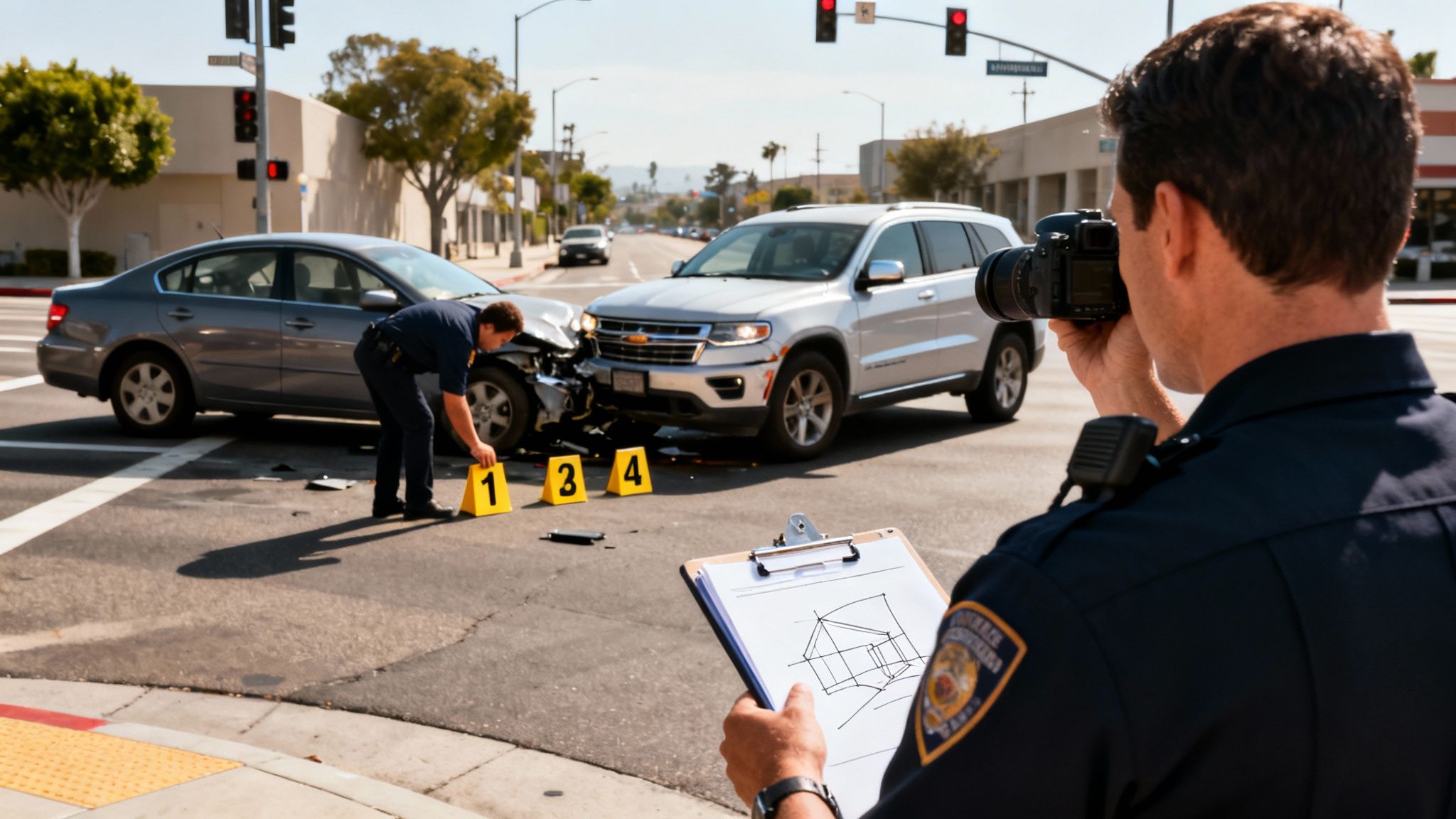
After a crash caused by another driver’s failure to yield right of way, it’s often shocking to hear their insurance company try to turn the tables and blame you. This is a common and incredibly frustrating tactic. They might suggest you were speeding, distracted, or could have done something differently to avoid the collision.
Their goal is always the same: to protect their profits by paying you as little as possible.
This is why proving fault isn’t just about what happened—it’s about what you can prove happened. Building a strong, undeniable case is a methodical process. It relies on collecting and piecing together powerful evidence, and as your legal advocates, we take on this entire burden so you can focus on getting better.
The Evidence We Use to Build Your Case
A successful personal injury claim is built on a foundation of solid, indisputable facts. Our experienced Houston car accident attorneys immediately launch a thorough investigation to gather every piece of information that tells the true story of the accident. We leave no stone unturned in our fight to establish the other driver’s negligence.
Key evidence we look for often includes:
- The Official Police Report: This document contains the responding officer's initial assessment of the scene, diagrams, witness information, and, most importantly, any citations issued for a right-of-way violation.
- Witness Statements: Eyewitnesses can provide crucial, unbiased accounts of what they saw. We make it a priority to track down and interview witnesses to lock in their testimony while their memory is still fresh.
- Photos and Videos: Pictures of vehicle damage, skid marks, road conditions, and nearby traffic signs can be invaluable. We also dig for traffic camera footage or surveillance video from nearby businesses that may have captured the entire incident.
- Vehicle "Black Box" Data: Many modern cars have an Event Data Recorder (EDR) that records critical information like speed, braking, and steering input in the moments right before a crash. This data doesn't lie.
Each piece of evidence helps us reconstruct the accident, creating a clear picture of exactly how the other driver’s failure to yield directly caused your injuries.
Understanding Texas Comparative Responsibility
In Texas, the law of comparative responsibility (also known as comparative negligence) allows for blame to be shared. Insurance companies often use this to reduce your settlement. Under this rule, if you are found to be partially at fault for an accident, your final compensation is reduced by your percentage of fault. For instance, if you are awarded $100,000 but found to be 10% responsible, your award drops to $90,000.
Here's the critical part: if you are found to be 51% or more at fault, you are legally barred from recovering any compensation at all. This is known as the 51% bar rule, and insurers will do everything in their power to push the blame past this threshold to deny your claim entirely.
Our job as your Texas personal injury lawyer is to aggressively fight back against these unfair blame-shifting tactics. We use the evidence we’ve gathered to build a powerful case that clearly shows the other driver was primarily, if not entirely, responsible for the harm you’ve suffered.
Whether your case involves a complex car accident, a devastating truck crash, or the tragic loss of a loved one in a wrongful death incident, our team has the experience to protect your rights. We meticulously prepare every single case as if it’s going to trial. This ensures we are always in the strongest possible position to negotiate a fair settlement or, if necessary, win a verdict in court. You don’t have to let the insurance company dictate your future.
What To Do After a Right of Way Accident
In the chaotic, painful moments after a crash, it’s hard to think straight. But the actions you take at the scene—and in the days that follow—can make a significant difference in your ability to get the compensation you deserve. Following these practical steps helps protect your rights and allows you to focus on healing.
Your first priority is always your health. If you or anyone else might be hurt, call 911 right away. Adrenaline can easily mask serious injuries like internal bleeding or a concussion, so getting checked out by a medical professional is non-negotiable.
Practical Advice to Protect Your Legal Rights
Once you've made sure everyone is safe and help is on the way, the next step is to start gathering evidence. The information you collect now will become the foundation of your personal injury claim.
-
Call the Police: Never let the other driver talk you out of calling the police, even if the wreck seems minor. A police report is an official, third-party account of what happened, and it often includes the officer’s initial thoughts on who failed to yield right of way.
-
Document Everything: Use your phone to take pictures and videos of everything—the damage to all vehicles from different angles, skid marks on the pavement, nearby traffic signs like "yield" or "stop," and any visible injuries you have.
-
Gather Witness Information: If anyone saw the crash, get their name and phone number. An independent witness can be your most powerful ally, especially when the other driver starts changing their story.
Be very careful about what you say. A simple, polite "I'm sorry" can be twisted by an insurance company into a full-blown admission of fault. Stick to the facts when you talk to the other driver or the police.
You are not required to give a recorded statement to the other driver's insurance adjuster. Their goal is to protect their company's bottom line. Politely decline and tell them your attorney will handle all communications.
How to Handle Insurance Companies
Insurance adjusters are trained negotiators. They often call victims soon after a crash, hoping to lock in a quick, lowball settlement before you even know the full extent of your injuries. If you take that early offer, you’re almost certainly leaving money on the table—money you'll need for future medical treatments and lost income.
Never sign any documents or accept a check from the at-fault driver's insurance company without talking to an experienced Houston car accident attorney first. Our team at The Law Office of Bryan Fagan, PLLC, will take over all communications with the insurance company, shielding you from their tactics and fighting for your rights every step of the way. Taking these protective steps builds a strong case and lets you focus on what really matters—getting better.
You Don’t Have to Face the Insurance Companies Alone
A serious accident can turn your world upside down—but you don't have to navigate the aftermath by yourself. The road to recovery often feels overwhelming. You're juggling physical pain, emotional trauma, and a frightening stack of medical bills. Add in lost wages from time off work, and the financial pressure can make it impossible to focus on what really matters: healing.
This is the harsh reality for so many people hurt in crashes where another driver failed to yield right of way. While you're trying to put your life back together, you can be sure the at-fault driver’s insurance company is already building a case against you. Their job is to protect their company's bottom line by paying you as little as possible—or denying your claim altogether.
An Advocate in Your Corner
This is where The Law Office of Bryan Fagan, PLLC comes in. You don't just need a lawyer; you need a dedicated advocate who will stand as a shield between you and the insurance companies. We take over every phone call, manage all the paperwork, and handle every negotiation so you can pour your energy into your recovery.
We become your voice, making sure your story is told and your rights are fiercely protected. We’ve seen all the tactics insurers use to downplay serious injuries and unfairly shift blame. Our team of experienced Texas personal injury lawyers, including skilled truck crash lawyers in Houston, knows how to counter those strategies with a powerful, evidence-based case designed to secure the compensation you deserve. It can be confusing to figure out what your own policy covers, like the specifics of windshield replacement insurance coverage, and we're here to clarify every single detail of your claim.
You Pay Nothing Unless We Win Your Case
We believe your financial situation should never be a barrier to getting top-notch legal help. That’s why we work on a contingency fee basis. This means you pay absolutely nothing upfront. No retainers, no hourly bills, no hidden costs. We only get paid if we successfully recover money for you.
Our promise is simple: If you don’t get paid, we don’t get paid. This approach allows you to secure elite legal representation without any financial risk.
Getting your life back on track is possible, and our team is ready to fight for you. We invite you to schedule a free, no-obligation consultation with one of our compassionate attorneys. Let us hear your story, answer your questions, and lay out a clear plan for how we can help you secure the justice and financial stability you and your family deserve. You can learn more about how contingency fee lawyers work and see why it’s the best path forward for your case.
Don't wait to get the help you need. Recovery is possible, and legal help is available.
Common Questions After a Right-of-Way Crash
When you're dealing with the pain and stress of a car accident, you need clear answers. Here, we tackle some of the most pressing questions we hear from people injured in right-of-way accidents across Texas.
What if we got to a 4-way stop at the same time?
This is a classic "he said, she said" situation. Under Texas law, if two cars pull up to a four-way stop at the exact same moment, the driver on the left must yield to the driver on the right.
But proving who really arrived “first” is where things get tricky. Without solid evidence, it's just one person's word against another. This is where witness statements or video from a nearby security camera can completely change the outcome. A good Texas personal injury lawyer knows exactly where to look to find the proof needed to show who legally had the right to go.
The other driver's insurance says I'm at fault. What do I do?
Do not panic—this is a standard tactic. The other driver's insurance adjuster's goal is to pay you as little as possible. They will use Texas's "comparative responsibility" rule to try and pin a percentage of the blame on you. If they can convince a jury that you were 51% or more responsible, you get nothing.
This is why you should never give a recorded statement to the other driver’s insurance company without speaking to a lawyer first. They are trained to ask questions that can twist your words and hurt your case. Let a Houston car accident attorney from our firm step in. We'll handle all their calls, protect you from these manipulative tactics, and build a strong case proving their driver was the one at fault.
How Long Do You Have to File a Claim in Texas?
In Texas, the statute of limitations for personal injury claims means the clock starts ticking the moment the accident happens. You generally have two years from the date of the crash to file a lawsuit. That might sound like a long time, but you should never wait.
The longer you delay, the more your case can weaken. Evidence disappears, skid marks fade, and witnesses’ memories get fuzzy.
Getting an attorney involved right away ensures that the investigation starts immediately while the evidence is still fresh. We can make sure every legal deadline is met, protecting your right to fight for full compensation for your medical bills, lost wages, and the pain you’ve been forced to endure.
At The Law Office of Bryan Fagan, PLLC, we understand how overwhelming this experience is. You don't have to carry this burden alone. We invite you to schedule a free, no-pressure consultation to talk about your case with a compassionate and experienced attorney who will fight for the justice you deserve. Contact us now to get started.