A serious accident can change your life in seconds—but you don’t have to face the aftermath alone. If you’ve been injured in a motorcycle crash, understanding the law is the first step toward getting the justice and compensation you deserve.
When it comes to the question, “is lane splitting legal in Texas,” the answer is a clear and simple no. Lane splitting, the practice of a motorcyclist riding between two lanes of slow-moving or stopped traffic, is an illegal maneuver in the state of Texas.
Clearing Up the Confusion on Texas Motorcycle Laws
For years, the topic of lane splitting existed in a legal gray area here in Texas. While it wasn’t explicitly permitted, no specific law made it illegal either. This created widespread confusion for motorcyclists, other drivers, and even law enforcement, often complicating personal injury claims after a crash.
That ambiguity finally came to an end. After years of being in a murky legal spot, everything changed in June 2023 when Governor Greg Abbott signed House Bill 4122 into law, slamming the door shut on that loophole for good.

This new law provides critical clarity for anyone injured in an accident involving this dangerous practice. It officially defines lane splitting as a traffic violation, which can be a game-changing factor when determining negligence in a personal injury case.
What This Means for Your Accident Claim
If you were injured in a collision because a motorcyclist was illegally lane splitting, this new law is squarely on your side. Proving the other party was breaking the law at the time of the crash strengthens your claim significantly.
That illegal act can establish clear fault, helping you pursue the compensation you need for medical bills, lost wages, and your pain and suffering.
For accident victims, understanding the legal landscape is the first step to protecting your rights. Here’s a quick summary to keep things clear.
Texas Lane Splitting Law at a Glance
| Legal Question | Answer in Texas |
|---|---|
| Is lane splitting legal? | No. It is explicitly illegal as of June 2023. |
| What does the law say? | House Bill 4122 amended the Transportation Code, making it an offense to operate a motorcycle between lanes of traffic moving in the same direction. |
| How does this affect my accident claim? | If a motorcyclist was lane splitting, they were breaking the law. This can be used as strong evidence of their negligence or fault for the crash. |
| What if a lane-splitting biker hit me? | You have a strong basis for a personal injury claim to recover compensation for your injuries and damages. |
This table shows just how much the legal ground has shifted. An action that was once in a gray area is now a clear-cut violation, which is a powerful tool for victims.
Understanding this law is your first defense. If you or a loved one has been hurt in a motorcycle accident, you don’t have to navigate the complex legal system alone. The experienced Houston car accident attorneys at The Law Office of Bryan Fagan, PLLC are here to help. Schedule a free, no-obligation consultation to discuss your case and learn how we can fight for you.
Why Lane Splitting Is So Dangerous on Texas Roads
Anyone who’s tried to navigate a packed Houston freeway like I-10 during rush hour knows it’s a challenge on a good day. Now, imagine a motorcycle suddenly zipping between the lanes of slow-moving or stopped cars. That’s lane splitting, and it introduces a level of chaos that Texas roads just aren’t designed to handle safely. This one maneuver dramatically increases the risk of a catastrophic accident for everyone involved.

The biggest problem? It completely erases the safety cushion that drivers rely on. When you check your mirror to change lanes, you expect to see an open space or a car at a predictable distance—not a motorcycle appearing out of thin air right next to you. That element of surprise is a recipe for disaster.
Common Risks of Illegal Lane Splitting
When a motorcyclist weaves between cars, they’re essentially riding through a series of blind spots. A perfectly legal and safe lane change by a car or truck can turn into a tragic collision in an instant. The consequences are often devastating.
The risks tied to this illegal maneuver are stark and immediate:
- Zero Reaction Time: Drivers simply don’t have time to react to a motorcycle that suddenly materializes beside them. This often leads directly to side-swipe or merge accidents.
- Blind Spot Dangers: Motorcycles are already small and harder to see. Lane splitting puts them in the exact spots where they are most likely to be completely invisible to other drivers.
- Sudden Stops: If traffic brakes unexpectedly, a lane-splitting motorcyclist has nowhere to go. They can easily be crushed between two much larger vehicles.
- Road Hazards: The space between lanes is where debris, potholes, and oil slicks tend to collect, creating a treacherous and unpredictable path for a motorcycle.
These aren’t just hypotheticals; they’re grim realities on our roads. Research confirms that the higher the speed during lane splitting, the greater the likelihood of an accident and the more severe the injuries will be. You can read more about these safety findings here.
A Real-World Houston Accident Scenario
Picture this: After a Houston freeway crash on the 610 Loop, you’re in heavy traffic. You put on your signal, check your mirrors, glance over your shoulder at your blind spot, and start to ease into the next lane. Out of nowhere, a motorcycle that was illegally lane splitting is right in your path. There’s no time to brake and no room to swerve.
The collision that follows can change lives forever. The motorcyclist is completely unprotected, and even a low-speed impact can cause a catastrophic injury, like a traumatic brain injury, or even a wrongful death. For you, the driver, the emotional trauma can be immense, not to mention the potential legal battle. This is exactly why Texas has outlawed lane splitting—to prevent these senseless tragedies from happening on our roads.
How Illegal Lane Splitting Determines Fault in an Accident
After a crash, one of the very first things insurance companies and lawyers do is determine who was at fault. When a motorcycle was illegally lane splitting, that job gets a whole lot easier.
The simple fact that the motorcyclist was breaking a specific Texas traffic law is a powerful piece of evidence. In personal injury law, this is called negligence per se, and it can directly establish the rider’s fault.
Negligence simply means that a person failed to act with reasonable care, and their carelessness caused you harm. By choosing to lane split, a rider is violating the Texas Transportation Code. This illegal act is often seen as clear-cut proof of their fault in causing the collision.
Understanding Texas Comparative Responsibility
Texas law uses a system called proportionate responsibility, also known as modified comparative responsibility. Think of it as a pie chart of blame. After an accident, each person involved is assigned a percentage of fault based on their actions.
This is where the critical 51% bar rule comes into play. Under this rule, you can only get compensation for your injuries if you are found to be 50% or less at fault for what happened.
If a judge or jury decides you are 51% or more responsible for the crash, Texas law completely bars you from recovering any money. Not a single dime. This is exactly why proving the other person’s negligence is so critical to your case.
Let’s use a real-world example. Imagine a truck driver changes lanes on a Houston freeway and hits a lane-splitting motorcyclist. A jury might find that the motorcyclist was 80% at fault for their illegal and dangerous maneuver. However, they might also assign the truck crash lawyer Houston 20% of the blame to the truck driver for not double-checking their blind spot.
In this scenario, because the rider is well over the 50% threshold, they would be blocked from claiming any compensation for their injuries. On the flip side, the truck driver, who was only 20% at fault, could recover 80% of their damages from the motorcyclist’s insurance. Figuring out these percentages is a complex part of any claim, and for cases where fault is disputed, understanding the process for challenging fault in an accident can provide useful insight.
How Fault Affects Your Compensation
The percentage of fault assigned to you directly reduces the amount of compensation you can receive.
Let’s say you were awarded $100,000 in damages, but you were also found to be 20% at fault. Your final award would be reduced by that 20%, leaving you with $80,000. This is why having an experienced Texas personal injury lawyer is so important. We fight to minimize your percentage of fault and maximize your financial recovery. You can see more about how this works with insurance payouts by reading our guide on bodily injury liability coverage.
The Legal Price for Lane Splitting in Texas
The law against lane splitting isn’t just a friendly suggestion—it comes with real penalties. If you’ve been hurt by a rider’s reckless decision to weave through traffic, understanding these consequences helps show just how seriously the law views their negligence. The rules are there to hold people accountable when they put others in danger.
Thanks to Texas House Bill 4122, the consequences are spelled out clearly. At a minimum, a motorcyclist caught lane splitting will get a traffic ticket, starting with a $175 fine. That might sound like a typical citation, but things can get much worse depending on the circumstances.
When a Traffic Ticket Turns into a Criminal Charge
Law enforcement has the discretion to decide if the lane splitting was a minor infraction or something far more dangerous. If the rider’s behavior showed a blatant disregard for the safety of others—imagine someone speeding between cars on a packed Dallas freeway—the charge can be elevated to reckless driving.
This is where the consequences become serious. A reckless driving charge tied to lane splitting can be a Class B misdemeanor. The penalties are steep and can include:
- Hefty Fines: Fines can jump to as much as $2,000.
- Jail Time: The rider could face up to 180 days in county jail.
- License Suspension: A conviction often means losing their driver’s license for a period of time.
These stiff penalties make it clear: Texas law will not tolerate actions that needlessly put people at risk. You can learn more about the specific penalties for reckless driving here.
Lane Splitting vs. Legal Lane Sharing: Knowing the Difference
It is very important to distinguish between illegal lane splitting and the legal practice of lane sharing. They sound similar, but they are very different.
Lane sharing is when two motorcycles ride side-by-side in the same lane. This is completely legal in Texas and is a common practice for riders traveling in groups. Lane splitting, on the other hand, is when a motorcycle rides between two separate lanes of traffic. That is the illegal maneuver.
This distinction is a critical piece of the puzzle in an accident claim. A rider who was legally lane sharing was following the rules. But a rider who was illegally lane splitting was breaking the law, and that single act can be a powerful tool for proving they were at fault for the crash. It’s the kind of critical evidence your Houston car accident attorney will use to build a powerful case and fight for the compensation you deserve.
What To Do After An Accident Involving Lane Splitting
The moments after a crash are chaotic and stressful. Your head is spinning, adrenaline is pumping, and it’s tough to think clearly. But the steps you take next are crucial for both your health and your legal rights. If a motorcyclist’s illegal lane splitting caused the accident, the actions you take at the scene are the first step in building a strong personal injury claim.
First and foremost, prioritize your safety and health. If you can, move your vehicle to a safe place away from traffic and call 911 immediately. Even if you feel okay, it’s critical to be evaluated by a medical professional. Some of the most serious injuries, like concussions or internal bleeding, may not have immediate symptoms. Seeing a doctor creates an official record that connects your injuries directly to the crash—a vital piece of evidence for your case.
Practical Advice: Steps to Take at the Scene
While you wait for help to arrive, and only if you are able to, begin gathering evidence. What you collect at the scene can be invaluable later.
- Take Photos and Videos: Use your smartphone to document everything. Get pictures of both vehicles, their final positions, any skid marks, the weather conditions, and any visible injuries you have.
- Get an Official Police Report: When an officer arrives, explain what happened calmly and clearly. Be sure to state that the motorcyclist was lane splitting between cars. A police report that notes this illegal action is a powerful tool for your claim.
- Gather Witness Information: If anyone saw the crash, ask for their name and phone number. An unbiased account from an independent witness can be incredibly persuasive when proving fault.
How to Handle Insurance Companies
In the shock of the moment, it’s natural to be polite, but avoid discussing who was at fault with the other driver. A simple “I’m sorry” can be twisted by an insurance company and used to argue you admitted guilt.
When the other driver’s insurance adjuster calls, stick to the basic facts. Do not give a recorded statement until you’ve spoken with a lawyer. Remember, the adjuster’s job is to protect their company by paying out as little as possible.
While the legal details of a lane splitting crash are unique, many of the immediate safety and documentation steps are universal. You can learn more about the general steps to take after a car accident to make sure you have all your bases covered.
This flowchart shows how a basic lane splitting ticket can escalate into much more serious charges depending on how recklessly the rider was behaving.
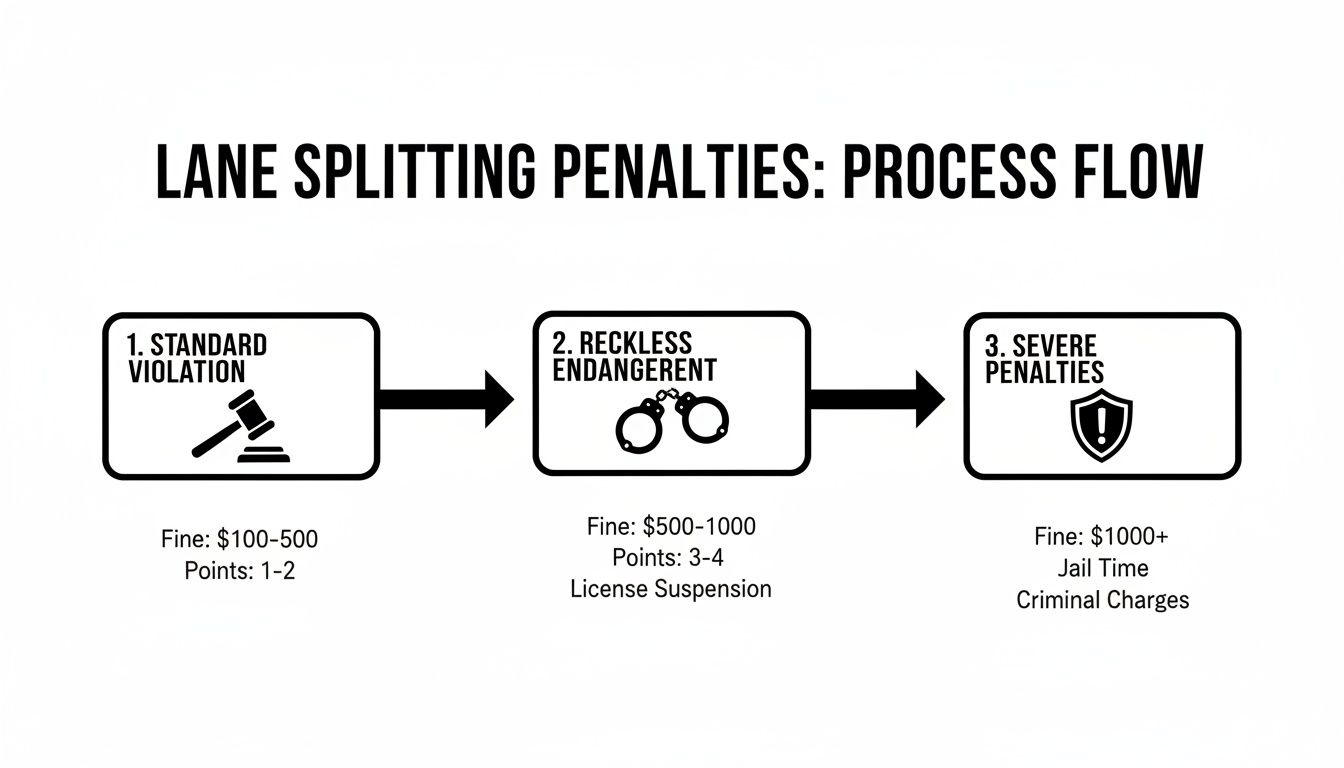
As you can see, what starts as a standard traffic violation can quickly become a criminal matter if the rider’s actions are deemed reckless, highlighting just how seriously this offense can be treated.
Finally, your most important step is to contact an experienced Texas personal injury lawyer. The legal system is complicated, but you don’t have to face it alone. We can walk you through what comes next and protect your rights from day one. For a more in-depth look, check out our complete guide on what to do after a car accident here in Texas.
How Our Texas Personal Injury Lawyers Can Help You Recover
Dealing with a legal battle by yourself after an injury is an overwhelming thought, especially when your top priority should be healing. That’s where the experienced legal team at The Law Office of Bryan Fagan, PLLC comes in. We are here to take that weight off your shoulders so you can focus on your recovery.
We handle every detail of your case from start to finish. Our first step is to launch a thorough investigation into the accident. We will gather all crucial evidence, from the official police report noting the illegal lane splitting to witness statements and any available traffic camera footage. We leave no stone unturned to build a powerful case that clearly proves the other driver was at fault.
We Fight for Your Maximum Compensation
We understand that the true cost of an accident goes far beyond the initial medical bills. Our firm works with financial and medical experts to calculate the full, long-term value of your damages.
This includes compensation for:
- All current and future medical expenses
- Lost income and diminished earning capacity
- Pain, suffering, and emotional trauma
- Damage to your vehicle and other property
As skilled negotiators, we will aggressively challenge the insurance companies on your behalf. They use tactics to downplay your injuries or shift blame, but we know how to counter them and will not let them undervalue your claim. Our firm has a proven track record in complex truck crash and car accident cases, and we are always prepared to take your fight to court if a fair settlement is not offered.
We work on a contingency-fee basis. That means you pay absolutely nothing unless we win your case. There are no upfront costs or hidden fees—our payment comes from the compensation we secure for you.
You do not have to go through this alone. We are here to provide the compassionate, experienced guidance you deserve, every step of the way.
How Long Do You Have to File a Claim in Texas?
It’s completely normal to have a flood of questions after a serious accident. The legal road ahead can look intimidating, but getting clear, honest answers is the first step toward getting your life back on track. We’ve put together some of the most common questions we hear from people injured in motorcycle crashes across Texas.
The Other Driver’s Insurance Says I Am at Fault. What Now?
Do not be discouraged. This is a common tactic from insurance adjusters whose job is to protect their company’s bottom line. Their goal is to deny your claim or pay as little as possible. It is essential that you do not take their assessment as the final word.
The fact that the motorcyclist was lane splitting—an illegal act in Texas—is powerful evidence of their negligence. An experienced Houston car accident attorney can use the police report, Texas traffic laws, and witness statements to build a strong case and prove the motorcyclist was responsible for your injuries. A wrongful death lawyer Texas can help if you’ve lost a loved one.
How Long Do I Have to File an Injury Claim in Texas?
In Texas, you are up against a strict deadline called the statute of limitations. For most personal injury claims, you have just two years from the date of the crash to file a lawsuit.
If you miss that two-year window, the court will almost certainly dismiss your case, and you will lose your right to seek compensation forever. This is why it is so critical to speak with a lawyer right away. Acting quickly allows your legal team to preserve key evidence and ensure all legal deadlines are met.
Does the Motorcycle’s Speed Matter If Lane Splitting Is Already Illegal?
Yes, absolutely. While lane splitting is illegal at any speed, excessive speed demonstrates a much greater level of recklessness and disregard for the safety of others. It significantly increases the likelihood that the crash will cause a catastrophic injury or even a wrongful death.
Our legal team would investigate the motorcycle’s speed at the moment of impact. This evidence strengthens your case, allowing us to argue that the rider’s reckless actions justify maximum compensation for your medical bills, lost income, and the pain and suffering you have endured. To get a better feel for how these cases are built, you can check out our detailed guide on motorcycle accident claims.
A serious accident can turn your world upside down, but you don’t have to face the recovery process alone. At The Law Office of Bryan Fagan, PLLC, our experienced and compassionate Texas personal injury lawyers are ready to fight for you. We will handle all the legal complexities so you can focus on what truly matters: healing.
Recovery is possible, and legal help is available. Your fight is our fight. Contact us today for a free, no-obligation consultation to discuss your case and learn how we can help you get the justice and peace of mind you deserve. Visit us at https://www.texaspersonalinjury.net.