A serious accident can change your life in seconds — but you don’t have to face it alone. Discovering the driver who hit you is uninsured adds a devastating layer of stress and confusion. Suddenly, you're facing overwhelming questions about paying medical bills, covering lost wages, and repairing your vehicle.
This is exactly why Texas uninsured motorist coverage is so critical. It acts as your financial shield when someone else’s negligence leaves you with nowhere to turn.
Your Financial Shield After a Crash with an Uninsured Driver

The moments after a wreck are chaotic and frightening. Learning the at-fault driver has no insurance feels like a punch to the gut. You did the right thing by carrying insurance, but now you’re left to pick up the pieces of their mistake. This is precisely where your own policy is designed to step up and protect you.
Texas Uninsured/Underinsured Motorist (UM/UIM) coverage is a specific part of your auto policy that you buy to protect yourself, your family, and your passengers. It kicks in when the person responsible for your injuries either has no insurance at all or not enough to cover the true cost of your losses.
How This Coverage Protects You
This protection isn't automatic; you must have it on your policy to use it. However, Texas law is on your side—insurers are required to offer it, and you have to reject it in writing if you don't want it. Given the high number of uninsured drivers on Texas roads, declining this coverage is a significant risk.
When you file a UM/UIM claim, you are making a claim against your own insurance company. They are required to step into the shoes of the uninsured driver and pay for your damages. This includes:
- Medical Bills: Ambulance rides, hospital stays, surgeries, physical therapy, and future medical care.
- Lost Wages: The income you lose because you are unable to work while recovering.
- Pain and Suffering: Compensation for the physical pain and emotional trauma the accident caused.
- Vehicle Repairs: If you have UM/UIM property damage coverage, it can cover fixing or replacing your car.
Navigating Your Next Steps
Handling this process alone is incredibly difficult. The same insurance company you've paid premiums to for years can suddenly become an adversary. Their goal is often to pay as little as possible, which is why having an experienced Houston car accident attorney on your side is so critical.
A serious accident can change your life in seconds—but you don’t have to face it alone. Understanding your policy is the first step toward reclaiming your future.
Our firm is here to offer clear, straightforward guidance. We will help you understand your policy, figure out how much uninsured motorist coverage you should carry, and take over the frustrating negotiations with the insurance company.
Your focus should be on healing, not on fighting for the compensation you rightfully deserve. Let us handle the legal battle and protect your financial future.
Making Sense of Uninsured and Underinsured Motorist Coverage
Insurance policies can feel like they're written in a different language. When you're trying to recover from a serious accident, the last thing you need is confusing legal jargon. Let's cut through the noise and explain what your coverage actually means in plain English.
At its core, Texas uninsured motorist coverage is divided into two key parts, each designed to protect you from a specific type of harm.
Uninsured Motorist Bodily Injury (UMBI)
Uninsured Motorist Bodily Injury (UMBI) is the part of your policy that covers the human cost of a crash. This is what pays for your medical bills, lost income if you can't work, and compensation for the physical pain and emotional trauma you and your passengers have suffered when an uninsured driver is at fault.
For example, after a Houston freeway crash caused by a driver who flees the scene, your UMBI coverage becomes your financial lifeline. It's there to pay for your hospital stay, physical therapy, and the wages you lose while you focus on getting better.
Uninsured Motorist Property Damage (UMPD)
While UMBI takes care of you, Uninsured Motorist Property Damage (UMPD) takes care of your car. This coverage is specifically for repairing your vehicle if it's damaged by someone with no insurance or in a hit-and-run.
In Texas, UMPD policies have a standard $250 deductible, which is often much lower than the deductible on a standard collision policy. It saves you money out-of-pocket for an accident you didn't cause. In our Houston hit-and-run example, UMPD is what would pay the body shop to get your car back on the road.
To make it even clearer, here’s a quick breakdown of how these coverages work in the real world.
Types of Texas Uninsured Motorist (UM/UIM) Coverage
This table breaks down the different types of UM/UIM coverage available in Texas and explains what each one covers after an accident.
| Coverage Type | What It Covers | Common Scenario |
|---|---|---|
| UM Bodily Injury (UMBI) | Medical bills, lost wages, pain and suffering for you and your passengers. | A hit-and-run driver causes a collision, leaving you with serious injuries. |
| UM Property Damage (UMPD) | Repairs to your vehicle after an accident with an uninsured driver. | An uninsured driver rear-ends you at a red light, damaging your bumper and trunk. |
| Underinsured Motorist (UIM) | The gap between your total damages and the at-fault driver's low policy limits. | The at-fault driver only has the state minimum coverage, which isn't enough for your medical bills. |
Each of these coverages is a critical piece of your financial safety net, especially on Texas roads.
What About Underinsured Motorist (UIM) Coverage?
Sometimes the driver who hits you has insurance—it’s just not enough. Texas only requires drivers to carry a minimum of $30,000 in liability coverage for injuring one person. After a serious accident, medical bills can exceed that amount within days.
This is where Underinsured Motorist (UIM) coverage becomes essential.
If the at-fault driver's insurance runs out but your medical bills and other damages are much higher, your own UIM policy steps in to cover the difference. It's what keeps you from being buried in debt because someone else was irresponsible.
Let’s say a crash leaves you with $100,000 in medical bills and lost wages. The driver who caused it only has the state-minimum $30,000 policy. Once their insurance pays its limit, you’re still left with a $70,000 shortfall. Your UIM coverage would kick in to pay that remaining amount, up to your own policy limits. You can dive deeper into how this works in our guide on underinsured motorist coverage in Texas.
It's critical to know that while insurance companies in Texas must offer you this coverage, you can reject it in writing. But given the risks, it's a protection you can't afford to skip. The statistics are grim—Texas has one of the highest rates of uninsured drivers in the country, with some studies showing that more than one out of every seven drivers on our roads has no coverage at all.
When Does Your UM and UIM Coverage Apply in Texas?
A serious crash can turn your world upside down. The last thing you need is to discover the driver who hit you has little or no insurance. Understanding when your own policy becomes your financial lifeline is key to protecting yourself and your family.
This is where your Texas uninsured/underinsured motorist coverage (UM/UIM) comes in. Think of it as your personal safety net—it's there to catch you when the person who caused your injuries can't take financial responsibility. While every accident is different, there are three main situations where this crucial coverage applies.
The At-Fault Driver Has No Insurance
This is the most straightforward scenario. Another driver causes a collision that is clearly their fault, but they admit they don’t have insurance. They broke the law, and now you’re stuck with a damaged car, mounting medical bills, and lost time from work.
In this situation, you file a claim directly with your own insurance company under your Uninsured Motorist (UM) coverage. Your insurer effectively steps into the shoes of the uninsured driver and pays for your damages, up to your policy limits.
Imagine you're driving in Dallas and someone runs a red light, T-boning your car. They have no insurance. Your UM coverage is designed to pay for the ambulance ride, treatment for your injuries, and the wages you lose while you can't work.
The At-Fault Driver Is Underinsured
Sometimes, the at-fault driver has insurance, but it’s only the bare minimum Texas requires—$30,000 for a single person's injuries. After a catastrophic injury, especially one from a truck crash, medical bills can easily climb into the six figures. A minimum-limits policy is rarely enough.
This is where your Underinsured Motorist (UIM) coverage is so important. Once the at-fault driver's insurance pays out its full policy limit, your UIM coverage kicks in to cover the rest of your damages.
Here's how it works:
- You're badly hurt in a wreck on I-35 in Austin. Your total damages—medical bills, lost income, and pain and suffering—come to $150,000.
- The driver who hit you only has a $30,000 liability policy, which their insurance company pays you.
- That still leaves you with $120,000 in unpaid damages.
- Your UIM coverage will then step in to pay that remaining $120,000, assuming your policy limits are high enough.
Without UIM, you'd be on the hook for that massive shortfall yourself, facing potential financial ruin for an accident you didn't cause.
The Crash Was a Hit-and-Run
A hit-and-run is one of the most frightening types of accidents. A driver hits you and then speeds away, leaving you injured and alone. Because you can't identify the driver or their insurance, the law treats them as an uninsured motorist.
This is a critical protection offered by your Texas uninsured motorist coverage. For example, if you get rear-ended on Loop 610 in Houston and the other car flees, your UM policy is there to help. It can cover your medical bills and, if you have UMPD (Uninsured Motorist Property Damage), the repairs to your car. Proving it was a true hit-and-run is key, which is why a police report and witness statements are so vital.
Protection Beyond Your Vehicle
It’s crucial to remember that this coverage protects you, not just your car. This means your UM/UIM policy can also apply if you are injured by an uninsured or hit-and-run driver while:
- Walking as a pedestrian
- Riding your bike
- Riding as a passenger in a friend’s car
This protection follows you, providing a financial safety net in many devastating situations. With Texas roads getting more dangerous, this coverage isn't a luxury—it's a necessity. The unfortunate reality is that driving in Texas is a gamble. Uninsured motorists made up 15.4% of drivers in 2023, meaning more than one in seven drivers on the road has no coverage. You can read more about these findings from the Insurance Research Council.
A Step-by-Step Guide to Filing Your UM/UIM Claim
Knowing you have Texas uninsured motorist coverage is a relief, but turning that coverage into a successful claim requires quick, strategic action. When you're trying to heal from your injuries, the process can feel overwhelming. This guide breaks it down into a clear, step-by-step roadmap to protect your rights.
The moment you file a UM/UIM claim, your relationship with your own insurance company changes. They are no longer just your provider; they become the other side of the negotiating table. Their goal is to protect their profits, which often means paying you as little as possible.
Your First Critical Actions After the Crash
What you do in the first few hours and days after an accident can make or break your claim. You must start building a strong foundation of proof—proof of your injuries, your losses, and the fact that the other driver was at fault and uninsured.
Here are the first things you must do:
-
Get Medical Attention Immediately: Your health is the top priority. Even if you think you’re fine, see a doctor. Serious injuries like concussions or internal bleeding don't always show symptoms right away. This visit also creates a critical medical record connecting your injuries to the accident.
-
Report the Accident to the Police: Always call 911 from the scene. A police report is an official, third-party record of what happened. It will document key details and often includes the officer’s opinion on who was at fault and confirms the other driver’s insurance status.
-
Notify Your Own Insurance Company—Fast: Your policy has strict deadlines for reporting an accident. Call your insurance company as soon as possible to inform them about the crash and your intent to open a UM/UIM claim. Stick to the basic facts and do not give a recorded statement until you've spoken with a lawyer.
Building Your Case Meticulously
From day one, you must document everything. The strength of your evidence will determine whether you receive fair compensation.
You are trying to prove two main things: the other driver caused the wreck, and they were either uninsured or underinsured.
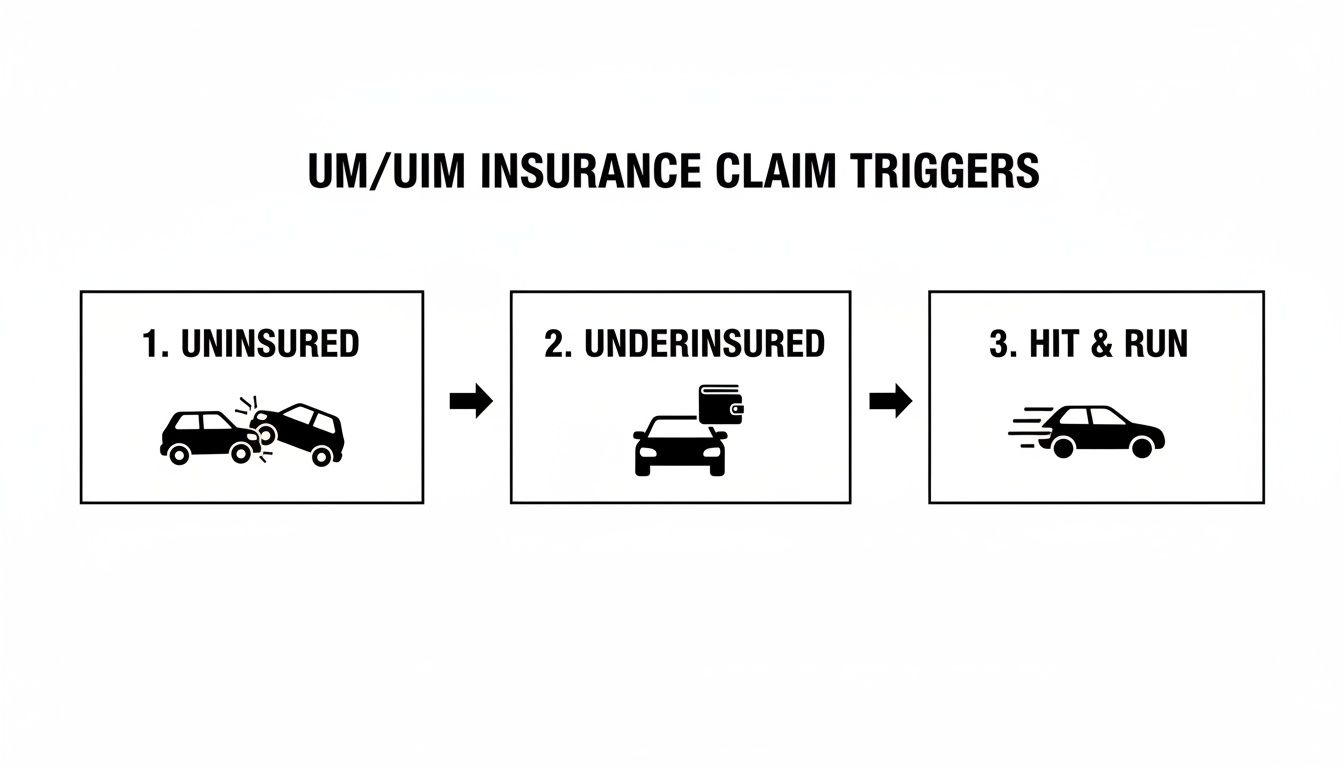
This chart shows the three situations that activate your policy: a crash with an uninsured driver, an underinsured driver, or a hit-and-run.
Remember, the burden of proof is on you. Your insurer will not simply take your word for it. You must present a compelling case backed by solid evidence that justifies the full value of your damages.
Start gathering every piece of information you can, such as:
- Photos and Videos: Take pictures of the accident scene, vehicle damage, road hazards, and your visible injuries.
- Witness Information: Get the names and phone numbers of anyone who saw what happened.
- Medical Records: Keep a dedicated file for every doctor’s visit, hospital bill, prescription receipt, and physical therapy note.
- Financial Documents: Track your lost income with pay stubs and keep receipts for any out-of-pocket expenses.
The Vital Role of a Texas Personal Injury Lawyer
This is where a skilled Texas personal injury lawyer becomes your most powerful ally. Trying to handle this process by yourself puts you at a significant disadvantage.
An experienced lawyer will take over all communications with the insurance adjuster, build a rock-solid case for you, and fight to ensure your own insurance company treats you fairly. They know the tactics adjusters use to offer low settlements and, more importantly, they know how to counter them.
If a hit-and-run driver left you injured, a lawyer is especially critical. You can learn more in our guide on what to do after you are hit by an uninsured motorist in Texas. Don’t let your insurance company decide what your recovery is worth.
Common Roadblocks in a Texas UM/UIM Claim
Filing a Texas uninsured motorist coverage claim should be a straightforward process. You’ve paid your premiums for this exact situation. But the reality is that your own insurance company can, and often will, create frustrating roadblocks to deny or reduce the value of your claim.

It's a difficult truth, but the moment you file a UM/UIM claim, your insurer’s goals shift. They are a business protecting their bottom line. Knowing their tactics is your first line of defense.
Common Disputes and Lowball Offers
Insurance adjusters are professional negotiators who use a playbook of arguments to devalue legitimate claims. You have to be ready for their tactics.
Here are some of their common moves:
- Blaming You for the Crash: The adjuster might twist your words or use details from the police report to argue you were partly at fault. Under Texas's comparative responsibility rule, if you're found more than 50% to blame, you recover nothing.
- Questioning Your Injuries: They often suggest your injuries were pre-existing or aren't as severe as your doctors say. This is a classic tactic to avoid paying for your future medical care and long-term needs.
- Making a Lowball Settlement Offer: The first offer is almost always a low one. The insurer hopes you're stressed and desperate enough to accept it without thinking. It rarely covers the full scope of your future medical needs, lost earning capacity, or pain and suffering.
With a shocking 14.5% of Texas drivers completely uninsured—that’s about one in every seven cars—these claims are filed every day. As a result, insurers are experts at minimizing payouts. These uninsured drivers cost responsible Texans millions, a problem made worse by our state's size and number of vehicles. You can discover more insights about the impact of uninsured drivers in Texas to understand why this coverage is so critical.
Navigating Texas-Specific Insurance Rules
It’s not just about negotiation tactics. Texas has specific laws that can jeopardize your UM/UIM claim if you don’t follow them perfectly. One mistake could cause you to lose your right to full compensation.
For example, if a driver with a small $30,000 policy causes a catastrophic injury on a Houston freeway, leaving you with $200,000 in damages, you must get written consent from your own insurer before accepting that $30,000 from their insurance.
Failing to get your insurer’s permission before settling with the at-fault driver can give your own company grounds to deny your UIM claim entirely, leaving you with a massive financial shortfall.
Another key Texas rule is the ban on "stacking." This means you can't combine the UM/UIM coverage limits from multiple vehicles on your policy to create a larger pool of money after a single accident.
How a Lawyer Protects Your Claim
These roadblocks are precisely why having an experienced advocate on your side is so important. An experienced truck crash lawyer in Houston or a wrongful death lawyer Texas knows these rules and tactics. They will manage all communications, build a powerful case that proves the full value of your damages, and force the insurance company to act fairly.
Your attorney anticipates these challenges and builds a strategy to overcome them, protecting your rights when you are at your most vulnerable and leveling the playing field.
Why an Experienced Lawyer Is Your Greatest Asset
A serious accident can turn your life upside down in an instant. In the aftermath, you might assume that because you’re filing a claim against your own Texas uninsured motorist coverage, your insurance company will have your back. After all, you’ve paid your premiums for this protection.
Unfortunately, that's rarely the case.
Your insurance company is a business. Its primary goal is to protect its profits, which often means paying out as little as possible. The friendly-sounding adjuster on the phone is trained to find reasons to undervalue, delay, or deny your claim. This is where an experienced Texas personal injury lawyer becomes your most powerful advocate.
Leveling the Playing Field Against the Insurer
Hiring an attorney immediately puts you on equal footing with the insurance company. While you focus on what truly matters—your health and your family—your lawyer handles the entire claims process, shielding you from the stress of dealing with adjusters.
A skilled lawyer brings invaluable experience to your case, including the ability to:
- Launch a Full-Scale Investigation: We do more than just read the police report. We dig deeper, gathering critical evidence like witness statements, traffic camera footage, and cellphone records to build an undeniable case that proves the other driver was at fault.
- Calculate the True Value of Your Claim: We work with medical and financial experts to get a complete picture of your damages. This isn't just about your current medical bills; it's about future surgeries, ongoing therapy, lost earning potential, and the real cost of your pain and suffering.
- Take Over All Negotiations: A seasoned Houston car accident attorney knows the tactics adjusters use to push low settlements. We manage all communication and fight aggressively for a settlement that reflects everything you've lost and everything you need to move forward.
When you're up against an uninsured driver, getting specialized guidance from personal injury law firms is absolutely critical to navigating the complexities of a UM/UIM claim and protecting your rights.
You should never be pressured into accepting a settlement that is just a fraction of what you deserve. An attorney ensures your story is heard and that your claim is valued fairly.
And if the insurance company refuses to make a fair offer? We are always prepared to take your fight to the courtroom to demand justice.
Take the First Step Toward Recovery
You do not have to face this battle alone. Your energy should be on your physical and emotional recovery, not on a legal war with a powerful corporation. The Law Office of Bryan Fagan, PLLC, is here to lift that weight from your shoulders.
We invite you to schedule a free, no-obligation consultation with our team. We'll listen to your story, explain your legal rights, and provide clear, understandable next steps. Recovery is possible, and with the right legal team fighting for you, you can take back control of your future.
How Long Do You Have to File a Claim in Texas?
It’s completely normal to have questions swirling around after an accident, especially when you’re dealing with something as confusing as insurance claims. We hear a lot of the same concerns from our clients. Here are some straightforward answers to the questions we get asked most often about Texas uninsured motorist coverage.
"What Happens If I Already Rejected UM/UIM Coverage?"
This is a very difficult situation. If you signed a form rejecting UM/UIM coverage when you purchased your auto policy, your options for compensation are severely limited. The main path left is to sue the at-fault driver directly.
Unfortunately, this is often a dead end. Someone driving without insurance is rarely in a financial position to pay a significant court judgment. While your own PIP coverage or health insurance might cover some immediate medical bills, they won’t cover other major losses like pain and suffering or future lost income.
"How Long Do I Have to File a UM/UIM Claim in Texas?"
While the official two-year statute of limitations for personal injury lawsuits applies to UM/UIM cases in Texas, that is not the deadline you should focus on.
Your insurance policy is a contract with its own, much shorter deadlines. You are required to notify your insurer about the accident and your claim promptly. Waiting even a few weeks can give them an excuse to argue you’ve violated the policy terms, putting your entire claim at risk. Acting quickly is essential to protecting your rights.
"Will My Insurance Rates Go Up If I Use My UM/UIM Coverage?"
This is one of the biggest fears we hear from accident victims. The answer is a firm no. Under Texas law, your insurance company is legally prohibited from raising your rates or penalizing you in any way for filing a UM/UIM claim when you were not at fault.
You paid your premiums for this exact protection. It is a benefit you purchased and are entitled to use. You should never be punished for using it. If an insurance adjuster suggests your rates might increase, it's a major red flag that you need an experienced attorney in your corner immediately.
A serious accident can change your life in seconds, but you don’t have to face the aftermath alone. The dedicated team at The Law Office of Bryan Fagan, PLLC is here to answer all your questions and fight for the full compensation you deserve. We invite you to schedule a free, no-obligation consultation to understand your rights and take the first step toward recovery. Recovery is possible, and legal help is available. Contact us today and let us handle the fight for you.