Skip to content
A serious accident can change your life in seconds, but you don't have to face it alone.
One moment you were driving to work, picking up your kids, or heading home on a Houston freeway. The next, you were gripping the steering wheel, feeling the force of impact, and trying to make sense of what just happened. Now the crash is over, but your shoulder still hurts. Reaching into a cabinet hurts. Sleeping hurts. Getting dressed hurts. You may already be wondering whether this pain will go away, whether you'll need surgery, and how you're supposed to pay bills if you can't work normally.
That uncertainty is common after a shoulder injury. A torn rotator cuff can look minor from the outside while disrupting nearly everything you do. It can also become a fight with the insurance company sooner than expected, especially if the adjuster starts questioning whether the crash really caused the tear.
If you're trying to understand a torn rotator cuff car accident settlement in Texas, clarity matters. You need to know how Texas fault rules affect compensation, what evidence increases case value, what mistakes can hurt your claim, and how to protect yourself before the insurance company shapes the story for you.
Your Life After the Accident Doesn't Have to Be Defined by Pain
After a crash, many people tell the same story. At first, adrenaline takes over. They go home thinking they're sore. Then over the next day or two, shoulder pain settles in and stays. A simple movement like lifting a bag of groceries or reaching for a seatbelt suddenly feels sharp, weak, or unstable.
After a Houston freeway crash, for example, a driver may notice that the shoulder on the seatbelt side aches constantly and clicks with movement. Another person may have braced against the steering wheel before impact and now can't raise an arm without pain. Those details matter because they help explain how this injury happens in real life, not just in medical charts.

The stress is physical and financial
A shoulder injury touches more than your arm. It affects your sleep, your job, your ability to drive, and the ordinary routines that make a day manageable. If you work with your hands, climb, lift, type for long periods, or care for children, a torn rotator cuff can change your week overnight.
That's also when people start asking practical questions:
- Will the insurer pay for treatment
- Should I accept an early offer
- Do I need a Texas personal injury lawyer
- What happens if the other driver blames me
Those are fair questions. If you're still deciding who to speak with, it can help to compare personal injury lawyers so you understand what experience, communication style, and case handling approach fit your situation.
You don't need to know everything today. You just need to avoid the mistakes that give the insurer an advantage before your medical picture becomes clear.
You can regain control
A settlement isn't based on guesswork alone. It's built from medical records, proof of fault, evidence of how the injury affects your work and daily life, and how well your legal team pushes back when the insurer tries to minimize the claim.
You may still be in pain, confused about the process, and worried about the future. That's normal. The path forward starts with understanding the injury itself and why shoulder claims often become more complicated than people expect.
Understanding Your Torn Rotator Cuff Injury
Your rotator cuff is a group of four muscles and tendons that keep your upper arm bone centered in the shoulder socket. In plain English, it helps you lift, rotate, and control your arm. If you think of the shoulder as a tent pole, the rotator cuff works like the guide ropes that keep everything stable while still allowing movement.
When those tendons are strained or torn, the shoulder often feels weak, painful, and unreliable. That's why people with this injury often struggle with overhead reaching, lifting objects, pulling doors open, fastening a seatbelt, or sleeping on the injured side.
How a car crash causes this injury
In a collision, your shoulder doesn't move in a normal way. It absorbs sudden force. That can happen when you:
- Brace against the steering wheel
- Get pulled sharply by the seatbelt
- Twist during impact
- Take a direct hit from the interior of the vehicle
A rear-end collision, side-impact crash, or hard braking event can all create enough force to injure the shoulder. The key point is that the mechanism often makes sense medically. A rotator cuff tear is not some unusual complaint that appears out of nowhere after a wreck.
Partial tears and complete tears
Not every torn rotator cuff is the same. Some tears are partial, meaning the tendon is damaged but not fully torn through. Others are complete, meaning the tear is more severe and shoulder function is affected more dramatically.
That difference often shows up in daily life. A partial tear may bring persistent pain and weakness. A more serious tear may make it hard to raise the arm at all or continue normal work duties.
Practical rule: If your shoulder pain keeps interfering with ordinary tasks after a crash, don't assume it's a strain that will fade on its own. Persistent symptoms need medical attention and documentation.
Why diagnosis matters so much
Shoulder claims often turn on objective proof. A doctor's examination, imaging, treatment notes, and specialist opinions help show whether the injury is traumatic, how serious it is, and what treatment may be necessary.
That matters because insurance companies often treat shoulder complaints differently from obvious fractures. If an adjuster sees only vague pain complaints, the claim may be undervalued. If the file shows consistent treatment, imaging, and clear medical findings, the discussion changes.
A torn rotator cuff car accident settlement usually depends on more than the label of the injury. It depends on whether the medical record tells a clean, believable story from the crash to diagnosis to treatment.
Calculating Your Torn Rotator Cuff Settlement in Texas
People understandably want a number. The more useful question is how that number gets built.
In Texas, compensation in a shoulder injury case usually comes from two broad categories: economic damages and non-economic damages. Economic damages are the losses you can document directly. Non-economic damages reflect the human impact of the injury, including pain and loss of normal function.
According to this Texas rotator cuff settlement overview, torn rotator cuff settlements from car accidents in Texas typically range from $10,000 for minor soft tissue tears to over $175,000 for moderate partial tears requiring shoulder surgery, while severe complete tears with permanent damage can exceed $100,000 and in some cases reach over $1 million, depending on the facts of the case.
The building blocks of settlement value
Here's a practical way to think about it.
| Damage Type | Description | Examples |
|---|---|---|
| Economic Damages | Financial losses tied to the injury | Emergency care, orthopedic visits, imaging, surgery, physical therapy, medication, lost income, reduced ability to earn a living |
| Non-Economic Damages | Personal losses that don't come with a fixed bill | Physical pain, sleep disruption, emotional strain, limited mobility, inability to enjoy daily activities, difficulty caring for family |
Economic damages are usually easier to prove
These are often the first numbers people focus on because they leave a paper trail. Bills, treatment records, wage statements, and employer documentation help show what the injury has already cost you.
A shoulder injury can create economic losses far beyond the first medical visit. Many cases involve continuing therapy, specialist follow-up, and work restrictions. If your job requires lifting, climbing, reaching, driving, or repetitive arm use, your lost income claim may become a major part of the case.
Non-economic damages are just as real
This part of the claim often matters most to the injured person because it reflects the part of recovery that doesn't fit neatly on a spreadsheet. Pain while sleeping. Trouble bathing or dressing. Loss of independence. Missing family activities because your shoulder won't cooperate.
Those losses count, even though they're harder to quantify.
Strong claims connect the medical file to everyday life. It's not enough to show that your shoulder hurts. You need to show how that pain changed your work, routine, and recovery.
Why ranges vary so much
Two people can both have rotator cuff tears and still have very different case values. One may recover well with conservative treatment. Another may need surgery and face lasting restrictions. One may have clean liability. Another may have a dispute over fault that drags the value down.
If you want a deeper explanation of the math behind injury claims, this guide on how to calculate a car accident settlement is a useful starting point. Some injured Texans also look for a Texas Personal Injury Lawyer when they want representation on a no-fee-unless-we-win basis.
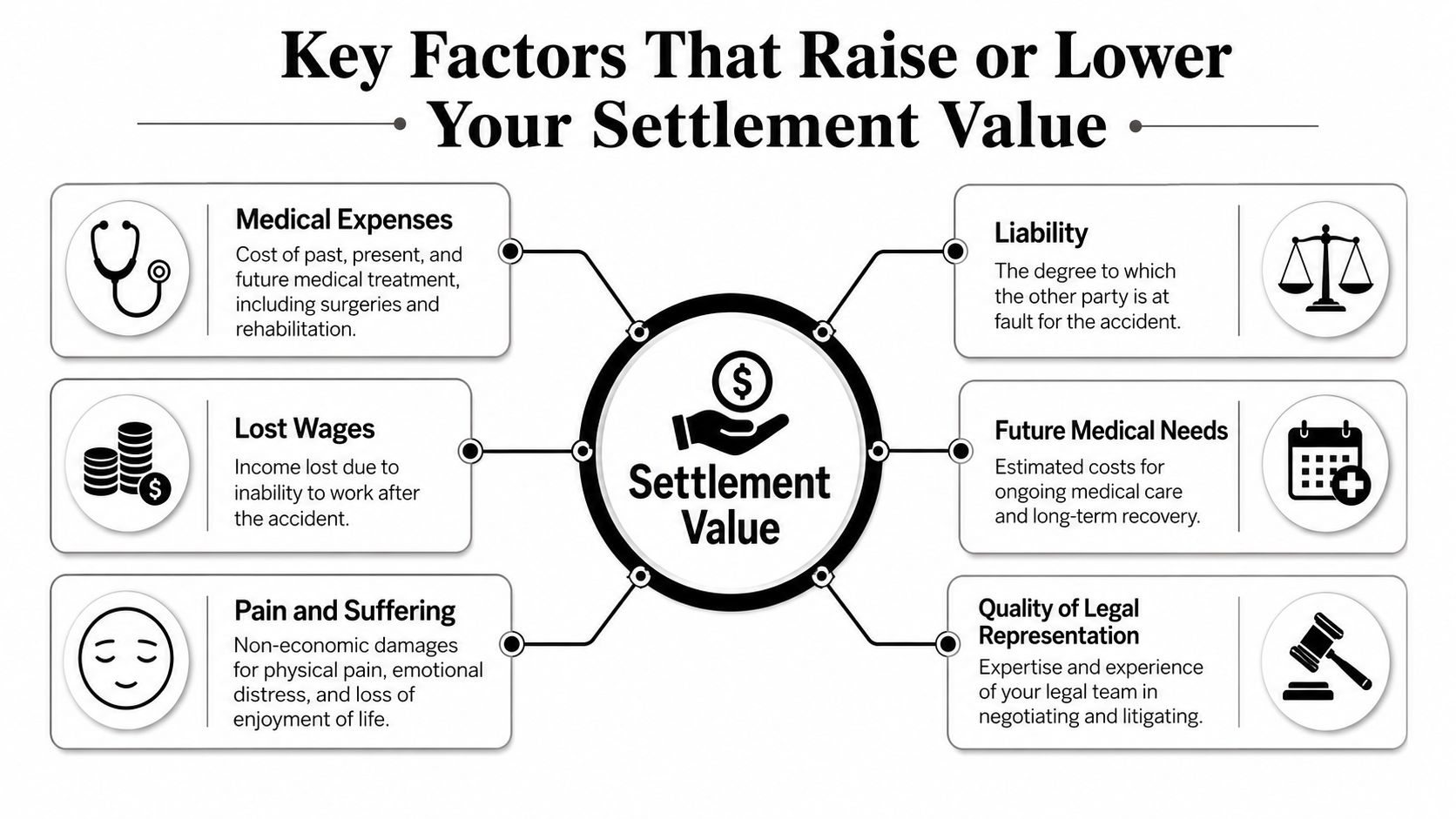
Key Factors That Raise or Lower Your Settlement Value
Settlement value isn't random. Insurers and juries look for specific facts that either strengthen or weaken the case. The stronger the proof on those points, the harder it is for the other side to discount your injury.
Surgery usually changes the case value
The biggest driver in many shoulder cases is whether surgery was required. According to this settlement analysis of rotator cuff injuries, the need for surgery is the single most critical variable in determining settlement value, and cases involving surgical repair often settle between $75,000 and $250,000, sometimes higher.
That makes practical sense. Surgery tends to do three things at once:
- It confirms severity through objective treatment
- It raises economic damages because medical costs increase
- It supports pain and suffering claims because recovery is longer and more difficult
A non-surgical claim can still be valid and meaningful. But when a surgeon recommends repair, the insurer usually has a harder time arguing that the injury is minor.
Liability matters in Texas
Texas follows a modified comparative responsibility rule. In plain terms, fault affects money.
If the evidence shows the other driver caused the crash, settlement discussions usually focus on damages. If fault is disputed, the case value can drop quickly. The insurer may argue you changed lanes unsafely, followed too closely, failed to react, or contributed in some other way.
Under the Texas-specific rule summarized in the earlier Texas source, if an injured person is 50% or more at fault, Texas law bars recovery, and if fault is less than that, compensation is reduced proportionally. That's one reason proving negligence early matters so much.
Pre-existing shoulder problems are a favorite insurer argument
This is the issue many people don't see coming. The adjuster may say your shoulder problem was already there because of age, wear and tear, or old soreness. That argument can reduce settlement value if your records are incomplete or your medical proof is weak.
Insurance companies know shoulder imaging can show degeneration. They use that to argue the crash didn't really cause the tear or only caused a temporary flare-up.
What else affects value
A few other factors often push the number up or down:
- Your occupation: A shoulder injury affects a warehouse worker, mechanic, nurse, or electrician differently than someone in a less physical role.
- Consistency of treatment: Gaps in care give the insurer room to argue you healed quickly or weren't badly hurt.
- Quality of proof: Imaging, specialist opinions, and clear records usually carry more weight than vague complaints.
- Long-term limits: Permanent weakness, reduced range of motion, or difficulty returning to prior work usually increase seriousness.
If you want a broader look at these issues, this resource on what factors affect an injury settlement in Texas lays out the main value drivers.
The Texas Personal Injury Claim Process and Timeline
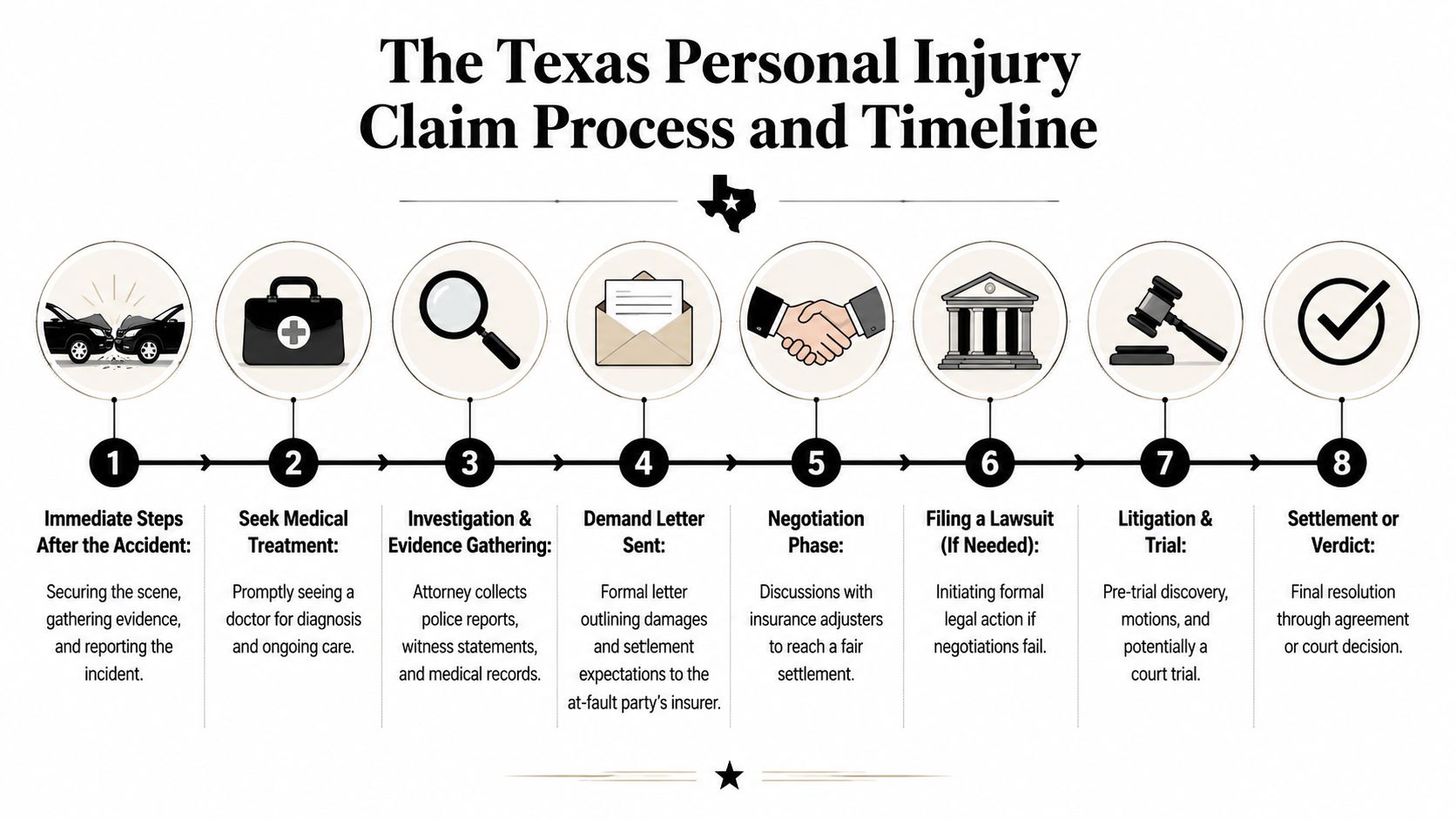
The claim process feels less overwhelming when you break it into steps. Most rotator cuff cases don't resolve the day after the crash. They develop over time as doctors diagnose the injury, treatment unfolds, and the evidence becomes clearer.
Early on, practical steps matter outside the legal claim too. If the collision involved a private-party vehicle purchase and mechanical concerns become part of the story, it may help to spot red flags on Texas used cars so you understand title and vehicle-history issues that sometimes surface after a wreck.
Here is the typical road map followed.
What to do first
- Get medical care quickly. A prompt evaluation protects your health and creates the first record tying the shoulder pain to the crash.
- Report the accident. Police reports and incident details often become central evidence later.
- Notify the relevant insurance companies. Open the claim, but be careful about detailed statements before you understand the injury.
- Preserve evidence. Photos, witness names, vehicle damage, and treatment records all help.
What happens after the claim opens
Once the immediate crisis passes, the case usually enters a longer evidence-building stage.
- Investigation begins: Records, crash reports, photos, witness statements, and medical records are gathered.
- Treatment continues: Your legal position often becomes clearer only after your doctor understands the full extent of the tear.
- A demand package is prepared: This lays out fault, damages, and the basis for settlement.
- Negotiations follow: The adjuster may dispute causation, treatment, or value.
- A lawsuit may be filed: If the insurer won't offer fair compensation, filing suit may be necessary.
This overview of the process can also help:
How long do you have to file a claim in Texas
This deadline is strict. Under Texas Civil Practice and Remedies Code § 16.003 as discussed here, you have two years from the date of the car accident to file a personal injury lawsuit in Texas. Missing that deadline means you forfeit your right to seek compensation forever.
Don't confuse insurance negotiations with preserving your legal rights. A claim can still be under discussion while the filing deadline gets closer.
That's why injured people often contact a Houston car accident attorney well before they think they're ready to settle. Waiting can make evidence harder to collect and can leave too little time if negotiations fail.
Common Pitfalls to Avoid in Your Rotator Cuff Claim
Shoulder claims often get damaged by preventable mistakes. Some happen because people trust the insurance process too much. Others happen because they don't realize how carefully the insurer is looking for alternate explanations.
What not to do
- Don't downplay symptoms to your doctors. If your records say you're doing fine when you're struggling to lift your arm, the insurer will use that against you.
- Don't give the other driver's insurer a recorded statement casually. Seemingly harmless answers can be framed as admissions later.
- Don't sign broad medical authorizations without understanding them. The insurer may look for unrelated history to shift blame.
- Don't jump at a quick offer. Early offers often come before the full course of treatment is known.
- Don't stop treatment without guidance. Gaps in care can weaken causation and severity arguments.
The pre-existing condition trap
One of the most common insurer defenses is that your shoulder was already degenerating and the crash had little to do with your symptoms. According to this discussion of rotator cuff claims after a car wreck, insurers frequently argue that a rotator cuff tear is a pre-existing degenerative condition, especially in clients over 40, and attorneys often counter that argument with diagnostic imaging and expert medical testimony showing an acute tear or a significant aggravation of a previously asymptomatic condition.
That's why consistency matters so much. If your records show the crash happened, shoulder pain started soon after, imaging followed, and treatment stayed consistent, the insurer has a harder time rewriting the cause.
A prior shoulder issue does not automatically destroy a claim. The real question is whether the crash caused a new injury or made a dormant problem significantly worse.
What works better
A stronger claim usually includes a clean timeline, regular treatment, and medical records that clearly connect the shoulder condition to the wreck. If you had prior soreness but were functioning normally before the crash, that fact needs to be documented carefully and early.
You Don't Have to Fight the Insurance Companies Alone
By the time a rotator cuff claim reaches serious settlement talks, several issues are usually in play at once. Fault may be disputed. The insurer may question whether the tear was pre-existing. Medical treatment may still be unfolding. And the value of the case may depend on records, opinions, and deadlines that most injured people have never dealt with before.
That's why legal help isn't just about paperwork. It's about protecting the story of your injury before the insurance company reshapes it into something smaller and cheaper. A Texas personal injury lawyer or Houston car accident attorney can gather the records, frame the medical evidence, handle adjuster communications, and move the case toward negotiation or suit while you focus on getting better.
For people trying to decide whether they need representation, this article on whether you need a personal injury lawyer in Texas is a useful place to start. If your insurance issues become broader than the injury claim itself, resources such as Duncan & Associates on denied claims can also help you understand the kinds of disputes that arise when insurers resist payment.
If your crash involved a larger commercial vehicle, a truck crash lawyer Houston may be the right fit because those cases often involve separate evidence and corporate policies. If a family is grieving a fatal collision instead of dealing with an orthopedic injury, a wrongful death lawyer Texas can pursue a different kind of claim built around loss, accountability, and long-term financial harm. Depending on the facts, related legal support may also involve a car accident case review, guidance for truck wreck litigation, discussion of wrongful death rights, or help with catastrophic injury claims.
Trying to manage all of that alone while recovering from shoulder pain puts a lot on your shoulders. You don't have to do that.
If you're dealing with shoulder pain after a crash and need straightforward answers, the Law Office of Bryan Fagan, PLLC offers free consultations for injured Texans and their families. You can talk through your options, learn how Texas fault rules may affect your case, and get clear guidance on the next step. Recovery is possible, and legal help is available when you're ready.