Skip to content
A serious accident can change your life in seconds, but you don't have to face it alone.
If you're reading this after an injury on a vessel, at a dock, in the Houston Ship Channel, or offshore, you're probably dealing with more than pain. You may be wondering who pays for treatment, whether you should trust the company doctor, what happens to your paycheck, and how federal maritime law fits with Texas injury rules. Those questions are common, and they matter.
A maritime injury claim isn't the same as a typical onshore workplace case. The law can change based on where you were hurt, what kind of work you did, whether you qualify as a seaman, and whether a federal deadline applies before a Texas deadline would. That mix of federal and state rules is where many injured workers lose ground early.
Texas personal injury law still matters because fault, negligence, comparative responsibility, and filing deadlines shape many injury cases in this state. In plain terms, the person or company that caused the harm may be responsible for the losses that follow. If an injured worker shares part of the blame, that can affect recovery in negligence-based claims. The key is to identify the right legal path early and protect the evidence before the employer and insurer frame the story for you.
An Injury at Sea Can Change Your Life You Are Not Alone
A hard fall on a slick deck. A crush injury during cargo operations. A line snap, equipment failure, or offshore explosion. One moment you're doing your job. The next, your life may look completely different.

For many families, the first days after a maritime injury feel chaotic. Medical appointments start piling up. Your supervisor may ask for statements. Bills don't stop. If a loved one was killed, the grief can be overwhelming, and legal questions can feel impossible to handle alone.
Why these cases feel different
Maritime claims often sit at the intersection of federal maritime law and Texas injury practice. That means your case may involve rights that don't exist in an ordinary workplace injury claim, but it also means the rules can be less familiar and less forgiving.
After a Houston freeway crash, people usually think about insurance, police reports, and the other driver's fault. After a maritime injury, the issues can include vessel status, crew assignments, maintenance and cure, seaworthiness, longshore coverage, and overlapping deadlines. The facts matter immediately.
Practical rule: The early steps after a maritime injury often shape the entire case. What gets reported, documented, and treated in the first days can affect both your health and your legal options.
What injured workers need most
You need clear answers. You need to know whether negligence played a role, what compensation may be available, and how to avoid common mistakes that weaken a claim. You also need advice that respects what you're going through, not legal jargon that adds more stress.
That's true whether your injury happened offshore, at a Texas port, or while working around commercial vessels. It's also true if your family is searching for a wrongful death lawyer Texas families can call after a fatal maritime loss, or if you first found this firm while looking for a Houston car accident attorney or truck crash lawyer Houston families trust after a serious road collision. Catastrophic injuries raise many of the same practical concerns across different case types.
Here, the path forward starts with identifying your legal status, preserving proof, and acting before the shortest deadline closes the door.
Understanding Your Rights as an Injured Maritime Worker
A deckhand hurt off Galveston, a longshore worker injured at the Port of Houston, and a mechanic struck while servicing equipment near navigable water may all call it a "work injury." Legally, those cases can follow very different paths. That difference affects who pays medical bills, whether fault must be proven, what wage benefits are available, and whether Texas law, federal maritime law, or both shape the claim.
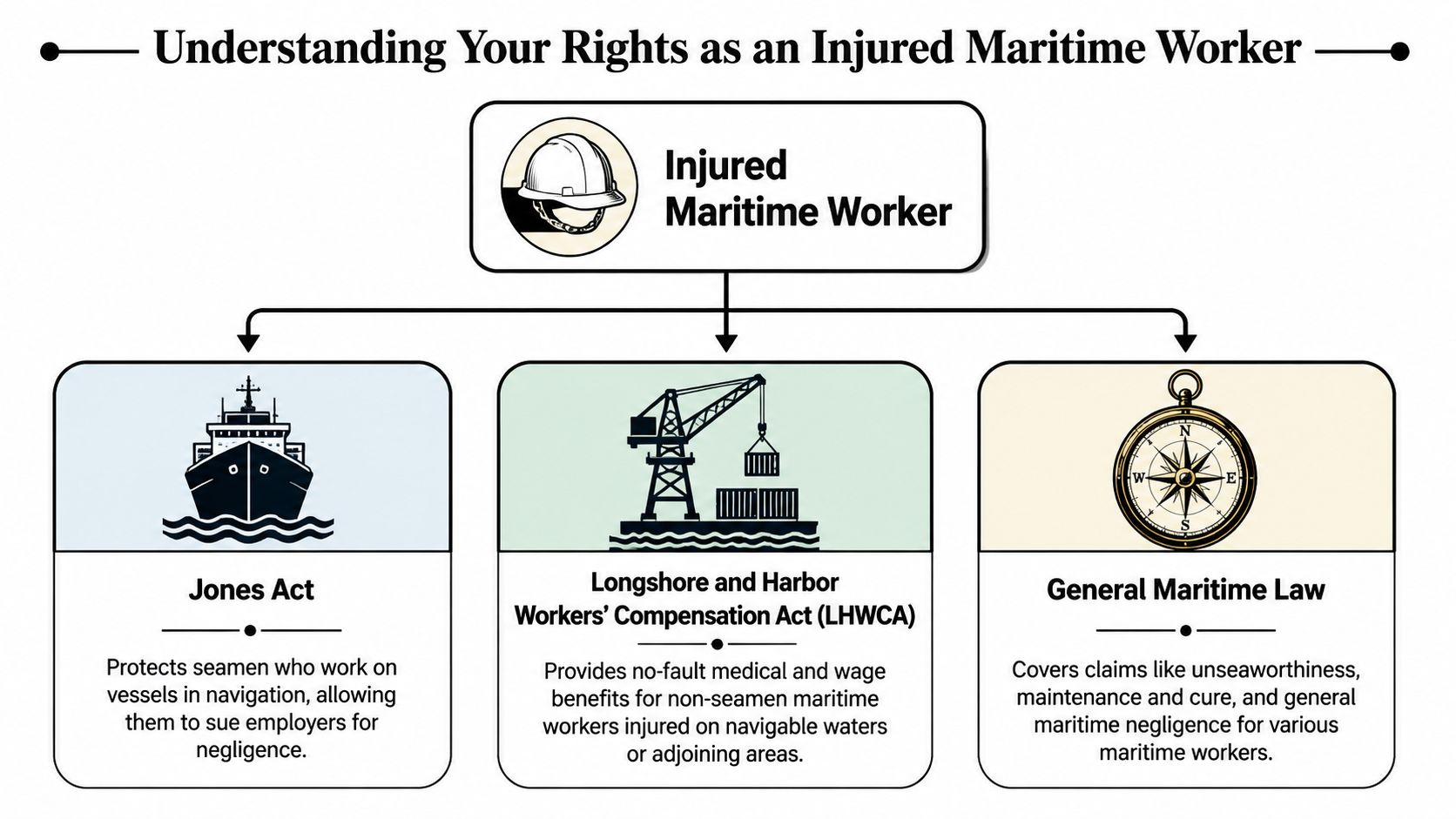
In Texas, that classification question comes first. Maritime injury cases often involve the Jones Act, the Longshore and Harbor Workers' Compensation Act, and general maritime law. The legal status of the worker and the location and nature of the job usually matter more than the employer's first label for the incident. Texas ports and waterways support a massive workforce, and Texas maritime activity indirectly supports over 1.7 million jobs, according to the Texas Ports Association. But volume does not make these claims simple.
The Jones Act
The Jones Act usually applies to seamen. In practice, that means a worker with a substantial connection to a vessel in navigation, not someone who only steps aboard occasionally.
If you qualify as a seaman, you may bring a negligence claim against your employer. That matters because a Jones Act case can allow recovery for lost income, medical expenses, pain, suffering, and other damages tied to the injury. Fault is part of the case, but the burden is often more worker-friendly than people expect. If unsafe staffing, poor training, bad orders, slippery decks, defective gear, or rushed operations played a role, those facts may support the claim.
Texas workers are often told their case is "just workers' comp." That can be wrong. A Jones Act claim is very different from an ordinary state work injury claim, and the difference can change the value and direction of the case.
The LHWCA
The Longshore and Harbor Workers' Compensation Act covers many maritime workers who are not seamen, including many longshoremen, harbor workers, ship repairers, and terminal workers. It works more like a federal work-injury benefit system.
You usually do not have to prove employer negligence to receive benefits under the LHWCA. The trade-off is narrower recovery than a successful Jones Act negligence case. Covered workers can generally receive medical benefits and disability payments equal to two-thirds of their average weekly wage under the U.S. Department of Labor's LHWCA program. If you are comparing that federal system with state job injury rules, this guide to Texas workers' compensation rules helps explain where the overlap ends.
General maritime law
Some of the most important rights in a maritime case do not come from a single statute.
- Maintenance and cure requires a vessel owner to provide an injured seaman with basic living expenses and medical care after an injury or illness suffered in the service of the vessel.
- Unseaworthiness may apply when the vessel, crew, equipment, or working condition was not reasonably fit for its intended use.
These claims can exist alongside a Jones Act claim. That overlap is where many Texas maritime cases become more technical. Federal maritime law may control the substance of the claim, but Texas-specific facts still shape how evidence is gathered, which doctors are involved, where suit may be filed, how witnesses are located, and how quickly the defense can put pressure on an injured worker.
A Texas Personal Injury Lawyer who handles serious injury litigation can help sort out those questions early. In maritime cases, early classification is not paperwork. It is case strategy.
The First Steps to Take Immediately After a Maritime Injury
A deckhand slips on an oil-slicked surface near Galveston, feels a sharp pull in his back, and finishes the shift because the crew is short. By that night, he can barely stand up. By the next morning, the company has its own version of what happened.
That pattern is common in Texas maritime cases. The first day after an injury affects medical care, witness proof, vessel records, and which legal path applies under federal maritime law or, in some offshore situations, Texas injury rules.
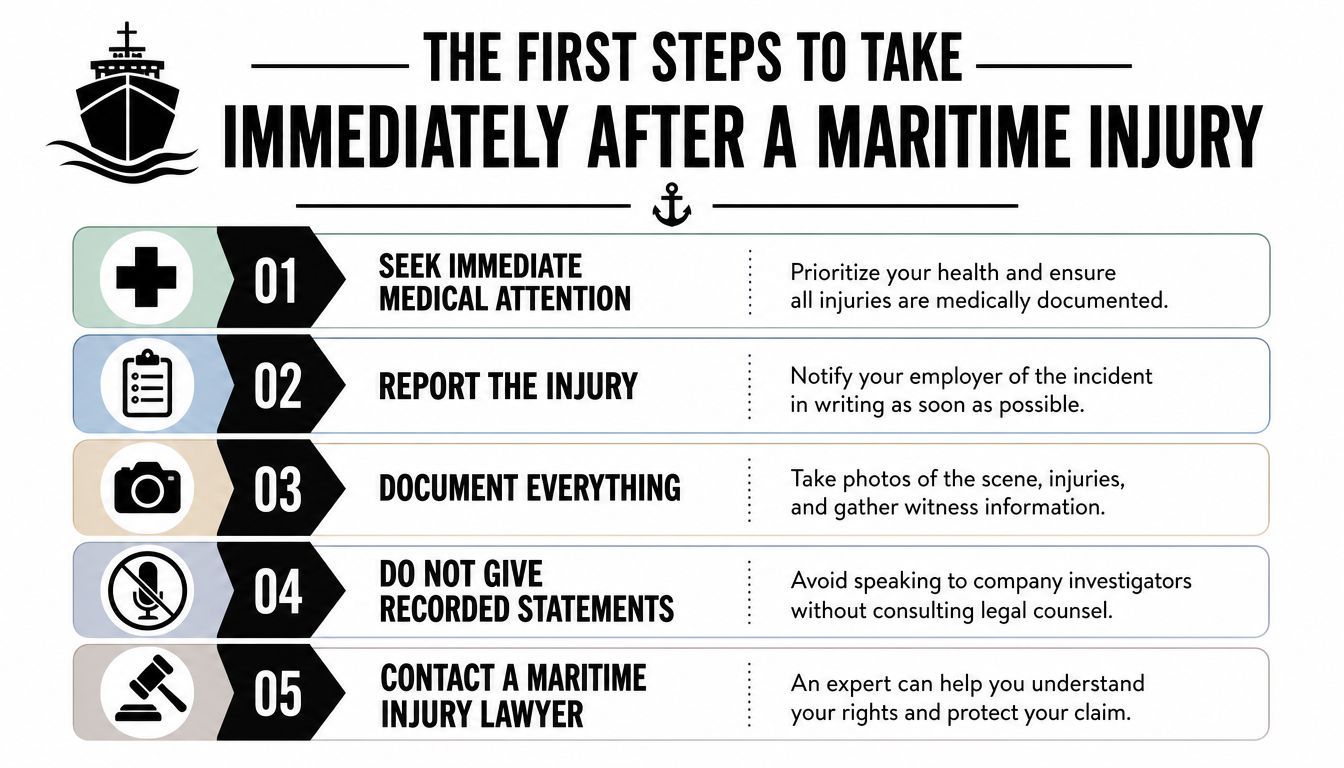
Five steps that protect both health and the claim
Get medical care right away
Start with your health. A back strain, head injury, hand crush, chemical exposure, or fall injury can look manageable in the first hour and get much worse over the next few days. Prompt treatment also creates a record that ties the injury to the job.Report the injury in writing
Tell a supervisor as soon as you can. Then follow up in writing by text, email, incident report, or any method you can later prove. In maritime cases, timing disputes come up fast, and a written report often matters more than a verbal conversation.Preserve the facts before they shift
Write down the vessel name, location, time, task being performed, equipment involved, weather or deck conditions, and names of witnesses. If you can do it safely and lawfully, take photos of the area, the equipment, and any visible injuries. On the Texas coast and in offshore cases, records can be spread across the vessel, the employer, a contractor, and shore-side management, so early documentation matters.Be careful with company paperwork and recorded statements
Employers, insurers, and claims handlers often ask for statements while you are still in pain and before you understand the full injury. Some forms look routine but frame fault, minimize symptoms, or give broad access to unrelated medical history. Read slowly. Do not guess. Do not let anyone rush you.Get legal advice early
Early case review helps identify whether the claim points toward the Jones Act, general maritime law, the Longshore and Harbor Workers' Compensation Act, or a Texas-based claim tied to an offshore accident. That early classification changes what evidence should be requested, which deadlines may apply, and how to respond if benefits are delayed.
A short video can help frame the urgency after a serious injury:
Why maintenance and cure disputes start early
Maintenance and cure problems usually do not begin with a formal denial. They start with pressure. A worker is told to return before he is medically ready, to treat only with a company-selected doctor, or to accept that he has reached maximum medical improvement before the medical record supports it.
According to this discussion of Texas maritime injury practice, employers must continue cure benefits until maximum medical improvement is reached. If payments stop too early, get follow-up care, keep every prescription and work-status note, and speak with counsel before signing anything that suggests you are fully recovered.
That trade-off is real. Injured workers often want to cooperate and keep the job relationship intact. But in my experience, waiting too long to question a cutoff can let the paper record harden in the employer's favor.
What helps, and what usually hurts
What helps:
- Detailed notes about pain levels, restrictions, missed work, and medical visits
- Consistent treatment with providers who document the injury carefully
- Copies of every report, text, email, and discharge instruction
- Early review of filing deadlines, including how Texas personal injury statutes of limitation can affect related claims
What hurts:
- Trying to work through the injury without treatment
- Assuming the company report is complete or neutral
- Signing forms you do not fully understand
- Posting online about physical activity while the claim is still active
A company incident report is one piece of evidence. It is not the final word on what happened.
Do Not Miss Your Deadline Navigating Maritime Claim Timelines
A worker gets hurt offshore, reports the incident, starts treatment, and assumes there is time to see whether the company will do the right thing. Weeks turn into months. By the time the claim is reviewed closely, the first question is no longer how serious the injury is. It is whether the deadline has already started to close.
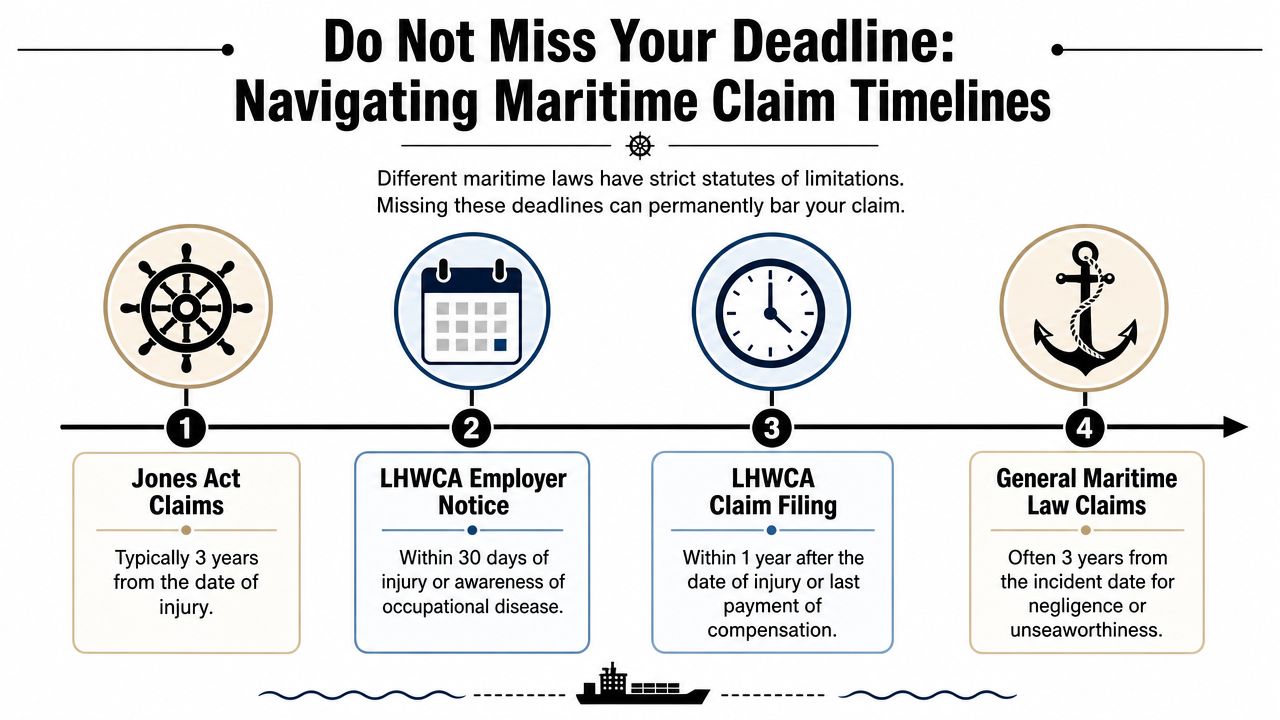
That is why timing in maritime cases has to be handled early and carefully. Federal maritime law and Texas law do not use one uniform clock. A Jones Act claim has a 3 year limitations period, an LHWCA claim has a 1 year filing deadline, a DOHSA wrongful death claim generally allows 3 years, and Texas general personal injury claims, including many claims tied to offshore work, often carry a 2 year deadline, according to this Texas maritime and offshore injury explanation. The shortest plausible deadline should shape your next step until a lawyer confirms which law applies.
Why deadlines get confusing
Maritime injury cases often sit at the intersection of federal rules and Texas procedure. That is where workers get tripped up.
The vessel you worked on, the job you performed, where the injury happened, and whether the case involves negligence, benefits, or wrongful death can all affect the filing deadline. A seaman may have a Jones Act claim. A longshore or harbor worker may fall under the LHWCA. An offshore accident may also raise Texas timing issues depending on the claim being pursued. The right answer depends on the facts, not the label someone used at the dock or in an HR email.
For a broader look at how state deadlines can affect related claims, review this explanation of the Texas personal injury statute of limitations.
A simple comparison
| Claim type | Typical filing timeline |
|---|---|
| Jones Act | 3 years |
| LHWCA | 1 year |
| DOHSA wrongful death | 3 years |
| Texas general personal injury | 2 years |
The shortest deadline controls the risk
In practice, this is one of the hardest trade-offs injured workers face. Waiting may feel reasonable if you are still treating, hoping to return to work, or trying not to inflame the relationship with your employer. Legally, delay can cost you the claim.
A missed deadline can block recovery even where fault is clear and the injury is serious. That is especially true in maritime cases because federal remedies and Texas-based claims can overlap, but they do not always expire on the same schedule. Early review lets you preserve the broadest set of options before one of them disappears.
Do not calendar a deadline based on a guess. Mark the earliest possible filing date and get case-specific advice as soon as possible.
How a Texas Maritime Injury Lawyer Builds Your Case for Compensation
By the time many injured workers call, they're exhausted. They've already reported the accident, seen at least one doctor, and heard from an adjuster or company representative. The legal job is to take that pressure off your shoulders and turn a confusing event into a provable case.
The investigation starts with the story and the records
A serious maritime case usually begins with two tracks running at the same time. First, the lawyer gets your account in detail. Second, the lawyer works to secure the records that can confirm or challenge it.
That may include incident reports, crew logs, maintenance records, safety manuals, training records, photographs, dispatch communications, medical files, and witness statements. In a vessel case, the difference between a routine injury and a powerful negligence claim is often hidden in records the worker never sees on their own.
After a Houston freeway crash, lawyers often look at crash reports, vehicle damage, and insurance coverage. In a maritime case, the comparable work often centers on vessel conditions, job assignments, equipment failures, and whether the employer followed safe procedures.
Medical proof drives case value
A good claim needs more than proof that you got hurt. It needs proof of how the injury affects your life now and how it may affect your future.
That's why lawyers often help coordinate care with the right specialists and make sure the records clearly address work restrictions, diagnosis, treatment needs, and long-term limitations. If you suffered an amputation, brain injury, spinal injury, or other life-changing harm, the damages picture may extend far beyond the first round of hospital bills. The same is true in other serious injury cases, including car accident claims, catastrophic injury matters, and wrongful death claims.
Negotiation is only useful when the case is ready for trial
Insurers and employers often pay more attention when they see a file that's been built carefully. That means liability is documented, treatment is organized, witnesses are identified, and damages are supported by records instead of rough estimates.
In practice, the case often moves through these stages:
Early analysis
The lawyer determines which law likely applies and what claims should be preserved.Evidence preservation
Notices go out. Records are requested. Witnesses are located before memories fade.Damages development
Lost wages, future care, pain and suffering, and other recoverable losses are assembled into a coherent demand.Settlement talks or suit
If the defense won't make a fair offer, the case is prepared for litigation.
One practical point matters here. A Texas personal injury lawyer handling maritime work must be comfortable with both settlement strategy and courtroom preparation. If the other side believes the case won't be tried, negotiations often stall.
Where Texas law concepts still matter
Even in maritime cases, familiar Texas injury concepts help clients understand the process. Negligence asks who failed to use reasonable care. Comparative responsibility asks whether the injured person may share some blame. Wrongful death claims focus on the losses suffered after a fatal incident. Those ideas aren't abstract. They shape how evidence is gathered and how the defense tries to limit exposure.
That's why families who first searched for a wrongful death lawyer Texas option, a Houston car accident attorney, or a truck crash lawyer Houston firm often recognize the same basic litigation pattern. The facts must be proved. The losses must be documented. The pressure to settle cheap has to be resisted.
Take the First Step Toward Recovery Schedule Your Free Consultation
Choosing a lawyer after a maritime injury isn't just about credentials. It's about finding someone who can identify the right legal framework, move quickly to preserve evidence, and communicate clearly while you're trying to heal.
What to look for in a lawyer
A helpful starting list includes:
Experience with complex injury cases
Maritime claims can involve federal law, Texas negligence principles, employer defenses, and overlapping deadlines.A practical process
You should know how documents are gathered, how medical records are handled, and who will answer your questions.Clear fee information
Many injury cases are handled on contingency, which means the fee is tied to the outcome rather than upfront billing. This overview of how contingency fees work in Texas personal injury cases explains the basic structure.Organized intake and communication
Early case details matter. Tools like powerful client intake forms can help law firms collect accurate information quickly, which is especially useful when injuries, witnesses, and medical treatment are evolving fast.
A free consultation should give you clarity
You shouldn't leave an initial consultation more confused than when you started. You should come away with a better sense of what law may apply, what steps need to happen next, what not to say to the insurer, and how the claim may move forward.
The Law Office of Bryan Fagan, PLLC handles Texas personal injury matters involving serious injuries and families seeking answers after tragedy. In a maritime context, that means giving you a realistic assessment, not pressure. If another route fits better, you should be told that too.
Recovery after a serious maritime injury takes time. So does grieving after a fatal loss. But legal guidance can remove uncertainty, protect your claim, and help you make informed decisions for yourself and your family.
Your situation may feel unstable right now. It won't stay this way forever. With the right support, recovery is possible, and legal help is available.
If you were hurt on the water, offshore, or at a Texas port, contact the Law Office of Bryan Fagan, PLLC to schedule a free consultation. We can listen to what happened, explain your options in plain English, and help you take the next step toward recovery.