 Skip to content
A serious accident can change your life in seconds, but you don't have to face it alone. After a crash, you may be dealing with pain, medical bills, missed work, vehicle damage, and an insurance company focused on limiting what it pays. The problem becomes more urgent when your losses are far greater than the at-fault driver's liability coverage.
A Stowers demand letter in Texas can create important settlement pressure in that situation. It's a carefully prepared, within-limits offer that gives the insurer a reasonable chance to protect its policyholder from an excess judgment. The rules are technical, so a demand that looks reasonable to you may not provide Stowers protection if it has unclear terms, missing releases, or unresolved lien issues.
This guide explains how the doctrine works, how Texas negligence and comparative responsibility rules affect your claim, when a demand may be appropriate, and why a Stowers demand isn't the same as a general insurance bad-faith claim.
When a Serious Texas Crash Leaves You Facing Limited Insurance
After a serious Houston freeway crash, you may know the other driver caused the collision and still face a difficult problem: the available liability insurance may be far below your losses. Treatment can continue while your ability to work remains uncertain. Your family may also need help with transportation, care, and daily expenses. The policy limit may look like a firm wall, but it does not always end your options.
Consider a driver whose negligence causes a spinal injury. Medical treatment, lost income, pain, and future needs can quickly exceed that driver's coverage. A Stowers demand letter in Texas gives the insurer a formal chance to settle the liability claim within the policy limit and obtain a complete release for the insured driver. Timing matters because the demand must give the carrier a reasonable opportunity to evaluate and accept it.

If the at-fault driver's coverage cannot meet your losses, also check whether you have underinsured motorist coverage in Texas. That coverage may help address part of the gap, although it involves a separate claim and different policy requirements. Liens, medical bills, and the release language also need careful attention. A demand that leaves those issues unclear may create avoidable disputes.
Texas law recognizes the Stowers doctrine as a protection for injured claimants and insured drivers when an insurer controls settlement decisions. If the carrier unreasonably refuses a proper within-limits demand and the case later produces an excess judgment, the carrier may face responsibility for the amount above the policy limit. The doctrine comes from G.A. Stowers Furniture Co. v. American Indemnity Co., decided by the Texas Supreme Court in 1929. Its history is summarized in this Texas Stowers demand resource.
Fault still matters
A Stowers demand does not replace proof of negligence. You generally must show that another person owed you a duty, breached it, and caused your injuries and losses. Crash reports, photographs, witness accounts, vehicle data, medical records, and testimony may help establish those facts.
Texas also follows modified comparative responsibility. You can recover damages if you're 50% or less responsible, but your recovery is reduced by your percentage of responsibility. If you're more than 50% at fault, you recover nothing under the rule described by Texas personal injury law guidance.
A Stowers demand therefore works as a time-sensitive settlement tool, not a routine request for payment. It depends on clear liability, supported damages, accurate policy information, and terms the insurer can accept without guessing about liens, releases, or the next step.
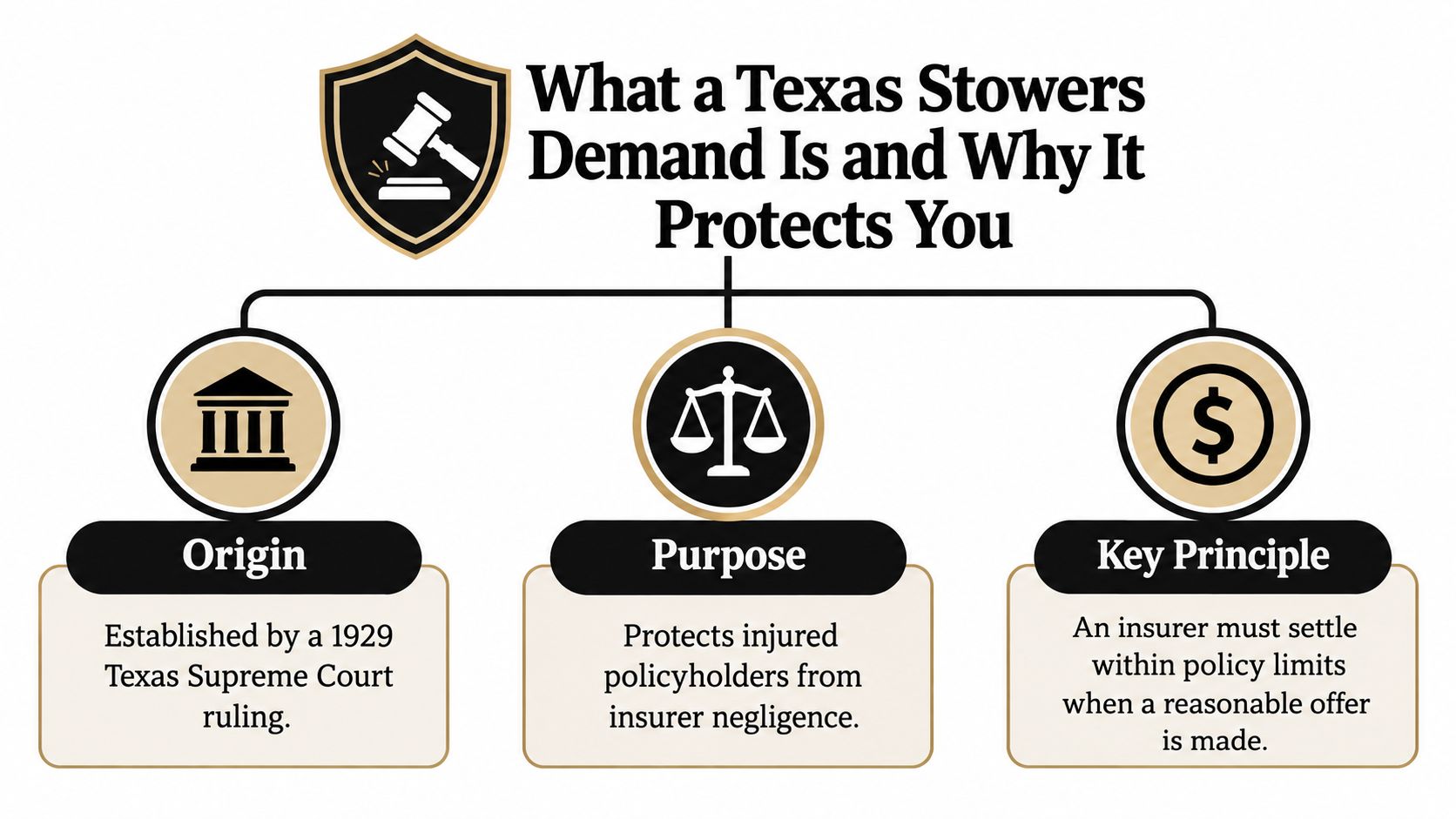
What a Texas Stowers Demand Is and Why It Protects You
The Stowers doctrine is a Texas common-law rule governing an insurer's handling of a third-party liability claim. The injured person sends a settlement offer to the at-fault party's insurer. If the offer is within the policy limits and an ordinarily prudent insurer would accept it, the carrier must evaluate the risk carefully.
The doctrine dates to 1929, when the Texas Supreme Court decided G.A. Stowers Furniture Co. v. American Indemnity Co., 15 S.W.2d 544 (Tex. 1929). The case created a rule that can make an insurer liable for an excess judgment when it unreasonably refuses a proper settlement demand within the policy limits. That historical foundation is summarized in this Texas Stowers doctrine reference.
The three core requirements
A valid Stowers demand generally rests on three central conditions:
The claim must be covered. The underlying injury claim must fall within the liability policy's coverage. If coverage is disputed, the demand may require a more careful legal analysis.
The demand must stay within policy limits. You must offer to resolve the claim for an amount the carrier can pay under the applicable liability limit. A demand for more than that limit may be an ordinary settlement offer rather than a Stowers demand.
An ordinarily prudent insurer would accept it. The carrier must be able to evaluate the likely liability and the potential size of an excess judgment. Strong evidence of fault and serious, documented injuries can make the risk clear.
Many Texas practice materials also emphasize a full and unconditional release of the insured and a reasonable response period. These terms matter because the carrier must be able to accept the offer and protect its policyholder from personal exposure.
A routine settlement letter may invite negotiation. A Stowers demand is more precise. It tells the insurer, in substance, that the claimant will resolve the covered claim within the limits if the insurer accepts the stated terms by the stated deadline.
Practical rule: A Stowers demand protects your leverage only when the insurer can understand exactly what it's being offered and can accept without additional negotiations.
The doctrine also fits within the broader Texas personal injury settlement process, which can lead from a demand to settlement or trial. If an insurer rejects a valid demand, that rejection alone usually doesn't create immediate payment of the excess. A later excess verdict is generally needed before the carrier's exposure is tested.
For readers handling a coverage dispute, an insurer may also send a reservation of rights letter. That document can signal that the carrier is defending while reserving the right to dispute coverage. It shouldn't be treated as interchangeable with a Stowers demand.
How to Prepare a Valid Stowers Demand That Insurers Must Take Seriously
A serious-injury claim may be worth far more than the available insurance. If the evidence already shows clear fault and substantial harm, a carefully prepared Stowers demand can give the carrier a defined chance to protect its insured from personal exposure. It is a time-sensitive settlement tool, not a routine letter asking the insurer to negotiate.
Before mailing it, your attorney should confirm the applicable policy limit, identify every insured, collect evidence supporting fault, and organize medical and financial proof. The package should help the carrier assess whether refusing the offer could leave its policyholder facing a judgment above the policy limits.

Start with the policy and the release
The demand must be within the applicable liability policy limits. Confirm the limit before making the offer, because payment of that amount must fully satisfy the stated settlement terms. Identify the claim, accident, insured, and settlement amount in clear language.
The offer should provide a full and unconditional release of the insured in exchange for payment of the policy limits. Avoid wording that allows you to pursue the insured later for the same liability claim after acceptance. In a wrongful-death matter, the release must also address the people who have legal standing to resolve the claim.
Make acceptance simple
The carrier should be able to accept by tendering the policy limits within the stated response period. Conditions requiring the insurer to obtain separate agreements from medical providers, resolve unrelated disputes, or complete steps outside its control may give the carrier an argument that the offer was not unconditional.
A clear demand can state that the claimant will release the insured from the covered liability claim after timely tender of the applicable policy limits, subject to the written release attached to the letter. The language must fit the facts, policy, parties, and lien situation. Copying a form without legal review can create avoidable problems.
Texas sources describe a reasonable opportunity to respond, with practice guidance commonly discussing about 30 days. The proper period depends on the circumstances. A complicated truck collision involving several parties and extensive records may require more evaluation time than a clear, well-documented crash.
Address liens and supporting proof
Unresolved hospital claims, medical liens, and subrogation interests can weaken a demand if the insurer cannot determine whether acceptance will resolve the insured's exposure. One Texas practice discussion warns that lien and hospital-claim issues should be settled or addressed from the proceeds before the demand becomes effective. Review those concerns in this Texas Stowers doctrine resource.
Your supporting package may include:
- Liability evidence: Provide the crash report, photographs, witness information, video, and other proof showing how the collision occurred.
- Medical documentation: Include records connecting the injuries to the accident and explaining the treatment received.
- Financial losses: Organize wage-loss information and other documented economic harm without claiming more than the evidence supports.
- Future needs: Explain ongoing treatment, limitations, or care needs when qualified medical evidence supports them.
- Release materials: Attach the release or describe precisely what will be provided after timely payment.
Send the demand after liability and damages are developed enough for meaningful review. An early demand may be rejected as premature. An offer that overreaches, contains unclear conditions, or leaves the release incomplete may fail to provide the protection you intended.
Serving Documenting and Enforcing Your Stowers Demand Step by Step
Sending the letter is only one part of the process. You also need a reliable record showing what the insurer received, what information it had, when the response period began, and how the carrier handled the offer.
Choose timing that supports evaluation
The demand should be sent when the evidence is developed enough for an ordinarily prudent insurer to assess liability and potential damages. That may mean waiting until important medical records, bills, wage information, and liability evidence are available. You don't want to send your strongest settlement tool before the carrier has the information needed to make a meaningful decision.
At the same time, delay can create pressure of its own. Texas generally applies a two-year statute of limitations to most personal injury claims, with the period usually beginning on the date of the injury or accident, as explained in this Texas personal injury deadline guide. Your demand strategy must leave enough time to file suit and protect your legal rights.
Build a dependable paper trail
Use a delivery method that provides proof the insurer received the letter. Keep the final demand, attachments, delivery confirmation, policy correspondence, and every response in one organized file. Record calls with dates, participants, and a short summary of what each person said.
A simple tracking table can help:
| Record | What to preserve |
|---|---|
| Demand package | The exact letter, release, and attachments |
| Delivery proof | Confirmation showing when the carrier received it |
| Response deadline | The date and time stated in the offer |
| Communications | Emails, letters, and call notes |
| Claim evaluation | Any written acceptance, rejection, or request for information |
Follow up in writing if the adjuster asks questions or seeks more time. A written response can clarify whether the original offer remains open, whether the deadline changes, and whether the carrier has raised a genuine coverage issue or delayed evaluation.
Understand the possible outcomes
If the insurer accepts, the parties complete the release and payment process. If the carrier rejects the demand or allows the deadline to pass, the underlying case may continue toward litigation.
An insurer's refusal doesn't automatically mean you've won a Stowers case. The practical enforcement benchmark usually includes a later verdict above the policy limits, along with proof that the demand met the required conditions, liability for at least the policy limits was reasonably clear, and the refusal was unreasonable. These requirements are described in this Texas Stowers demand explanation.
That's why you should avoid treating a missed deadline as the end of the claim. Preserve the evidence, continue building the underlying case, and speak with a Texas personal injury lawyer before making decisions about settlement, litigation, or an assignment of claims.
Pursuing Insurance Bad Faith When the Carrier Unreasonably Refuses
People often use Stowers and insurance bad faith as though they mean the same thing. They overlap in everyday conversation, but they can involve different legal theories, parties, and procedures.
A Stowers claim generally concerns an insurer's failure to reasonably settle a third-party liability claim within policy limits. The claim belongs to the insured, although legal rights may later be assigned in connection with an excess judgment. A broader bad-faith dispute may involve the handling of first-party coverage, such as an uninsured or underinsured motorist claim.
Compare the possible paths
| Issue | Stowers | First-party coverage or bad faith |
|---|---|---|
| Main relationship | Liability insurer and its insured | Your own insurer and you |
| Central concern | Refusal to accept a proper within-limits demand | Handling, investigation, coverage, or payment |
| Typical trigger | A qualifying demand followed by an excess judgment | A dispute over your own coverage claim |
| Procedure | Depends on the liability case and later enforcement | May involve coverage litigation, appraisal, or statutory claims |
If you're pursuing UM/UIM benefits after the at-fault driver's coverage is exhausted, don't assume Stowers automatically governs your claim. Texas authority continues to distinguish Stowers from bad-faith claims, and recent Texas decisions have reaffirmed that bad-faith allegations don't automatically create an exception to an appraisal clause or change the coverage procedure. This Texas insurance bad-faith resource provides additional background for evaluating that distinction.
An appraisal dispute can also proceed on its own track. You may need to determine whether the immediate issue is the value of covered damage, whether coverage applies, or whether the carrier mishandled a first-party claim. Those questions require a review of the policy and the insurer's actions, not just the fact that a Stowers demand was rejected.
For a plain-language overview of the broader topic, this insurance bad faith vehicle guide can help you identify common issues to discuss with counsel. Don't make a demand, sign a release, or abandon a UM/UIM claim based only on a general explanation. A Texas personal injury lawyer can separate the liability claim from your first-party coverage rights and protect each path.
Get Trusted Help to Protect Your Recovery and Your Rights
After an accident, preserve photographs, obtain medical care, save insurer communications, and avoid giving a recorded statement or signing a release before you understand what it covers. Don't minimize symptoms, guess about fault, or discuss the claim publicly. Your words and records can affect how the insurer evaluates negligence, damages, and comparative responsibility.
A Houston car accident attorney can assess the crash evidence and insurance coverage. A truck crash lawyer Houston families trust can examine the driver, company, and available liability policies. If a fatal collision has taken someone you love, a wrongful death lawyer in Texas can explain who may bring a claim and how the release must be structured. Serious spinal, brain, burn, or other life-changing injuries may also require a lawyer experienced with catastrophic injury representation, while motorcycle and uninsured-driver cases may call for different evidence and coverage strategies.
The Stowers doctrine can be powerful, but it's not a form letter. Policy limits, fault, medical proof, release language, liens, deadlines, and the insurer's conduct all matter. Acting early helps you protect evidence and avoid losing important rights under Texas's two-year personal injury deadline.
You can schedule a free consultation with the Law Office of Bryan Fagan, PLLC, which represents injured people and families across Houston, Dallas–Fort Worth, Austin, San Antonio, and surrounding Texas communities. The firm handles personal injury matters on a contingency-fee basis, meaning you don't pay attorney fees unless the firm wins, subject to the terms of your agreement.
The Law Office of Bryan Fagan, PLLC can review your crash, insurance coverage, potential Stowers demand, liens, and available UM/UIM options during a free consultation. Contact the firm promptly so your evidence, deadlines, and recovery options receive careful attention.


