 Skip to content
A serious accident can change your life in seconds, but you don't have to face it alone. You may have stepped into an elevator at an apartment building, office tower, hospital, hotel, or parking garage and suffered a sudden drop, a misleveling fall, a door entrapment, or a frightening confinement. Now you may be dealing with pain, medical bills, missed work, and unanswered questions about who should be held responsible.
An elevator accident lawyer in Texas can help identify the correct defendant, preserve records, and pursue compensation under Texas law. Elevator cases aren't always ordinary premises-liability claims. The owner, maintenance contractor, manufacturer, property manager, employer, or more than one of them may have responsibility.
Elevator and escalator incidents are a serious public-safety concern. A CDC-cited CPWR analysis reported that these incidents killed 31 people and seriously injured about 17,000 people each year, based on federal data covering the periods identified in the analysis. The CPWR elevator and escalator injury analysis also reported that elevators caused nearly 90% of deaths and 60% of serious injuries in the underlying data. Your first priorities should be medical care, written documentation, and protecting evidence.
Right After an Elevator Accident in Texas
If you're hurt, don't assume minor pain means minor harm. Adrenaline can mask symptoms, and some injuries become more obvious after the immediate shock wears off. Go to an emergency room or urgent-care facility, depending on the severity of your condition, and describe every symptom, including pain, numbness, dizziness, limited movement, anxiety, or trouble sleeping.
Medical records create an important foundation for a Texas injury claim. Delayed treatment gives an insurance adjuster an argument that the accident didn't cause your condition or that your injury isn't as serious as you report. Follow the doctor's instructions, attend recommended appointments, and keep records of prescriptions, referrals, restrictions, and follow-up care.
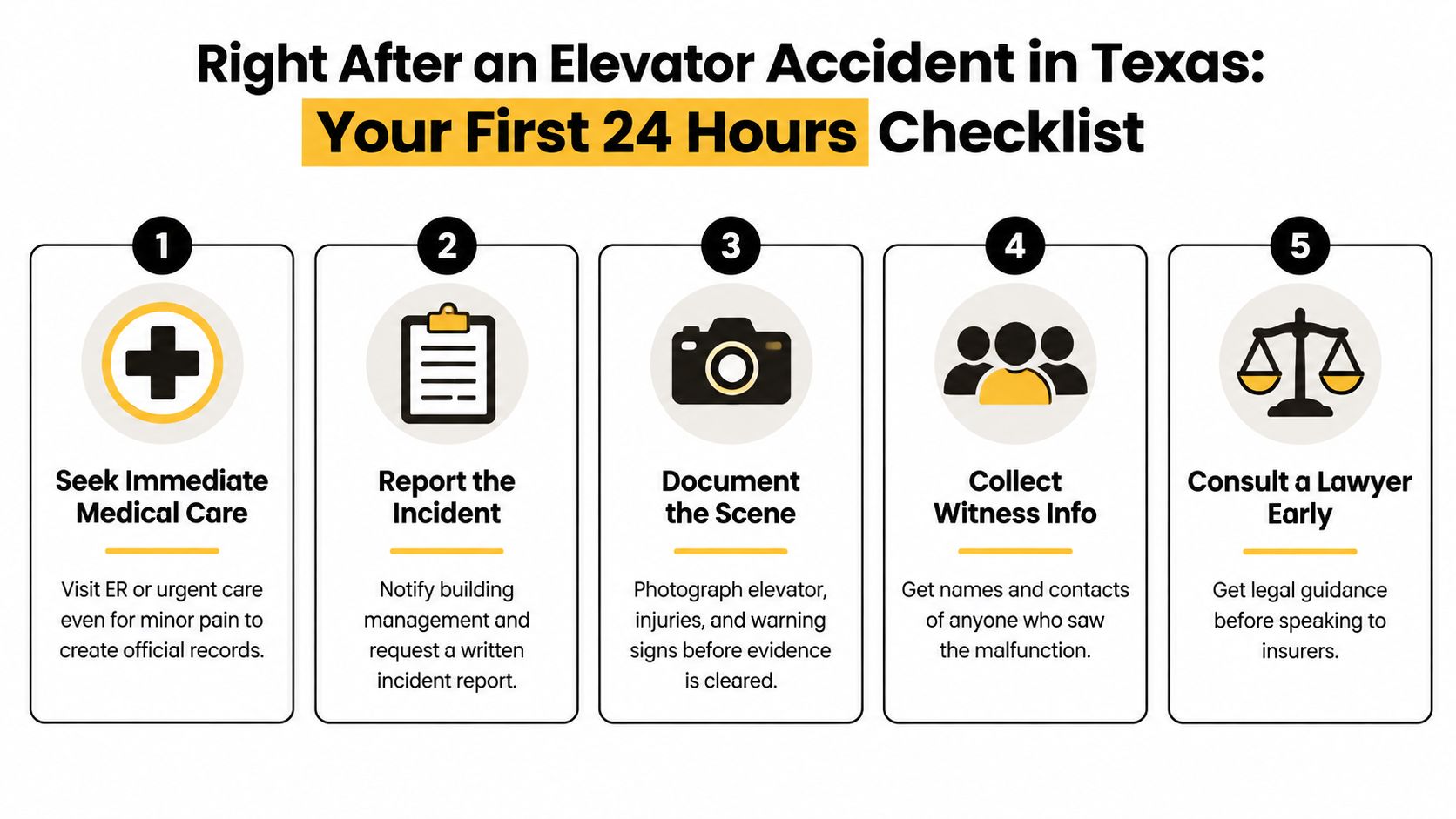
Take these steps before leaving
Call for emergency help when needed. Call 911 when you have severe pain, bleeding, loss of consciousness, suspected spinal injury, crushing injuries, or another emergency. Building security can assist with immediate reporting, but security personnel aren't a substitute for medical evaluation.
Report the incident in writing. Notify the building owner, manager, landlord, or security desk before you leave if you can do so safely. Ask for a copy of the internal incident report or log. If staff won't provide one, write down who received your report, when you made it, and what you said.
Photograph the scene. Take pictures of the elevator cab, doors, floor alignment, buttons, warning signs, lighting, visible damage, and the surrounding area. Photograph your injuries as they develop, and preserve torn clothing, damaged shoes, or broken personal property.
Collect witness information. Ask passengers, employees, security personnel, and other bystanders for their names and phone numbers. A witness may remember a sudden movement, unusual noise, door problem, warning, or previous complaint that you didn't notice.
Be careful with insurers. The elevator company, property owner, or another responsible party may have an insurer contact you quickly. You aren't required to give a recorded statement before getting legal advice. Don't guess about facts, minimize your pain, or sign a release without understanding what rights you're giving up.
Practical rule: Get medical care first, document the scene second, and speak with a lawyer before an insurer turns an early conversation into evidence against you.
Building the Evidence Before It Disappears
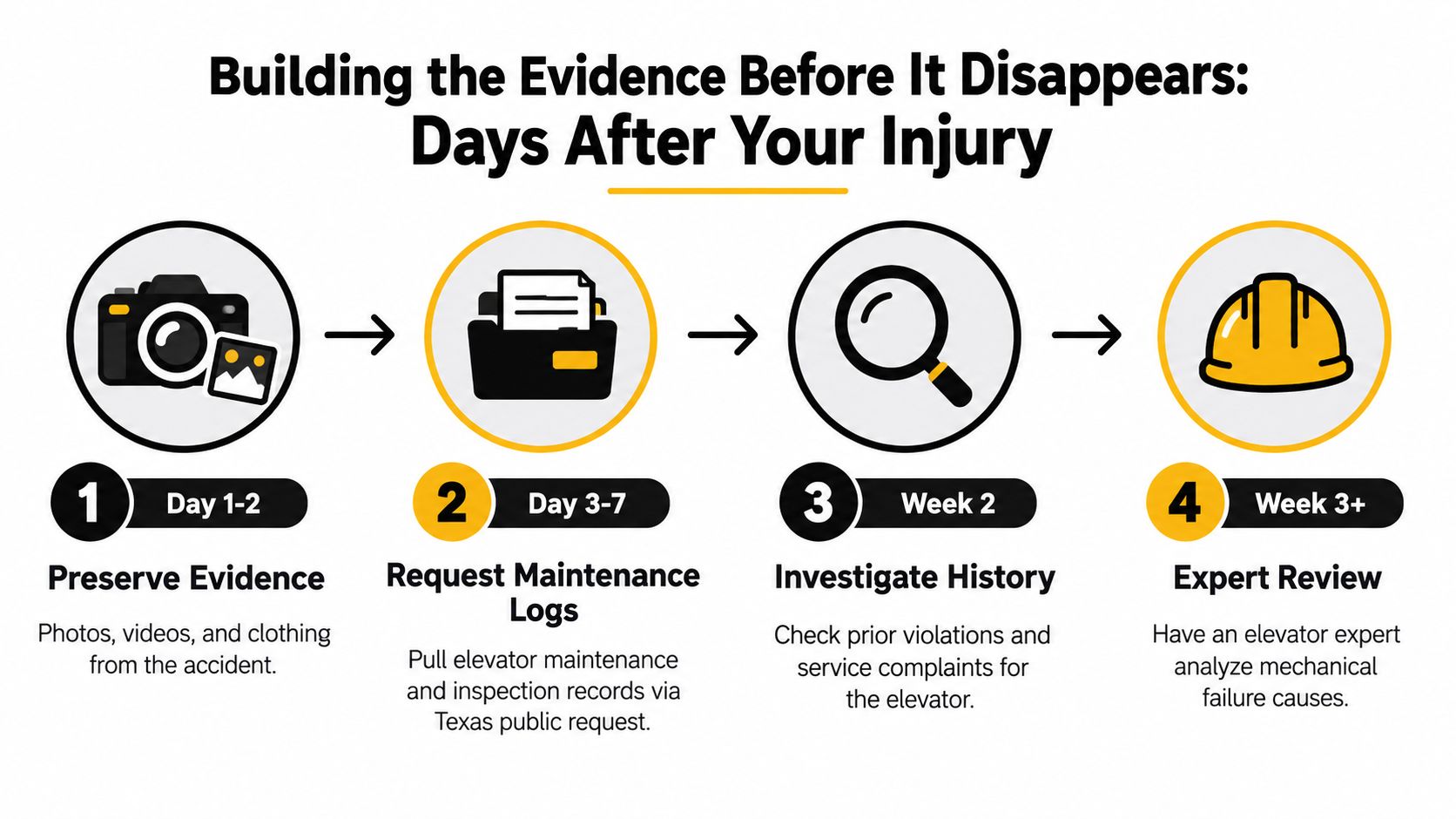
The physical elevator may be repaired, returned to service, or altered before anyone preserves the condition you encountered. That makes early investigation essential. A lawyer should send a preservation letter to the property owner, management company, maintenance contractor, manufacturer, and any other possible custodian of records.
Start with the records most likely to explain what happened:
- Maintenance logs and service tickets: These can show scheduled work, missed maintenance, recurring complaints, incomplete repairs, and whether technicians identified the same problem before your accident.
- Inspection and compliance records: Texas Department of Licensing and Regulation materials may help establish inspection history, reported conditions, and responsibility under the state elevator-safety framework.
- Controller and event-recorder data: Fault codes and controller information may reveal the sequence of a malfunction. This information can be overwritten or lost when equipment is reset, repaired, or placed back into operation.
- Surveillance footage: Request video from the elevator, lobby, hallway, security desk, and loading areas immediately. Building systems often overwrite footage on routine cycles, so a written demand should identify the date, approximate time, cameras, and incident.
- Incident reports and communications: Preserve emails, text messages, work orders, 911 information, photographs, and messages exchanged with management or insurers.
Build the damages file too
Evidence isn't limited to the elevator. Keep hospital records, bills, treatment plans, work restrictions, wage statements, tax records, and notes about missed shifts or lost opportunities. Save receipts for medical equipment, transportation, prescriptions, and other accident-related costs.
Updated photographs can show swelling, bruising, scarring, mobility limits, and changes over time. In a serious case, an elevator engineer, biomechanical expert, medical specialist, or vocational professional may help explain the failure mechanism, the forces involved, and the effect on your ability to work.
A public-record request may help locate government-held inspection material. A subpoena may be necessary for private maintenance records or information the owner refuses to provide. For a broader discussion of documentation, see what evidence is needed for an injury claim in Texas. If the elevator was owned or operated by a government entity, Suing a Government Entity: The Texas Tort Claims Act addresses the shorter notice deadlines that can apply to injury claims against the government.
Who May Be Liable for an Elevator Injury
The right question isn't, “Can I sue the elevator company?” The right question is, who controlled the safety decision that could have prevented your injury? A careful investigation maps the equipment, contracts, complaints, inspection duties, repair history, and work relationship before assigning blame.
A building owner may face a premises-liability claim for failing to inspect, maintain, warn about, or remove a dangerous elevator from service. A management company may have received complaints or controlled daily operations. A maintenance contractor may be responsible for a skipped inspection, careless repair, failure to respond to a service call, or inaccurate service record.
The manufacturer can become a defendant when a defective brake, cable, door sensor, controller, or other component caused the event. That theory may involve product liability rather than ordinary premises negligence. A construction contractor may also matter if improper installation, unsafe construction use, or defective work contributed to the accident.
Here is a practical starting point for identifying the potential defendants:
| Potential Defendants in a Texas Elevator Injury Case | Legal Theory | Typical Texas Example |
|---|---|---|
| Building owner or landlord | Premises negligence | Failing to address repeated door problems or keep the elevator out of service |
| Property manager | Negligence or agency liability | Receiving a complaint and failing to arrange a safe response |
| Maintenance contractor | Negligent maintenance or repair | Skipping required service, making an unsafe repair, or failing to report a defect |
| Manufacturer or component maker | Product liability | A defective brake, sensor, cable, or controller causes the failure |
| Employer | Workers' compensation and possible third-party issues | An employee is injured while working, with employer recovery limited by applicable workers' compensation rules |
| General contractor | Construction negligence | Allowing an improperly installed or unsafe elevator to be used |
Texas-specific elevator rules matter because they help identify inspection, reporting, licensing, and maintenance responsibilities. For general safety background, this safety of elevators overview provides useful context about common elevator hazards and safety systems. Recent Texas Supreme Court litigation involving an elevator-maintenance contractor also shows why the contractor's role deserves independent analysis, rather than assuming the property owner is the only possible defendant. The Texas Supreme Court opinion is relevant to that defendant-and-remedy question.
If you were injured at work, workers' compensation may limit a claim against your employer, but that doesn't automatically eliminate possible claims against an owner, maintenance company, manufacturer, or other third party. A preservation, or spoliation, letter should go to every likely defendant so each party understands that maintenance logs, inspection records, video, controller data, contracts, and communications must be retained.
Texas Filing Deadlines and Shared Fault Rules
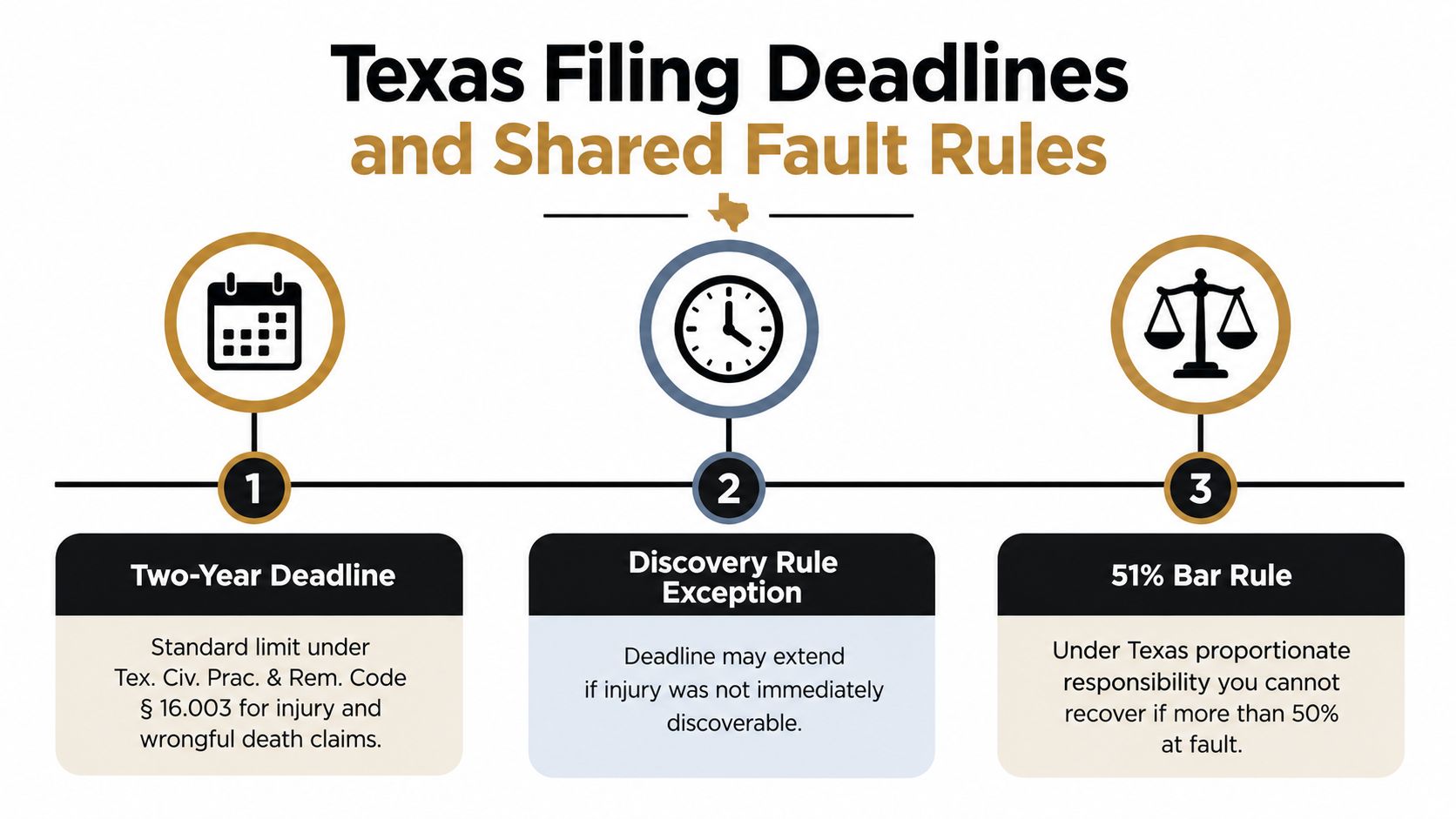
An elevator injury can leave you focused on treatment while a filing deadline continues to run. Texas generally gives you two years from the date of a personal injury to file a claim. Texas personal injury deadline guidance explains why you should investigate your rights before treatment ends. Waiting to learn the full value of your losses can put the claim at risk.
Wrongful-death timing follows a different starting point. The period generally runs from the date of death, not the accident date. Texas wrongful-death limitations guidance explains why families should seek legal advice promptly while preserving maintenance records, inspection history, funeral expenses, financial-support evidence, and loss-of-companionship claims.
Texas elevator owners must report each equipment accident to the Texas Department of Licensing and Regulation within 24 hours, using the department-approved incident form and the fastest available method. TDLR's elevator and escalator reporting notice describes that requirement. The report may identify the owner, insurer, equipment, and initial accident description. It will not necessarily contain the evidence needed to prove liability.
How shared responsibility affects recovery
Texas uses modified comparative responsibility. Your compensation decreases by your assigned percentage of fault, and recovery is barred if you are more than 50% responsible. This Texas comparative negligence explanation provides guidance on how shared fault affects recovery. Texas comparative-negligence guidance illustrates the same allocation method: a victim found 30% at fault in a $100,000 case would recover $70,000.
A defense lawyer may claim that you ignored a warning, leaned into closing doors, overloaded the elevator, or used it unsafely. Those allegations do not establish a percentage by themselves. The evidence must show what you did, what the owner or maintenance contractor owed, and how each act contributed to the injury.
Contract terms can reveal who controlled inspections, repairs, emergency response, and records. Facility managers can review these SLA tips for elevator contracts for context. For an injured passenger, that information can help identify the correct defendant before records or responsibility become disputed.
Damages You May Recover After an Elevator Injury
Your damages should reflect the full effect of the accident, not only the first hospital bill. A strong claim connects each loss to medical records, employment evidence, witness accounts, and testimony about how your daily life changed.
Economic damages may include emergency treatment, surgery, hospitalization, rehabilitation, medication, medical equipment, future care, lost wages, reduced earning capacity, vocational retraining, and reasonable out-of-pocket expenses. Keep receipts for transportation, parking, home assistance, and other costs that exist because your injury changed what you can do.
Non-economic damages address harms that don't come with a simple invoice. They may include physical pain, mental anguish, disfigurement, disability, loss of enjoyment of life, and loss of consortium for a spouse. A person who remains physically intact may still have a serious claim for trauma, anxiety, or confinement-related psychological harm when medical evidence supports it.
| Recoverable Damages in a Texas Elevator Accident Case | Common Examples | Value Drivers |
|---|---|---|
| Economic losses | Medical care, prescriptions, lost wages, equipment, transportation | Treatment needs, work restrictions, future earning effect, documentation |
| Non-economic losses | Pain, mental anguish, disfigurement, disability, loss of enjoyment | Severity, duration, permanence, daily-life changes, medical opinions |
| Consortium losses | Effects on a spouse's relationship and shared life | Evidence of relationship impact and continuing limitations |
| Wrongful-death losses | Funeral costs, lost support, services, companionship, mental anguish | Financial records, family relationship, expected support, proof of loss |
Consider two different injuries. A back injury requiring fusion surgery may involve immediate care, lengthy rehabilitation, work restrictions, and a risk of future limitations. A catastrophic brain injury requiring continuous care may involve long-term supervision, life-care planning, home changes, lost earning capacity, and profound effects on the family. The correct valuation depends on evidence, not a generic settlement formula.
For a broader explanation of What Damages Can You Recover in a Texas Injury Case?, review the available categories of compensation for Texas injury victims. In a fatal elevator incident, family members should preserve funeral and burial records, proof of financial support, evidence of household services, and documentation of the relationship and emotional loss.
Insurer Tactics and How a Lawyer Pushes Back
Insurance companies often contact injured people before the full medical picture is known. A quick check may sound helpful when bills are arriving, but accepting it can release claims for future surgery, rehabilitation, lost income, and lasting impairment. Don't settle before you understand the injury and the evidence.
A recorded statement creates another risk. Adjusters may ask questions that seem routine, then compare your early answers with later medical records or witness accounts. You should be truthful, but you don't have to speculate, minimize symptoms, or manage a recorded interview alone.
Common pressure points
- Early low offers: An insurer may focus on bills already incurred while ignoring future treatment and work loss. A lawyer waits for meaningful medical information and builds a complete damages package.
- Blaming the passenger: The carrier may claim you ignored a warning, misused the elevator, or failed to watch the doors. Maintenance records, photographs, witness accounts, and expert analysis can test that claim.
- Broad medical authorizations: An authorization may give an insurer access to years of unrelated medical history. Release only appropriate records after receiving legal advice.
- Social-media searching: Posts, photographs, and comments can be taken out of context. Don't discuss the accident, injuries, settlement, or physical activity publicly while a claim is pending.
- Delay: Repeated requests for information can pressure you to accept less. Counsel can track deadlines, control communications, and file suit when negotiation no longer protects your interests.
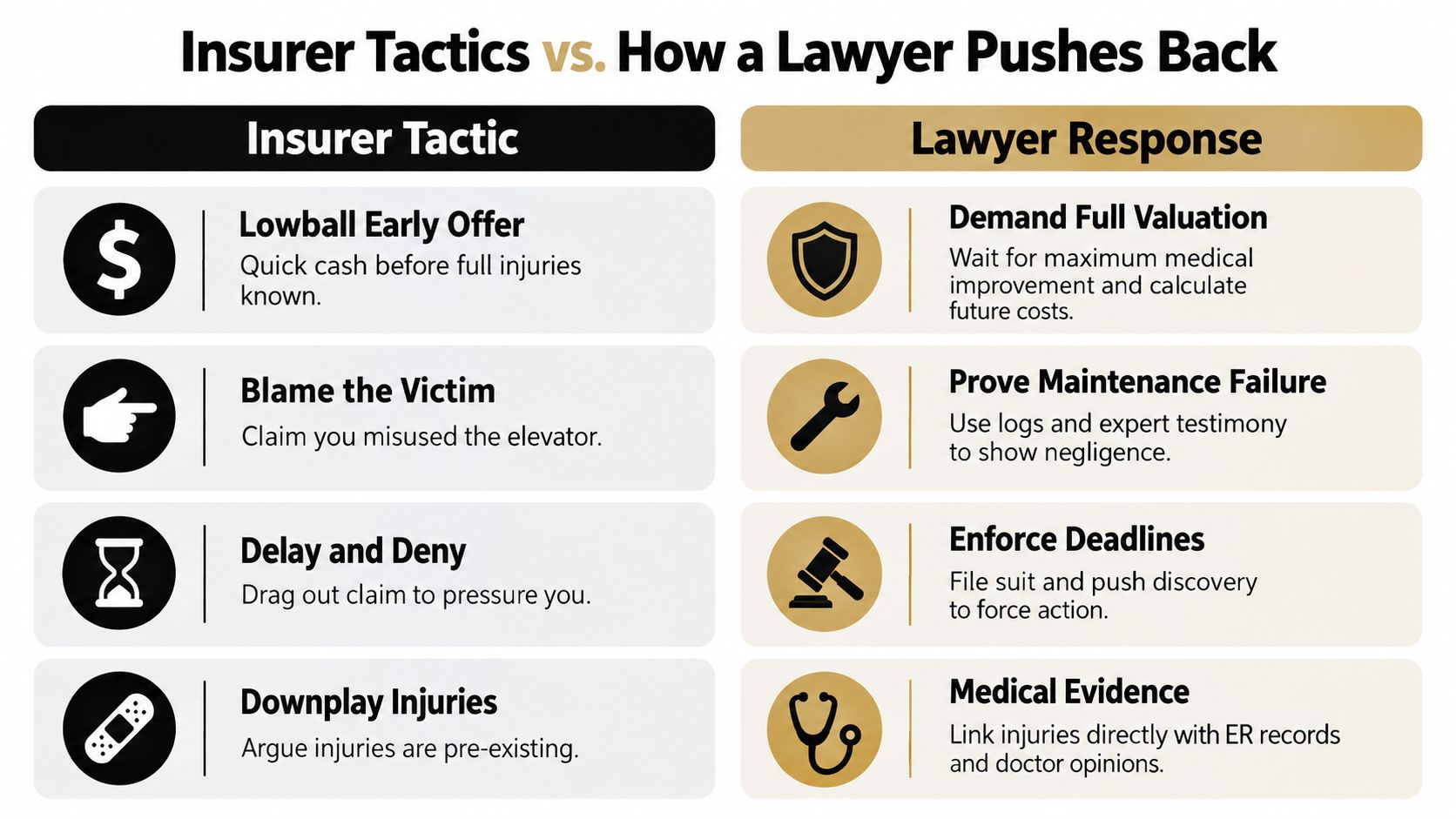
A lawyer's response should be organized, not theatrical. The legal team can send a litigation hold for maintenance logs and surveillance footage, retain elevator-engineering or biomechanical experts, obtain medical opinions, document work losses, and negotiate from evidence. Preparation often gives an insurer a clear reason to value the claim seriously.
For disputes involving an insurer's improper handling of a claim, Texas bad-faith insurance guidance may provide useful background. Your elevator claim itself still depends on proving the accident, the responsible party, causation, and damages.
The following video offers general context about the role of legal counsel in injury claims:
When to Call a Texas Elevator Accident Lawyer
Call a Texas elevator accident lawyer as soon as you're medically stable, preferably during the first week after the incident. Early counsel can send preservation letters before repairs, routine video deletion, equipment resets, or internal investigations change the evidence. The lawyer can also identify whether the owner, maintenance contractor, manufacturer, employer, or another party controlled the relevant safety duty.
You should call promptly if:
- You needed emergency care or missed work. Serious medical treatment and income loss can make the claim more complex.
- You may need surgery or long-term care. Future damages require careful medical and vocational proof.
- A loved one died. Wrongful-death deadlines and evidence preservation require immediate attention.
- A company or adjuster contacted you. Don't give a recorded statement or accept a release before receiving advice.
- You were injured at work. Workers' compensation and third-party claims can involve different rules and defendants.
- The elevator was repaired or returned to service. Physical evidence may be harder to inspect later.
A firm should investigate the scene, request the TDLR incident material, preserve video and equipment data, interview witnesses, review contracts and service records, and explain the available remedies in plain English. You don't need to know the technical cause before making the call. Your job is to recover. Your lawyer's job is to find out what happened and build the case.
The Law Office of Bryan Fagan, PLLC handles Texas personal injury matters, including elevator injuries, car accident claims, truck collisions, catastrophic injuries, and wrongful-death cases. If your broader search includes a Houston car accident attorney, a truck crash lawyer in Houston, or a wrongful-death lawyer in Texas, the same firm can discuss whether your facts fit one of those related claims.
The Law Office of Bryan Fagan, PLLC can investigate your elevator injury, identify every potentially responsible party, preserve maintenance and video evidence, and pursue compensation for medical care, lost income, pain, and future needs. Schedule a free consultation by visiting Law Office of Bryan Fagan, PLLC, and take the next step with a Texas team that understands how to protect your claim while you focus on recovery.


