A serious car accident can change your life in seconds—but you don’t have to face it alone. When the driver who hit you has insurance, but not enough to cover the mountain of medical bills and lost wages you’re facing, the future can feel uncertain.
That’s where Underinsured Motorist (UIM) coverage comes in. It’s a crucial part of your own auto policy that acts as a financial backstop when you need it most, and understanding your rights is the first step toward recovery.
Your Financial Safety Net After a Texas Car Accident

It’s a shocking reality for many Texas families: the person who caused their accident only carries the state-minimum liability insurance. Often, that’s not even enough to cover the cost of a single trip to the emergency room, let alone long-term care for a catastrophic injury.
This is exactly why your own UIM coverage can become the most important financial protection you have.
What Is Underinsured Motorist Coverage?
Think of UIM coverage as a safety net you wisely put in place for yourself and your family. It isn’t insurance for the other driver; it’s protection for you. When the at-fault driver's policy is maxed out, your UIM coverage steps in to help pay for the rest of your losses.
This coverage is specifically designed to bridge the gap between your total damages and the other driver's inadequate policy limits. In Texas, insurance companies are required by law to offer you this coverage, and if you choose not to have it, you must reject it in writing.
Your UIM benefits can help pay for a wide range of accident-related costs, including:
- Medical Expenses: This covers everything from your initial hospital stay and surgeries to future physical therapy and rehabilitation.
- Lost Wages: If your injuries keep you out of work, UIM can help replace that lost income.
- Pain and Suffering: This provides compensation for the physical pain and emotional trauma you’ve endured because of the crash.
- Disability or Disfigurement: If you suffer permanent impairments or scarring, this helps cover those life-altering damages.
Understanding the Difference Between UIM and UM Coverage
It’s easy to get underinsured and uninsured motorist coverage confused. While they are often sold together as a package, they apply in very different scenarios.
Underinsured Motorist (UIM) coverage applies when the at-fault driver has insurance, but their policy limits aren't high enough to cover all your damages.
Uninsured Motorist (UM) coverage protects you when the at-fault driver has no insurance at all or when you’re the victim of a hit-and-run and the driver is never found.
Both are absolutely vital for protecting yourself on Texas roads. If you’re not sure about the details of UM policies, you can learn more about how Uninsured Motorist coverage works in Texas in our detailed guide. Protecting your family starts with understanding all the tools available right in your own insurance policy.
The Reality of Driving on Texas Roads
Sharing the road in Texas, whether you're navigating the sprawling I-10 in Houston or the packed I-35 corridor through Austin, means you're trusting millions of other drivers to be responsible. But when their negligence causes a crash, the consequences can be devastating.
You might assume the other driver has enough insurance to cover the damage, but that's a dangerous gamble. The hard truth is that many Texas drivers carry only the bare minimum coverage required by law—a reality that makes your own Underinsured Motorist (UIM) coverage one of the most critical financial safety nets you can have.
Why State-Minimum Insurance Just Doesn't Cut It
Texas requires drivers to carry a minimum amount of liability insurance, often called a "30/60/25" policy. It sounds official, but when you break it down, it's frighteningly inadequate for a serious injury.
Here’s what those numbers actually mean for you after a wreck:
- $30,000 for bodily injury for one person.
- $60,000 for total bodily injuries per accident if more than one person is hurt.
- $25,000 for property damage.
At first glance, $30,000 might seem like a decent amount. But the real-world costs of a moderate to serious injury can burn through that limit in a flash. A single ambulance ride, an emergency room visit, an MRI, and one essential surgery can easily blow past the at-fault driver's entire policy.
For example, after a Houston freeway crash, your medical bills could quickly surpass the other driver’s coverage before you've even started physical therapy. That’s where their responsibility ends and your financial nightmare begins—unless you have a backup plan.
To put this gap in perspective, look at how quickly minimum coverage gets exhausted by real-world costs.
Texas Minimum Liability vs Real Accident Costs
The disconnect between Texas's minimum insurance requirements and the actual costs of a moderate accident is staggering. This table shows just how little protection a "30/60/25" policy offers when you're facing real medical bills and property damage.
| Expense Type | Typical Cost After a Moderate Accident | At-Fault Driver's Minimum Coverage (Per Person) |
|---|---|---|
| Medical Expenses | $50,000+ | $30,000 |
| (ER, Surgery, Physical Therapy) | ||
| Lost Wages | $15,000+ | Not directly covered by liability, paid from the $30,000 limit |
| (3 months off work) | ||
| Vehicle Repair/Replacement | $30,000+ | $25,000 |
| (for a standard new vehicle) | ||
| Total Costs | $95,000+ | $55,000 (Max total payout) |
As you can see, a single accident can leave you with tens of thousands of dollars in uncovered expenses, even when the other driver is 100% at fault due to their negligence. This is exactly where UIM coverage steps in to protect you.
The Alarming Number of Underinsured Drivers
This isn't just a hypothetical problem. The risk is real and widespread. An alarming number of drivers in the Lone Star State are underinsured for even a moderate collision, often sticking to that bare-minimum $30,000 liability limit.
Data from the Insurance Research Council showed underinsured driver rates hit 14.7% in 2023. That means nearly one in every seven drivers you pass might not have enough insurance to cover your injuries if they cause a crash. You can read more about the prevalence of underinsured motorists in Texas to see the full scope of the issue.
This gap between minimum coverage and actual costs is precisely why UIM coverage exists. It's your personal safety net, designed to shield you from the financial fallout caused by someone else's irresponsibility.
A Real-World Example of a Coverage Gap
Let’s look at a common scenario. You’re stopped at a red light in a Dallas intersection when a distracted driver slams into you from behind. The impact results in a broken leg and a severe concussion, forcing you to miss several months of work.
- Your Medical Bills: $55,000
- Your Lost Wages: $20,000
- Total Initial Losses: $75,000
The at-fault driver has the Texas minimum: $30,000 in liability coverage. Their insurance company pays out the full policy limit, which is a start, but you’re still left with a $45,000 shortfall. And that’s before accounting for the pain and suffering you've been forced to endure.
Without UIM coverage, that $45,000 bill lands squarely on your shoulders. This is how one accident, caused by someone else, can lead to overwhelming debt. Having a skilled Houston car accident attorney is critical for navigating these complex claims and making sure you can access the full benefits of the UIM coverage you've been paying for.
How a UIM Claim Works in Texas Step by Step
A serious accident can change your life in an instant. But when you find out the other driver’s insurance won’t come close to covering your medical bills, it feels like getting hit all over again. This is the exact moment your own underinsured motorist (UIM) coverage becomes the most important asset you have.
Navigating a UIM claim can feel like a maze, but it’s a process you can get through with the right guidance. It’s a journey that only begins after you’ve collected every last penny from the at-fault driver’s policy.
The First Step: Securing the At-Fault Driver's Policy Limit
Before your own UIM benefits can even enter the picture, you have to get the maximum possible payout from the other driver's liability insurance. Think of it as a prerequisite. Your insurance company demands this as proof that the other driver was, in fact, underinsured and that you need to tap into your own coverage.
Let’s walk through a real-world example.
Imagine you're hit in a truck crash on a Dallas freeway. It wasn't your fault, and your medical bills are piling up, quickly hitting $100,000. The driver who hit you only carries the Texas state-minimum $30,000 liability policy.
Our first job as your legal team is to file a claim against their insurance and secure that full $30,000. Once we have that settlement check in hand, we can finally turn to your insurance policy to go after the remaining $70,000 you're owed through your UIM coverage.
This first phase involves a lot of legwork—gathering police reports, stacking up medical records, and proving your lost wages to build an undeniable case against the at-fault driver. A skilled truck crash lawyer in Houston knows exactly how to prove fault and maximize this initial recovery.
This visual shows how quickly the costs from a Texas car wreck can spiral, leaving a financial gap that UIM coverage is specifically designed to fill.
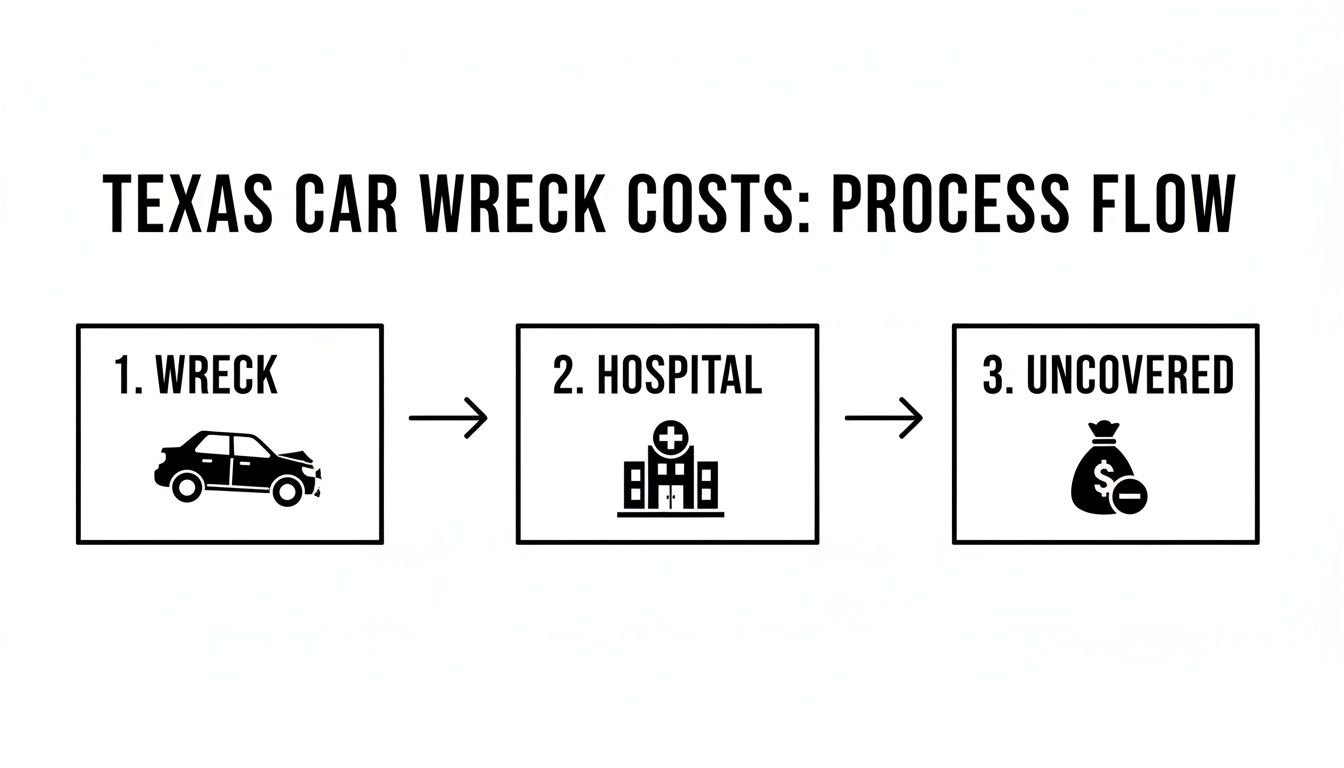
As the flowchart shows, the initial crash is just the beginning. The uncovered expenses that follow are why having a solid UIM safety net is absolutely critical for Texas drivers.
Understanding the Texas UIM Offset Rule
Once we pivot to your UIM claim, you need to know about a tricky, Texas-specific rule called the offset provision. This is a rule that blindsides a lot of people and perfectly illustrates why having an experienced Texas injury lawyer in your corner is so important.
In Texas, your insurance company gets to "offset"—or subtract—the amount you got from the at-fault driver's insurance from your total UIM coverage limit.
Let’s jump back to our Dallas freeway crash example to see how this works:
- Your Total Damages: $100,000
- At-Fault Driver's Payout: $30,000
- Your UIM Policy Limit: $100,000
You might think your UIM policy would simply pay the $70,000 difference. But because of the offset rule, your insurer first subtracts the $30,000 you already received from your $100,000 UIM policy limit. This move reduces your available UIM coverage down to $70,000. In this case, you’re still made whole.
But what if your UIM policy limit was only $50,000? The $30,000 offset would slash your available coverage to just $20,000, leaving you with a massive financial shortfall. This is exactly why we always tell our clients to carry UIM coverage with limits equal to or, even better, greater than their own liability coverage.
Navigating the UIM Claim with Your Insurer
After settling with the other driver, the next move is to formally present the UIM claim to your own insurance company. This isn't just a phone call; it's submitting a detailed demand package that documents every dollar of your remaining damages, from future medical needs to your pain and suffering.
Here’s the hard truth: even though it’s your own insurance company, they don't always make it easy. Their goal is the same as any other insurer—to pay out as little as possible. As you learn how this works, it’s helpful to read up on strategies for maximizing your auto accident settlement.
An experienced attorney takes over these negotiations for you. We fight to get you the full and fair compensation you're entitled to under the policy you paid for. We shield you from lowball offers and make sure your insurer listens.
Practical Steps for Filing Your UIM Claim
A serious accident can flip your world upside down in a heartbeat. But when you're hit by an underinsured driver, you don't have to face the aftermath alone. The practical steps you take in the hours, days, and weeks that follow are absolutely critical. Knowing what to do after an accident builds a strong foundation for your claim and helps protect your family’s future.
Your health is always priority number one. After any crash, even a fender bender, you need to get a medical evaluation. Some of the most severe injuries—like internal bleeding or traumatic brain injuries—don't show symptoms immediately. Seeing a doctor creates an official record that ties your injuries directly to the accident, which is powerful evidence you’ll need later.
Following your doctor's treatment plan is just as important. If you start skipping physical therapy or follow-up appointments, you’re handing the insurance adjuster an excuse to argue your injuries aren't as bad as you claim.
Gather and Preserve Critical Evidence
While you focus on getting better, it’s crucial to preserve evidence from the crash. If you're able to, or if you can ask someone to help, start gathering information right at the scene. The strength of your claim often comes down to the quality of the evidence you collect from the very beginning.
Here are the essentials to lock down:
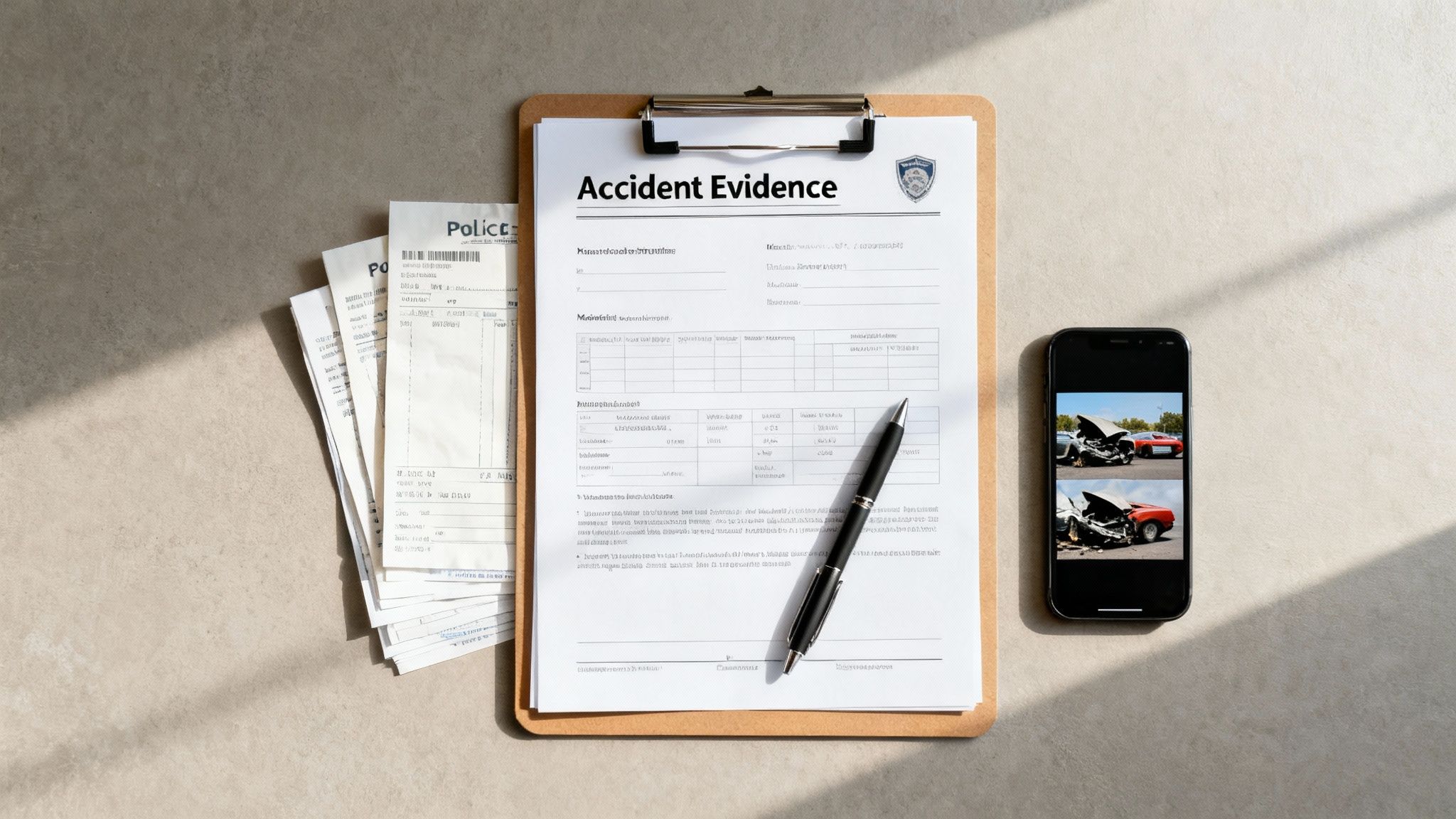
- Police Report: Always call 911. The responding officer will create an official crash report detailing their initial thoughts on what happened and who was at fault. Get a copy as soon as it’s available.
- Photos and Videos: Use your phone to document everything. Snap pictures of the damage to both cars, where they ended up, any skid marks, nearby traffic signals, and your visible injuries.
- Witness Information: Did anyone see the crash? Get their name and phone number. An independent witness can be incredibly persuasive when it comes to proving the other driver’s negligence.
Notifying the Insurance Companies Correctly
You'll need to report the accident to two insurers: the at-fault driver's and your own. When you call your insurance company, stick to the basic facts—your name, the date and location of the crash, and the other driver's info. That's it.
Crucial Advice: Do not give a recorded statement to any insurance adjuster—not even your own—before you’ve spoken with a personal injury lawyer. Adjusters are trained to ask leading questions designed to get you to downplay your injuries or accidentally admit some fault.
How Long Do You Have to File a Claim in Texas?
Keep a detailed file of every single document related to your accident and injuries. This means medical bills, pharmacy receipts, car repair estimates, and even a log of your mileage driving to doctor’s appointments. You should also track your missed days from work and collect pay stubs to prove your lost income.
It's also incredibly important to know about the statute of limitations. In Texas, you generally have just two years from the date of the accident to file a personal injury lawsuit. That might sound like a long time, but building a solid case takes time. If you wait too long, you could lose your right to recover anything at all. When it's time to formally make your UIM claim, a strong demand letter is key. You can find help structuring this critical document with a legal demand letter template.
For a more detailed walkthrough, check out our guide on how to file a car accident claim in Texas. An experienced Houston car accident attorney can manage all these moving parts for you, making sure every deadline is hit and your rights are protected from day one.
Why Your Own Insurer Can Become an Adversary
You’ve paid your insurance premiums faithfully for years, maybe even decades. You trusted that your provider would have your back if something terrible happened on the road. It’s a completely normal and understandable way to think.
But when you file an underinsured motorist (UIM) claim, the entire dynamic flips on its head. The shift can be jarring and feel deeply unfair.
Suddenly, the same company you’ve been paying to protect you is now sitting on the other side of the negotiating table. The moment your claim moves from the at-fault driver's policy to your own UIM coverage, your insurer's financial interests become directly opposed to yours. This isn't personal; it's just business. Their goal is to protect their bottom line, which means minimizing every single payout—including the one to you.
The Conflict of Interest in a UIM Claim
The hard reality is that your insurance company, in the context of a UIM claim, essentially steps into the shoes of the underinsured driver who hit you. They will use the same playbook as any other insurer to devalue your claim, question the severity of your injuries, and drag out the payment process.
They might argue that your injuries weren't really from the crash or that your medical treatments were excessive and unnecessary. This is the point where many accident victims, already exhausted from their physical and emotional recovery, feel pressured into accepting a quick, lowball settlement that doesn't come close to covering their actual losses.
It's a painful irony: the very policy you bought for peace of mind becomes yet another battle you have to fight. You are no longer just their loyal policyholder; you are a claimant seeking money that the company would much rather keep.
How a Lawyer Levels the Playing Field
This adversarial relationship is exactly why hiring an experienced Texas personal injury lawyer isn't a luxury—it’s an absolute necessity. Your attorney’s one and only job is to protect your interests and fight for every dollar of compensation you are rightfully owed under your policy.
An attorney brings several critical advantages to this fight:
- Accurate Claim Valuation: We calculate the full, true value of your claim, which goes far beyond just your current medical bills. We factor in future surgeries, ongoing physical therapy, lost earning capacity, and the profound, life-altering impact of your pain and suffering.
- Expert Negotiation: We handle all the calls, emails, and back-and-forth with the insurance adjuster. We know their tactics inside and out, and we know how to counter them with hard evidence and a deep understanding of Texas insurance law.
- Legal Leverage: Your insurer knows that an attorney is fully prepared to file a lawsuit if they refuse to make a fair settlement offer. This credible threat of litigation is often the single most powerful tool for bringing them to the table in good faith.
The risks of trying to handle this alone are simply too high. With millions of underinsured or uninsured drivers on Texas roads, your UIM coverage is a vital safety net. Statistics show that about 1 in 7 Texas drivers—roughly 14.5%—are cruising without any insurance at all. This makes having a skilled advocate to enforce your UIM rights more important than ever.
Protecting You from Bad Faith Tactics
In some cases, an insurer’s behavior can cross the line from tough negotiation to outright illegal conduct. This is known as acting in "bad faith."
An insurer might be acting in bad faith if they:
- Unreasonably deny a valid claim without conducting a proper investigation.
- Intentionally delay payment for months or even years without a good reason.
- Misrepresent the terms of your own policy to try and avoid paying what they owe.
- Fail to communicate with you about your claim’s status, leaving you in the dark.
When this happens, you may have grounds for a separate lawsuit against your insurance company for their misconduct. You can learn more about how we handle these situations by reading our guide on what constitutes a bad faith insurance claim in Texas.
A dedicated Houston car accident attorney not only fights for the benefits you are owed under your UIM policy but also holds your insurer accountable for treating you fairly and honestly. Your recovery is far too important to leave to chance.
You Are Not Alone. We Are Here to Help.
A serious crash can turn your world upside down in an instant—but you don’t have to go through it alone. When you’re dealing with debilitating injuries, medical bills that just keep coming, and the stress of not being able to work, the last thing you need is a fight with an insurance company. The hard truth about underinsured motorist coverage in Texas is that the claims process is often designed to be confusing and frustrating, even when it’s your own policy.
It’s easy to feel overwhelmed, but don’t lose sight of what this coverage is all about. UIM is the critical safety net you put in place to protect your family from someone else’s mistake. You paid your premiums for this exact protection, and you have every right to demand the full benefits you are owed.
Your Advocate in a Difficult Fight
The physical, emotional, and financial toll after a wreck is immense. We know what you're going through because we have guided countless Texas families through this exact same struggle. You are not just another case file to us; you are a person who deserves to be treated with dignity and compassion.
Our job as your Texas personal injury lawyer is to take this heavy burden off your shoulders. We handle the aggressive insurance adjusters, the complicated paperwork, and the strict legal deadlines so you can focus on what really matters: getting better and taking care of your family. Whether you were hit by a semi-truck or injured in a chaotic freeway pile-up, we are ready to fight for you.
We provide dedicated legal support for a wide range of cases, including:
- Complex car accident claims involving serious injuries.
- Catastrophic incidents requiring a skilled truck crash lawyer in Houston.
- Heartbreaking cases that demand a compassionate wrongful death lawyer in Texas.
- Claims involving life-altering or catastrophic injuries.
Take the First Step Toward Recovery Today
You do not have to accept a lowball offer or feel powerless against a massive insurance corporation. Getting your life back on track is possible, and expert legal help is available right now. Taking that first step is much easier than you might think.
We invite you to schedule a free, no-obligation consultation with our experienced legal team. This is a safe space for you to tell your story, ask all your questions, and get clear, honest answers about your rights and options. Let us show you how we can help you secure the justice and financial stability your family deserves.
You have been through enough. Let us take the fight from here. Call The Law Office of Bryan Fagan, PLLC today or fill out our online form to get started.
Frequently Asked Questions About Texas UIM Claims
It’s completely normal to have a flood of questions after a car accident, especially when you’re trying to make sense of underinsured motorist coverage in Texas. Getting straight answers is the first step toward protecting yourself and making sure your family is financially secure. We’ve put together some of the most common questions we hear from clients to give you the clarity you need.
How Much UIM Coverage Should I Have in Texas?
This is one of the most critical financial decisions you can make for your own protection. While every situation is different, a good rule of thumb is to carry UIM limits that are at least equal to your own liability coverage. So, if you have a $100,000/$300,000 liability policy, it’s wise to match it with your UIM coverage.
Think about your own life: What are your health insurance deductibles? How would your family manage if you were out of work? The more you have to protect, the more UIM coverage you should consider. A high limit is your best defense against an irresponsible driver derailing your family’s future.
What if My Insurance Company Denies My UIM Claim?
A denial isn't the final word—it's the start of a fight. Insurance companies often look for reasons to deny valid claims, whether they’re disputing who caused the wreck or arguing that your injuries aren't as bad as you say they are.
You absolutely have the right to push back. An experienced Texas personal injury lawyer can get to the bottom of their denial, build a case with strong evidence to counter their arguments, and negotiate aggressively to get them to pay what they owe. If we find the insurer acted in bad faith, we can even file a separate lawsuit to hold them accountable.
Does UIM Cover Damage to My Vehicle?
Yes, but it's important to know how it's broken down. In Texas, your UM/UIM policy is split into two parts:
- Bodily Injury (BI): This is the part that covers your medical bills, lost income, and pain and suffering.
- Property Damage (PD): This part specifically covers repairs to your car.
If a driver without enough insurance hits you, your UM/UIM PD coverage can pay to fix or replace your vehicle. You’ll have a standard $250 deductible, which is almost always a better deal than using your own collision coverage and paying a much higher deductible.
A serious accident can flip your world upside down in an instant—but you don’t have to fight the legal battle on your own. The team at The Law Office of Bryan Fagan, PLLC is here to fight for the compensation you are owed. We invite you to schedule a free, no-obligation consultation to get clear answers and learn how we can help you move forward. Contact us today at https://texaspersonalinjury.net and let us take the fight from here.