 Skip to content
A serious accident can change your life in seconds, but you don't have to face it alone. You may be leaving a Houston emergency room with stitches, a brace, and instructions for follow-up care while medical bills continue arriving. The hardest part is that some of the most expensive treatment may not have started yet.
Future medical expenses damages in Texas are the reasonable costs of care you're likely to need later because another person's negligence caused your injury. That may include surgery, therapy, medication, medical equipment, home health care, or other necessary services. Texas law treats those projected expenses separately from bills you've already incurred, and the claim depends on proof, not guesswork.
Understanding Future Medical Expenses Damages in Texas
After a Houston freeway crash, the emergency visit may be over while the expensive part of your recovery is still ahead. Your doctor may recommend months of physical therapy, additional imaging, medication, or a possible procedure. You may also be asking whether the injury will limit your work or your ability to care for your family. Those projected costs can become a major part of your personal injury claim.
Texas law permits future medical damages when you prove a reasonable probability that the care will be needed and the reasonably probable amount of that care. Absolute certainty is not required, and Texas courts do not demand one particular type of evidence. Juries can weigh your injury, treatment history, ongoing symptoms, and prognosis. Texas courts have described this standard in published decisions.
Why future care requires a separate case
Past bills show what doctors have already treated. Future damages require a medical explanation and a dollar estimate for care that has not happened yet. Insurers often point to an unscheduled surgery or a treatment plan that remains open and argue that the expense is only possible. Your evidence must connect the expected care to your diagnosis, symptoms, medical history, and prognosis.
The need for treatment and the cost of treatment are separate proof problems. A jury may accept that you will need additional care but still reject a large award if the proposed price lacks a reliable foundation. Your case must establish both.
That proof often includes:
- Medical records: These document the injury, treatment course, referrals, and continuing symptoms.
- Treating-doctor opinions: Your physician can connect the accident to anticipated care and explain its medical necessity.
- Life-care evidence: A qualified planner can organize future services, equipment, medications, and assistance.
- Cost evidence: Experts, provider records, and pricing information can support the projected dollar amount.
Review the broader categories that may apply to a Texas injury claim through CasePulse personal injury navigation, particularly if the accident also caused lost income, impairment, or a family member's death.
Fault must be established before damages are calculated. You generally must show that another person owed you a duty, breached it through negligence, and caused your injury. Texas uses modified comparative responsibility. You can recover when you're 50% or less at fault, but the award is reduced by your percentage of responsibility. If you're more than 50% responsible, recovery is barred. The rule is summarized in this Texas proportionate responsibility guide.
How Texas Law Decides If Future Care Counts
Texas applies a two-part test. You must prove both parts, and a strong argument on one won't fix a failure on the other.
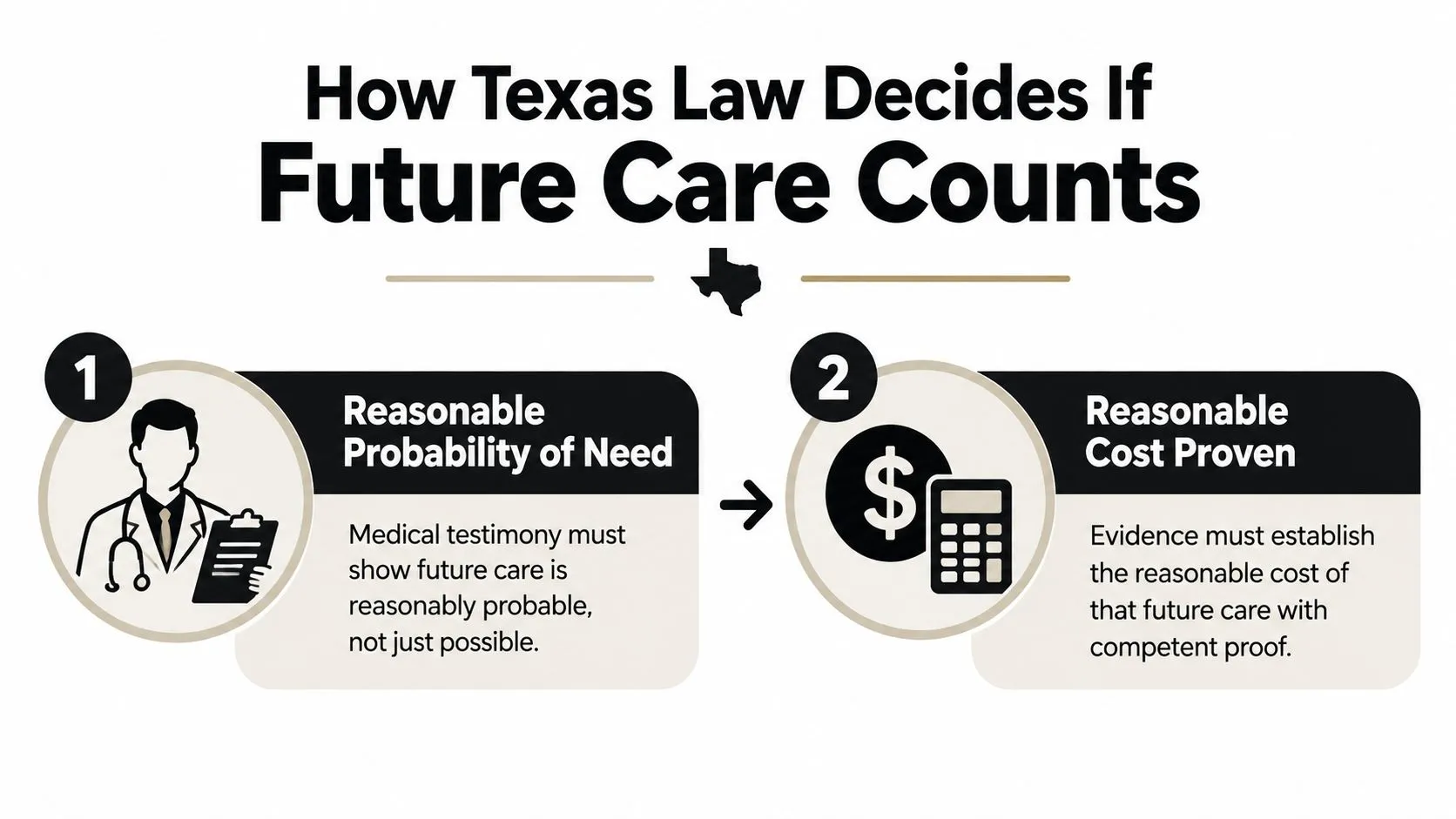
First, prove the need is reasonably probable
The question isn't whether treatment is imaginable. It's whether the evidence shows that future care is more likely than not to be needed. A recent Texas appellate decision describes the standard as requiring reasonable probability, not absolute certainty. You can review that legal discussion in the Texas First Court of Appeals opinion on future medical expenses.
Consider a 42-year-old oilfield worker who suffers a traumatic brain injury in an 18-wheeler crash. His treating neurologist may explain the lasting symptoms, the need for cognitive therapy, and the likelihood of continuing neurological care. A rehabilitation professional may identify assistance needed at home or work. The doctor's opinion must connect the proposed treatment to the injury, rather than just list everything that might help.
A vague statement such as “he may need care someday” gives the defense room to attack the claim. Stronger proof identifies the service, explains why it's needed, and ties it to objective findings and the patient's course of treatment.
Second, prove the reasonably probable amount
This is the part many explanations skip. You don't just have to establish that care is likely. You also need a credible basis for what that care will reasonably cost.
A life-care planner can identify the frequency and duration of therapy, medications, equipment, home assistance, and follow-up visits. A physician can support medical necessity. A cost expert or economist can then use competent evidence to value those services. Texas doesn't require one fixed formula or a particular type of evidence, but the amount must rest on a reasonable foundation.
Practical rule: A future-care claim can fail because the medical need is too uncertain, or because the proposed amount has no reliable support.
Texas juries have broad discretion in valuing future medical damages. They may extrapolate from your prior treatment, injuries, and condition at trial. For a broader overview of compensation categories, see What Damages Can You Recover in a Texas Injury Case?.
What Costs Typically Qualify as Future Medical Damages
The qualifying question is practical: what care will your injury require, and what will that care cost? A serious spinal injury may involve surgery, therapy, equipment, and assistance. A traumatic brain injury may require cognitive treatment and supervision. Severe burns may lead to repeated procedures, specialized medication, and scar management.
| Category | What It Covers | Typical Texas Valuation Notes |
|---|---|---|
| Surgery and hospital care | Procedures, facility care, anesthesia, and recovery services | Medical testimony should explain why the procedure is reasonably probable |
| Medication | Prescription drugs and related monitoring | Evidence should address the medication's purpose and expected duration |
| Physical and occupational therapy | Rehabilitation, strength, mobility, and daily-function training | Prior treatment and continuing limitations can support projected frequency |
| Durable medical equipment | Wheelchairs, braces, prosthetics, and related devices | The plan should identify the equipment and expected replacement needs |
| Home modifications | Ramps, bathroom changes, and accessibility improvements | Functional limitations must justify each modification |
| Attendant and home health care | Skilled services, personal assistance, and supervision | A planner can describe the hours and type of care supported by medical evidence |
| Transportation | Travel to treatment and medically necessary appointments | Mileage, appointment frequency, and access needs help establish the estimate |
| Mental health and vocational care | Counseling, cognitive support, and specialized return-to-work rehabilitation | These services must connect to the injury and resulting restrictions |
Texas cases show why the need for care and the dollar amount require separate proof. One Texas Supreme Court record reflects a $1.208 million future-healthcare award for a child's care until age 18. Another Texas appellate record includes a $36,000 future medical award found reasonably probable. A separate appellate record describes a $7,242,403 future-care award, matching the amount supported by the doctor's testimony. The underlying authorities appear in the Texas Tech Law Review discussion of future medical damages and the Texas court opinion.
Those figures do not establish a standard payout for a particular diagnosis. They show how Texas juries evaluate the connection between the injury, the proposed services, and the evidence supporting the charge. A doctor may establish that treatment is needed, while a life-care planner or other qualified witness explains frequency, duration, equipment, and related costs. The jury still decides what amount the evidence justifies.
If your providers recommend continued rehabilitation after a crash, information about non-surgical accident recovery may help you identify treatment that should appear in your records. Keep the recommendations, referrals, visit history, and stated restrictions. Those details can support both the need for care and the projected scope of treatment.
Catastrophic injuries may require therapy, medication, devices, home support, and supervision for many years. Review Texas catastrophic injury lifetime care claims for issues that commonly arise in those cases. Also account for fertility care, future psychological treatment, transportation, and vocational rehabilitation when the injury supports them. Current hospital bills rarely capture the full cost of future care.
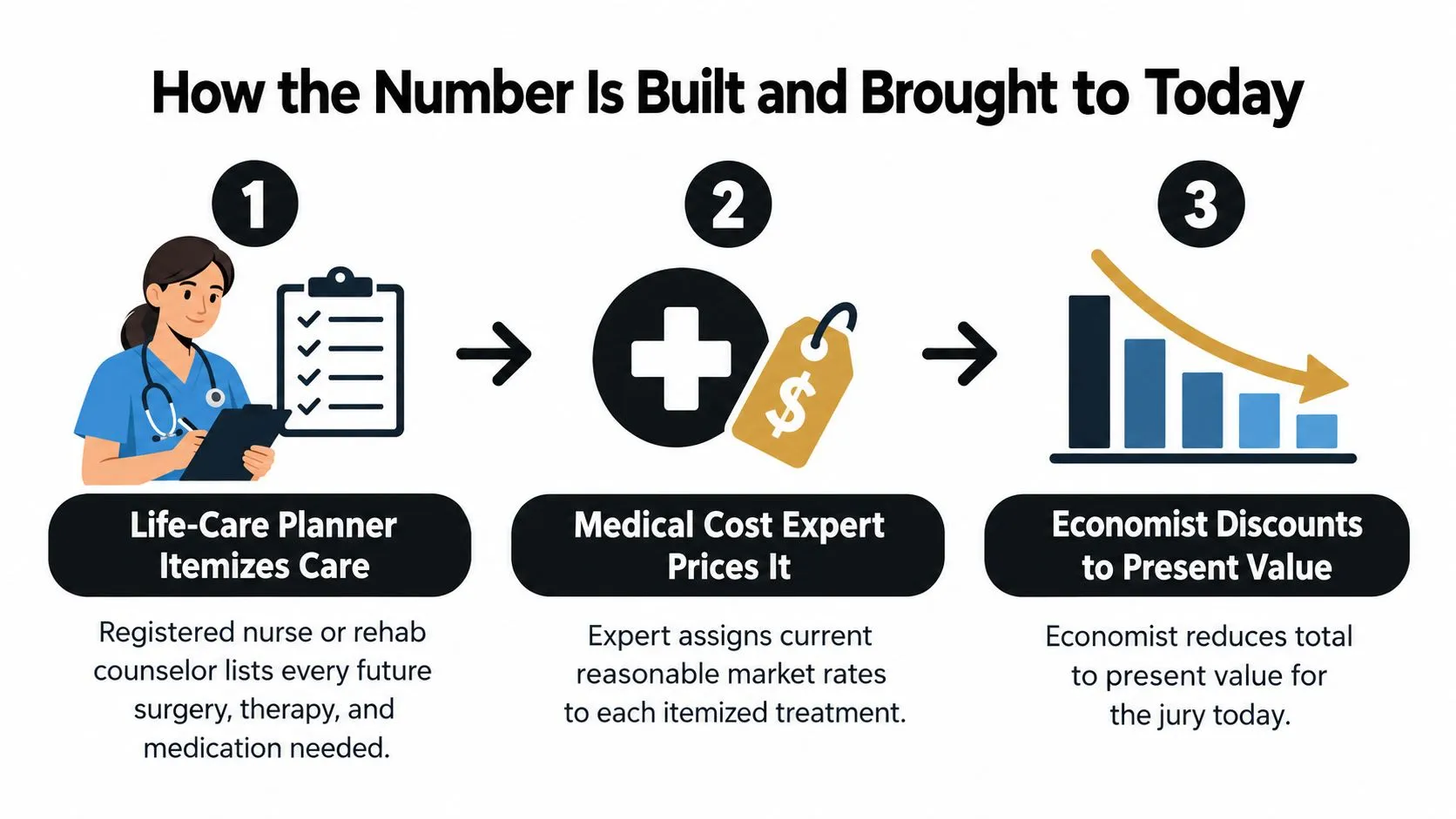
How the Number Is Built and Brought to Today
A reliable projection usually begins with the medical facts, not a spreadsheet. The professionals involved must build the estimate in a logical order so the jury can see why each service belongs in the claim.
The life-care planner itemizes the needs
A life-care planner, often a registered nurse or rehabilitation counselor, reviews the diagnosis, records, treatment history, prognosis, and daily limitations. The planner may list future surgeries, therapy, medications, supplies, equipment, home changes, transportation, and assistance.
The planner shouldn't create a wish list. Every item should have a medical reason, an expected frequency, and a relationship to the injury. The strongest plans fit the patient's actual treatment course and the treating physician's opinions.
Medical professionals establish necessity
Your treating physician or another qualified medical expert must explain why the listed services are medically necessary. That opinion links the care plan to the diagnosis and addresses questions such as whether symptoms are permanent, whether a procedure is likely, and what could happen without treatment.
A physician may support the medical side while a cost expert identifies reasonable charges. The legal materials on catastrophic injury claims describe this practical use of treating-physician opinions and life-care planning evidence in projecting future services. You can review that discussion in Texas catastrophic injury life-care planning guidance.
The economist converts future costs into present value
A jury generally evaluates the amount needed today to pay for reasonably probable future care, rather than adding up undiscounted future dollars. An economist applies present-value analysis, which accounts for the time value of money.
Suppose a care plan projects $5,000 per year for 30 years at a 5% discount rate. The economist calculates the lump sum that could reasonably cover those future payments under the assumptions presented to the jury. The example illustrates the method, not a prediction of any individual award.
The discount rate creates a genuine dispute. A lower rate generally produces a larger present-value figure, while an insurer may argue for a higher rate based on safe investment yields. Your attorney should test the assumptions, explain them in plain English, and show why the proposed rate fits the evidence.
This video provides another visual explanation of the damage-calculation process:
How Insurance Companies Push Back on These Claims
Insurance companies don't accept a life-care plan just because it looks detailed. Their lawyers look for gaps between the medical records, the proposed treatment, and the dollar estimate. They may use an examination doctor, a cost expert, or your own treatment gaps to argue that the projection is inflated.
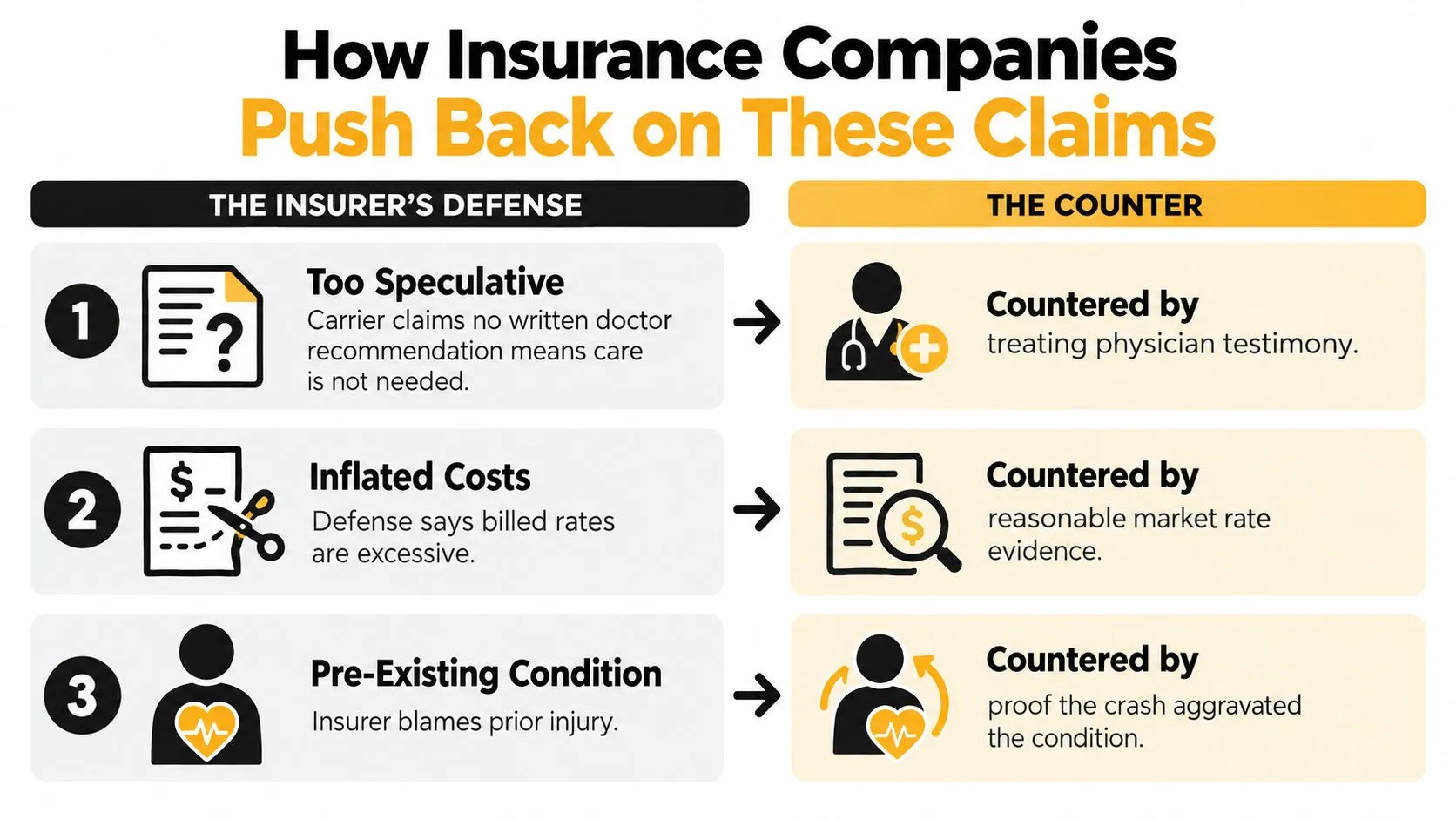
“The care is speculative”
An adjuster may say no future surgery or therapy belongs in the claim because it isn't scheduled. That argument ignores how doctors manage many injuries. Physicians often monitor symptoms, continue conservative care, or wait for progression before setting a procedure date.
The response is specific medical proof. Ask your doctor to address the anticipated treatment, the reason for it, the likely timing when medically appropriate, and the consequences of going without it. Written records and deposition testimony can make the difference.
“The planner is a hired gun”
Defense counsel may attack a life-care planner as someone paid to support your case. That attack is easier when the plan contains broad services unsupported by clinical records. A planner with appropriate clinical credentials, careful methodology, and Texas litigation experience can explain the basis for each item.
“The costs are inflated”
The defense may challenge provider rates, medication duration, replacement assumptions, or the discount rate. An independent medical examination doctor may recommend less frequent treatment, while an economist may present a different present-value calculation.
You should preserve information about mobility devices and related coverage, including the relevant mobility equipment insurance policy, but don't assume insurance coverage eliminates your legal claim. Coverage questions and liability damages are separate issues.
Pre-existing conditions create another common fight. The carrier may blame your symptoms on an old injury. Your medical team must distinguish the prior condition from the crash-related aggravation and identify the care caused by the new trauma.
Comparative responsibility can also reduce the final award. Texas law permits recovery only when the claimant is 50% or less responsible, and the recovery is reduced by the assigned percentage of fault, as described in the earlier Texas responsibility source. Failing to follow reasonable prescribed care can give the defense another way to argue that your future needs or damages should be reduced.
Practical Steps Injured Texans Should Take After a Crash
You can strengthen a future-care claim by creating a reliable record now. Start this week, even if you haven't decided whether to file a lawsuit.
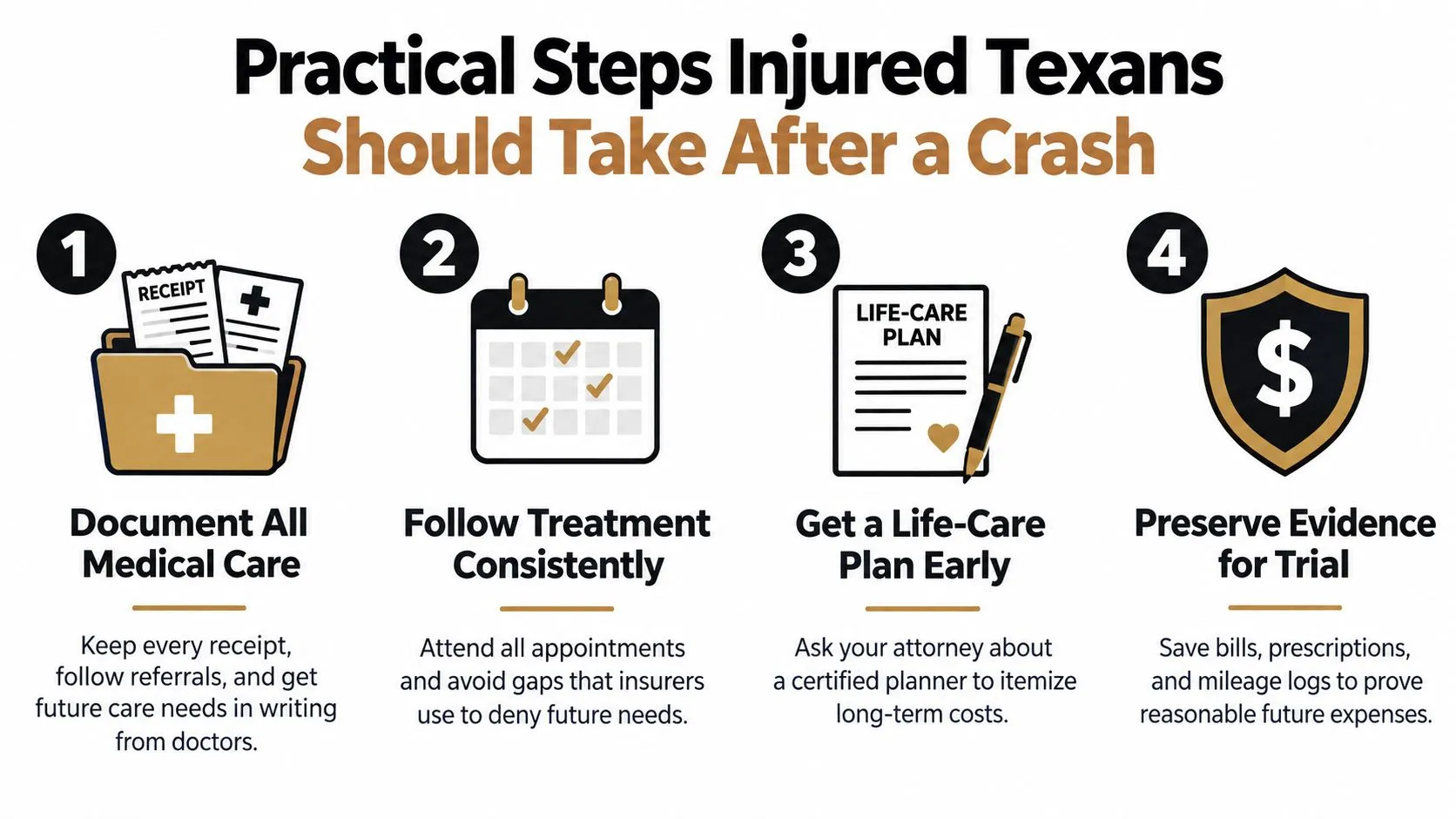
Document every medical visit. Keep bills, receipts, prescriptions, referrals, imaging records, and mileage. Follow reasonable treatment recommendations. If cost, transportation, work, or insurance prevents treatment, tell your provider and keep proof of the barrier.
Ask doctors to document the future. Request clear records addressing your prognosis, permanent restrictions, anticipated therapy, medication, equipment, surgery, and other likely care. Your physician's clinical explanation is more useful than a general statement that you may need “ongoing treatment.”
Keep a care diary. Record pain, sleep problems, missed work, medication effects, and daily limitations. Don't exaggerate. Consistent, honest notes can help show how the injury affects your life and why future services remain necessary.
Preserve accident evidence. Keep the vehicle available for inspection. Obtain the police report, including the Texas CR-3 when available, and preserve dashcam footage, photographs, witness information, and 911 audio.
Control insurance communications. Don't give a recorded statement to the other driver's carrier before a lawyer reviews the request. Adjusters may ask questions that sound routine but can later be used to minimize fault, injury severity, or future treatment.
Photograph visible injuries over time. Weekly photographs can show healing, scarring, swelling, bruising, or changes that a single emergency-room image won't capture.
Texas injury claims generally have a two-year filing deadline under Tex. Civ. Prac. & Rem. Code § 16.003. Review the deadline explained in The Two-Year Deadline for Texas Injury Claims and don't wait until the final months. Medical bills and payment questions are also addressed in how medical bills are paid after an accident in Texas.
If you were hurt in a Dallas collision, injured in a Houston truck crash, or lost a loved one in a fatal wreck, speak with a Texas personal injury lawyer before discussing settlement. A free consultation can identify evidence that may disappear and deadlines that may affect your rights.
Pursuing the Compensation You Deserve
A strong future-medical claim has four connected parts: a diagnosis, a medically supported care plan, competent cost evidence, and a clear explanation of how the accident caused the need. You're not asking an insurer to pay for every treatment that might someday be useful. You're presenting the reasonable cost of care your doctors and qualified experts support.
The case may proceed along three tracks:
- Pre-suit demand: Counsel organizes medical records, physician opinions, life-care planning, and present-value calculations into a demand package.
- Litigation: If the carrier refuses to engage fairly, formal discovery can obtain medical, billing, insurance, vehicle, and responsibility evidence.
- Settlement planning: Once the evidence is strong or a verdict is available, negotiation can address how compensation should be paid, including a Texas structured settlement.
A Houston car accident attorney can investigate a collision involving a distracted or intoxicated driver. A truck crash lawyer Houston families trust should understand commercial records, driver history, and the long-term consequences of catastrophic injury. If a loved one died, a wrongful death lawyer Texas families consult can evaluate the separate losses and claims that may apply.
Texas law also provides procedural tools for settlement discussions, including Chapter 38 provisions, while proportionate responsibility can still affect recovery when fault is assigned. Your lawyer should address those issues early, not after an insurer has already framed the case against you.
The Law Office of Bryan Fagan, PLLC handles Texas personal injury matters on a contingency-fee basis, so clients generally don't pay attorney fees unless there's a recovery. Ask during your consultation how the firm approaches expert witnesses, life-care planning, and the costs of building future-damages proof.
The Law Office of Bryan Fagan, PLLC offers free consultations to review your medical records, evaluate the reasonable probability and cost of future care, and identify the strongest path toward compensation. Contact the firm before giving a recorded statement or accepting a settlement, because recovery is possible and experienced legal help is available.


