 Skip to content
A serious accident can change your life in seconds, but you don't have to face it alone. If your family woke with headaches, nausea, confusion, or unusual fatigue after a furnace, generator, water heater, vehicle, or other fuel-burning equipment operated nearby, get everyone into fresh air and call 911. Carbon monoxide has no reliable warning smell, and legal decisions should come only after everyone is medically safe.
A carbon monoxide poisoning lawsuit in Texas usually depends on more than symptoms. The case must connect the source, the exposure, the medical injury, and the person or company responsible. That connection often depends on evidence collected in the first hours and days, before an appliance is repaired, a detector is discarded, or memories become uncertain.
When a Silent Leak Changes Everything in Texas
A Houston family may wake before sunrise with pounding headaches and nausea. One person feels dizzy, another struggles to stay awake, and a child seems unusually tired. The family may first suspect food poisoning or a virus. If a cracked heat exchanger or another furnace failure allows combustion gas into the home overnight, every minute inside can increase the danger.
The immediate response is simple, even though the situation is frightening:
- Leave the building: Get every person and pet into fresh air. Don't re-enter until emergency personnel say it's safe.
- Call 911: Tell the dispatcher that you suspect carbon monoxide exposure.
- Request an ambient reading: Ask the responding fire department or EMS crew to record carbon monoxide levels with their meter and preserve the incident report.
- Seek emergency testing: Take every household member to an emergency department for a carboxyhemoglobin blood test, preferably before oxygen treatment changes the reading.
A resource explaining common sources and indoor air quality dangers can help families understand why furnaces, water heaters, generators, vehicles, and blocked vents require urgent attention. It shouldn't replace emergency care or a professional inspection.
The questions that follow the emergency
Once the family is safe, the legal questions become concrete. Who owned the furnace? Who controlled the property? Who last inspected or repaired it? Did a tenant, landlord, employer, hotel operator, contractor, or manufacturer know about a condition that could release carbon monoxide? Did anyone have a duty to warn occupants or workers?
The answers may be found in maintenance requests, inspection records, service invoices, utility communications, fire department notes, photographs, and medical records. A family shouldn't clean up, repair, replace, or discard the suspected source before a qualified professional evaluates it.
Practical rule: Treat the furnace, detector, vent, generator, vehicle, and service records as potential evidence, not household clutter.
Symptoms alone rarely tell the complete story. Texas cases often turn on whether an expert can reconstruct when the exposure occurred, how the gas entered the occupied space, and whether the reported medical condition is consistent with that exposure. Your first conversation with a lawyer should therefore focus on preserving the evidence chain, not on guessing a settlement amount.
Who Can Be Held Liable for Carbon Monoxide Exposure in Texas
The responsible defendant depends on the source and the control relationship. A serious injury doesn't automatically make a landlord liable, and a death doesn't automatically establish a product defect. The evidence must show a duty, a breach of that duty, causation, and damages.
Common liability paths
A landlord or property owner may face premises liability when an unsafe furnace, water heater, flue, detector, or ventilation condition caused exposure. Rental-property duties can also involve Texas Property Code Chapter 92, including repair obligations under Section 92.052, when the required conditions are present. Lease terms, notice records, prior complaints, and the owner's control over repairs matter.
An employer may be protected by workers' compensation exclusivity if the employer carries workers' compensation insurance. A separate claim may still exist against a contractor, property owner, equipment maker, or another third party. Direct employer litigation can involve different issues when the facts support gross negligence, but the precise route requires careful review.
A manufacturer, distributor, or seller may be sued under product-liability or negligence theories if a furnace, water heater, generator, detector, or vehicle had a design, manufacturing, or warning defect. The product must be preserved for testing. A used-car seller may also face failure-to-warn allegations if it resold a vehicle with a known or discoverable exhaust problem.
Hotels and short-term rental hosts can face premises-liability and negligence theories when guests encounter an unsafe room, improperly vented fuel-burning appliance, or missing warning. A contractor or HVAC company may be responsible for defective installation, inadequate inspection, or a repair that failed to identify a dangerous condition.
| Potential Defendants in a Texas CO Lawsuit | Legal Theory | Texas Authority |
|---|---|---|
| Landlord or property owner | Premises liability and negligent maintenance | Texas Property Code Section 92.052 may apply to residential repair duties |
| Employer | Workers' compensation issues, gross-negligence theories, or third-party negligence | Texas workers' compensation exclusivity rules and applicable negligence law |
| Appliance, generator, detector, or vehicle manufacturer | Product liability, design or manufacturing defect, failure to warn | Texas product-liability principles |
| HVAC contractor or inspector | Negligent installation, inspection, or repair | Texas negligence law |
| Hotel or short-term rental host | Premises liability and failure to warn | Texas premises-liability law |
| Used-vehicle seller or dealership | Failure to warn, negligent sale, or product-related theories | Texas negligence and product-liability principles |
A 2026 San Antonio lawsuit alleged that a used Ford Mustang's exhaust defect caused fatal carbon monoxide poisoning and sought wrongful-death and personal-injury damages. A separate Texas police-officer case against Ford resulted in a 2025 trial verdict for Ford. Those matters illustrate why vehicle cases require proof of defect, notice, exposure, and medical causation, rather than merely proof that a person became ill.
How to Preserve the Evidence That Wins a CO Case
Carbon monoxide evidence can disappear quickly. A landlord may replace a furnace, an employer may correct ventilation, a dealership may repair a vehicle, or a family may discard a detector because it appears broken. Those actions can make later testing far less useful.
Build the chain in the right order
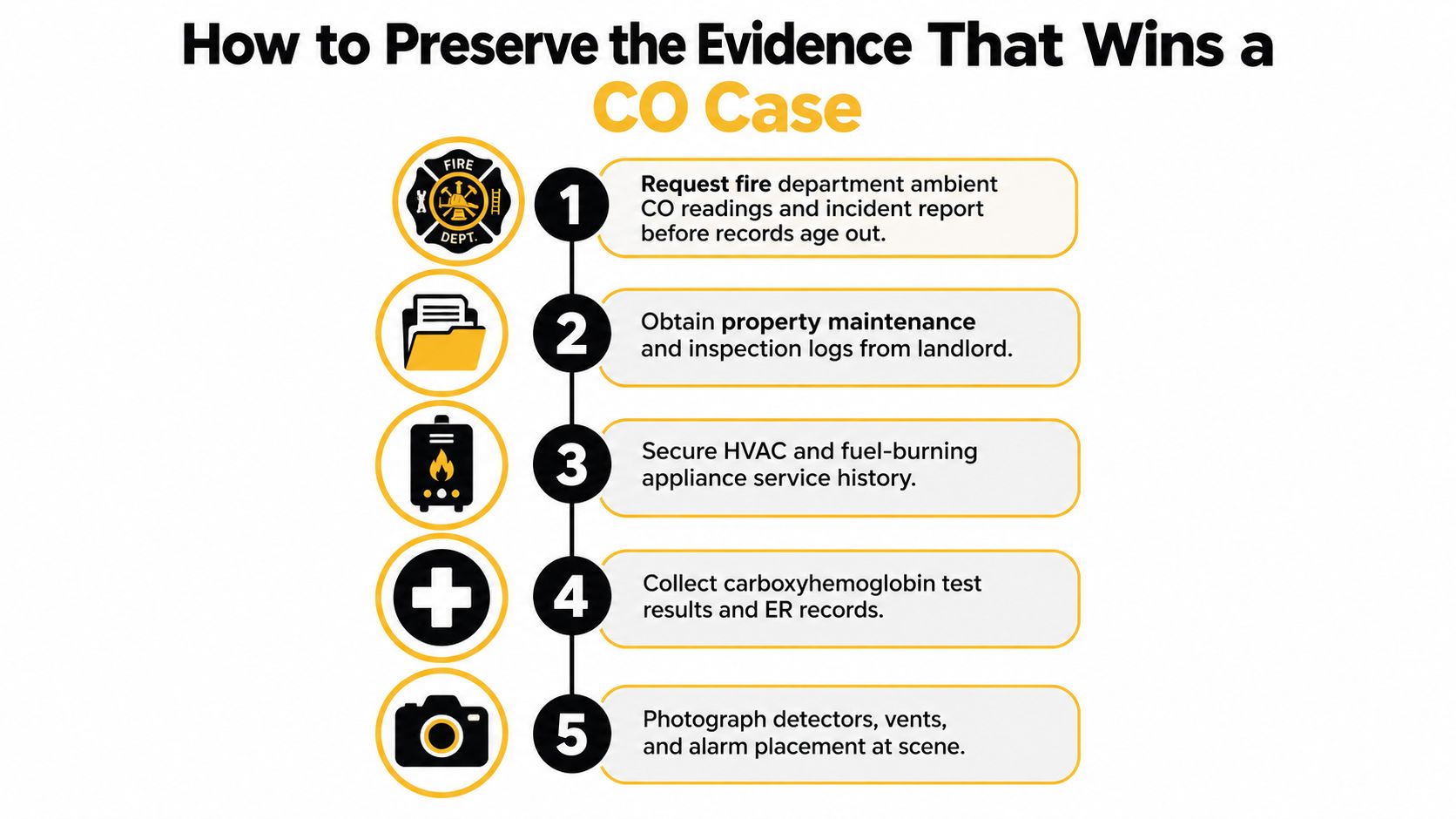
First, obtain emergency readings and reports. Request the fire department's immediate ambient carbon monoxide readings, EMS notes, and incident report. These records may provide the only measurement taken while the scene still reflected the original condition.
Second, preserve medical testing. Ask the emergency department for the carboxyhemoglobin result and complete records. Normal carboxyhemoglobin is below 3% for non-smokers, levels above 10% indicate significant exposure, and levels above 25% are consistent with severe, life-threatening poisoning. These thresholds and the timing of the blood draw matter, particularly because oxygen therapy can affect later readings. The technical evidence stack is discussed in this trial-law resource on carbon monoxide evidence.
Third, document the scene before repair. Photograph the appliance, flue, vent configuration, detector placement, generator location, vehicle exhaust system, and surrounding conditions. Don't move or dispose of the suspected source unless emergency personnel require it.
Fourth, send preservation letters promptly. A lawyer should send spoliation letters to each potential defendant, including a landlord, HVAC contractor, employer, dealership, or manufacturer. The letters should demand preservation of the appliance or vehicle, detector, maintenance records, inspection logs, complaints, work orders, video, electronic records, and relevant product or batch information. The firm's discussion of spoliation of evidence explains why later alteration can affect the case.
Fifth, retain the right expert. An industrial hygienist, mechanical engineer, or carbon monoxide forensic specialist may inspect the source and reconstruct the exposure pathway. A medical expert must then connect the exposure to the claimed injury, including neurological harm when supported by the records.
Why missing one link matters
A medical record may show that a person felt sick, but it may not identify the source. A fire department reading may show gas at the property, but it may not prove a lasting neurological injury. An appliance inspection may identify a defect, but it may not establish that the defect caused the particular exposure.
Texas toxic-tort litigation commonly requires expert testimony tying the symptoms and injury to carbon monoxide exposure. If the physical source is repaired before inspection, later experts may lose the chance to measure the original condition, ventilation failure, or defect mechanism. That is why preservation is often more important than making an early demand.
How Long You Have to File a Carbon Monoxide Claim in Texas
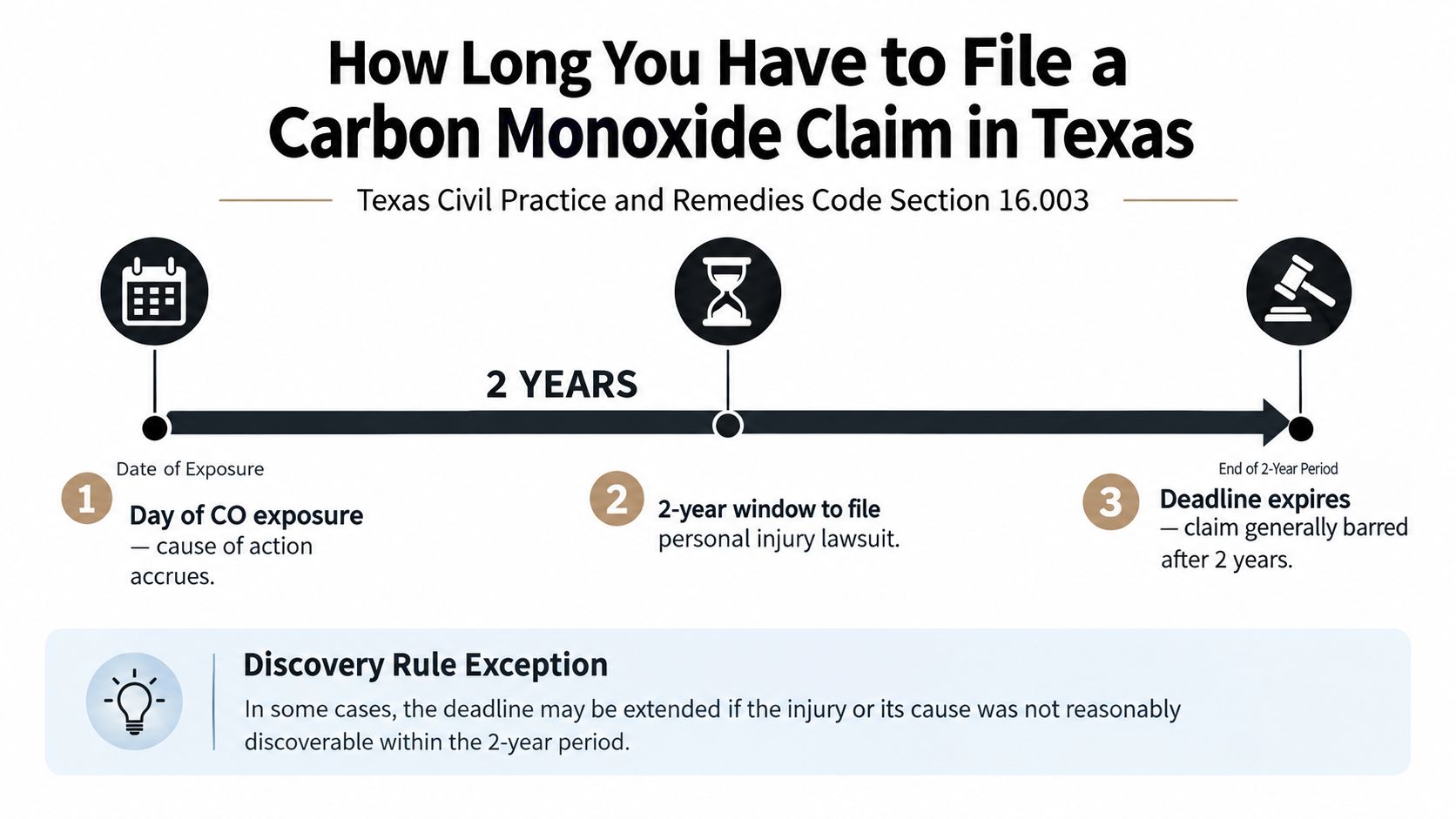
Texas generally gives you two years to file a personal-injury lawsuit, and a wrongful-death claim also generally must be filed within two years. The Texas statute provides that wrongful-death timing runs from the date of death, not from the date of the underlying exposure or injury. See Texas personal injury statute-of-limitations information and the text of Texas Civil Practice and Remedies Code Section 16.003.
How the date works
If exposure occurs on March 10, 2026, the ordinary personal-injury deadline is generally tied to that injury date. You shouldn't assume the clock begins when symptoms finally resolve, when a doctor confirms long-term effects, or when an insurer finishes investigating.
Wrongful death follows a different trigger. If a person is exposed on March 10 but dies on March 20, the wrongful-death period generally begins on the date of death. A survival action may involve the deceased person's own claim and must be evaluated separately with the wrongful-death claim.
The discovery rule can matter in limited situations, including an occupational exposure where the injury could not reasonably be discovered immediately. It isn't an automatic extension for every delayed diagnosis. A lawyer must examine when the injury was legally discoverable and whether the facts support a tolling argument.
Special timing problems
Minors and other legal disabilities may have different tolling rules. Claims involving a government entity may also require an early notice letter, and the deadline and required content can vary by entity and governing law. Don't assume notice to a landlord, employer, city, or county satisfies every statutory requirement.
Missing the filing deadline can result in dismissal, and equitable tolling is uncommon. Calendar the exposure date, injury date, and death date immediately, then investigate before evidence disappears. A consultation should happen well before the deadline, not after negotiations consume the available time.
What Damages You Can Recover After CO Poisoning
A Texas carbon monoxide claim may involve both immediate losses and needs that continue for years. Medical records, employment history, household responsibilities, expert opinions, and testimony from family members help show what the exposure changed.
Economic damages may include emergency treatment, hospitalization, medication, rehabilitation, future medical care, lost wages, and reduced earning capacity. When hypoxic brain injury affects memory, concentration, judgment, or personality, a life-care planner or vocational expert may help explain future needs. The amount must be supported by evidence rather than a generic formula.
Non-economic damages may include physical pain, mental anguish, loss of enjoyment of life, disfigurement, and impairment. A survivor who returns home but cannot safely work, drive, sleep, or participate in family activities may have a significant quality-of-life claim even when the initial hospital stay was short. Texas does not provide a simple universal price for these experiences.
This explanation of economic and non-economic damages can help you organize the different categories without treating any online estimate as a valuation of your case.
| Damages Recoverable After Texas Carbon Monoxide Poisoning | What It Covers | How Texas Juries Value It |
|---|---|---|
| Medical expenses | Emergency care, hospitalization, treatment, rehabilitation, and future care | Bills, medical testimony, treatment records, and future-care evidence |
| Lost income | Missed work and reduced ability to earn | Payroll records, tax documents, employer testimony, and vocational evidence |
| Physical pain | Acute poisoning and continuing physical effects | Survivor testimony, treatment history, and medical opinions |
| Mental anguish | Fear, trauma, anxiety, cognitive changes, and emotional suffering | Testimony from the survivor, family, and treating professionals |
| Loss of enjoyment | Inability to perform activities and responsibilities previously enjoyed | Before-and-after evidence about daily life and abilities |
| Wrongful-death losses | Pecuniary loss, companionship, support, mental anguish, and funeral expenses | Family testimony, financial records, relationship evidence, and funeral documentation |
| Survival damages | Claims belonging to the estate for the injured person's losses before death | Medical records, testimony, and estate documentation |
Wrongful-death damages may include the family's financial and relational losses, while a survival action preserves claims the deceased person could have pursued. The responsible parties may challenge the relationship, the financial proof, or the medical connection, so families should preserve employment records, household evidence, photographs, messages, and treatment information.
Punitive damages require proof beyond ordinary negligence and depend on the facts. A defendant's repeated notice of a dangerous condition, followed by conscious disregard, may become important, but no punitive recovery should be assumed before the evidence is developed.
Settlement and Trial Strategy for Texas CO Cases
A settlement can provide certainty and avoid the burden of trial. A verdict can create leverage and may provide a larger recovery, but it also carries delay, expense, and the risk that a jury rejects causation or assigns substantial responsibility to the plaintiff.
What settlement requires
A strong demand package should explain the exposure pathway, identify the responsible parties, organize medical evidence, and document economic and non-economic harm. It should also address the defense arguments before the insurer raises them. Mediation can give both sides a controlled setting to evaluate risk, while a structured settlement may help fund continuing neurological care.
Insurance limits matter. A defendant may have significant legal exposure but limited coverage or limited reachable assets. That doesn't end the investigation, but it affects negotiation strategy and whether pursuing a judgment is practical.
What trial requires
At trial, jurors need a clear story. Demonstrative evidence can show the appliance failure timeline, the movement of combustion gas, the timing of the fire department reading, the blood-test sequence, and the progression of medical symptoms. A mechanical expert and medical expert must support the story with reliable methods.
Texas uses a modified comparative-responsibility rule. Under the 51% bar, a claimant found more than 50% responsible cannot recover, while a claimant found 50% responsible has recovery reduced by that share. The rule and its practical application are explained in this Texas comparative-fault resource.
Defense counsel may argue that the victim ignored a warning, failed to maintain a detector, operated equipment improperly, or knew about a smell or malfunction. Those arguments make photographs, maintenance records, warnings, witness statements, and prior complaints important. Don't give a recorded statement to an insurer before understanding how the company may use it to assign blame.
A settlement decision should reflect medical certainty, liability evidence, available insurance, venue, and your family's ability to tolerate a longer litigation process.
A case may be better positioned for trial when the evidence strongly proves a defect or dangerous condition, the medical injury is well documented, and the defense has refused to recognize clear responsibility. Settlement may make more sense when causation is disputed, the evidence has been compromised, or predictable funding is essential for care. The choice belongs to the client after counsel explains both the value and the risk.
Your Next Steps After a Carbon Monoxide Injury in Texas
The first month should focus on health, preservation, and deadline control. You don't need to solve the entire case immediately, but you do need to prevent avoidable evidence loss.
A practical first-30-day plan
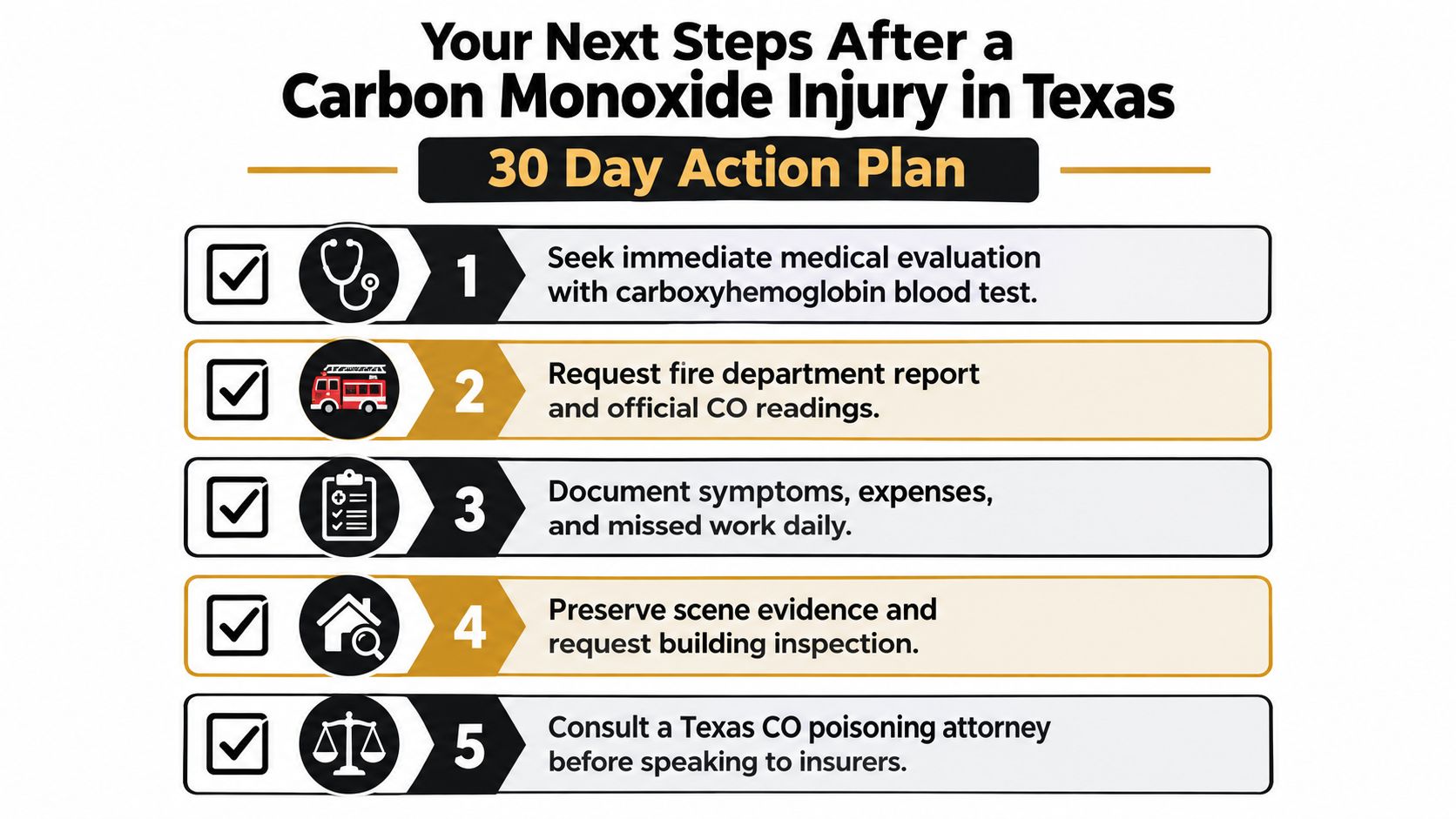
- Get medical evaluation: Ask for emergency assessment and a carboxyhemoglobin blood test. Follow up when symptoms continue, return, or change.
- Request written records: Obtain the fire department report, ambient readings, EMS notes, landlord or employer incident report, and any licensed-inspector or fire-marshal findings.
- Photograph the scene: Document the appliance, detector, flue, vent, generator, vehicle, and room configuration before repairs or replacement.
- Preserve the source: Keep the detector, appliance parts, vehicle, service documents, maintenance logs, inspection records, and recall communications available for examination.
- Track the injury: Save medical bills, prescription records, wage information, missed-work dates, and a daily symptom journal.
- Send preservation notices: A lawyer should send letters to every potential defendant promptly, including the landlord, employer, contractor, dealership, manufacturer, hotel, or property manager.
- Avoid premature statements: Don't provide a recorded statement or accept a quick settlement from an insurer before the evidence and comparative-responsibility issues are reviewed.
- Contact counsel early: A Texas personal injury lawyer can assess the filing deadline, identify the proper defendants, and coordinate qualified liability and medical experts.
If the exposure happened because of an unsafe building condition, the legal analysis may overlap with Slip and Fall / Premises Liability in Texas, which concerns representation for injuries caused by unsafe property conditions. The label of the claim matters less than identifying who controlled the hazard and what the records show.
The Law Office of Bryan Fagan, PLLC offers free consultations and contingency-fee representation, so you can discuss the exposure, evidence chain, medical records, and potential defendants without paying an attorney fee unless the firm recovers for you. Contact the Law Office of Bryan Fagan, PLLC to review your Texas carbon monoxide claim, understand the two-year deadline, and decide whether settlement or trial preparation fits your family's needs. Recovery is possible, and legal help is available while you focus on healing and protecting your family.


