 Skip to content

A serious accident can change your life in seconds, but you don't have to face it alone.
After a Houston crash, you may be dealing with medical treatment, missed work, vehicle damage, and an insurance adjuster who suddenly stops returning calls. At first, the carrier may sound helpful. Then the questions become repetitive, the investigation slows, and a denial letter arrives with a vague reference to a policy exclusion. That experience can leave you wondering whether the company paid to protect you is now working against you.
Texas law recognizes that insurance companies must handle claims fairly. A denial, delay, or low settlement offer isn't automatically bad faith, but unreasonable claims handling can support both contract and extra-contractual remedies. The analysis may involve Chapter 541 of the Texas Insurance Code, common-law duties, prompt-payment rules, and, in liability cases, the Stowers doctrine. For UM/UIM claims, a 2025 Texas Supreme Court decision also makes the order of litigation especially important.
When an Insurance Company Stops Doing Its Job
After a Houston freeway crash, suppose another driver broad-sides your SUV. You miss two weeks of work, your shoulder still needs treatment, and you're waiting for doctors to determine whether you'll need more care. The adjuster initially calls every few days and says the claim is moving forward.
Then the tone changes.
Your calls go to voicemail. Emails receive short replies, if they receive replies at all. The adjuster asks for records you already sent and insists that the investigation can't continue until you provide something unrelated to the collision. A new adjuster takes over, then another. Finally, the insurer sends a denial letter that cites a policy exclusion without clearly explaining how that exclusion applies.
You're left paying medical bills while the company controls the money and information. That isn't just frustrating. A pattern of unexplained delay, incomplete investigation, or misleading policy explanations may raise questions under Texas bad-faith law.
Practical rule: Keep your communications calm and written whenever possible. A complete timeline often matters more than one angry conversation.
Texas recognizes two major legal foundations for bad-faith insurance claims. The Texas Supreme Court first recognized the common-law duty of good faith and fair dealing in English v. Fischer in 1983. The statutory track comes primarily from Chapter 541 of the Texas Insurance Code, which addresses deceptive, unfair, and prohibited insurance practices. The modern standard was refined in Universe Life Insurance Co. v. Giles, which focuses on whether the insurer knew or should have known that it lacked a reasonable basis to deny or delay payment. Texas bad-faith insurance law and its two legal tracks provides additional background on this framework.
In a third-party liability case, a properly handled settlement demand can create separate pressure under the Stowers doctrine. In a UM/UIM dispute, however, the legal sequence can work differently. The 2025 Texas Supreme Court ruling generally requires the underlying liability and damages issues to be resolved before the extra-contractual bad-faith phase proceeds. That procedural trap can affect discovery, timing, settlement pressure, and the evidence available later.
If your insurer has stopped responding, document the problem and review what to do when an insurance company isn't responding to a claim. You may need help before the delay becomes a missed deadline.
How Texas Law Defines Bad Faith Insurance Practices
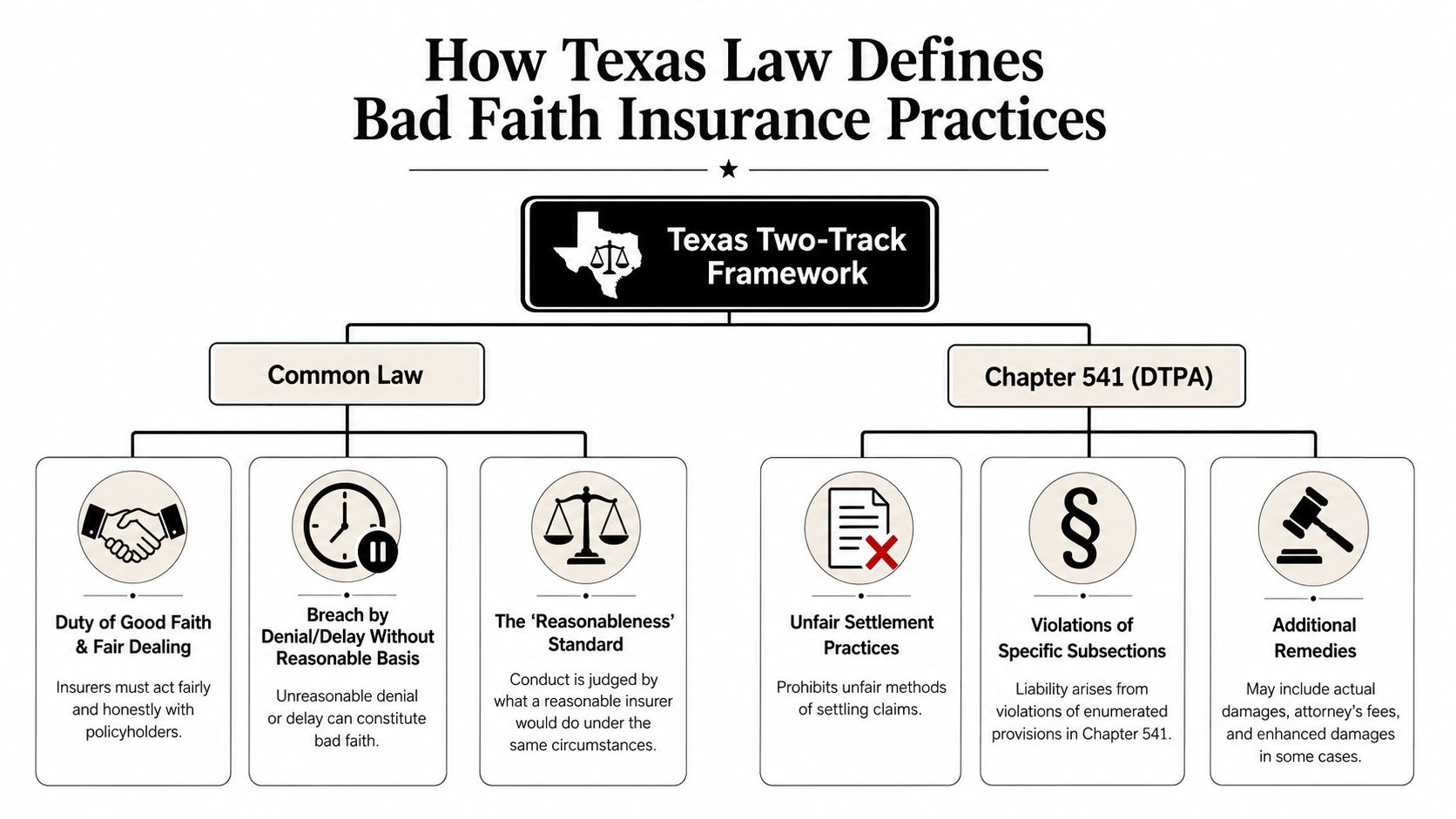
Texas bad faith insurance law has two connected but distinct tracks. One arises from common law. The other comes from statutes, especially Chapter 541 of the Texas Insurance Code.
The common-law duty
Under the common-law duty of good faith and fair dealing, an insurer may face liability when it denies or delays a claim without a reasonable basis and knew or should have known that no reasonable basis existed. The question isn't whether the insurer made the wrong decision. Courts examine the facts available to the carrier and the reasonableness of its investigation and decision.
In practical terms, a covered claim shouldn't be rejected because an adjuster ignored favorable evidence, relied on an incomplete report, or reached a conclusion before gathering the necessary facts. The carrier can investigate disputed causation and coverage. It can also defend a reasonable interpretation of the policy. But a legitimate disagreement isn't the same as a predetermined or unsupported denial.
The statutory track
Chapter 541 addresses unfair settlement practices, misrepresentations, and other prohibited conduct. The statute can apply when an insurer fails to investigate reasonably, misrepresents policy provisions, refuses to explain a decision, or fails to attempt a fair settlement when liability is reasonably clear. The Texas Insurance Code Chapter 541 contains the governing statutory language.
Chapter 542 adds prompt-payment requirements. Texas law generally requires acknowledgment within 15 days, a decision within 15 business days after requested information is received in ordinary cases, and payment within 5 business days after acceptance. When applicable deadlines are missed, the law can impose an 18% per-year penalty on the amount owed, plus reasonable attorney's fees. These deadlines and remedies are summarized in this Texas prompt-payment law resource.
Policy benefits and bad-faith damages must be separated carefully. Benefits owed under the policy generally belong in a breach-of-contract claim. They aren't automatically extra-contractual damages under Chapter 541 unless the policy itself gives the insured a right to those benefits. The insurer's handling of those benefits can still provide evidence of bad faith.
The 2025 UM/UIM ruling adds another layer. An injured insured usually can't force the carrier into immediate bad-faith discovery after a UIM denial. The claimant generally must first establish the other driver's liability and the amount of damages. Only then does the extra-contractual dispute move forward.
For a plain-language discussion of insurer tactics and claim protection, Dealing With Insurance Companies After a Texas Accident can help you identify practical issues before speaking with a carrier.
Warning Signs Your Insurer May Be Acting in Bad Faith
One missed call doesn't prove bad faith. Insurance claims become legally concerning when the carrier's conduct forms a documented pattern that lacks a reasonable explanation.
Conduct that deserves attention
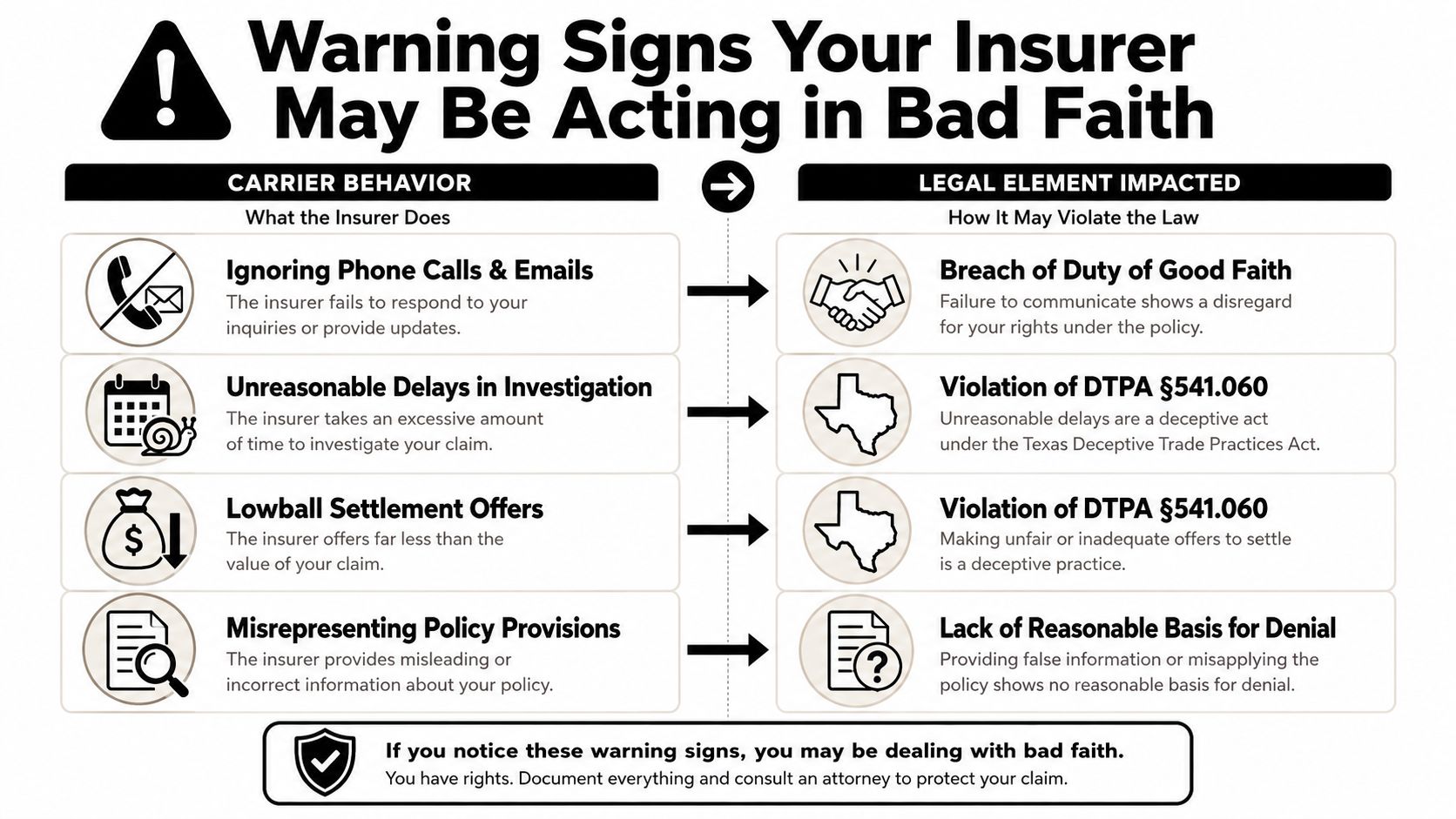
- Ignoring communication: Repeatedly unanswered calls and emails may support an argument that the insurer failed to communicate or failed to attempt a fair settlement.
- Unreasonable requests: A carrier can request relevant records, but demanding unrelated documents or repeatedly asking for materials already supplied may suggest an investigation designed to delay.
- Unsupported delays: If the insurer keeps postponing inspections or decisions without explaining what information is missing, preserve every date and message.
- A sudden exclusion: A denial that relies on a policy exclusion the adjuster never previously mentioned may raise a misrepresentation issue under Texas Insurance Code Section 541.061, depending on the facts.
- Low settlement offers: A low offer alone isn't bad faith. It becomes more significant when the insurer ignores medical records, repair estimates, liability evidence, or other information showing the value of the claim.
- Repeated adjuster changes: Changing personnel isn't automatically improper, but frequent reassignment combined with lost documents and stalled decisions can help show a pattern.
An insurer may also pressure you to provide a recorded statement before explaining the policy position. You should answer truthfully, but don't guess about facts you don't know or sign a release before understanding what rights you're giving up.
A reservation-of-rights letter can also confuse the process. It may state that the insurer will investigate while preserving coverage defenses. That letter isn't automatically evidence of bad faith, but you should understand exactly what the carrier is reserving and why. Learn more about reservation-of-rights letters in Texas insurance claims.
The strongest cases usually show more than a rude phone call. They show dates, missing investigation steps, conflicting explanations, ignored evidence, and a denial that cannot be supported by the information the insurer had.
Damages You Can Recover in a Texas Bad Faith Case
A Texas insurance dispute may involve several recovery categories, but each one has a different legal foundation. The first question is whether the insurer owed policy benefits. The second is whether the carrier's handling caused separate harm or violated statutory duties.
Common-law claims may seek extra-contractual losses tied to the insurer's conduct. Depending on the evidence, those losses can include mental anguish, inconvenience, lost time, and amounts needed to make the claimant whole. A claimant must still prove a connection between the conduct and the damages. Bad faith isn't a shortcut around proof.
Chapter 541 provides statutory remedies for unfair or deceptive practices. Under Section 541.152, additional damages may be available, with a cap of three times the damages in the circumstances described by the statute. The precise recovery depends on the facts, the type of violation, and the evidence of the insurer's conduct.
Chapter 542 can add the prompt-payment remedy discussed earlier. If the insurer wrongfully withholds payment and the statutory requirements are met, the 18% per-year penalty and reasonable attorney's fees may apply. The penalty isn't automatic for every delayed claim, so the claim history and legal justification for the delay matter.
| Damage Type | Source of Law | What You Recover | Key Cap or Limit |
|---|---|---|---|
| Policy benefits | Insurance contract | Covered benefits owed under the policy | Depends on policy terms, exclusions, and limits |
| Extra-contractual losses | Common law | Proven harm caused by unreasonable claims handling | Requires evidence connecting conduct to loss |
| Statutory damages | Texas Insurance Code Chapter 541 | Remedies for qualifying unfair or deceptive practices | Section 541.152 includes a three-times-damages cap in applicable cases |
| Prompt-payment remedy | Texas Insurance Code Chapter 542 | 18% per-year penalty on the amount owed and reasonable attorney's fees | Requires a qualifying violation and applicable statutory conditions |
| Excess judgment | Stowers doctrine | Potential exposure beyond policy limits in a third-party case | Depends on a proper demand, reasonably clear liability, and later excess judgment |
Policy limits don't automatically become bad-faith damages. In third-party liability cases, however, a valid Stowers demand can create exposure for an excess judgment if the insurer rejects an offer it should have accepted. That is different from adding policy benefits to a statutory claim.
A Texas bad-faith insurance overview explains why contract benefits and statutory damages must be analyzed separately.
Deadlines and Procedural Steps for Filing a Claim
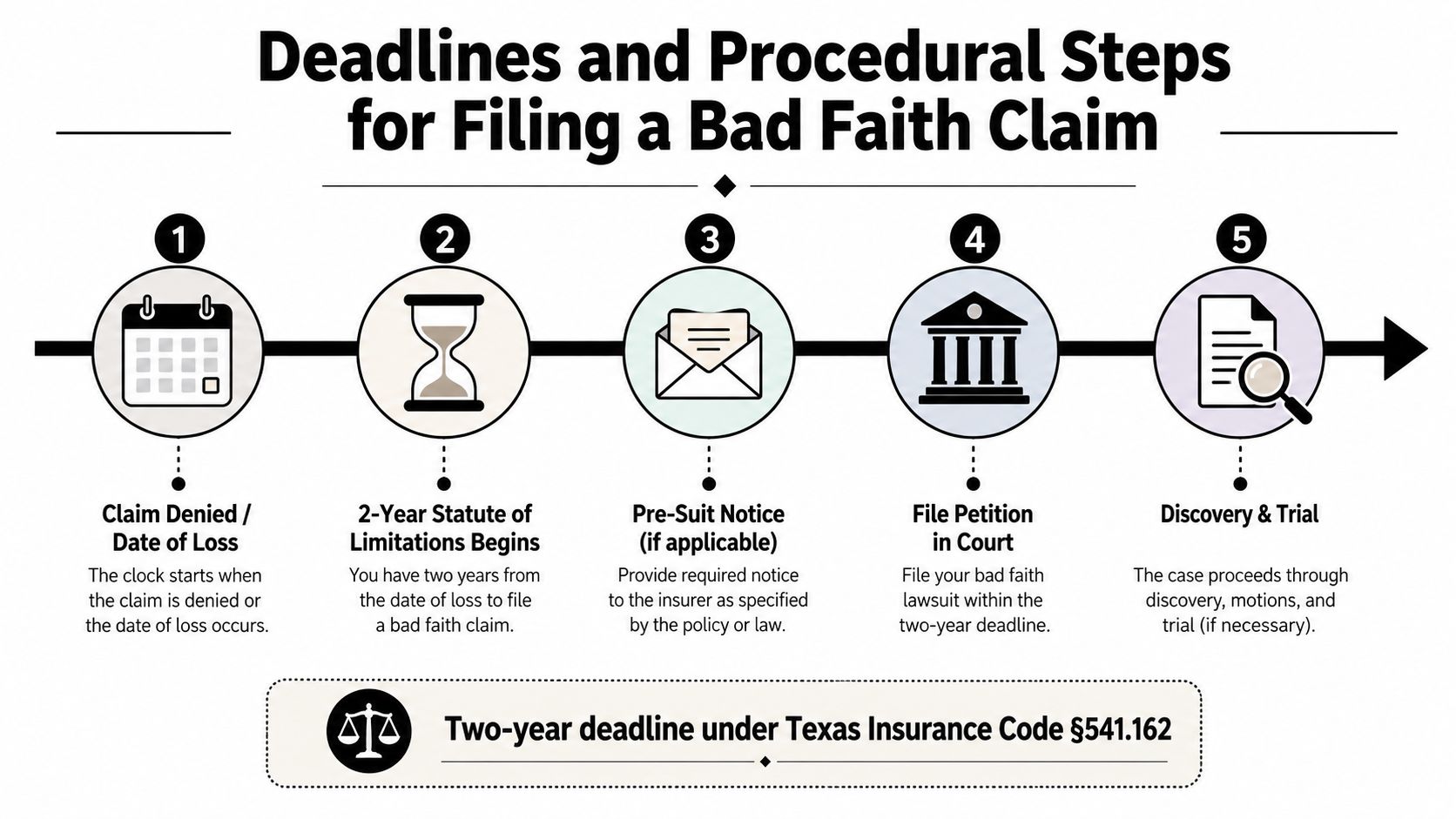
Deadlines can end a claim before a court considers whether the insurer acted unfairly. Under Texas Insurance Code Section 541.162, a lawsuit generally must be filed within two years of the unfair act or the discovery of it. The exact accrual analysis can be complicated, especially when the carrier continues communicating after a denial, so don't assume the deadline starts when the claim feels resolved.
The filing sequence
- Identify the triggering conduct. Save the denial, underpayment notice, delay communications, or other act that may support the claim.
- Calculate the limitations date. Section 541.162 generally uses a two-year period. Have counsel evaluate the accrual date rather than relying on a calendar estimate.
- Send required notice. Section 541.154 generally requires pre-suit notice and gives the insurer a 60-day response window before suit.
- Evaluate related injury claims. Texas personal injury claims generally have a two-year filing period under Section 16.003. The same deadline can apply to injury resulting in death. See the Texas personal injury limitations statute.
- File and preserve evidence. A petition, discovery plan, and properly supported expert record should match the legal theory from the beginning.
Comparative responsibility can also affect an accident case. Texas follows a modified comparative responsibility rule, often called the 51% bar. If the claimant is more than 50% responsible, recovery is barred. At 50% or less, the award is reduced by the claimant's assigned percentage. The Texas comparative responsibility statute explains that framework.
UM/UIM bad-faith claims now require particular attention to sequence. The 2025 Texas Supreme Court ruling generally requires bifurcation and abatement. The underlying dispute over the other driver's fault and your damages typically comes first, followed by the extra-contractual claim. That means your lawyer must build the accident, medical, wage, and damages evidence before expecting bad-faith discovery.
For property losses, readers may also find these Texas roof insurance claim tips for hail useful when organizing photographs, estimates, and claim communications. If the carrier denies the claim, preserve the denial and review how to appeal a denied insurance claim.
Evidence That Strengthens a Bad Faith Insurance Claim
A viable claim is built from the record, not from the intensity of your frustration. The insurer's complete claim file may show what the adjuster knew, what the carrier requested, what inspections occurred, and whether the decision changed without a factual reason.
Start with your own file:
- Written correspondence: Keep letters, emails, texts, claim forms, estimates, medical submissions, and denial explanations.
- Communication log: Record the date, participants, subject, promises made, and documents requested after every call.
- Policy materials: Preserve the declarations page, full policy, endorsements, exclusions, and amendments.
- Damage proof: Gather photographs, videos, invoices, repair records, medical records, wage documentation, and witness information.
- Carrier documents: Request claim notes, inspection reports, expert opinions, reservation-of-rights letters, and payment explanations through the proper process.
A Stowers demand letter can serve two purposes in a third-party case. It may create a stronger position for settlement when it offers a full release within policy limits and gives the carrier enough information to evaluate liability and damages. It also creates a record showing what the insurer knew and whether it had a reasonable opportunity to protect the insured.
The demand must be acceptance-capable. It should identify the parties, deadline, release terms, supporting liability evidence, medical records, damages, and payment instructions. A vague demand may not create the same legal pressure.
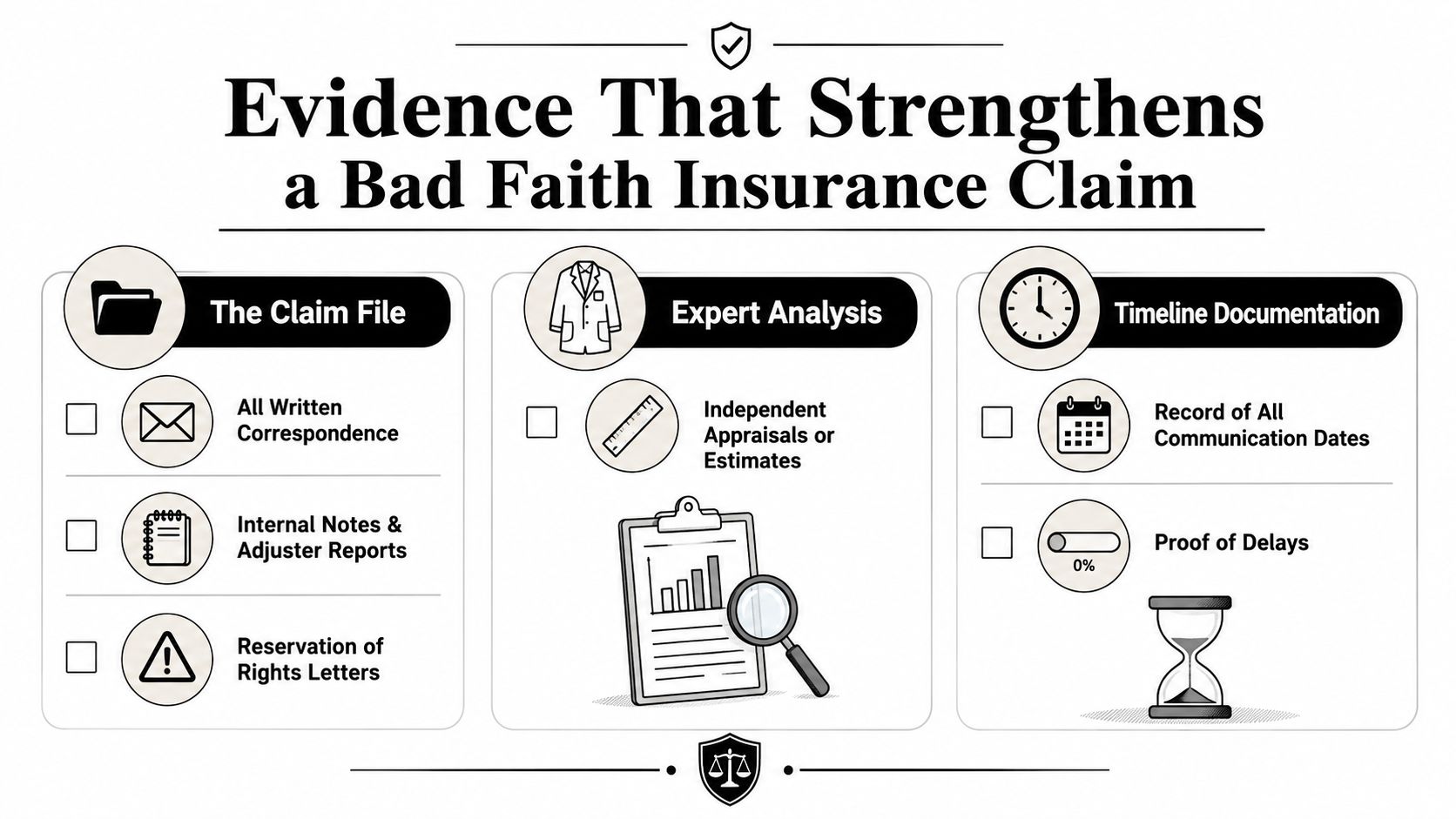
Independent opinions can matter when an insurer relies on an engineering report, repair estimate, medical review, or other objective explanation. An independent expert or peer review may identify missing facts, flawed assumptions, or damage the carrier overlooked. The expert must connect the opinion to the actual claim, not just disagree in general terms.
A bona fide coverage dispute can defeat a bad-faith theory even when you believe the insurer is wrong. The focus is whether the carrier had a reasonable basis and investigated fairly. Strong evidence shows why the carrier's process was unreasonable at the time of its decision.
Settlement Versus Lawsuit in Texas Bad Faith Disputes
Settlement is often practical when the carrier understands that the claim file creates litigation risk. A well-supported demand can identify the covered loss, liability evidence, medical or repair proof, policy terms, and deadline. In a third-party case, a qualifying Stowers demand can put the entire excess judgment at issue if a reasonably prudent insurer would have accepted it.
Pre-suit negotiation works best when the record is organized. A demand that says the insurer acted unfairly may produce a denial. A demand that identifies missed investigation steps, contradictory explanations, prompt-payment violations, and documented damages gives the carrier something concrete to evaluate.
Mediation can help when both sides need a neutral person to test their assumptions. It may resolve a coverage and damages dispute without the cost of depositions, expert challenges, and trial. It isn't always productive, particularly when the insurer refuses to acknowledge basic facts or withholds the claim file.
A lawsuit may become necessary when informal requests fail. Litigation can provide tools to examine the adjuster's work, claim supervisors' decisions, expert reports, communications, and reasons for delay. It also forces the parties to follow formal deadlines and evidence rules.
UM/UIM claims require special planning after the 2025 Texas Supreme Court ruling. The underlying liability and damages case generally proceeds before the extra-contractual bad-faith phase. That can reduce immediate discovery into the insurer's conduct, but it also clarifies what must be proved first. Your lawyer should weigh medical proof, fault disputes, policy language, costs, timing, and the likelihood that additional discovery will change the carrier's position.
How the Law Office of Bryan Fagan Can Help You Move Forward
A careful review starts with the accident and the insurance file, not with a demand for money. Counsel can help preserve photographs, crash reports, witness information, medical records, wage documentation, policy materials, claim correspondence, and repair evidence before important details disappear.
The Law Office of Bryan Fagan, PLLC offers a free case review and can develop a records-gathering plan for Texas accident victims and families. The firm handles matters involving car collisions, truck crashes, wrongful death, catastrophic injuries, and uninsured or underinsured motorist disputes. A Houston car accident attorney may examine whether the at-fault driver caused the crash, whether comparative responsibility could be raised, and how the insurer is evaluating your losses.
Reviewing the carrier's conduct
A lawyer can request and analyze the claim-handling record, including denial letters, adjuster communications, investigation materials, demand responses, and internal carrier communications obtained through the legal process. That review helps distinguish a legitimate coverage dispute from conduct that may support Chapter 541, common-law, or prompt-payment claims.
For a serious commercial collision, a truck crash lawyer Houston families trust should also examine driver records, company policies, vehicle information, electronic evidence, and the carrier's settlement position. If a fatal crash occurred, a wrongful death lawyer Texas families consult can coordinate the injury claim with the family's losses and the applicable filing deadline.
Planning the case
Counsel can prepare a Stowers demand when the evidence and settlement terms support one. In UM/UIM litigation, the lawyer should plan around bifurcation and abatement, proving liability and damages before pursuing the extra-contractual phase. Mediation may be appropriate, while a lawsuit may be needed to obtain depositions and formal discovery.
The firm represents eligible clients on a contingency-fee basis, meaning there's no fee unless it wins. Its Houston presence includes Harris, Fort Bend, Montgomery, and Brazoria counties. Contacting counsel early gives you a better chance to protect evidence and evaluate the two-year limitations periods before they expire.
The Law Office of Bryan Fagan, PLLC offers free consultations for Texans facing delayed, denied, or underpaid insurance claims after an accident. Contact the firm to review your claim history, protect your deadlines, and determine whether settlement or litigation is the right next step. Recovery is possible, and experienced legal help is available.


