A serious accident can change your life in seconds — but you don’t have to face it alone. In Texas, it’s illegal for any driver to read, write, or send an electronic message while their vehicle is in motion. This law is supposed to keep our roads safe, but the tragic reality is that crashes caused by someone's inattention happen every single day across the state. If you've been injured or lost a loved one, understanding your rights is the first step toward justice.
Your Life Changed in an Instant, But You Are Not Alone
A crash on a Houston freeway can shatter your world in a moment. One second, you're driving along I-10 or the 610 Loop, and the next, you're dealing with the shock, pain, and confusion of an accident caused by someone else's carelessness. We understand what you're going through, and you don’t have to navigate this overwhelming experience by yourself.
This guide is designed to give you clear, straightforward answers about distracted driving laws in Texas and explain how they empower you to seek justice. We'll walk you through exactly what the law says, how a driver's violation can strengthen your injury claim, and the practical advice you can use to protect your right to compensation.

Why Understanding These Laws Matters for Your Claim
After a serious accident, knowledge is the first step toward getting your life back. When a driver chooses to text, use an app, or otherwise take their focus off the road, they aren't just breaking the law—they are acting negligently. Under Texas personal injury law, that negligence is the key to holding them accountable for the harm they've caused you.
According to the Texas Department of Transportation, distracted driving caused 487 deaths and over 2,800 serious injuries in just one recent year. These aren't just numbers on a page; they represent real families whose lives were turned upside down in an instant.
A car traveling at 55 mph can cover the length of a football field in just five seconds—the average time it takes to read a single text message. This small distraction can have catastrophic consequences.
At The Law Office of Bryan Fagan, PLLC, our job is to connect the dots between the other driver's illegal actions and your injuries and losses. Proving they were distracted is a critical part of building a successful claim for the damages you're facing, including:
- Mounting medical bills from the emergency room, surgeries, and ongoing rehabilitation.
- Lost income from the time you were forced to miss work while trying to recover.
- The immense pain and suffering the accident has inflicted on your life.
Whether your accident involved a car, a large commercial truck, or resulted in the tragic loss of a loved one, you have rights. A Houston car accident attorney can help you stand up to the insurance companies and fight for the fair compensation you deserve. You are not just another case number to us; you are a member of our community who needs a trusted advocate.
The Statewide Ban on Texting While Driving: What You Need to Know
The most important distracted driving law in Texas is the statewide ban on texting while driving. For a long time, Texas was one of the few states left without a universal law, which led to a confusing patchwork of different rules from city to city. Thankfully, that changed, creating a single, clear standard that we can now use to protect crash victims like you.
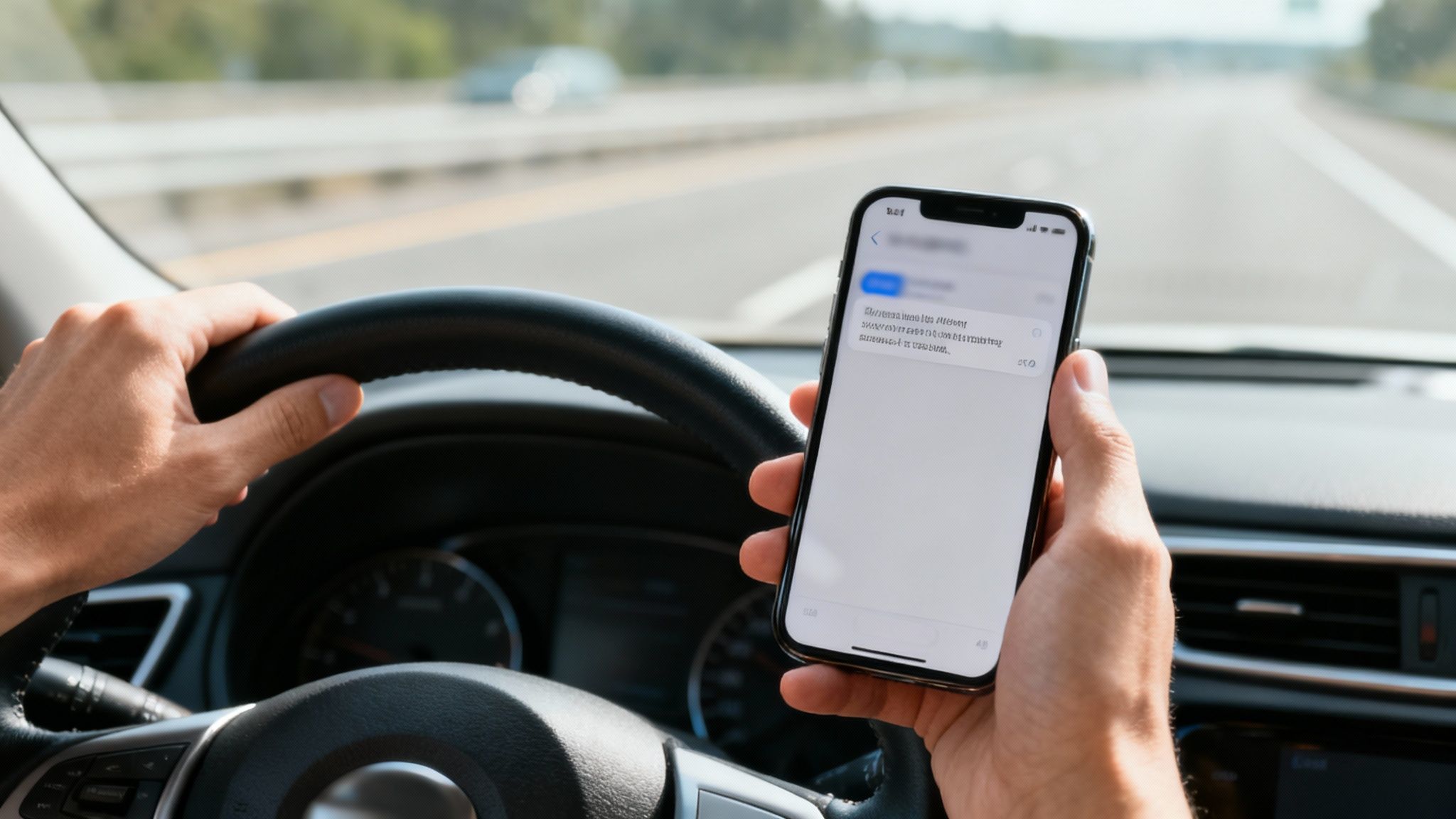
This law, officially known as House Bill 62, makes it illegal for any driver to use a handheld device to read, write, or send an electronic message while their car is moving. This isn’t just about SMS texts; it covers emails, social media messages, and pretty much any other digital communication. Knowing this rule is critical, because it can have a massive impact on your personal injury case.
When a driver breaks this law and causes a wreck, their illegal action becomes powerful evidence of negligence. Think about a driver on I-45 in Houston who looks down to read a text. In that single moment, they've not only broken the law but have also recklessly endangered everyone around them. That illegal act is a key piece of the puzzle we use to hold them fully accountable for the harm they've caused.
The History And Impact Of The Law
Getting a statewide texting ban on the books was a long and difficult fight. It tragically took a major disaster to finally push the legislation across the finish line, showing just how devastating this preventable behavior can be. After several failed attempts over the years, House Bill 62 was finally signed into law and went into effect on September 1, 2017.
The final push for this change came after a horrific crash on March 29, 2017, near San Antonio, where a driver who was texting killed 13 people on a church bus. That event stirred public outrage and made it impossible for lawmakers to ignore the problem any longer. Today, fines for a first offense start between $25 and $99 and jump to $100-$200 for repeat offenders, signaling that the state is serious about cracking down.
While those fines might seem low, the legal impact of a texting-while-driving ticket in a personal injury claim is huge. It clearly establishes that the driver failed in their basic duty to operate their vehicle safely.
For families who have lost a loved one in a wrongful death caused by a distracted driver, this law provides a solid foundation for seeking justice. A wrongful death lawyer Texas can leverage the driver's violation of this statute to build an undeniable case that their carelessness directly led to your family's tragic loss.
What The Law Prohibits In Detail
The Texas texting ban is very clear about what counts as an "electronic message." It’s not just about old-school SMS texts. The law was written broadly to make sure it covers the way we communicate today.
Here’s a simple rundown of what’s illegal to do in a moving vehicle:
- Reading a text message from a friend or family member.
- Typing out an email to a colleague on your phone.
- Sending a message on a social media app like Facebook Messenger or WhatsApp.
- Looking at any written communication on a handheld device.
Now, there are a few specific exceptions. You are still allowed to use your phone for its GPS navigation system, to play music, or to make hands-free calls. The crucial difference is the physical act of reading or manually typing out messages. If a driver’s hands and eyes are tied up with a screen to communicate, they are breaking the law and putting lives at risk. When that negligence leads to a truck crash in Houston, the results can be catastrophic, and proving the violation is the first step toward getting the compensation you deserve.
Beyond Texting: Other Critical Distracted Driving Rules
The statewide texting ban gets most of the attention, but it’s really just the tip of the iceberg when it comes to distracted driving laws in Texas. A driver’s dangerous inattention can take many forms, and the law has evolved to address these other risks. Understanding the full scope of these rules is a game-changer for a personal injury claim.
Proving the at-fault driver was doing anything illegal with their phone—not just texting—can dramatically strengthen your case for compensation. Whether they were adjusting a GPS, taking a call in a restricted zone, or scrolling through an app, each action shows a clear disregard for the safety of everyone else on the road. We know exactly how to use that evidence to hold them accountable.
Stricter Rules in Sensitive Areas
Texas law gets even tougher on drivers in places where people are most vulnerable, especially children. This is why there’s a complete ban on using a handheld cell phone for any reason in an active school zone. It doesn’t matter if you’re making a call, checking directions, or just holding the device—it’s illegal, period.
Imagine a parent inching along in a school pickup line while checking work emails. If they get distracted and hit another car or, worse, a child, violating that specific rule is powerful proof of their negligence. The same strict hands-free rules apply when you’re driving through an active construction zone with workers present, giving them a much-needed layer of protection from preventable tragedies.
Before the statewide ban passed, Texas laws were a patchwork of local ordinances and specific rules. It was the passage of House Bill 62 in 2017 that finally created a universal texting ban, which was later reinforced by laws requiring hands-free use in sensitive areas like school zones. You can learn more about how these distracted driving laws evolved on the official Laughlin Air Force Base website.
These specific restrictions aren't just about avoiding a traffic ticket; they set a clear standard of care that drivers are expected to follow. When they fail to meet that standard and you get hurt, a Texas personal injury lawyer can use their violation to build a rock-solid claim for your medical bills, lost income, and suffering.
Who Is Restricted From Driving With a Handheld Device in Texas?
To make it easier to understand, Texas law creates specific "no-go" zones and puts extra responsibility on certain types of drivers. Here's a quick rundown of who faces stricter rules on handheld device use.
| Driver Or Situation | Type Of Restriction | Governing Law |
|---|---|---|
| All Drivers | Ban on electronic messaging (texting, emailing) while driving. | Texas Transportation Code § 545.4251 |
| Drivers in a School Zone | Total ban on using a handheld device for any purpose. | Texas Transportation Code § 545.4252 |
| Drivers Under 18 | Complete ban on using any wireless communication device. | Texas Transportation Code § 545.424 |
| Drivers with a Learner's Permit | Total ban for the first six months of driving. | Texas Transportation Code § 545.424 |
| Bus Drivers with Passengers | Ban on all cell phone use when passengers are on board. | Texas Transportation Code § 545.425 |
These laws aren't suggestions—they are mandatory safety standards. A violation isn't just a mistake; it's negligence.
Special Regulations for Certain Drivers
The law also singles out specific groups of drivers and holds them to a higher standard, either because of their inexperience or the huge responsibility they carry. Knowing these extra rules can be crucial if your crash involved a young person or a commercial vehicle.
Texas law includes stricter regulations for:
- Drivers Under 18: Novice drivers are flat-out prohibited from using a wireless communication device for any reason. This total ban exists because the combination of inexperience and distraction is a recipe for disaster.
- Drivers with a Learner's Permit: For the first six months behind the wheel, new drivers with a learner's permit face the same complete ban on all cell phone use.
- Commercial Bus Drivers: Anyone operating a bus with passengers—including school bus drivers—is forbidden from using a cell phone while passengers are on board.
If you or a loved one suffered a catastrophic injury in a wreck caused by a teen driver on their phone or a distracted bus driver, these specific prohibitions become the core of your case. They offer undeniable proof that the driver was not only being careless but was actively breaking a law designed to prevent the exact harm you suffered. This gives your attorney the leverage needed to fight back against insurance companies and get you the justice you deserve.
How a Distraction Violation Strengthens Your Injury Claim
When another driver's carelessness turns your life upside down, Texas law provides a clear path to hold them accountable. The first step is understanding how a simple traffic ticket—like one for texting while driving—can become the cornerstone of your entire injury claim. This is where legal rules have a direct, real-world impact on your case.
A distracted driving ticket is a powerful piece of evidence within personal injury law. It serves as undeniable proof that the other driver failed in their most basic duty: to operate their vehicle safely and pay attention. That single violation can build the foundation for a successful recovery.
The Power of Negligence Per Se
In a typical car wreck case, your attorney must prove the other driver was negligent—a legal term for being careless and causing your injuries. But when a driver breaks a safety law, like the Texas-wide texting ban, we can use a powerful legal shortcut called negligence per se.
Think of it like this: negligence per se means "negligence in itself." If we can show the driver broke a safety law designed to prevent the very type of harm you suffered, the court automatically considers them negligent. This is a game-changer for your case.
Instead of building an argument from the ground up to show the driver was careless, their illegal action speaks for itself. The ticket proves their fault, clearing a major hurdle so we can focus on proving the full extent of your injuries and losses.
This is exactly why finding a violation of Texas's distracted driving laws is so critical. It cuts through the excuses and sends a clear message to the insurance company that their client was flat-out wrong.
How Long Do You Have to File a Claim in Texas?
In Texas, you generally have two years from the date of the accident to file a personal injury lawsuit. This deadline is known as the statute of limitations. While it may seem like a long time, it is critical to act quickly. Building a strong case takes time, and evidence like witness memories and surveillance footage can disappear. Missing this deadline means you lose your right to seek compensation forever.
How Texas Comparative Fault Rules Work
What happens if the insurance company tries to blame you, even just a little bit, for the crash? This is a common tactic. But Texas has a specific rule to keep things fair, known as modified comparative fault, or the 51% Bar Rule.
Here’s what it means for you: you can still recover money for your injuries even if you were partially to blame, as long as your share of the fault is 50% or less. The court simply reduces your total compensation by your percentage of fault.
For example, after a Houston freeway crash, a jury awards you $100,000 but decides you were 10% at fault. You would still walk away with $90,000. If, however, they find you 51% or more to blame, you get nothing. Proving the other driver was illegally distracted makes it incredibly difficult for an insurance adjuster to successfully pin a large chunk of the blame on you.
How We Prove The Other Driver Was Distracted
After a crash, it's a safe bet the other driver will deny they were on their phone. Why wouldn't they? Admitting it is admitting fault, and their insurance company will stand right behind that denial. This is exactly where our experience becomes your most powerful tool. We know how to dig for the truth and build a case that the insurance company can't ignore.
Proving a driver was distracted isn't a guessing game; it's a methodical, step-by-step investigation. Our team uses specific legal strategies to get our hands on the kind of evidence that exposes the other driver's negligence and forces them to take responsibility for the harm they've caused. This proof is the bedrock of your claim for the compensation you deserve.
Gathering The Necessary Evidence
Building a rock-solid distracted driving claim takes more than just your word against theirs. It demands hard, undeniable proof. We use the power of the legal system to access critical information you could never get on your own.
Our process is designed to uncover the facts, and it often includes:
- Subpoenaing Cell Phone Records: We can legally compel the at-fault driver's cell phone provider to turn over their records. These documents show exact timestamps for calls, texts, and data usage, creating a clear timeline we can match to the moment of the crash.
- Analyzing the Police Report: We comb through the official police report, looking for any notes the responding officer made about driver inattention, comments from witnesses, or anything the other driver might have admitted at the scene.
- Interviewing Eyewitnesses: We track down and speak with anyone who saw what happened. A bystander who noticed the driver looking down at their phone right before impact can provide incredibly powerful testimony.
- Retrieving Black Box Data: Most modern cars are equipped with an Event Data Recorder (EDR), or "black box." This device records crucial data like speed, braking, and steering in the seconds before a collision. A lack of any evasive action is a classic sign of a distracted driver.
Proving distraction often comes down to connecting the dots. A cell phone record showing a text was sent at 2:15 PM, combined with a 911 call reporting the crash at 2:16 PM, tells a compelling story that a jury and an insurance adjuster cannot ignore.
This is where our years of experience make all the difference. We know what to look for, how to get it legally, and how to use it to hold negligent drivers accountable.
Using Evidence to Prove Negligence
Once we have this evidence in hand, we piece it together to paint a clear picture of what really happened. For example, in a severe T-bone collision on a San Antonio road, the other driver swore our client ran a stop sign. It was a classic he-said, she-said—until we subpoenaed his phone records. Those records proved he was on a FaceTime call at the exact moment of impact. That single piece of evidence turned the entire case around, proving his distraction was the real cause of the crash.
In more complex accidents, especially those involving commercial vehicles, a truck crash lawyer Houston might bring in specialists to analyze the crash scene itself. You can learn more about how an accident reconstruction expert witness can help establish the facts of your case. Our goal is simple: leave no stone unturned in the fight to get you the recovery you need.
Practical Advice: What to Do After a Distracted Driving Accident
In the chaotic moments after a serious accident, it's completely normal to feel shocked, scared, and unsure of what to do next. But the actions you take right then and there can make a huge difference for your health and your ability to file a successful claim down the road.
Think of this as your roadmap for the minutes, hours, and days following a crash caused by a distracted driver. Each step is designed to protect your rights and set the foundation for your recovery.
Prioritize Your Health Immediately
Your first and most important job is to take care of yourself. You must seek immediate medical attention, even if you feel fine. The adrenaline that floods your system after a crash is a powerful painkiller, and it can easily mask serious injuries like whiplash, internal bleeding, or even a traumatic brain injury.
Getting checked out by paramedics at the scene or heading to an emergency room does two critical things. First, it ensures you get the care you need. Second, it creates an official medical record that directly links your injuries to the accident, stopping an insurance company from later claiming your injuries aren't that serious or were caused by something else.
Document Everything You Can at the Scene
If you're physically able to, gathering evidence at the scene is invaluable. You don't have to be a detective—just capture the facts before they disappear.
Use your smartphone to:
- Take photos and videos of both cars, their positions on the road, skid marks, and any nearby traffic signs or signals.
- Get the other driver's information, including their name, address, phone number, driver's license number, and insurance details.
- Identify potential witnesses and ask for their names and contact information. An independent account from a bystander can be incredibly powerful.
When you speak to the police, stick to the facts and stay calm. If you saw the other driver looking at their phone or have any reason to suspect they were distracted, tell the officer. Your statement can ensure this suspicion is noted in the official police report. For a more detailed guide, you can learn more about what to do after a car accident in our comprehensive article.
How to Handle Insurance Companies
It won't be long before you get a call from the other driver's insurance adjuster. They might sound friendly and concerned, but you have to remember their one and only goal: to pay out as little as possible for your claim.
You should never give a recorded statement to the other driver's insurance company without first speaking to an experienced Houston car accident attorney. Adjusters are trained to ask tricky questions designed to get you to downplay your injuries or accidentally accept partial blame.
A simple "I'm okay" can be twisted to mean you weren't hurt at all. An apology can be used as an admission of fault. The best move is to politely decline to give a statement and tell them your lawyer will be in touch. This simple step protects you from their tactics and defends your rights from day one.
The infographic below shows how we piece together the evidence needed to prove the other driver was distracted.
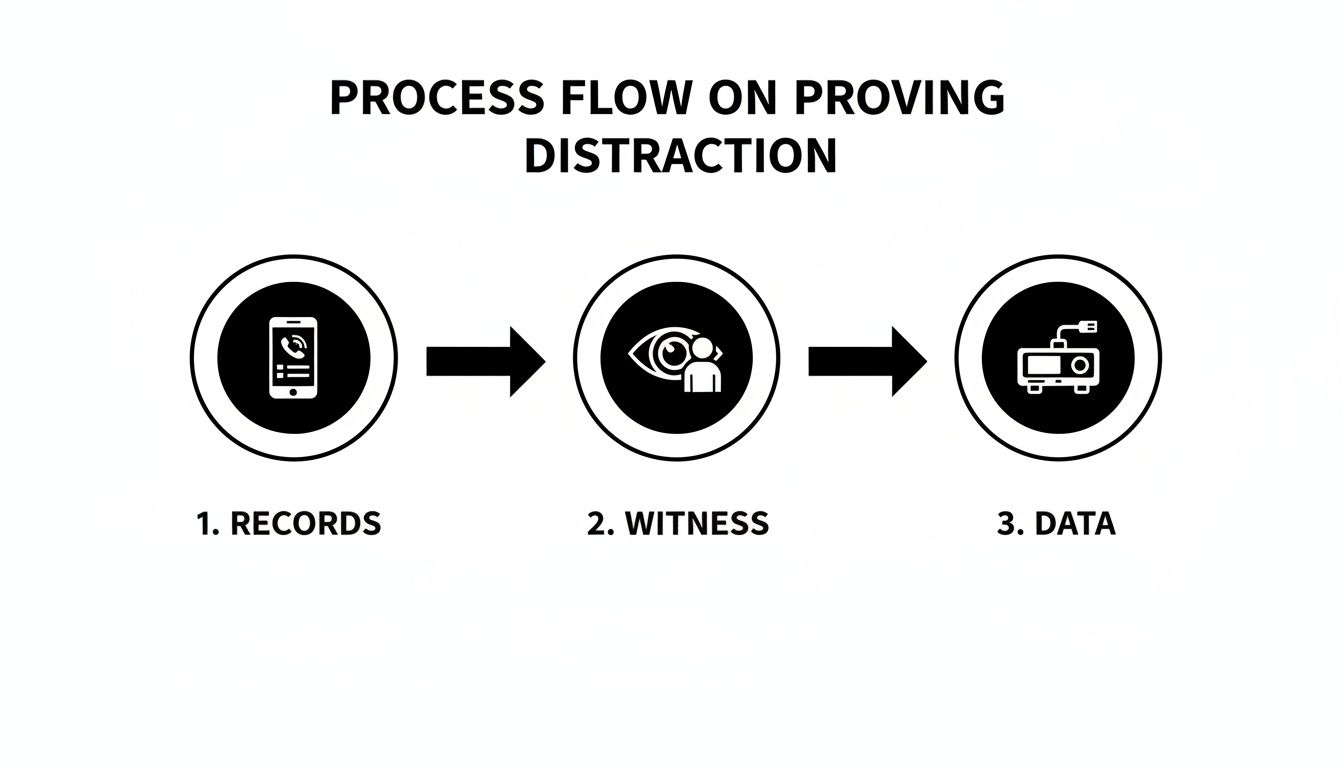
This process shows how we combine different types of evidence—from phone records and witness accounts to data from the vehicles themselves—to build a powerful and undeniable case.
When to Call a Lawyer: Take The First Step Toward Justice
Picking up the pieces after a serious crash is overwhelming, but you don't have to face it alone. The distracted driving laws in Texas were put in place to protect people exactly like you, and our firm is here to make sure those laws deliver justice. Proving another driver was distracted takes the right legal strategy, but it can be done—and you have every right to seek full compensation for what you've lost.
Your Path Forward Starts Here
You deserve to be compensated for your medical bills, the income you've lost, and the enormous pain and suffering you’ve been forced to endure. We invite you to take the first step by scheduling a free, no-obligation consultation with our experienced team.
We know firsthand the financial pressure that builds up after a wreck. That's why we work on a contingency fee basis. Put simply, it means you pay absolutely nothing unless we win your case. As you get ready to take action, it can also be helpful to understand practical details, like how a retainer works with a lawyer, to get a clearer picture of the process.
Recovery is possible, and dedicated legal help is available. Let us provide the clarity and support you need to move forward with confidence and secure the justice you deserve.
Choosing the right legal advocate is one of the most important decisions you'll make. To help you feel confident in your choice, our guide on how to pick a personal injury attorney offers some valuable insights. Let our team handle the legal fight so you can focus on what truly matters—healing.
At The Law Office of Bryan Fagan, PLLC, we are ready to listen to your story and fight for your rights. Contact us today for a free consultation to learn how we can help you on the road to recovery. Visit us at https://www.texaspersonalinjury.net.