A serious accident can change your life in seconds — but you don’t have to face it alone. If you're a rider in Texas, you need straight answers about your rights, especially after a wreck. At The Law Office of Bryan Fagan, PLLC, we understand the unique challenges you face, and we're here to provide the clarity and support you need.
One of the most common questions we hear is, "can motorcycles split lanes in Texas?" The answer is simple and direct: lane splitting is illegal in Texas.
The Straight Answer on Lane Splitting in Texas

For a long time, the legality of lane splitting—riding your bike between two lanes of slow or stopped cars—was a bit of a gray area. There wasn't a specific law on the books that explicitly forbade it, which created a ton of confusion for both riders and drivers. This legal fog often made things incredibly complicated after a crash, leaving injured motorcyclists wondering where they stood.
That ambiguity is now a thing of the past.
Let's be perfectly clear: lane splitting is now officially illegal in Texas. This change came with House Bill 4122, which Governor Greg Abbott signed into law in 2023. The bill added Section 545.0605 to the Texas Transportation Code, spelling out in no uncertain terms that motorcyclists must operate within a single marked lane.
There's no more wiggle room. Riding between lanes of traffic is a violation.
Understanding the Current Law
This new law finally gives everyone much-needed clarity. On one hand, it reinforces that motorcyclists are entitled to the full use of their lane. Other vehicles can’t legally squeeze you or crowd you out of your space. But that right comes with a clear responsibility: you have to stay within a single, marked lane.
Any move where you ride on the line between cars is now against the law.
To help you get a quick handle on the rules, here’s a simple breakdown of the current law.
Texas Lane Splitting Law at a Glance
This table provides a quick summary of the most critical information about the legality, penalties, and safety risks of lane splitting in Texas.
| Aspect | Key Information |
|---|---|
| Legal Status | Illegal as of 2023 under Texas Transportation Code § 545.0605. |
| What's Prohibited | Operating a motorcycle between marked lanes of traffic moving in the same direction. |
| What's Allowed | Operating entirely within a single marked lane; riding two abreast in one lane. |
| Common Penalty | A traffic citation and fine for improper lane usage. |
| Impact on Injury Claims | Can be used by insurance companies to assign fault to the motorcyclist. |
As you can see, the law is straightforward, but its implications after an accident are anything but.
If you've been hurt in a crash where lane splitting was involved—whether you were the one riding or you were in the other vehicle—it is absolutely critical to understand how this law impacts your case. Insurance adjusters are already using it to try and deny claims outright.
A serious crash on a Houston freeway is a devastating event. Knowing the law is the first step, but understanding how it applies to fault, negligence, and your right to compensation is where an experienced Texas personal injury lawyer becomes your greatest asset. Your actions matter, but so do the actions of every other driver on the road.
Why the Law Exists: The Risks and Realities
To understand the law, it helps to understand the "why" behind it, especially when it directly impacts your safety. The Texas law against lane splitting wasn’t created to inconvenience bikers; it was written to prevent tragedies. The ban is rooted in the very real, split-second dangers that arise when a motorcycle tries to squeeze between lanes of cars.
From a driver's perspective, a motorcycle appearing suddenly between lanes can feel like it came out of nowhere. This surprise factor eliminates a driver's ability to see the rider, particularly in their blind spots. A simple, everyday lane change can turn catastrophic in an instant.
The Dangers Hiding in Congested Traffic
Picture this: you're stuck in rush hour traffic on I-10 in Houston. Cars are jockeying for position. Now, imagine a motorcyclist trying to thread the needle right next to you. If another car swerves unexpectedly or you need to merge over, there is absolutely zero time for anyone to react.
That lack of reaction time is a core reason the law is on the books. The tight space between cars leaves no escape route for a rider if someone opens a door, makes a sudden lane change, or traffic slams to a halt. The law is designed to protect everyone—riders and drivers alike—from these incredibly high-risk situations.
The numbers behind these risks are chilling. Texas saw over 700 motorcycle fatalities in 2023, a truly staggering figure. Lane-related maneuvers are a factor in 15-20% of crashes in urban areas, especially in notorious congestion zones like Dallas' I-35 or Austin's MoPac Expressway. While riders are already more vulnerable everywhere, trying to split lanes in Texas illegally sends that risk through the roof—over 50% of multi-vehicle motorcycle deaths are linked to blind spots and drivers misjudging distances.
Protecting Everyone on the Road
Ultimately, the ban on lane splitting is about creating predictability and safety for everyone sharing the road. When every vehicle stays in its designated lane, it fosters a more orderly and far safer environment. Drivers can anticipate what others will do, and riders have the full width of their lane to maneuver and stay safe.
Of course, accidents still happen even with these laws in place. Often, they are caused by the negligence of other drivers and have nothing to do with what the motorcyclist was doing. One of the biggest culprits in devastating collisions is distracted driving, which puts every single person on the road in danger. You can learn more about how Texas distracted driving laws impact injury claims in our detailed guide.
After a serious wreck, it's completely normal to feel overwhelmed and unsure of what to do next. Just remember, even if the details of your crash seem messy or complicated, you have the right to get answers and hold the people who hurt you accountable.
An experienced Texas personal injury lawyer knows how to investigate these complex accidents. Our job is to uncover the truth and fight for the compensation you need to put your life back together.
How Lane Splitting Can Impact Your Injury Claim
When you're injured in a motorcycle accident, it's natural to worry, "Was any of this my fault?" This fear is especially common if you were lane splitting. You might believe that because it's illegal in Texas, you've automatically lost any right to compensation.
But that's not necessarily true. The situation is more nuanced.
Texas law uses a legal principle called modified comparative responsibility (or comparative negligence) to determine who can recover money after an accident. The core idea is straightforward. After a crash, the evidence is reviewed to assign each person involved a percentage of the total blame.
Understanding Your Percentage of Fault
Your ability to receive compensation depends entirely on your assigned percentage of fault. Here’s how it works:
- You can recover damages if you are 50% or less at fault. Your final award is simply reduced by your percentage of blame. For example, if a jury finds you were 20% at fault for lane splitting, but the other driver was 80% at fault for texting while driving, you can still collect 80% of your total damages.
- You cannot recover any damages if you are 51% or more at fault. This is the critical cutoff, often called the 51% bar rule. If you're found to be mostly responsible for the crash, Texas law blocks you from collecting anything from the other party.
This rule is precisely why the other driver's insurance company will fight hard to shift as much blame onto you as possible. They know if they can push your percentage of fault over that 51% line, they might avoid paying you anything.
The chaos after a wreck is confusing, but your right to seek justice shouldn't be. Getting a ticket for lane splitting does not automatically kill your injury claim. Often, the other driver's negligence—like speeding, drifting, or making a sudden lane change without looking—is the real reason the collision happened.
This infographic clearly illustrates how a rider's decision in traffic can dramatically shift their level of risk.
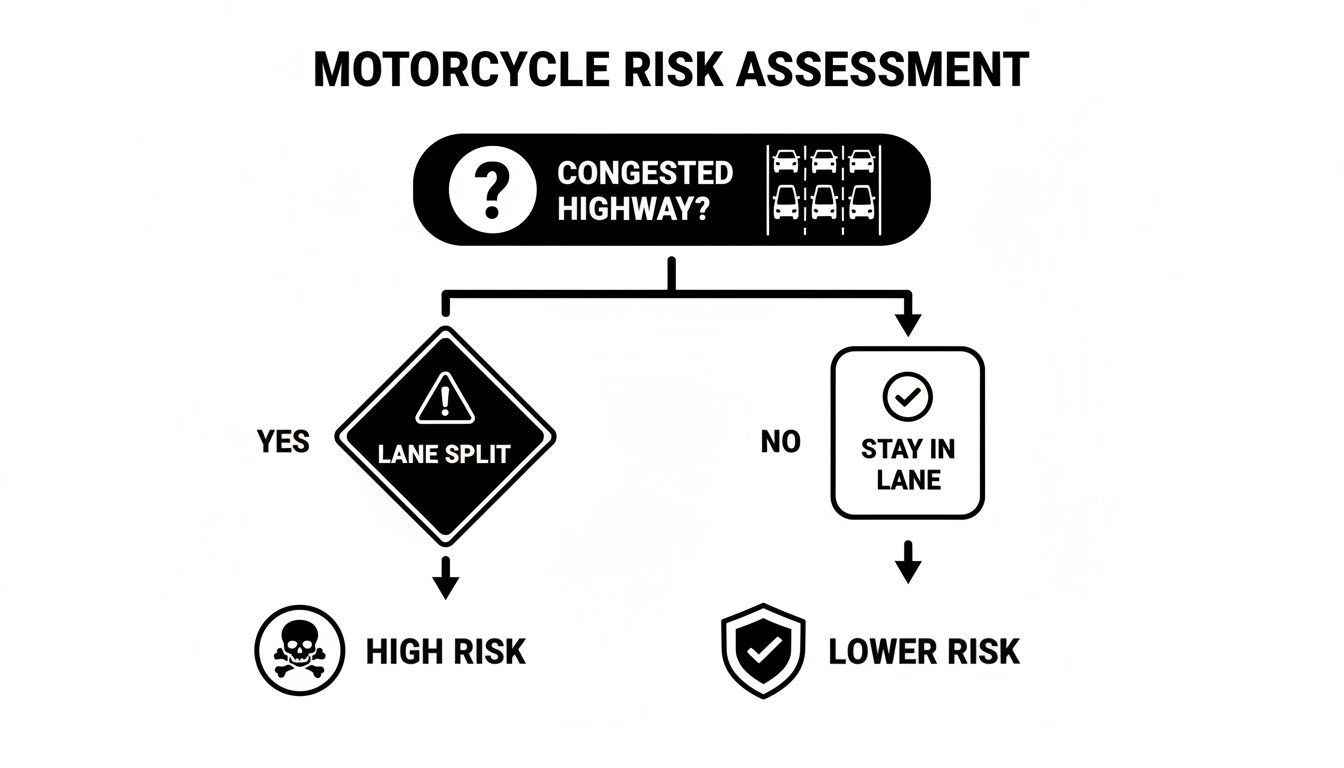
As you can see, choosing to stay in your lane when traffic gets heavy is a much lower-risk move than trying to weave between cars.
How a Houston Car Accident Attorney Fights Back
An experienced Texas personal injury lawyer has seen these insurance company tactics countless times. Our job is to build a rock-solid case that proves the other driver was the primary cause of your injuries. We dig for evidence, track down witnesses, and bring in accident reconstruction experts to piece together what really happened.
For instance, after a Houston freeway crash, an insurance adjuster might immediately blame the motorcyclist for lane splitting. But what if our investigation uncovers that the car driver swerved abruptly without signaling because they were replying to a text? In that case, the driver's distraction is a far bigger piece of the fault pie. We fight to make sure the blame is assigned correctly so you can focus on getting better.
You can learn more about how our dedicated legal team untangles these complex situations by exploring the details of a typical motorcycle accident claim. Your recovery is possible, and having skilled legal help is the first step toward securing it.
Lane Splitting vs. Lane Sharing: What Texas Law Actually Permits

When you're trying to understand your rights after a motorcycle crash, the exact words the law uses are everything. For riders, one of the most critical distinctions is the difference between "lane splitting" and "lane sharing"—and it's a distinction insurance adjusters often try to blur to avoid paying a fair claim.
Simply put, lane splitting means riding your motorcycle on the line between two lanes of cars. That's illegal. Lane sharing, on the other hand, is a perfectly legal and common practice for riders in Texas.
So, What Is Legal Lane Sharing in Texas?
The Texas Transportation Code gives a clear green light for two motorcyclists to ride side-by-side within the same marked lane. This is called lane sharing, or riding "two abreast," and it’s a fundamental right for riders who want to travel together safely while taking up about the same space as a regular car.
Here's the easiest way to remember it:
- Lane Splitting: One motorcycle weaving between two separate lanes of traffic. This is illegal.
- Lane Sharing: Two motorcycles riding next to each other, staying entirely within the boundaries of a single lane. This is legal.
Insurance companies are experts on this distinction. If you were hurt while legally sharing a lane with a friend, don't be surprised if the at-fault driver's insurance adjuster tries to twist your actions into illegal "lane splitting" to pin the blame on you.
Why Confusing the Two Has Serious Consequences
The legal consequences of these two actions couldn't be more different. Getting ticketed for splitting lanes can result in fines of $175 or more and could even lead to a reckless driving charge. It also creates a huge challenge for your injury claim.
Under Texas's comparative responsibility law, if you are found to be more than 50% at fault for an accident—which can happen if you were illegally lane splitting—you are barred from recovering any money for your injuries.
For example, after a Houston freeway crash, two friends are riding side-by-side (lane sharing) on US-290. Suddenly, a car drifts into their lane without signaling, causing a serious crash. This is a clear case of driver negligence. But if an insurance adjuster claims the riders were "improperly splitting lanes," they are deliberately misrepresenting the law to get out of paying a legitimate claim.
While knowing the rules for your bike is essential, it can also be helpful to see how other vehicles are regulated, like in this breakdown of electric bike laws by state. A skilled Houston car accident attorney will shut down these unfair insurance company tactics and make sure the facts of your case are presented clearly and truthfully.
What to Do Immediately After a Motorcycle Accident

A motorcycle crash is terrifying and disorienting. In the chaotic moments that follow, it can be almost impossible to think clearly. However, the steps you take right after the wreck are crucial for protecting both your health and your legal rights. Your top priority should always be your safety.
Practical Advice for Accident Victims
- Prioritize Safety: If you can, move yourself and your bike out of traffic to avoid a second collision.
- Call 911: Report the accident and request emergency medical services. An official police report is vital evidence.
- Seek Medical Attention: Get a medical evaluation immediately, even if you feel fine. Adrenaline can mask serious injuries like internal bleeding or concussions. This also creates a medical record linking your injuries to the crash.
- Gather Evidence: If you are physically able, use your phone to take photos and videos of the scene, vehicle damage, your injuries, and the other driver's license, insurance card, and license plate.
- Get Witness Information: If anyone saw what happened, politely ask for their name and contact information. Independent witness testimony can be incredibly powerful.
- Be Careful What You Say: Do not apologize or admit fault to anyone. Stick to the basic facts when speaking with the police.
How to Handle Insurance Companies
You will likely get a call from the other driver’s insurance adjuster very quickly. Be extremely cautious. Their goal is to minimize their company's payout.
You are not required to give a recorded statement to the other driver's insurance company. It is in your best interest to politely decline until you have spoken with a Texas personal injury lawyer.
Simply provide the basic facts about when and where the accident occurred. Do not discuss fault, and do not downplay your injuries by saying "I'm okay." Anything you say can be used against you. The safest response is to tell them your attorney will be in touch.
A serious crash can make you feel like your world has shattered, especially when you've been hit by a car and are facing a long, painful recovery. Taking these steps helps protect you. When you call a lawyer, you get an advocate who can handle the legal fight so you can focus on healing.
How Our Texas Personal Injury Lawyers Can Fight for You
When you're recovering from a serious motorcycle crash, the last thing you should have to do is battle a large insurance corporation. Their goal is simple: protect their profits by paying you as little as possible. Our goal is to protect you. At The Law Office of Bryan Fagan, PLLC, we level the playing field.
We begin by launching our own immediate and thorough investigation into your crash. While you focus on your health, our dedicated team gets to work gathering police reports, interviewing witnesses, and collecting all your medical records. We leave no stone unturned.
Building a Powerful Case for You
Our approach is meticulous. We often work with accident reconstruction experts who use science and data to prove how the other driver's negligence caused your injuries. This hard evidence is crucial for defeating the tactics insurance adjusters use to shift blame onto you—especially if they try to unfairly use lane splitting as an excuse.
We take over all communication with the insurance companies, shielding you from their pressure and lowball settlement offers. Our experienced team, including skilled truck crash lawyers in Houston, fights for every penny of compensation you deserve for:
- All your medical bills, both present and future
- Lost wages and damage to your earning capacity
- Physical pain, emotional distress, and suffering
A serious injury can change your life in seconds—but you don’t have to face the aftermath alone. Our promise is simple: we don’t get paid unless we win your case.
Your recovery is the top priority. Let our experienced Texas personal injury lawyers handle the legal battle while you focus on healing. We are always prepared to take your case to trial if that’s what it takes to get the justice you and your family deserve.
How Long Do You Have to File a Claim in Texas?
In Texas, the law sets a strict deadline for filing a personal injury lawsuit, known as the statute of limitations. For most motorcycle accident cases, you have only two years from the date of the crash to file your claim.
If you miss this deadline, you will likely lose your right to seek compensation forever. Waiting is one of the biggest mistakes you can make. With each passing day, evidence can disappear, witnesses' memories fade, and the insurance company has more time to build a case against you. Contacting an attorney right away is the single best thing you can do to protect your rights and build the strongest possible case.
What if the Other Driver Was Texting and I Was Lane Splitting?
This scenario is a perfect example of how Texas's comparative responsibility rule works. The key question is: who was more at fault?
Even if you were technically lane splitting, a driver who was texting, drunk, or otherwise recklessly negligent will almost always bear the larger share of the blame in the eyes of a jury. The job of a Houston car accident attorney is to build a powerful case that proves it. If we can show the other driver was 80% responsible for the crash, you can still recover 80% of your damages. Never assume you don't have a case just because you might share some fault. Let us investigate the full picture first.
Will My Insurance Rates Go Up if I Was Ticketed for Lane Splitting?
It’s possible. A traffic ticket for an unsafe lane change can certainly lead to an increase in your insurance premiums.
However, our primary focus is on the bigger picture: securing the financial recovery you need for your medical bills, lost wages, and suffering. The value of a successful injury claim almost always dwarfs any potential increase in your insurance rates. A skilled lawyer can help you navigate both the personal injury claim and any related traffic citations to protect your financial future from every angle.
If you're curious about how state laws apply to other types of two-wheeled vehicles, this guide to Electric Scooter Laws By State is a helpful resource.
A serious injury can feel like an insurmountable challenge, but you don’t have to face it alone. Recovery is possible, and legal help is available. The compassionate and experienced attorneys at The Law Office of Bryan Fagan, PLLC are here to handle the legal fight so you can focus on healing. We invite you to contact us today for a free, no-obligation consultation to discuss your case. Let us listen to your story, answer your questions, and show you how we can help you move forward. Call us or visit https://texaspersonalinjury.net to get started.