A serious motorcycle accident can change your life in seconds—but you don’t have to face it alone. The moments after a crash are a blur of adrenaline, confusion, and pain. Your instincts might be all over the place, but the first few decisions you make are absolutely critical. They don’t just affect your physical recovery—they lay the groundwork for getting the compensation you deserve.
This guide provides clear, practical advice to help you navigate the aftermath of a crash. We'll explain your rights under Texas law and show you the steps you can take to protect yourself and your future.
Your Immediate Priorities After a Motorcycle Crash
In the chaos of a wreck, it's tough to think clearly. But your top priorities are simple: your health and your safety. Everything else can wait. A serious accident can change your life in seconds—but you don’t have to face it alone.
Protect Your Health First
We can't stress this enough: your health is everything. Even if you think you can walk it off, you need to get checked out by a medical professional. Adrenaline is a powerful painkiller, and it can easily mask life-threatening injuries like internal bleeding or a concussion.
- Call 911. No exceptions. This brings both paramedics and police to the scene. The paramedics will assess you for injuries that aren't obvious. The police will create an official crash report, which is one of the most important pieces of evidence you'll have.
- Go to the hospital if they tell you to. We've seen it happen time and time again. A rider gets into a crash on a Houston freeway, feels okay, refuses the ambulance, and then collapses hours later from a slow brain bleed. Don't take that risk. Your well-being is priceless.
- Tell the doctors everything. Every single ache, pain, scrape, or dizzy spell needs to be mentioned. This creates a direct medical link between the accident and your injuries, which is the foundation of any successful personal injury claim.
The flowchart below breaks down these essential first actions.
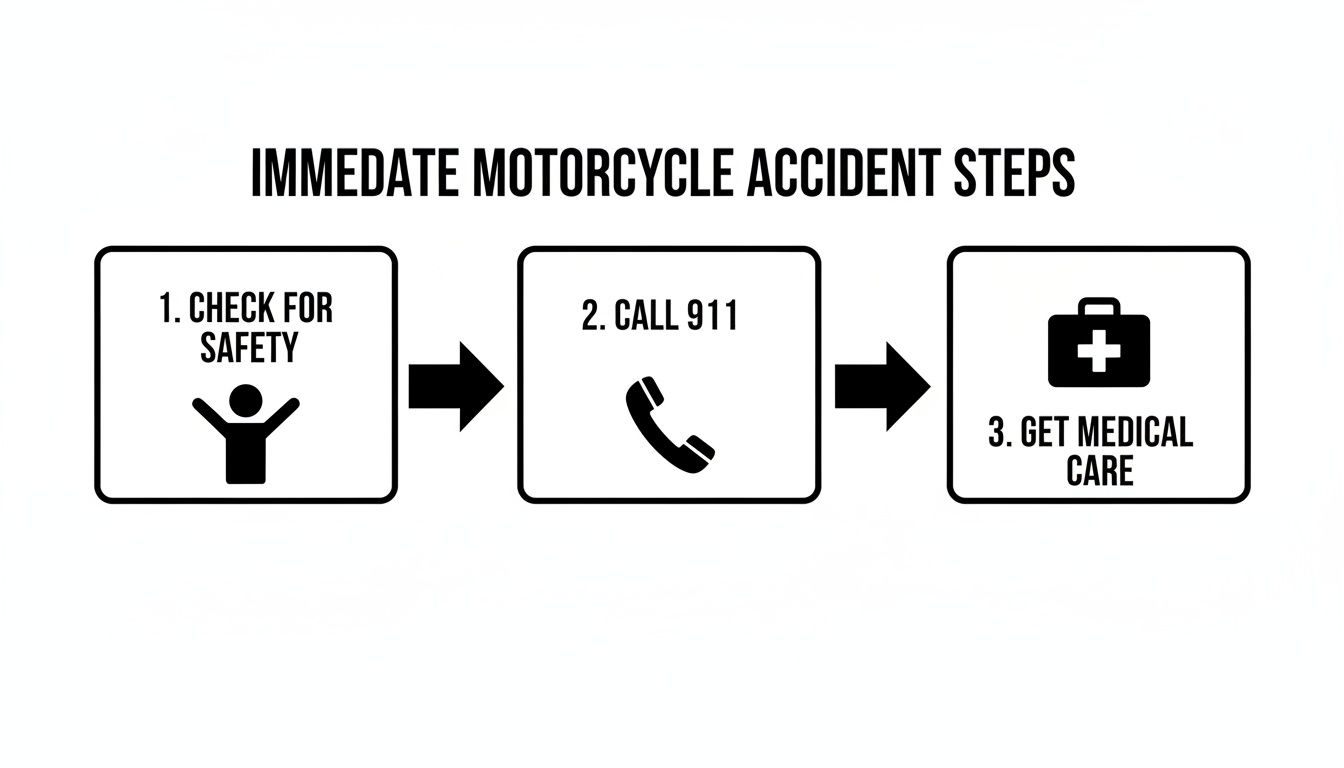
It really is that simple. Your well-being has to come before anything else.
To give you a quick reference for those chaotic first few minutes, here are the most important things to do right at the scene.
Immediate Post-Accident Safety Checklist
| Action | Why It's Critical |
|---|---|
| Call 911 Immediately | Summons medical help and ensures a police report is created. |
| Accept Medical Evaluation | Adrenaline can hide serious injuries like concussions or internal bleeding. |
| Move to Safety (If Able) | Prevents secondary accidents, especially on busy Texas highways. |
| Do Not Admit Fault | Avoid saying "I'm sorry" or anything that could be interpreted as taking blame. |
| Get Driver Information | Collect the other driver's name, insurance, and contact details. |
These steps are your first line of defense, both for your health and for any future legal action you may need to take.
Understand the Risks
The reality for riders is harsh. According to the National Highway Traffic Safety Administration, motorcyclists are about 28 times more likely to die in a crash per mile traveled than people in a passenger car. In 2022 alone, we lost over 5,500 riders in this country. These aren't just numbers; they're a stark reminder of why every crash needs to be taken seriously from the very first second. You can learn more about these sobering motorcycle accident findings and why immediate action is so vital.
Move to a Safe Location If Possible
After you've checked yourself for injuries, try to get out of harm's way if you can. The last thing you need is another vehicle hitting you or the crash scene.
If you're down in a live lane of traffic on a road like I-10 or the 610 Loop in Houston, your safety is the only thing that matters. Leave the bike. Get yourself to the shoulder or a median. Your motorcycle can be replaced; you can't.
Taking these initial steps—prioritizing your health and getting to safety—will not only kickstart your physical recovery but also build the foundation needed to hold the at-fault driver accountable. If you need help navigating this process, our team at The Law Office of Bryan Fagan, PLLC, is here to offer guidance from day one.
Gathering Crucial Evidence at the Scene
The moments after a motorcycle crash are chaotic, but if you're safely out of harm's way and physically able, what you do right then and there can make or break your case. Evidence has a very short shelf life. Skid marks fade, vehicles get towed, and even the weather can wash away proof of what really happened. While you wait for police and paramedics, becoming your own investigator is one of the most powerful things you can do.

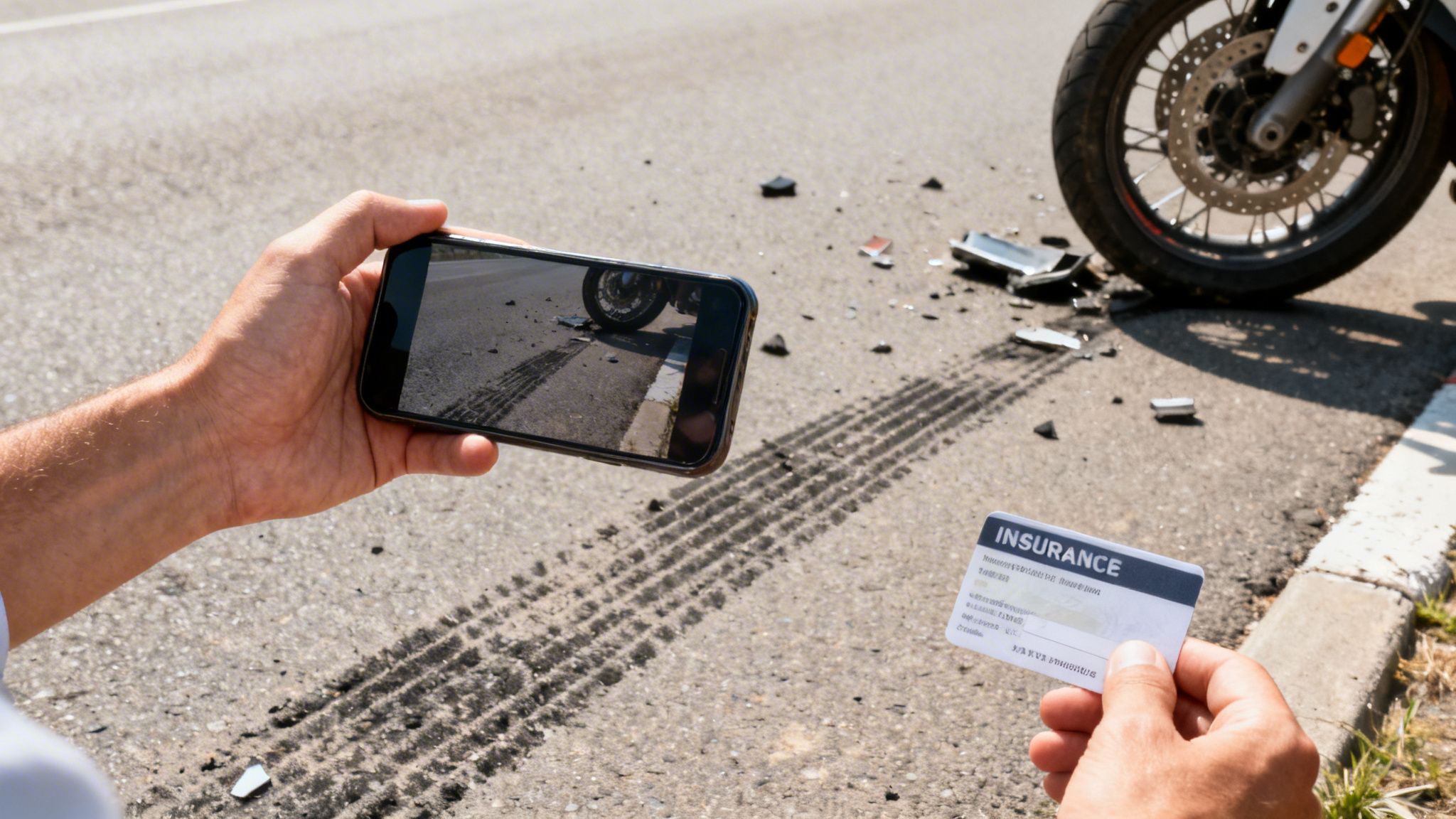
Your smartphone is your best friend in this situation. It allows you to create a visual record that can shut down the other driver's attempts to change their story later. Insurance companies will look for any excuse to deny a claim; photos don't lie.
What to Photograph at the Scene
Don’t just snap a couple of pictures. Take dozens from every angle you can think of. Get wide shots to show the whole scene, then move in for close-ups of specific details. You can never have too many photos.
Be sure to capture these key elements:
- Vehicle Positions: Document exactly where your bike and all other vehicles came to rest before they are moved. This is critical for accident reconstruction.
- Property Damage: Get detailed photos of the damage to your motorcycle, the other car, and any other property involved. This is essential for a potential truck crash lawyer Houston claim as well.
- Road Conditions: Take pictures of skid marks, shattered glass, potholes, loose gravel, or any other hazards that might have played a role.
- The Wider Area: Capture traffic signs, speed limit postings, and traffic signals. This helps establish the context of the crash.
- Your Injuries: Photograph any cuts, scrapes, bruises, or road rash you have. These images are powerful proof of the immediate physical toll of a catastrophic injury.
We recently handled a case where our client, after an intersection crash in Houston, took a quick photo of the other driver's front seat. That single picture showed a smartphone and a fast-food bag on the passenger seat—strong evidence that supported our claim the other driver was distracted.
Exchanging Information and Finding Witnesses
When dealing with the other driver, stay calm and stick to the facts. Never, ever apologize or say things like "I'm sorry" or "I didn't see you." Texas is an at-fault state, and any hint of an apology can and will be twisted into an admission of guilt by the insurance company.
Your only job is to get their information. Politely ask for their name, phone number, driver's license number, and insurance details. The easiest way to do this is to just take a picture of their insurance card and driver's license with your phone.
Next, look around for anyone who saw the crash happen. Independent witnesses are incredibly valuable because they have no stake in the outcome. Their testimony can be the key to proving negligence.
- Get Their Contact Info: Politely ask for their name and a good phone number.
- Note Their Viewpoint: Make a quick mental note of where they were standing or what they were doing. This helps establish their perspective.
A bystander who saw a car run a red light on a busy Dallas street provides the objective account needed to prove the other driver was at fault. While the police will also talk to witnesses, don't rely on them to get everyone. By gathering this information yourself, you’re giving your Texas personal injury lawyer the raw materials needed to build a powerful case and fight for the full compensation you deserve.
Handling Police and Insurance Company Calls
After the dust settles at a motorcycle accident scene, a different kind of challenge begins. You'll soon be dealing with phone calls—first from the police, then almost certainly from the other driver's insurance company. How you handle these conversations is critical. The words you choose can either protect your right to fair compensation or give an insurance adjuster exactly what they need to deny your claim.
It’s easy to feel intimidated, but you can take control by having a strategy. Remember, the responding officer is there to document the scene, and the insurance adjuster’s job is to protect their company’s bottom line—not yours. Your goal is to provide simple facts without saying anything that could hurt your case down the road.
What To Say To The Police Officer
When an officer arrives, they start building the official police report. This document is a cornerstone of any future injury claim, so it’s vital that your statement is both accurate and careful. Your best approach is to stick to the facts of what happened. Think in terms of a simple narrative. For example, "I was heading north on Main Street in the right lane. A blue car pulled out from a side street without stopping, and I couldn't avoid hitting it." Keep it simple and direct.
Here are a few common traps to avoid when speaking to law enforcement:
- Don't guess or speculate. If you aren't 100% sure about how fast you were going or the exact timing of events, just say, "I'm not sure." An incorrect guess can become a "fact" in the report that's difficult to challenge later.
- Never apologize. In Texas, saying "I'm sorry" can be twisted into an admission of fault, even if you were just being polite. It’s a hard habit to break, but it’s crucial.
- Don't minimize your injuries. Adrenaline is a powerful pain-masker. Never say "I'm fine" or "I'm okay." Instead, say you're feeling pain and that you'll be getting checked out by a doctor. This leaves the door open if more serious injuries appear hours or days later.
An officer’s initial assessment of fault often makes its way into the report. A calm, factual statement gives you the best chance of ensuring that report is accurate.
Navigating The Call From The Other Driver's Insurer
It won't be long before the at-fault driver's insurance adjuster calls you. They are trained professionals who often sound friendly and sympathetic, but their primary goal is to resolve your claim for the smallest amount of money possible.
The adjuster's favorite tool is the recorded statement. They will almost always ask for one, but you are under no legal obligation to give it. In our experience, these recordings are used to find inconsistencies in your story or get you to say something that undermines your claim. You should always politely but firmly decline.
We tell our clients to say something simple and direct: "I'm not prepared to give a recorded statement right now while I'm still processing what happened. Please direct any future communication to my attorney."
This response immediately stops the line of questioning and protects your rights. Never, ever accept a quick settlement offer. These initial offers are almost always lowball amounts that don't come close to covering the true cost of your medical bills, lost wages, and bike repairs. The world of insurance can be confusing, and even a basic understanding of your vehicle's insurance is a good starting point. Better yet, let an experienced motorcycle accident lawyer handle all communication with the insurance companies. It frees you up to focus on what really matters: your recovery.
Understanding Your Legal Rights Under Texas Law
When you’re dealing with the aftermath of a motorcycle wreck, the last thing you want is a complicated legal battle. But knowing your rights under Texas law isn't just about lawsuits—it’s about protecting yourself and your future. A few key rules can make or break your ability to get the compensation you need.
What is Negligence in Texas?
Texas is an "at-fault" state. This simply means the person who caused the accident is legally responsible for the damages. To get compensation, you (the injured rider) must prove the other driver was at fault. This is done by showing they were negligent.
Negligence is a legal term for carelessness. It means someone failed to act with the reasonable care any other person would have used in the same situation. Every driver has a duty to operate their vehicle safely. When a car accident or truck driver decides to text, speed, or make an illegal turn and hits you, they’ve breached that duty. That's negligence. Our job as Texas personal injury lawyers is to gather the evidence that proves it.
How Does Comparative Responsibility (the 51% Rule) Work?
This is one of the most critical rules in any Texas injury claim. It's officially called "modified comparative fault," but most people know it as the 51% Bar Rule. It’s a law that addresses the all-too-common scenario where the insurance company tries to blame you for the crash.
Here’s how it impacts your financial recovery:
- You can recover compensation as long as you are found to be 50% or less responsible for the accident. Your total award is just reduced by your percentage of fault.
- If you are found to be 51% or more at fault, you are barred from collecting any compensation. Your claim is worth zero.
Let’s use a real-world example: After a Houston freeway crash, you have $100,000 in damages. The jury decides you were 20% at fault because they believe you could have reacted a split-second sooner. Your final award would be reduced by 20% ($20,000), leaving you with $80,000. But if that same jury is convinced you were 51% to blame, your award drops to nothing. Insurance adjusters are masters at exploiting this rule, often trying to shift just enough blame onto bikers to avoid paying. This is exactly why you need a Houston car accident attorney to fight back.
How Long Do You Have to File a Claim in Texas?
Texas law gives you a strict window to file a lawsuit after an injury. This deadline is called the statute of limitations. For most personal injury claims, you have just two years from the date of the crash to file a lawsuit.
Two years might feel like a long time, but it disappears fast when you’re focused on surgeries, physical therapy, and just getting through the day. Building a strong case takes time—we have to investigate the crash, collect all your medical records, and negotiate with stubborn insurance companies.
If you let that two-year deadline pass, you lose your right to seek compensation forever. The court will dismiss your case, no matter how strong it is. This is true whether you're recovering from a serious injury or have lost a family member and need a wrongful death lawyer in Texas.
Texas Motorcycle Accident Legal Deadlines & Rules
| Legal Concept | What It Means for Your Claim |
|---|---|
| At-Fault System | You must prove the other driver's carelessness caused the wreck to receive compensation. |
| Comparative Responsibility | If you're found partially at fault, your compensation is reduced. If you're 51% or more at fault, you get nothing. |
| Statute of Limitations | You have a strict two-year deadline from the crash date to file a lawsuit in Texas, or your claim is lost forever. |
Understanding these rules makes it clear why time is not on your side. At The Law Office of Bryan Fagan, PLLC, we help riders navigate these laws and protect their rights. Schedule a free consultation with us today. Let’s talk about what happened and get you the clear answers you deserve.
Why an Experienced Motorcycle Accident Lawyer Matters
Trying to take on a massive insurance company by yourself after a serious motorcycle crash is a fight you shouldn't have to wage. Their adjusters and lawyers are trained professionals whose only job is to protect the company's bottom line—not yours. This is where an experienced motorcycle accident lawyer steps in, evening the odds and fighting for the justice you deserve.
The moment you hire our firm, you can feel a weight lift. We take over all communication with the insurance companies, period. No more fielding calls from adjusters trying to twist your words in a recorded statement or pressure you into a quick, lowball settlement. This creates a shield, allowing you to focus completely on what matters: your recovery.
Uncovering the Truth with Our Own Investigation
The insurance company's "investigation" is all about finding ways to deny or slash your claim. Our investigation is different. It’s built to find the truth and prove who was really at fault. We move fast to preserve critical evidence that can vanish in days, or even hours.
Our legal team consistently uncovers vital proof that insurance companies conveniently miss, including:
- Security and Traffic Camera Footage: We canvass nearby businesses and check for traffic cameras that may have recorded the crash, often providing an undeniable look at what happened.
- Expert Witness Testimony: We bring in accident reconstruction specialists who can analyze the physical evidence—skid marks, vehicle damage, road debris—to scientifically prove how the other driver’s negligence caused the wreck.
- Witness Statements: We track down and interview witnesses to lock in their unbiased accounts of the incident before memories fade, adding powerful support to your case.
This comprehensive approach allows us to build a claim based on solid facts, not the insurance company’s self-serving story.
Calculating the Full Cost of Your Accident
One of the biggest traps for an injured rider is buying into the insurance company’s valuation of their claim. Their first offer almost never accounts for the full, long-term impact of a serious motorcycle accident. It might cover the ER visit, but what about future surgeries, weeks of lost income, or the physical therapy you’ll need down the road?
Our attorneys meticulously calculate the true value of your losses. We dig into every detail, including:
- All current and future medical bills
- Lost wages and diminished earning capacity
- The cost to repair or replace your motorcycle
- Physical pain and suffering
- Emotional distress and mental anguish
An insurance adjuster sees a number on a spreadsheet that needs to be minimized. We see the person behind the claim—your pain, your family, your future—and we fight to make sure the compensation reflects everything that was taken from you.
Navigating a personal injury claim involves strict legal procedures and deadlines. Your attorney handles all of it, from knowing how to file court documents properly to meeting every deadline. We manage the complex legal work so you don’t have to. For a deeper look into this process, read more about how we handle a motorcycle accident claim. We handle these cases on a contingency-fee basis. This means you pay absolutely zero upfront costs or attorney’s fees. We only get paid if we win a settlement or verdict for you.
Common Questions After a Motorcycle Accident in Texas

In the aftermath of a motorcycle crash, the physical pain is often just the beginning. The confusion and uncertainty that follow can be just as overwhelming. At The Law Office of Bryan Fagan, PLLC, we've guided countless Texas riders through this difficult time, and we hear the same questions again and again. Here are some straightforward answers to the things you're probably worried about right now.
What If The Other Driver Was Uninsured or Fled The Scene?
It’s a nightmare scenario we see all too often: the driver who hit you either doesn't have insurance or speeds away, leaving you to deal with the consequences of their recklessness. Fortunately, this is exactly why you have your own insurance policy.
This is where your Uninsured/Underinsured Motorist (UM/UIM) coverage becomes an absolute lifeline. While it's optional in Texas, this part of your policy is designed to step in and cover your damages when the at-fault driver can't—or won't. It essentially acts as their insurance, paying for your medical bills, lost income, and other losses.
If you were the victim of a hit-and-run, it's critical that you report it to the police immediately. This not only creates an official record of the crime but is also a necessary step for filing a UM claim. A Texas personal injury lawyer can help you navigate this complex process, review your policy, and make sure you meet all the strict deadlines.
Can The Insurance Company Blame Me For My Helmet?
Yes, they will absolutely try. Even though most riders in Texas are legally required to wear a helmet, insurance adjusters will look for any excuse to shift blame. They might argue that your helmet was old, that it wasn't DOT-certified, or that it wasn't fitted properly, all in an attempt to claim you are partially responsible for your own head injury.
This is a classic insurance company tactic. Under Texas's comparative responsibility rule, if they can assign a percentage of fault to you, they can reduce the amount they have to pay. Their goal is to make it seem like your gear—not their client’s negligence—is the real problem.
An insurance company's job is to assign blame and reduce payouts. Our job is to prove the truth: the at-fault driver is responsible for the harm they caused, regardless of the helmet you were wearing.
An experienced motorcycle accident attorney knows how to fight back against these baseless claims. We focus on the facts: the crash was the direct cause of your injuries, and the other driver is the one who should be held accountable for their actions.
How Much Is My Motorcycle Accident Claim Worth?
There’s no online calculator or simple formula that can answer this question. Every crash is different, and the value of your claim depends entirely on how it has impacted your life. The one thing you can count on is that the insurance company's first offer will be a lowball amount that barely scratches the surface of your actual costs.
A fair valuation of your claim must account for everything you’ve lost:
- All medical expenses, from the initial ambulance ride and ER visit to surgery, physical therapy, and any medical care you’ll need in the future.
- Total lost income and, just as importantly, your diminished ability to earn a living in the future if you can't go back to your old job.
- Property damage, including your bike, your custom gear, your helmet, and anything else destroyed in the crash.
- Non-economic damages for your physical pain, mental anguish, and loss of enjoyment of life. For a rider in Austin, not being able to take those weekend rides through the Hill Country is a very real, compensable loss.
A skilled Houston car accident attorney will build a case that tells the whole story of how the accident has affected you, not just what the first stack of medical bills shows. We fight to make sure your settlement covers everything you need, both now and for the years ahead.
Do I Need A Lawyer If The Other Driver Admitted Fault?
Yes, absolutely. An apology or admission of fault at the scene is a good starting point, but it's not a legally binding guarantee of a fair settlement. The driver might have said they were sorry, but their insurance company will not be.
The adjuster’s job is to protect their company's bottom line. They will still launch a full investigation with one goal in mind: paying you as little as possible. They will pick apart your medical records, question your doctor’s treatment plan, and argue that your injuries aren't as bad as you say they are.
Having a lawyer on your side from the very beginning levels the playing field. We handle the insurance company, manage the entire claims process, and fight for the full compensation you deserve. This allows you to step back from the stress and focus on what truly matters: your recovery.
A serious accident can change your life in seconds—but you don’t have to face it alone. Recovery is possible, and legal help is available. The legal road ahead can seem complex, but you don't have to walk it by yourself. At The Law Office of Bryan Fagan, PLLC, we provide the compassionate support and aggressive advocacy you need to reclaim your life. We invite you to schedule a free, no-obligation consultation to discuss your case and learn how we can help. Contact us today to get the answers and the help you deserve.