A serious accident can change your life in seconds—but you don’t have to face it alone. If you've been in a truck accident in Texas, the steps you take in the first few hours are critical for protecting your health and your legal rights. Knowing what to do can make all the difference in your ability to recover the fair compensation you and your family need.
Your Immediate Steps After a Texas Truck Accident
The chaos and confusion after a collision with a commercial truck can feel completely overwhelming. Your adrenaline is pumping, and it's easy to forget what you’re supposed to do. Taking a few deliberate, focused actions right at the scene can protect your well-being and start building the foundation for a solid personal injury claim.
First things first: your health is the top priority. Call 911 immediately to report the crash and request paramedics, even if you think you feel fine. Some serious injuries, like internal bleeding or brain trauma, don't show symptoms right away. A medical evaluation creates an official record connecting your injuries to the crash—vital evidence for your claim.
While waiting for help, and only if you can do so safely, begin documenting everything. In the immediate aftermath, having tools like car safety hammers can be a lifesaver for escaping a wrecked vehicle. Once you're safe, your focus should shift to preserving evidence.
What to Do at the Scene
Securing evidence begins the moment the crash happens. Use your phone to take photos and videos of everything. Get shots of the position of the vehicles, the damage to your car and the truck, the road conditions, nearby traffic signs, and any visible injuries you have.
You will need to exchange information with the truck driver, but be sure to get more than just their driver's license. You need to ask for:
- The driver’s full name, license number, and contact information.
- The name of the trucking company and its USDOT number (usually printed on the truck’s cab).
- The truck’s license plate number and the trailer number (they are often different).
- Insurance information for both the driver and the trucking company.
This information is crucial because in a truck accident case, multiple parties could be responsible for what happened.
The infographic below breaks down the three most critical actions you must take immediately after a crash to protect yourself.
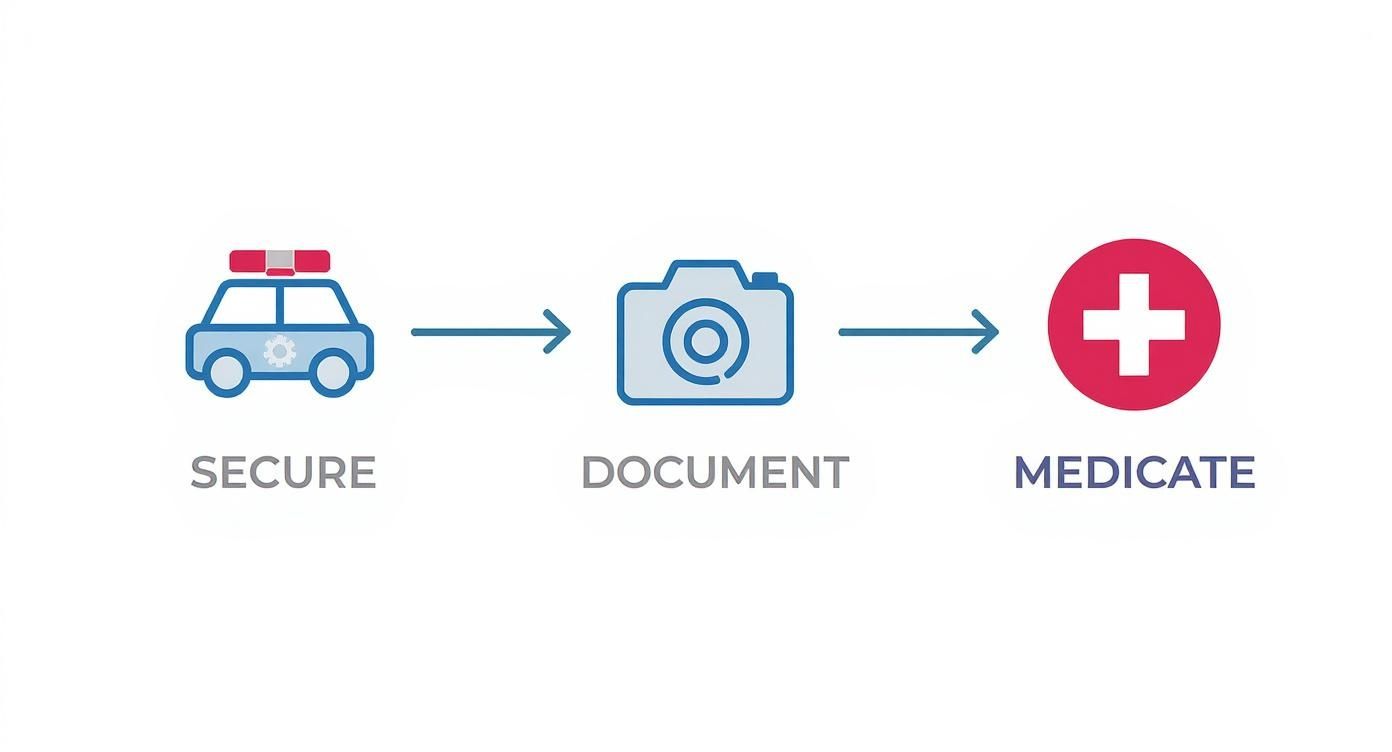
This process emphasizes that securing the scene, documenting evidence, and getting medical attention are the non-negotiable first steps.
Protecting Your Legal Rights
One of the biggest mistakes you can make is giving a recorded statement to the trucking company’s insurance adjuster. Their job is to find reasons to deny or pay as little as possible on your claim. Politely inform them you will not be providing a statement and that your attorney will be in touch. Never admit fault or even apologize to anyone at the scene.
After a crash, remember this: Anything you say to an insurance adjuster can and will be used against you. Protect yourself by speaking only with law enforcement and your attorney.
To help you stay organized during such a stressful time, here is a simple checklist you can follow.
Post-Accident Checklist
This step-by-step checklist is designed to guide your actions immediately after a truck accident to protect both your health and your legal rights.
| Action Item | Why It Is Crucial |
|---|---|
| Call 911 Immediately | Ensures police and medical help are dispatched. The police report is key evidence. |
| Seek Medical Attention | Documents your injuries and rules out hidden trauma. Creates a medical record. |
| Take Photos and Videos | Preserves a visual record of the scene, vehicle damage, and conditions before they change. |
| Gather Driver and Company Info | Identifies all potentially liable parties, including the driver, carrier, and their insurers. |
| Get Witness Contact Information | Independent witness testimony can be incredibly powerful in proving what happened. |
| Do Not Admit Fault | Avoid making any statements that could be interpreted as admitting responsibility. |
| Decline Adjuster Statements | Politely refuse to give a recorded statement to the other party's insurance company. |
| Contact a Lawyer ASAP | An experienced attorney can immediately start protecting your rights and preserving evidence. |
Following these steps provides a strong foundation for your claim.
The process of building a truck accident claim is far more complex than a standard car wreck case, and these initial steps are just the beginning. To get a better sense of the overall process, you can learn more about how to file a car accident claim in our detailed guide. Consulting with a Texas personal injury lawyer as soon as you can ensures your rights are protected from day one.
Who is Liable for a Truck Accident in Texas?
After a terrifying truck accident in Texas, one of the first questions you might have is, "Who is responsible for this?" Unlike a simple car crash where fault usually lies with one driver, a commercial truck wreck is a different story. The truth is, several parties could share the blame, and identifying every single one is key to getting the full compensation you and your family need to move forward.

Texas law recognizes that the actions—or failures—of many different people and companies can all lead to a single, devastating crash. A skilled Texas personal injury lawyer will dig deep to uncover every layer of negligence. It's like peeling an onion; what starts with the driver often leads to failures buried deep within a company's operations.
It's Almost Never Just the Driver
While the truck driver’s mistake often directly causes the crash, they are rarely the only one at fault. An experienced truck crash lawyer in Houston knows to look far beyond the person behind the wheel to investigate other parties who might be legally responsible.
Here are some of the key players who could be held accountable:
- The Trucking Company (Motor Carrier): The company that hired the driver is often a primary defendant. They can be found liable for negligent hiring (like hiring a driver with a history of DUIs), providing poor training, or pushing drivers to break federal safety rules to meet impossible deadlines.
- The Truck Manufacturer: If a defective part—like faulty brakes or a steering component that failed—played a role in the accident, the company that designed or built that part can be held responsible.
- The Cargo Shipper or Loader: The company responsible for loading the trailer has a duty to ensure the freight is secured properly and doesn't exceed legal weight limits. An unbalanced or overloaded truck can easily cause the driver to lose control.
- A Maintenance Company: Many trucking companies outsource vehicle repairs. If a third-party mechanic failed to properly service the truck, leading to mechanical failure on the road, they can be held liable for the resulting crash.
For example, after a Houston freeway crash, the initial police report might blame the truck driver for speeding in the rain. But a thorough investigation by a legal team could uncover that the trucking company was forcing drivers to ignore federal hours-of-service rules to make deliveries faster, meaning the driver was exhausted and shouldn't have been on the road at all.
How We Prove Negligence in Texas
In Texas, holding someone liable means proving negligence. This legal concept requires showing four things: that a party had a duty to act with reasonable care, that they breached that duty, that their breach directly caused your injuries, and that you suffered damages as a result.
In a truck accident claim, proving negligence isn't just about one driver's mistake. It’s about exposing a pattern of corporate choices that put profits ahead of people's safety.
Let’s go back to the overloaded truck example. The driver may have known the truck was too heavy, but the cargo loading company was the one that improperly distributed the weight. On top of that, the trucking company might have failed to inspect the load before the trip. In this situation, all three parties could share blame under Texas's rules of comparative responsibility.
Uncovering these complex connections requires immediate action to preserve crucial evidence like driver logs, maintenance records, and the truck's "black box" data. The trucking company and its insurers have teams working to minimize their responsibility from the moment the crash happens. That is why you need an advocate on your side who understands the complexities of a truck accident in Texas and will fight to hold every at-fault party accountable.
Understanding Key Texas Truck Accident Laws
When you're dealing with the aftermath of a truck accident in Texas, you're not just up against a driver—you're up against a complex web of state and federal laws. These aren't just technicalities; they are the rules that determine who is responsible, how much they pay, and how long you have to file a claim.
One of the first concepts the trucking company's insurer will try to use against you is comparative responsibility. This is Texas's way of handling accidents where more than one person might be partially at fault.
For example, let's say a truck swerves into your lane on a Dallas freeway, causing a serious collision. However, the investigation shows you were going five miles per hour over the speed limit. A jury might decide you were 10% responsible for the crash. Under this rule, you can still recover compensation, but your total award would be reduced by your percentage of fault. If your damages were calculated at $200,000, you would receive $180,000.
The 51% Bar Rule: A Critical Threshold
Here’s where it gets serious. Texas law draws a hard line. You can only recover compensation if your share of the blame is 50% or less.
If a jury finds you 51% or more at fault, you get nothing. Zero. This is known as the "51% bar rule," and it’s why the trucking company will fight to shift even a small amount of blame onto you.
Their strategy is to push you over that 51% cliff. It is an all-or-nothing system, which is why you need a skilled Texas personal injury lawyer to build an ironclad case proving the other parties were primarily at fault.
Using Their Own Rulebook Against Them
Commercial trucks are governed by a thick book of federal and state safety regulations. This isn't just red tape; it's a higher standard of care they must follow. When they break a rule and someone gets hurt, that violation is powerful evidence of negligence.
We investigate their records to find violations of key regulations, including:
- Hours-of-Service (HOS) Rules: Federal law strictly limits how long a trucker can drive without a mandatory rest break. We often find that drivers, pushed by their companies, falsify logbooks and drive while dangerously fatigued.
- Maintenance and Inspection Requirements: A trucking company has a legal duty to keep its fleet in safe working order. This means regular inspections and documented repairs. A crash caused by bald tires or failing brakes is a direct violation of the law.
- Hiring and Training Standards: Companies must run background checks, confirm a valid commercial driver's license (CDL), and provide proper training. If they hire a driver with a history of reckless driving, they are putting everyone on the road at risk.
When we can prove the trucking company broke a safety law, it creates a powerful presumption of fault that is very difficult for them to defend against.
How Long Do You Have to File a Claim in Texas?
You must be aware of the statute of limitations. In Texas, you must file a personal injury or wrongful death lawsuit within two years of the date of the truck accident.
If you miss this deadline, your case is over. The court will dismiss it, and you will lose your right to seek compensation forever, no matter how strong your claim is.
Two years might sound like a long time, but building a solid truck accident case is a marathon. Evidence gets lost, witnesses move, and memories fade. The best thing you can do to protect your rights is to contact a Houston car accident attorney as soon as possible to ensure all evidence is preserved and every legal deadline is met.
The Evidence You Need to Win Your Truck Accident Case
Building a successful personal injury claim is like constructing a house—it must be done with solid, undeniable evidence. After a catastrophic truck accident in Texas, a police report is just the starting point.
Your legal team must launch an immediate and thorough investigation to uncover every piece of information that tells the real story of what happened. This process digs much deeper than a typical car wreck case. We hunt for evidence unique to the commercial trucking industry—the kind of proof that often reveals a pattern of negligence by the company, not just a single mistake by its driver.
Unlocking the Truck’s Secrets
Commercial trucks are rolling data machines. This digital trail often contains the most damning proof of negligence. Your attorney can legally demand access to these systems through a process called discovery.
We immediately go after key evidence like:
- The Electronic Logging Device (ELD): This is the truck's "black box." It records everything from speed and braking to the driver's hours on the road. This data can instantly prove if a driver violated federal Hours-of-Service rules by driving while dangerously tired.
- Driver's Logbooks: While most trucks use electronic logs, paper logs are sometimes used. We comb through these for inconsistencies or signs of being doctored to hide rule-breaking.
- Maintenance and Repair Records: Trucking companies are legally required to keep their fleet safe. We pull these records to see if the truck in your crash had a history of brake problems, bad tires, or other mechanical failures that the company ignored.
- The Driver’s Qualification File: This is the driver's entire employment history. It contains their driving record, training certificates, and drug and alcohol screening results. This file can show if the company negligently hired a driver with a history of recklessness.
To build a strong truck accident claim, you need compelling evidence; footage from a reliable dash cam can often provide irrefutable proof of fault and circumstances. This raw video can be invaluable in piecing together the moments just before the crash.
Reconstructing the Crash to Prove What Really Happened
The evidence we gather allows us to paint a clear, detailed picture of how the accident occurred and who was truly at fault. For example, after a devastating crash on a Houston freeway, the black box data might show the driver didn't brake until the last second.
Combine that with logbooks showing they’d been on the road for 14 straight hours, and you have a powerful case for driver fatigue and company negligence.
Sadly, these incidents happen with shocking frequency. In 2023, Texas saw a staggering 43,780 commercial motor vehicle accidents involving over 128,000 people. Harris County led all counties with 6,113 truck accidents, followed by Dallas and Bexar counties, showing just how widespread this danger is on our roads. You can find out more about these troubling Texas truck accident statistics.
An experienced truck accident attorney knows that the most important evidence is often the information the trucking company tries hardest to bury. Swift legal action is critical to preserve this evidence before it's "lost."
By combining data from the truck with witness statements, police reports, and analysis from accident reconstruction experts, we establish a clear chain of liability. This comprehensive approach ensures that every party who contributed to your injuries—from the exhausted driver to the negligent trucking company—is held accountable. This meticulous work is the foundation of a winning case and the key to securing the justice you deserve.
Calculating the Full Compensation You Are Owed
When you've been in a catastrophic truck accident, the true cost goes far beyond the first stack of hospital bills. You have the right to be compensated for every single loss you have suffered. The first step toward a fair settlement is understanding how these losses are calculated to reflect what you've been through and what you'll need to move forward.

In Texas, compensation is split into two main categories: economic damages and non-economic damages. Together, their goal is to make you "whole" again, at least financially, by giving you the resources needed to rebuild your life.
Accounting for Every Financial Loss
Economic damages are the tangible, out-of-pocket costs you can prove with bills, receipts, and pay stubs. It is crucial to account for not only your current expenses but all the costs you will face in the future.
These damages typically cover:
- All Medical Expenses: This includes everything from the ambulance ride and ER visit to surgeries, hospital stays, physical therapy, prescription drugs, and any future medical care you will need.
- Lost Wages: If you were unable to work while recovering, you are owed the income you lost during that time.
- Diminished Earning Capacity: This is significant. If your injuries prevent you from returning to your old job or earning what you used to, you can be compensated for this long-term financial impact.
For instance, a construction worker in Houston who suffers a permanent back injury may never be able to handle a physically demanding job again. A Texas personal injury lawyer would work with financial experts to calculate the full value of their lost future earnings over their entire career.
Putting a Value on Your Pain and Suffering
Non-economic damages are just as real, but they are harder to put a price tag on. This is the compensation for the immense physical pain and emotional trauma you have been forced to endure.
No amount of money can ever erase what happened, but non-economic damages are the legal system's way of acknowledging the profound, personal toll the accident took on your life.
These damages are meant to cover losses like:
- Pain and Suffering: Compensation for the physical pain and discomfort your injuries have caused.
- Mental Anguish: This addresses the emotional fallout—anxiety, depression, fear, and PTSD—that often follows a traumatic crash.
- Physical Impairment and Disfigurement: Compensation for losing the use of a body part or for permanent scarring.
- Loss of Consortium: If your injuries have fundamentally damaged your relationship with your spouse.
- Loss of Enjoyment of Life: For the inability to return to hobbies, activities, and experiences you once loved.
Calculating the value of these damages takes skill and experience. Your attorney will build a powerful story using your medical records, your testimony, and statements from family and friends to show a jury the true human cost of the collision. To get a better sense of how these pieces fit together, you can learn more about the average settlement for a truck accident in our detailed article.
Types of Compensation in a Texas Truck Accident Claim
Here is a simple breakdown of the economic and non-economic damages you can pursue after a commercial truck wreck.
| Type of Damage | What It Covers |
|---|---|
| Economic | Tangible financial losses like medical bills (past and future), lost wages, property damage, and reduced earning potential. |
| Non-Economic | Intangible losses that affect your quality of life, including physical pain, emotional distress, scarring, and loss of enjoyment of life. |
Calculating the full scope of your losses is a detailed process, but it is the only way to ensure you receive the justice and financial stability you deserve. For families who have lost a loved one, a wrongful death lawyer in Texas can pursue similar damages to account for the devastating loss of companionship and financial support.
Why You Need a Dedicated Truck Accident Lawyer
After a devastating truck accident in Texas, it’s easy to feel overwhelmed and outmatched. While you are focused on healing, the trucking company and its insurance carrier have already put their legal teams to work. Their job is to protect their bottom line—usually by denying your claim or paying out as little as possible.

This isn't a fair fight. You shouldn't have to face it alone. Hiring an experienced Texas personal injury lawyer who specializes in these complex commercial vehicle cases is the single most important step you can take. They become your advocate, your investigator, and your shield against the aggressive tactics of corporate legal teams.
Leveling the Playing Field
A skilled lawyer does more than just fill out paperwork. They immediately launch an independent investigation to preserve crucial evidence before the trucking company has a chance to destroy it. This means sending spoliation letters to legally protect the truck's "black box" data, the driver's logbooks, and maintenance records.
Your legal team will:
- Conduct a thorough investigation to identify every party at fault—from the driver to the trucking company, cargo loaders, and even parts manufacturers.
- Hire industry experts, like accident reconstructionists and medical specialists, to build a powerful case on your behalf.
- Calculate the full value of your claim, including future medical costs and lost earning potential, to ensure no money is left on the table.
- Aggressively negotiate with insurance companies, who are far more likely to offer a fair settlement when they know you have a skilled trial lawyer ready to take them to court.
Having a dedicated truck accident attorney in your corner sends a clear message to the insurance company: you will not be intimidated, and you will not accept a lowball offer that fails to cover the true cost of your injuries.
Focusing on Your Recovery
Ultimately, a good lawyer takes the entire legal burden off your shoulders. They handle the constant phone calls, strict deadlines, and complex legal work. This frees you to focus on what truly matters—healing and putting your life back together. Understanding when to hire a personal injury lawyer is a critical decision that can change the outcome of your case.
This journey is tough, but you don't have to walk it alone. We invite you to schedule a free, no-obligation consultation with our compassionate attorneys. We can discuss your case and show you how we can fight for the justice and compensation you rightfully deserve.
Frequently Asked Questions
Navigating the aftermath of a serious Texas truck accident is confusing, and it's normal to have questions. Here are clear answers to the most common concerns we hear from victims and their families.
How Long Do I Have to File a Truck Accident Lawsuit in Texas?
In Texas, you generally have two years from the date of the crash to file a personal injury lawsuit. This strict deadline is known as the statute of limitations.
It is critical to speak with a lawyer long before this deadline approaches. Building a strong truck accident case takes time for investigation and evidence gathering. If you miss that two-year window, you will almost certainly lose your right to seek compensation forever.
Should I Accept the First Settlement Offer from the Insurance Company?
No, you should never accept the first offer. That initial settlement offer is almost always a lowball amount designed to close your claim quickly and for as little money as possible.
The first offer will likely not cover your future medical needs, long-term lost income, or the true extent of your pain and suffering. Always consult with an experienced Houston truck crash lawyer before you consider accepting a settlement or signing anything an insurance company sends you.
The first offer is a starting point for negotiation, not the final word. An experienced attorney knows how to counter these low offers and fight for the full compensation you are actually owed.
What Happens If the Trucker's Insurance Is Not Enough to Cover My Injuries?
This is a very real concern, especially when someone has suffered catastrophic injuries. While commercial trucks must carry higher insurance limits than regular cars, sometimes even that isn't enough to cover the devastating costs of a severe wreck.
This is where a skilled attorney specializing in a truck accident in Texas proves their worth. We immediately investigate to find every party who could be held responsible, not just the driver. This often includes:
- The trucking company (motor carrier) for negligent hiring or failing to maintain their fleet.
- The cargo owner or loader if freight was improperly secured and shifted during transit.
- A maintenance contractor responsible for faulty repairs on the truck.
- The manufacturer of a defective truck part, such as brakes or tires.
By identifying all liable parties, we can pursue compensation from multiple insurance policies to ensure the full scope of your damages is covered. This is how we make sure you have the resources you need for a lifetime of care.
The road to recovery after a serious truck accident is long, but you do not have to walk it alone. At The Law Office of Bryan Fagan, PLLC, our dedicated team is here to offer the compassionate support and strong legal representation you need. Recovery is possible, and legal help is available. We will handle every detail so you can focus on what matters most: your healing.
Contact us now to schedule your free, no-obligation consultation and learn how we can fight for the justice and financial security you and your family deserve.