A serious accident can change your life in seconds — but you don’t have to face it alone. When a drunk driver causes a catastrophic accident, the pain, confusion, and overwhelming questions can feel unbearable. In Texas, a unique legal rule called the dram shop law exists to hold establishments like bars, restaurants, or liquor stores accountable when they irresponsibly over-serve alcohol to someone who then goes on to cause harm, like in a drunk driving crash.
The crash itself is just the beginning of a long and difficult journey filled with medical appointments, mounting financial stress, and deep emotional trauma. We want you to know that your feelings are valid, and you are not alone in this fight.

Here in Texas, the law recognizes that the intoxicated driver might not be the only party at fault. An important legal principle, the dram shop law, gives you and your family a path to seek justice that goes beyond just the driver.
Expanding Accountability Beyond the Driver
This law allows you to hold a licensed alcohol provider accountable if they kept serving someone who was already obviously intoxicated to the point of being a clear danger to themselves and others. For example, if a Houston bar keeps pouring drinks for a patron who is slurring their words and stumbling, and that person then causes a devastating freeway crash, the bar can be held partially responsible for the wreckage that follows.
This legal concept is critical for several powerful reasons:
- Financial Recovery: It opens up another source of compensation for your extensive damages, which can easily exceed the drunk driver’s insurance limits.
- Public Safety: It puts pressure on bars and restaurants to act responsibly, which helps prevent future tragedies from happening in our communities.
- Complete Justice: It ensures that every single negligent party contributes to making things right for you and your family.
In the aftermath of a traumatic event, families often find themselves navigating profound grief. Getting practical guidance for dealing with the loss of a loved one can offer much-needed support during such a difficult time. This guide is here to provide clarity and hope by helping you understand your rights and the steps you can take toward recovery. You can learn more about when to hire a personal injury lawyer in our detailed article, but the most important first step is simply knowing that legal help is available.
The experienced attorneys at The Law Office of Bryan Fagan, PLLC are here to help you navigate this path. We believe in holding all responsible parties accountable, and we are ready to fight for you.
How Does the Texas Dram Shop Law Work?
So, what exactly is a dram shop law? The simplest way to think about it is a rule that holds businesses accountable for how they sell alcohol. It creates a chain of responsibility that goes beyond just the person who made the tragic choice to drive drunk.
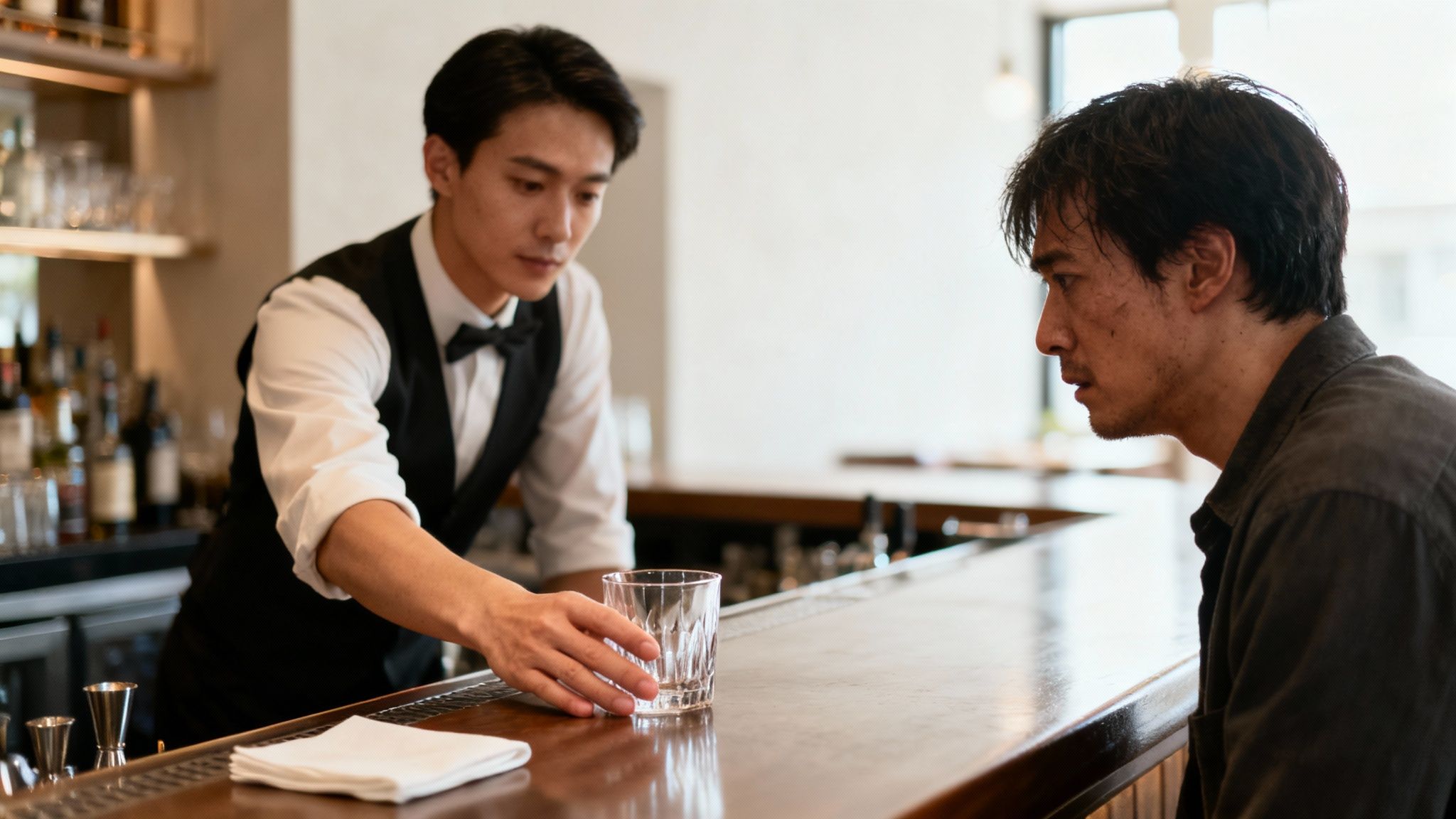
Here in Texas, the law is very specific. It allows victims to hold establishments like bars, restaurants, or even liquor stores liable when they serve or sell alcohol to a customer who is already obviously intoxicated. If that person then goes on to cause harm—like a horrific car crash—the business can be held financially responsible for the aftermath.
This isn't about unfairly punishing businesses. The real purpose is twofold: to protect the public by encouraging bars to serve alcohol responsibly and to give you, as a victim of a preventable accident, a path toward justice.
The Core of a Texas Dram Shop Claim
To really grasp what a dram shop law is, let’s look at a real-world example. Picture a bartender at a packed Houston sports bar who keeps serving drinks to a customer who is stumbling, slurring his words, and getting loud. The signs of dangerous intoxication are impossible to miss.
If that customer leaves, gets behind the wheel of his truck, and causes a devastating truck crash on I-45, the dram shop law says the bar shares the blame for what happened next. The law recognizes that the establishment had a clear chance to stop a tragedy from unfolding by simply cutting him off.
The key element is that the provider knew—or reasonably should have known—that the patron was so intoxicated they posed a clear danger to themselves and others. It's this negligent act of over-service that opens the door to liability.
This idea isn't new. The name "dram shop" actually comes from 19th-century England, where taverns sold gin by the "dram," a small spoonful. As people became more concerned about alcohol-fueled incidents, laws started to emerge holding these establishments accountable, setting the stage for the modern laws we have today. You can learn more about the history of dram shop laws on Wikipedia.
Why This Law Matters for You
For victims and their families, the Texas Dram Shop Act can be a lifeline. A drunk driver often has minimal insurance, which is rarely enough to cover the staggering costs of a catastrophic injury or a wrongful death claim. A successful dram shop claim can secure the financial resources needed for:
- Extensive medical treatment and long-term care: This covers everything from the initial hospital stay and surgeries to rehabilitation and future medical needs.
- Lost income and diminished earning capacity: Compensation for the paychecks you've already missed and the wages you won't be able to earn because of your injuries.
- Pain, suffering, and emotional distress: This acknowledges the immense human toll the accident has taken on you and your loved ones.
This law provides a crucial way to hold every negligent party responsible. Understanding that you might have more legal options than you first thought is the first step toward getting back on your feet and seeking the full justice you deserve.
Who Can Be Held Liable Under the Law?
After a devastating accident, figuring out every responsible party is a critical step. It’s how you secure the justice and financial support needed to get your life back on track. In Texas, the dram shop law is very specific about who can be held accountable for negligently serving alcohol. It’s not just about bars; the law applies to any provider with a license from the Texas Alcoholic Beverage Commission (TABC).
This means several types of businesses could share the blame for your injuries. If they served an obviously intoxicated person who went on to cause harm, they can and should be held responsible.
We've successfully pursued claims against:
- Bars and Nightclubs: These are the most frequent defendants in dram shop cases.
- Restaurants: Any restaurant that serves beer, wine, or liquor is subject to these laws.
- Convenience and Liquor Stores: These businesses are liable for selling alcohol to a person who is already clearly drunk.
- Sporting Venues and Concert Halls: Anywhere alcohol is sold for on-site consumption has a duty to serve responsibly.
The heart of the law boils down to two distinct, dangerous scenarios where an alcohol provider is negligent. Understanding these situations is the key to knowing if you have a valid claim.
Serving an Obviously Intoxicated Adult
The first and most common situation involves a TABC-licensed provider serving alcohol to an adult who was already obviously intoxicated. The law is clear: the person must have presented a clear danger to themselves and others at the time they were served.
But what does “obviously intoxicated” look like in the real world? It’s much more than just someone who has had a few drinks. We're talking about clear, visible signs of severe impairment that any trained server should recognize immediately.
For instance, a bartender in a busy Houston restaurant should know not to serve another round to a patron who is:
- Stumbling, swaying, or unable to walk straight.
- Slurring their words or speaking incoherently.
- Behaving in an unusually aggressive or belligerent manner.
- Struggling to keep their eyes open or head up.
When a server ignores these giant red flags and keeps pouring, the establishment is knowingly putting every single person on the road at risk.
The legal standard isn't about what the server actually knew, but what a reasonably prudent person should have known based on the customer's visible condition. This objective standard is central to holding establishments accountable for preventable tragedies.
Serving a Minor
The second path to liability is much more direct: serving or selling alcohol to a minor. In Texas, it is illegal for a licensed provider to serve an alcoholic beverage to anyone under the age of 21. Period.
Unlike cases involving adults, there is no need to prove the minor was "obviously intoxicated." The simple act of providing them with alcohol is, in and of itself, negligence. If that minor then causes a car accident, the establishment that served them can be held liable for all the resulting damage.
To help you understand who might be a defendant in your case, we’ve put together a simple table outlining potential liability.
Potential Defendants in a Texas Dram Shop Case
This table clarifies which parties can and generally cannot be held liable for over-serving alcohol in Texas, helping victims identify the correct parties for their claim.
| Party | Potential Liability Under Dram Shop Law | Key Condition for Liability |
|---|---|---|
| Bars, Restaurants, Nightclubs | Yes | Must have a TABC license and serve an obviously intoxicated adult or any minor. |
| Convenience & Liquor Stores | Yes | Must have a TABC license and sell to an obviously intoxicated adult or any minor. |
| Sporting Venues & Arenas | Yes | Must have a TABC license and serve an obviously intoxicated adult or any minor. |
| Social Host (Serving Adults) | No | Generally, a private host is not liable for an adult guest's actions. |
| Social Host (Serving Minors) | Yes (with conditions) | An adult (21+) can be liable for knowingly providing alcohol to a guest under 18. |
Identifying the correct defendant is the first step, but as you can see, the lines can sometimes get blurry, especially when social hosts are involved.
What About Social Hosts?
This is a question we hear all the time: can a private individual hosting a party be held liable? In Texas, the rules for social hosts are different. Generally speaking, a host who serves alcohol to an adult guest is not legally responsible if that guest later causes an accident.
However, there is a massive exception when it comes to minors. A social host who is 21 or older can absolutely be held liable if they knowingly provide alcohol to a guest under 18 who is not their own child. If that minor becomes intoxicated and injures someone, the adult who supplied the alcohol can be held responsible for the harm they helped cause.
How Do You Prove a Dram Shop Claim in Texas?
Winning a dram shop case isn't as simple as proving a drunk driver came from a certain bar. The law puts the burden of proof squarely on you, the injured party, to demonstrate that the establishment was negligent. A seasoned Texas personal injury lawyer knows this is a high bar to clear and understands exactly what kind of evidence is needed to build a powerful claim.
At its core, your case hinges on proving two key facts:
- The bar, restaurant, or store sold, served, or provided alcohol to someone who was already obviously intoxicated—so much so that they were a clear danger to themselves and others.
- That specific act of over-service was a direct cause of the accident that resulted in your injuries or the death of your loved one.
Meeting this standard is tough, and it’s why moving fast is absolutely critical. The evidence needed to prove your case can disappear in a matter of days. Starting the investigation immediately is non-negotiable.
This infographic gives a simple breakdown of who is typically held liable versus who is not under Texas dram shop laws.

As the visual shows, the line is usually drawn between a commercially licensed business and a private social host. Liability almost always falls on the business.
Gathering Critical Evidence
An experienced attorney knows the playbook. When you work with The Law Office of Bryan Fagan, PLLC, one of our very first moves is to fire off an evidence preservation letter to the establishment. This is a formal legal notice that commands them not to delete, alter, or destroy any evidence related to the incident.
Imagine a tragic wrongful death crash on I-10 in Houston. Our team would immediately demand the bar preserve its security footage. That video can be the single most compelling piece of evidence, showing a jury exactly how drunk the patron was before a bartender poured them another drink.
We also aggressively pursue other forms of proof, including:
- Credit Card Receipts and Bar Tabs: These create a timeline. They can show how many drinks were bought and how quickly. A long tab over a short period is a massive red flag for over-service.
- Eyewitness Testimony: We track down and interview other customers, bartenders, servers, and bouncers who were there. Their stories about the driver slurring words, stumbling, or acting aggressively can be incredibly powerful.
- Police Reports: The officer’s report is a goldmine of information. It will have details about the driver's behavior at the scene, field sobriety test results, and any breathalyzer or blood test data that establishes intoxication.
- TABC Investigation Records: If the Texas Alcoholic Beverage Commission (TABC) gets involved and investigates the bar, their findings can provide official documentation of negligent practices.
Proving a dram shop case is like assembling a puzzle. Each piece of evidence—a receipt, a witness statement, a few seconds of video—helps build a clear picture of negligence for the judge and jury.
Why Time Is Not on Your Side
Waiting is the single biggest mistake you can make. Security cameras often record on a loop, meaning that crucial video evidence could be automatically erased within a week. Witnesses forget key details, and bar staff might quit, making them nearly impossible to find.
A skilled Houston car accident attorney knows that the entire case often rests on the strength of the evidence gathered in those first few days. By calling a lawyer immediately, you give yourself the best possible shot at holding every at-fault party accountable. The sooner we start digging, the stronger your case will be.
What Compensation Can You Recover?
Let’s be clear: no amount of money can ever truly make up for the trauma and loss caused by a drunk driver. But securing fair compensation is a critical step in putting your life back together and protecting your family’s financial future. A successful dram shop claim ensures that all the responsible parties are held accountable for the devastation they caused, giving you the resources you need to heal.
In legal terms, this compensation is called "damages." Texas law splits damages into two main categories, each designed to address a different type of loss you’ve suffered. A skilled Texas personal injury lawyer will fight to get you every dollar you deserve under both.
Recovering Your Economic Damages
First up are economic damages. Think of these as the concrete, out-of-pocket financial losses the accident forced upon you. These are the tangible costs that show up on bills, receipts, and pay stubs—the financial avalanche that can bury a family after a serious crash.
The goal here is simple: to make you financially whole again. Our team will meticulously document every single expense to build an ironclad case for recovering costs like:
- Past and Future Medical Bills: This isn’t just the initial ER visit. It covers everything from surgeries and hospital stays to ongoing physical therapy, medications, rehabilitation, and any long-term care you might need down the road.
- Lost Wages and Income: We calculate the paychecks you’ve already missed because you were too injured to work.
- Diminished Earning Capacity: If your injuries are so severe that you can't return to your old job or earn what you used to, we fight for compensation to cover this future loss of income.
- Property Damage: This covers the cost to get your vehicle repaired or replaced, along with any other personal property that was destroyed in the wreck.
It can be helpful to understand how much compensation for a car accident you might be entitled to as you consider your next steps.
Compensation for Your Non-Economic Suffering
The second category, non-economic damages, is every bit as important. These damages are intended to compensate you for the immense, intangible suffering that the accident has inflicted on you and your loved ones. These losses don't come with a neat price tag, but they are incredibly real, and Texas law firmly recognizes your right to be compensated for them.
These damages acknowledge the human cost of the accident—the pain, the grief, and the emotional devastation that a negligent act leaves behind. Holding a negligent bar accountable helps acknowledge the full scope of your suffering.
An experienced lawyer knows how to put a value on these profound personal losses, which can include compensation for:
- Pain and Suffering: For the physical pain you’ve had to endure and may continue to live with for years to come.
- Mental and Emotional Anguish: This covers conditions like anxiety, depression, PTSD, and the sheer emotional distress of surviving a traumatic event.
- Loss of Enjoyment of Life: Compensation for being unable to participate in the hobbies, activities, and simple life experiences that once brought you joy.
- Physical Impairment or Disfigurement: This acknowledges the life-altering impact of permanent injuries, scarring, or the loss of physical function.
Wrongful Death Claims in Dram Shop Cases
For families left grieving the loss of a loved one, a dram shop claim can be a vital part of a wrongful death action. A compassionate wrongful death lawyer Texas can help you pursue justice from both the drunk driver and the establishment that illegally over-served them.
This provides the financial support needed to cover funeral and burial costs, the loss of your loved one’s income, and the profound loss of their love, companionship, and guidance. It’s a powerful way to demand accountability and seek justice for the person who was taken from you.
How Long Do You Have to File a Claim in Texas?
After a catastrophic accident or losing someone you love, the idea of a lawsuit is probably the furthest thing from your mind. But in Texas, the clock starts ticking immediately. The law sets a firm deadline, known as the statute of limitations, for filing a personal injury or wrongful death claim.
It's absolutely critical to understand this deadline. Once it passes, you lose your right to seek compensation forever.
For most personal injury cases in Texas, including dram shop claims, you have just two years from the date of the accident to file your lawsuit. Two years might seem like a long time, but it disappears in a flash when you're focused on healing, grieving, and just trying to put the pieces of your life back together.
Why Acting Immediately Is So Important
Building a solid dram shop case isn't like a typical car accident claim. It requires an immediate, boots-on-the-ground investigation. The evidence needed to prove a bar overserved someone is fragile and can vanish in a matter of days, not weeks or months.
Waiting to call a lawyer can cripple your ability to hold a negligent bar accountable for the chaos they helped cause.
Here’s exactly why you can't afford to wait:
- Evidence Disappears: Security camera footage is often the smoking gun that proves a patron was "obviously intoxicated." The problem? Most bars tape over that footage within a few days or weeks.
- Witnesses Forget: The memories of other customers and even the bartenders themselves fade fast. Finding them later is tough enough, but getting a clear, credible story becomes nearly impossible as time goes on.
- Records Are Lost: Key pieces of the puzzle—like credit card receipts, bar tabs, and employee work schedules—get misplaced, thrown out, or destroyed.
A successful dram shop claim depends on the evidence your attorney can preserve in the first few days and weeks after the crash. Swift action is not just a recommendation; it is essential to protecting your rights.
For families navigating a profound loss, it's also vital to know the specific timelines that apply. You can learn more about the wrongful death statute of limitations in Texas in our detailed guide, which breaks down these crucial deadlines.
The single best thing you can do for yourself and your family is to contact an experienced truck crash lawyer Houston as soon as possible. Making that one call gives your legal team the head start they need to gather the evidence required to build a winning case on your behalf.
Common Questions About Dram Shop Claims
When you're reeling from the aftermath of a drunk driving crash, it’s completely normal to have a flood of questions. Below, we've answered some of the most common concerns we hear from victims and their families as they start to figure out what a dram shop law is and how it might impact their case.
Can I Sue Both the Drunk Driver and the Bar?
Yes, absolutely. In Texas, you not only can but often should file claims against every party who was at fault. This means pursuing a personal injury lawsuit against the intoxicated driver while also filing a separate dram shop claim against the establishment that illegally served them.
These are two different legal actions that work hand-in-hand to get justice from everyone whose poor judgment contributed to your injuries. An experienced Texas personal injury lawyer can manage both claims at the same time, making sure every responsible party is held accountable and working to get you the maximum possible financial recovery.
What if I Was a Passenger in the Drunk Driver's Car?
You still have every right to file a claim. Even if you were riding in the car with the intoxicated driver, you can pursue a dram shop case against the bar or restaurant that irresponsibly over-served them before the accident.
The establishment's duty to serve alcohol safely extends to everyone on the road, including passengers. Their negligence put you in danger, and Texas law gives you the right to seek full compensation for your injuries directly from that business. It doesn't matter which car you were in—you deserve justice.
The Bar Says Its Servers Are TABC-Certified. Doesn't That Protect Them?
No, not automatically. While having TABC-certified staff is supposed to encourage responsible service, it’s not a "get out of jail free" card for a bar. Many establishments will try to use this as a defense, known as the "safe harbor" defense, claiming that because they trained their employees, they can’t be held liable.
But a good lawyer knows to dig deeper. We investigate whether the bar’s actual practices—like running aggressive drink specials or ignoring obvious signs of intoxication—completely undermined their own supposed policies. We often find that a bar’s actions on the night of the crash were the exact opposite of what their training manuals said, leaving them fully liable for the harm their patron caused.
A serious accident can make you feel completely alone, but you don’t have to search for answers or fight for justice by yourself. The dedicated attorneys at The Law Office of Bryan Fagan, PLLC are here to offer the compassionate support and tough representation you need. We know that recovery is possible and that legal help is available. We’ll stand with you, handle the legal headaches, and fight to get you the recovery you deserve. If you or someone you love has been injured, contact us today for a free, no-pressure consultation to learn about your rights and take the first step toward getting your life back.