
A serious accident or medical error can change your life in seconds—but you don’t have to face it alone. When a hospital stay leads to more harm than healing, it’s easy to feel betrayed, lost, and completely overwhelmed. You went there for help, but something went terribly wrong. If this is your reality, please know: you are not alone, and you have legal rights.
Suing a hospital for negligence in Texas is a complicated and difficult path. But for many, it’s the only way to hold a medical facility accountable for its mistakes and get the resources your family needs to begin to heal.
A Hospital Mistake Changed Your Life. What Now?

A serious injury or the death of someone you love because of a hospital's error can turn your world upside down in an instant. You placed your trust in a medical institution, only to be met with a devastating outcome. The experience leaves you questioning everything, unsure of where to turn or what to do next.
This guide was created to provide clarity. We believe that injured patients and their families deserve straight answers and a clear understanding of their options. Think of this as your roadmap to pursuing justice when a hospital fails in its most fundamental duty: to provide safe care.
Holding Hospitals Accountable
Filing a lawsuit against a hospital is about more than just money—it's about demanding accountability. The legal process is designed to ensure that facilities providing substandard care are held responsible for the damage they cause. This is not only crucial for your family's recovery but also for encouraging safer medical practices that can protect other patients in the future.
We get it. The idea of taking on a huge hospital system is intimidating. They have deep pockets and teams of lawyers on standby. But Texas law gives patients a way to fight back. With the right Texas personal injury lawyer, you can level the playing field and demand the compensation you deserve for your losses.
A successful negligence claim can provide the financial stability needed to cover overwhelming medical bills, lost income, and the long-term costs of rehabilitation or catastrophic injury care. It gives you the breathing room to focus on what truly matters: healing.
For instance, consider a patient in a Dallas hospital who develops a life-threatening infection after surgery because the staff failed to follow basic sanitation protocols. This preventable error leads to a much longer hospital stay, permanent health problems, and makes it impossible for them to return to work.
By suing the hospital for negligence, that patient would be seeking compensation for:
- All related medical treatments, including past bills and future care.
- Lost wages and diminished earning capacity if they can no longer do their job.
- Pain, suffering, and emotional distress caused by the traumatic ordeal.
This guide will walk you through the essential parts of a hospital negligence claim in Texas, from what actually constitutes malpractice to the types of damages you can seek. The road ahead may seem daunting, but remember that recovery is possible, and expert legal help is available to guide you every step of the way.
What Counts as Hospital Negligence in Texas?

When a hospital’s mistake leaves you or a family member injured, the first question is always: what happened, and was it negligence? In Texas, the answer is more complex than just a bad medical outcome.
True hospital negligence involves a failure to provide the accepted “standard of care.” This isn't some vague concept; it’s what a reasonably skilled hospital or healthcare provider would have done under the same circumstances. If the hospital and its staff fell below this bar and caused you harm, that’s where a negligence claim begins.
The Four Elements of a Hospital Negligence Claim
To build a successful case against a hospital in Texas, your attorney must prove four critical elements. Think of it as telling a complete story—if any chapter is missing, the whole thing falls apart.
We have to prove:
- Duty: The hospital had a legal obligation to care for you. This duty starts the moment you are admitted and become their patient.
- Breach: The hospital, through its staff, violated that duty by failing to meet the standard of care.
- Causation: This specific failure directly caused your injury or made your condition worse.
- Damages: You suffered real, tangible harm, including things like medical bills, lost income, and the physical and emotional pain you’ve endured.
For example, let's say a patient in a Houston hospital is flagged as a high fall risk. The hospital has a duty to implement fall precautions. If the nursing staff fails to put up bed rails or check on the patient (breach), and that patient falls and breaks their hip (causation), the cost of surgery, rehabilitation, and their suffering are the damages.
How Hospitals Are Held Responsible
Many people assume you can only sue the specific doctor or nurse who made the error. But in Texas, a legal principle called vicarious liability often makes the hospital itself responsible for the negligent actions of its employees.
This is a critical point. If a nurse, a lab tech, or a doctor employed by the hospital makes a mistake while on the job, the hospital can be held accountable. After all, the institution is responsible for creating a safe environment and overseeing its staff.
Hospital negligence is rarely just one person’s mistake. More often, it’s a symptom of a larger, systemic problem within the facility—a pattern of poor practices that puts everyone at risk.
Common examples of these system-wide failures include:
- Understaffing: Not enough nurses on the floor, leading to missed patient checks, medication mix-ups, or slow responses to emergencies.
- Inadequate Training: Failing to train staff on new equipment, updated safety rules, or critical care protocols.
- Poorly Maintained Facilities: Unsanitary conditions that breed hospital-acquired infections like MRSA or sepsis.
- Negligent Hiring: Bringing on staff with a history of incompetence or misconduct, often by skipping proper background checks.
- Faulty Communication Systems: A breakdown in communication between doctors, nurses, and specialists that results in a patient getting the wrong medication or treatment plan.
The scale of this problem is staggering. A World Health Organization study found that around 43 million instances of medical harm happen to patients globally every year. For Texans who have suffered from a hospital error, these numbers confirm that this is a widespread issue. You can read more about the global impact of medical errors and see just how serious it is.
If you suspect a systemic failure at a Texas hospital caused your injury, you need to speak with an experienced lawyer. We know how to dig into these complex cases and find out if you have a valid claim for suing a hospital for negligence.
What to Do After Suffering an Injury at a Hospital
When you start to suspect that a hospital’s mistake caused you or a loved one serious harm, the feeling is unsettling and often overwhelming. What you do in the days and weeks that follow is critical—not just for your health, but for your legal rights.
Your absolute first priority is your health. If you’ve suffered a new or worsened injury, you need to get medical attention right away. This might mean getting a second opinion from a completely different doctor or hospital, or starting treatment to correct the harm that was done. This isn't just about your well-being; it creates a new, independent medical record that documents the fallout from the original error.
Gathering Your Evidence
While you focus on recovery, you can also start to gather the documents and information that will form the backbone of a potential claim. The more organized you are from the start, the stronger your case will be.
Begin by requesting a complete copy of your medical records from the hospital where the injury happened. You have to be specific and ask for everything: doctor’s notes, nursing logs, lab results, imaging reports, and all billing statements. Texas law gives you the right to these documents.
Next, get a notebook and start a journal. Write down everything you can remember about what happened and how you’re doing now.
- Symptoms: Track your pain levels, physical limitations, and your emotional state day by day.
- Conversations: Note who you spoke to at the hospital, what they said, and when the conversation happened. Details matter.
- Expenses: Save every single bill, receipt, and statement connected to your injury. This includes co-pays, prescription costs, and even the mileage you drive to medical appointments.
- Physical Proof: Keep anything that might be relevant, like pill bottles, used wound dressings, or photos of your injury as it changes over time.
This initial phase of collecting information is a huge task, and it's where the groundwork for a successful claim is laid. Legal professionals often rely on skilled staff to manage these early client interactions, and you might see law firms Hire intake specialists just to streamline this process.
Before we go further, it's crucial to take immediate, organized steps to safeguard your potential claim. The checklist below outlines what you need to do right away to protect both your health and your legal standing.
Immediate Actions to Protect Your Claim
| Action Item | Why It's Important |
|---|---|
| Get a Second Medical Opinion | Prioritizes your health and creates an independent record of the harm caused by the initial negligence. |
| Request All Medical Records | Provides the official documentation of your treatment and is the primary evidence in a negligence case. |
| Start a Detailed Journal | Captures real-time evidence of your physical pain, emotional distress, and conversations that may be forgotten later. |
| Keep All Bills and Receipts | Documents the financial cost of the injury, which is a key component of your recoverable damages. |
| Do Not Speak to Hospital Insurers | Protects you from saying something that could be used to devalue or deny your claim. |
| Contact an Attorney Immediately | Ensures you don't miss critical deadlines and allows an expert to start building your case right away. |
Taking these actions can make a significant difference in the strength and outcome of your case down the road.
Be Cautious with Hospital Communications
You can expect a call from the hospital’s risk manager or their insurance adjuster shortly after the incident. They might sound friendly and concerned, but you must remember their job: to protect the hospital’s bottom line, not yours.
Our strong advice to all clients is this: Do not give a recorded statement, sign any documents, or accept any offers from the hospital or their insurance company without first speaking to your own lawyer. Anything you say can be used against you later to minimize or deny your claim.
How Long Do You Have to File a Claim in Texas?
It's critical to know that your right to sue a hospital for negligence doesn’t last forever. Texas law imposes a strict deadline, called the statute of limitations, for filing a medical malpractice claim.
In most cases, you have just two years from the date the negligence happened or from the date you reasonably should have discovered the injury to file a lawsuit. If you miss this deadline, the court will almost certainly throw out your case, and you will lose your right to seek compensation for good.
Two years might sound like a lot of time, but it flies by. Building a solid medical negligence case involves a deep investigation, collecting extensive records, and getting opinions from qualified medical experts. That all takes time. That’s why we always urge people to contact an experienced lawyer as soon as they suspect something has gone wrong. We can explain your rights and get to work protecting you from day one. To learn more, read about what is a personal injury lawyer and how they can guide you through this difficult process.
Building Your Case: A Look Inside a Texas Hospital Lawsuit
The thought of suing a hospital can feel like preparing to climb a mountain. It’s intimidating, but our goal is to guide you through the process, one step at a time. Understanding the path a Texas hospital negligence lawsuit follows can bring a sense of clarity and control during an incredibly difficult period.
The journey starts long before we ever set foot in a courtroom. Texas law has very specific pre-suit rules that we must follow under the Texas Medical Liability Act. The first step involves sending a formal, written notice of your claim to the hospital and every healthcare provider involved in your care.
This notice does two things: it starts a mandatory waiting period and gives us the legal right to request and obtain your complete medical records. In simple terms, it's our way of officially putting the hospital on notice that a serious error occurred, we are investigating, and we plan to hold them accountable.
The Critical Role Of The Expert Report
One of the single most important hurdles in any Texas hospital negligence case is the expert report. This isn’t a suggestion; it’s a non-negotiable legal requirement. The report is a formal, written opinion from a qualified medical professional—like a doctor or nurse with the same specialty—who has thoroughly reviewed the facts of your case.
This expert report must clearly accomplish two things:
- Explain how the hospital or its staff violated the required standard of care.
- Connect that specific failure directly to the injury you suffered.
If we can’t produce a strong, supportive expert report, Texas law is unforgiving: the court must dismiss your case. This is precisely why having an attorney who has a network of credible experts is so vital. This report is the key that unlocks your right to even have your day in court.
The simple steps below are the foundation you lay before your legal team can even begin this formal process.
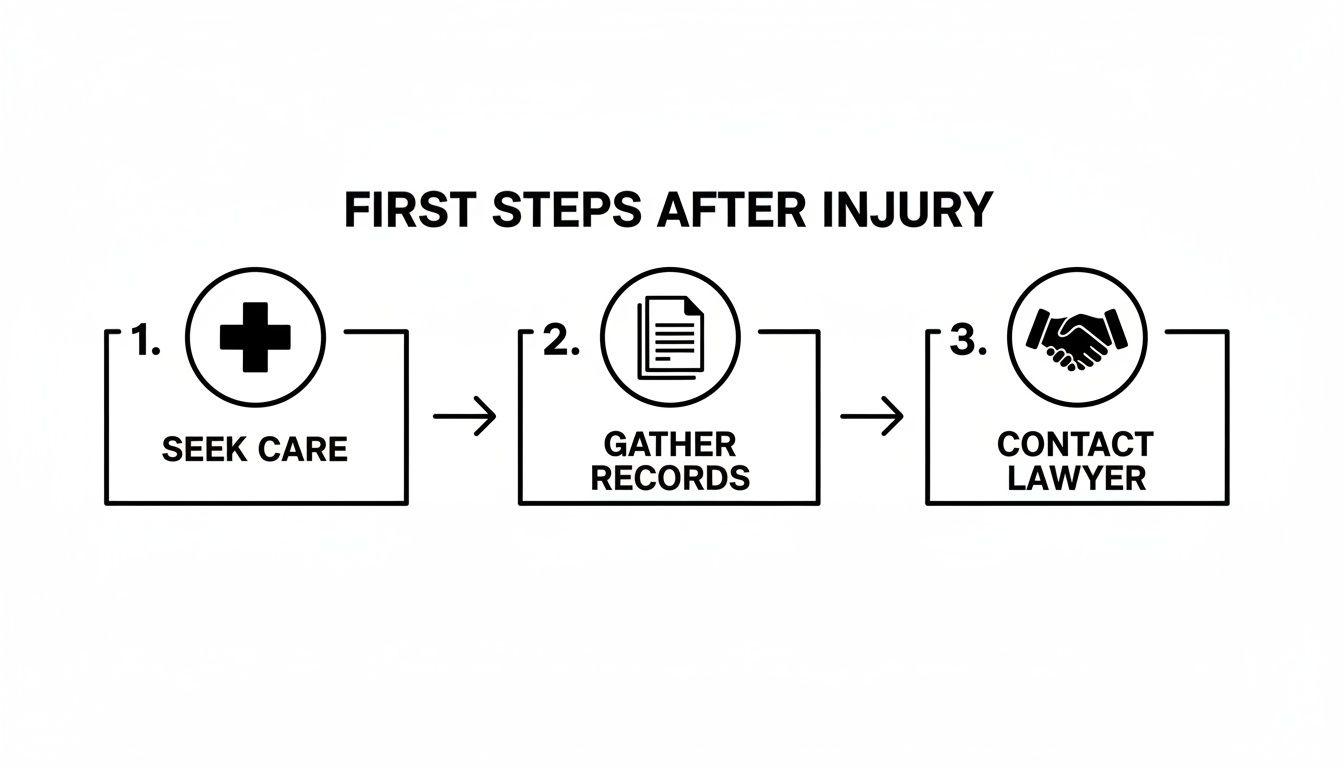
Taking these initial actions—getting medical care, collecting what you can, and calling a lawyer—allows us to hit the ground running and start building the powerful case you deserve.
From Filing A Lawsuit To Finding A Resolution
Once we’ve completed the pre-suit notice period and have a solid expert report in hand, we can officially file the lawsuit. This kicks off the formal litigation process, starting with a phase known as discovery.
During discovery, both sides exchange information and gather evidence. We use powerful legal tools like depositions (sworn testimony taken outside of court), interrogatories (written questions), and formal requests for documents to uncover all the facts. For instance, we might depose the nurses on duty during your hospital stay, demand the hospital’s staffing schedules for that shift, or obtain internal incident reports about your injury. In today's world, it's also important to know that digital communications matter, which is why knowing if text messages can hold up in court can be part of a comprehensive evidence strategy.
The vast majority of personal injury cases, including those against hospitals, settle before going to trial. Many find a resolution in mediation, which is a confidential negotiation guided by a neutral third party. While we are aggressive negotiators who will always fight for a settlement that covers your needs, we are also always prepared to go to trial if the hospital refuses to make a fair offer.
The reality is that these cases are tough. National data shows that nearly half of all medical malpractice claims are dismissed or abandoned by the patient's side. That statistic underscores just how important it is to have an experienced legal team that can anticipate and overcome these challenges. You can read the full research about these statistics and their financial impact to get a better sense of the legal landscape.
We believe you shouldn't have to worry about money while you're trying to heal. At The Law Office of Bryan Fagan, PLLC, we handle hospital negligence cases on a contingency-fee basis. This means you pay zero legal fees unless we win your case and recover compensation for you.
We are here to take on the legal complexities so you can focus on your health and your family. The road may be long, but you will have a dedicated advocate fighting for you every step of the way. Time is of the essence in these cases, so we urge you to learn more about the strict deadlines involved by reading about the medical malpractice statute of limitations in Texas.
Compensation You Can Recover in a Hospital Negligence Case

When you're trying to put your life back together after a medical error, it helps to know what you’re fighting for. In a hospital negligence lawsuit, the goal is to recover compensation—what the law calls “damages”—to cover every loss you've suffered.
This isn’t about hitting the lottery; it’s about getting what you need to be made as “whole” as possible. It’s about securing the financial stability to handle the road ahead. In Texas, we break these damages down into two key categories: economic and non-economic.
Economic Damages: The Tangible Costs of Negligence
Economic damages are the most straightforward part of a claim. These are the black-and-white, provable financial losses you’ve incurred because of the hospital's mistake. We’re talking about the costs you can track with bills, receipts, and pay stubs.
Our first job is to meticulously calculate the full extent of these financial burdens. Nothing gets overlooked.
Common economic damages include:
- Past and Future Medical Expenses: This covers everything from the corrective surgeries and hospital stays to long-term needs like physical therapy, prescription drugs, and in-home nursing care.
- Lost Wages and Income: We account for every dollar of income you’ve already lost because you were unable to work.
- Loss of Earning Capacity: If the injury has permanently impacted your ability to do your job or earn a living, we fight for compensation to cover that future financial shortfall.
- Home and Vehicle Modifications: Needing a wheelchair ramp, wider doorways, or adaptive driving equipment? Those costs are part of the claim.
Think about a construction worker from Dallas who develops a severe spinal cord injury from a post-op infection that hospital staff failed to manage. His economic damages aren't just his immediate hospital bills. They include a lifetime of specialized care, the income he'll lose from a physically demanding job, and the cost of making his home accessible.
Non-Economic Damages: The Human Cost of the Harm
Non-economic damages are just as real as the bills, but they’re far more personal. This is compensation for the profound, intangible ways the hospital’s negligence has shattered your quality of life.
Proving these losses takes more than a calculator. It requires an attorney who will take the time to understand your story and convey the true human cost of your suffering to a judge and jury. For a closer look at this topic, you can learn more about economic vs. non-economic damages in our article.
These damages are a legal recognition that your pain, your trauma, and your stolen joy have value and deserve to be compensated.
Non-economic damages cover the losses that don't come with a price tag:
- Pain and Suffering: For the physical pain you’ve been forced to endure and will continue to face.
- Mental Anguish: For the emotional trauma, anxiety, depression, or PTSD that follows a catastrophic medical event.
- Physical Impairment: For the loss of function in a part of your body.
- Disfigurement: For scars or other permanent changes to your appearance.
- Loss of Consortium: For the devastating impact the injury has had on your relationship with your spouse.
- Loss of Enjoyment of Life: For being robbed of the ability to participate in hobbies, activities, and moments you once loved.
Understanding Texas Damage Caps in Medical Malpractice Cases
It’s absolutely critical to know that Texas law places a limit, or a “cap,” on non-economic damages in medical malpractice cases. This law is frustrating for families, but an experienced lawyer knows how to work within its confines to maximize your total recovery.
The cap on non-economic damages is $250,000 per healthcare institution, with an overall limit of $500,000 from all institutions combined. A separate $250,000 cap applies to all physicians or individual providers involved.
While this may sound restrictive, a skilled attorney can structure a claim to pursue the highest amount the law allows. Most importantly, there is no cap on economic damages.
Juries are increasingly seeing the devastating harm caused by medical negligence. In 2024, the average of the top 50 medical malpractice verdicts nationwide soared to $56 million, a huge jump from $32 million just two years earlier. These massive verdicts show that when a case is presented powerfully, juries are willing to award substantial damages. While Texas caps limit what can be recovered for non-economic losses, these national trends emphasize why building a rock-solid case is key to maximizing every available dollar.
We are committed to fighting for every single penny you are owed—both for your measurable financial losses and for the profound human suffering you’ve been forced to endure.
Common Questions About Suing a Hospital in Texas
Even when you know something went terribly wrong, the idea of suing a hospital can feel overwhelming. It’s a daunting prospect, and it’s completely normal to have questions and fears. We’ve heard these same concerns from families all across Texas, and we want to provide some clear, straightforward answers.
How Much Does It Cost to Hire a Medical Malpractice Lawyer?
This is usually the first question on everyone's mind, and the answer often brings a wave of relief. At The Law Office of Bryan Fagan, PLLC, we handle these incredibly complex cases on a contingency-fee basis.
What does that mean for you? It means you pay no upfront costs or attorney’s fees. We personally finance your case, covering everything from hiring the necessary medical experts to paying court filing fees.
You only pay us if we win your case and recover compensation for you.
Will My Case Definitely Go to Court?
Not always. In fact, the vast majority of medical negligence cases are resolved through settlements long before a trial begins. We are experienced negotiators who can often secure a fair outcome through direct discussions with the hospital’s insurance company or in a formal mediation.
But our willingness to go to trial is our biggest advantage. If a hospital refuses to make a settlement offer that truly and fairly covers your family’s losses, we will not hesitate to take your fight to a judge and jury. We prepare every single case as if it’s going to trial from day one.
A consent form is not a free pass for a hospital to commit negligence. Consenting to a medical procedure means you accept the known, inherent risks—not that you accept substandard care that falls below the accepted medical standard.
Can I Sue if I Signed a Consent Form?
Yes, absolutely. Signing a consent form never gives away your right to safe and competent medical care.
For example, you might consent to the known risk of infection during a surgery. You do not, however, consent to a surgeon leaving a sponge inside you or an anesthesiologist giving you the wrong dose of medication. If the harm you suffered was caused by a professional failing to meet the standard of care, that consent form won't protect them.
How Can I Take On a Powerful Hospital System?
By leveling the playing field. Taking on a massive hospital corporation and its army of lawyers by yourself is an impossible fight. But when you have an experienced law firm in your corner, you are no longer the underdog.
We have the resources, the legal knowledge, and the unwavering determination to stand up to these large institutions. The law was written to hold everyone accountable for their actions—no matter how big or influential they are. Our job is to make sure it does.
The journey to recovery after a hospital error can be long, but you do not have to walk it alone. The Law Office of Bryan Fagan, PLLC is here to provide the compassionate support and aggressive advocacy you need to secure justice. If you or a loved one has been harmed, we invite you to schedule a free, no-obligation consultation to discuss your rights and legal options. Contact us today at https://texaspersonalinjury.net and let us start fighting for you.