A serious accident can change your life in seconds—but you don’t have to face it alone. In the aftermath, one of the most critical questions you'll face is, how long after an accident can you claim injury? In Texas, the answer is straightforward but strict: you generally have two years from the date of the incident to file a personal injury lawsuit. This legal window is your one opportunity to seek the compensation you and your family rightfully deserve.
The Texas Two-Year Deadline for Injury Claims

After getting hurt in a wreck, time can feel like a blur. You're juggling doctor’s appointments, dealing with insurance adjusters, and just trying to manage the pain day-to-day. Legal deadlines can easily fall by the wayside.
But understanding the Texas statute of limitations is the single most important step you can take to protect your rights. This isn't just an arbitrary date on a calendar; it’s a legal framework designed to make sure claims are handled while evidence is still fresh and memories are clear.
After a Houston freeway crash, for example, your priority is healing, not lawsuits. But then the medical bills start rolling in, and you realize you can't go back to work. The financial pressure becomes overwhelming. This is exactly why the two-year deadline exists—it gives you a defined period to pursue justice without letting the process drag on indefinitely.
What This Deadline Really Means for You
This time limit applies to filing a formal lawsuit, not just opening an insurance claim. While you absolutely should notify the insurance company right away, that phone call does not stop the two-year legal clock. It’s a common and devastating mistake to think that because you're negotiating with an adjuster, your right to sue is protected. It isn't.
The countdown starts ticking on the day of the accident. So, if your crash happened on March 15, 2024, you have until March 15, 2026, to get your lawsuit filed with the court. If you miss that date—even by one day—you can lose your right to compensation forever.
A statute of limitations isn't a suggestion; it's a hard stop. Once that two-year window slams shut, the courthouse doors may close with it, preventing you from ever holding the negligent party accountable.
While the two-year rule covers most personal injury cases, like those from a car accident or a commercial truck crash, Texas law has some critical exceptions. These can come into play in cases involving minors, injuries that aren't discovered right away, or claims against government entities, which often have much shorter notice periods.
Knowing which timeline applies to your unique situation is everything. The compassionate team at The Law Office of Bryan Fagan, PLLC is here to bring clarity to the chaos and make sure you don't miss a single critical deadline.
What Is the Statute of Limitations in Texas?
That legal phrase, "statute of limitations," can sound intimidating, but the concept is simple. Think of it as a legal countdown timer. The moment you're injured in an accident, a clock starts ticking, giving you a specific window of time to formally file a lawsuit. If you let that clock run out, you almost always lose your right to seek compensation through the courts.
In Texas, this critical deadline is spelled out in the Texas Civil Practice and Remedies Code § 16.003. This law puts a firm two-year deadline on most personal injury cases. In plain English, you have exactly two years from the date you were hurt to sue the person or company responsible.
So, why does this legal stopwatch even exist? It all comes down to keeping the justice system fair and reliable for everyone involved.
- Evidence Doesn't Last Forever: Over time, physical evidence from an accident scene can be lost, destroyed, or just degrade. The two-year rule pushes everyone to act while the evidence is still fresh and intact.
- Memories Fade: Ask a witness what they saw last week, and you’ll get a clearer answer than if you ask them three years from now. This deadline ensures that testimony from you, the at-fault party, and any bystanders is as accurate as possible.
- Preventing Endless Threats: The deadline provides a sense of finality. It stops people and businesses from having to live under the constant, indefinite threat of a lawsuit years after an incident occurred.
The Foundation of Your Claim: Proving Negligence
To make the most of that two-year window, you have to be able to prove that someone else was negligent. In Texas personal injury law, negligence is a legal term for when someone fails to act with reasonable care, and their carelessness is the direct reason you got hurt. Texas follows a rule of "comparative responsibility," which means if you were partially at fault, your compensation may be reduced. However, as long as you are not more than 50% responsible, you can still recover damages.
For example, after a Houston freeway crash, a driver who was texting while driving is clearly at fault. Their carelessness—their negligence—is the direct cause of the crash and all the injuries that follow. For every single person hurt in that wreck, the two-year clock started ticking the second the crash happened.
At its core, your personal injury claim is built on proving four things: the other party had a duty to be careful, they failed in that duty (negligence), their failure caused the accident, and you suffered real damages because of it.
How Texas Compares to Other States
It’s important to remember that these deadlines are set state by state, and they can be wildly different depending on where you are. While Texas sticks to a firm two-year rule for most negligence claims, our neighbors might handle it differently. Across the United States, the statute of limitations for personal injury claims can range from one to six years, though two or three years is most common. You can learn more about how different state laws compare on this topic.
This variation is exactly why understanding Texas-specific laws is so vital to protecting your rights after an accident here. An experienced Houston car accident attorney lives and breathes these deadlines and will make sure your case is filed well before that critical clock runs out.
How Long Do You Have to File a Claim in Texas? When the Deadline Can Be Extended
Life is complex, and Texas law gets that. The standard two-year deadline for filing a personal injury claim doesn't always fit every situation. Sometimes, the true extent of an injury doesn’t show up for months or even years.
For these unique circumstances, the law provides specific exceptions that can pause or "toll" the standard filing period. These aren't loopholes; they're carefully defined rules designed to protect victims who, through no fault of their own, couldn't have known about their injury or were legally unable to act. Figuring out if one applies to your case could be the key to preserving your right to compensation.
The Discovery Rule for Hidden Injuries
One of the most important exceptions is the discovery rule. Think of it as a fairness doctrine. The law basically says the two-year clock shouldn't start ticking if you don't even know you've been hurt. This rule applies when an injury is "inherently undiscoverable," meaning a reasonable person wouldn't have found out about it right away.
Imagine you were in a fender-bender on a Dallas freeway. You felt sore but brushed it off as bruising that would heal. Months later, you start getting severe back pain and numbness in your legs. An MRI reveals a herniated disc that your doctor confirms was directly caused by the crash.
Under the discovery rule, the two-year statute of limitations might not begin on the day of the accident, but on the day you discovered—or reasonably should have discovered—the true nature and cause of your spinal injury.
This prevents at-fault parties from getting off the hook just because an injury took time to surface. But be warned: applying this rule is almost always a fight. The insurance company will argue you should have known about your injury sooner. This is exactly where having a knowledgeable Texas personal injury lawyer becomes essential to argue on your behalf.
Special Protections for Injured Children
Texas law provides special protection when the victim of an accident is a child. When a minor (someone under 18) is injured, the two-year statute of limitations is tolled, which is just a legal term for paused.
The countdown doesn’t actually begin until the child's 18th birthday. This means an injured minor generally has until their 20th birthday to file a personal injury lawsuit. The rule exists because kids can't legally file lawsuits or enter into contracts on their own.
Here’s a real-world example:
- A 10-year-old is seriously injured when a distracted driver hits them while they're riding their bike.
- The two-year clock does not start on the day of the accident.
- Instead, it's paused for eight years.
- When the child turns 18, the two-year clock finally begins to tick, giving them until they are 20 years old to file a claim.
While this extension provides a safety net, it's almost always better for a parent or legal guardian to file a claim on the child's behalf much sooner. Waiting years makes it incredibly difficult to find witnesses, gather evidence, and prove the full extent of the damages. Taking prompt action helps cover immediate medical bills and builds a much stronger case down the road.
Other, less common exceptions may exist for situations involving fraud or mental incapacitation. Because every case is unique, you should never just assume your time has run out. An experienced attorney can analyze the specifics of your accident and determine how long you truly have to seek justice.
Critical Deadlines You Cannot Afford to Miss
While some exceptions can stretch the timeline for filing a lawsuit, other situations come with much shorter and stricter deadlines. Missing these can slam the door shut on your right to compensation for good, which is why acting fast is so critical. These special cases often catch accident victims completely by surprise.
One of the tightest and most frequently missed deadlines involves claims against a government entity. This is all laid out in a special law called the Texas Tort Claims Act.
The Exceptionally Short Window for Government Claims
If your injury was caused by a government employee or happened on public property, the rulebook gets tossed out. You don't get the standard two years to figure things out. Instead, you're required to provide a formal notice of claim to the right government agency within a very tight timeframe.
For instance, if you’re hit by a city bus in Houston, or a county-owned maintenance truck slams into your car, you could have as little as six months—or even less, depending on the specific city or county rules—to file this official notice.
A notice of claim isn't a lawsuit. It’s a formal, written heads-up to the government agency that you intend to seek damages. If you fail to send this notice within the short deadline, you can be completely barred from ever filing a lawsuit, no matter how badly you were hurt.
This requirement is a procedural trap that trips up many people. They operate under the assumption that the two-year statute of limitations has them covered, never realizing a separate, much faster clock is already ticking.
Wrongful Death Claims Have Their Own Clock
Losing a family member in an accident brings a kind of grief that's hard to put into words. While legal matters are the last thing on anyone's mind, Texas law sets a specific deadline for these heartbreaking cases. Families wanting to file a wrongful death claim also have two years to file a lawsuit.
This two-year countdown for wrongful death claims typically starts on the date your loved one passed away. It’s a completely separate deadline from any personal injury claim your loved one might have had if they had survived. A wrongful death lawyer Texas can help your family navigate these complex timelines during an incredibly difficult time.
The timeline below shows how certain events can pause, or "toll," the standard two-year deadline for personal injury claims in Texas.
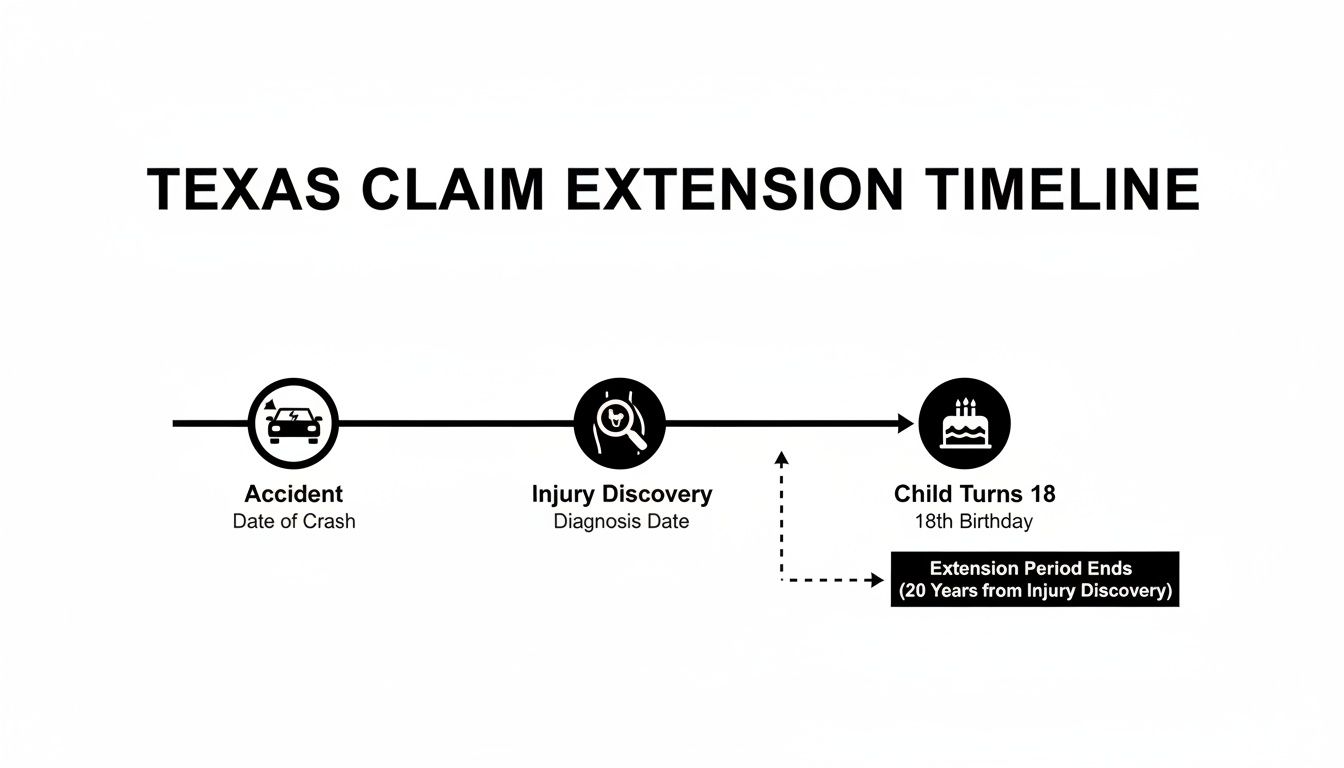
This visual highlights key moments, like discovering a hidden injury or a child turning 18, which can legally reset the starting point of that two-year clock.
As you can see, not all deadlines are created equal. It's crucial to understand the differences, especially when shorter notice periods are involved.
Standard vs. Special Claim Timelines in Texas
| Scenario | Legal Action | Typical Deadline | Critical Note |
|---|---|---|---|
| Standard Car Accident | Personal Injury Lawsuit | 2 Years from Accident | This is the general statute of limitations for most personal injury cases. |
| Wrongful Death | Wrongful Death Lawsuit | 2 Years from Date of Death | This clock starts on the day the person passed away, not the accident date. |
| Claim vs. City/County | Notice of Claim | 6 Months or Less | This is a pre-lawsuit notice requirement. Missing it can prevent a lawsuit. |
| Claim vs. State of Texas | Notice of Claim | 6 Months | Similar to city/county claims, this notice is a mandatory first step. |
Understanding these distinctions is the first step toward protecting your rights. A missed notice period can be just as damaging as a missed statute of limitations.
Insurance Deadlines vs. Lawsuit Deadlines
Finally, it’s absolutely essential to understand the difference between insurance company deadlines and the legal statute of limitations. They are not the same thing.
- Insurance Deadlines: Your own policy probably has language requiring you to report an accident "promptly" or within a "reasonable time." This is usually a matter of days or weeks and is required to even get the insurance claim process started.
- Lawsuit Deadlines (Statute of Limitations): This is the hard, legally-enforced two-year deadline to take your case to court.
An insurance adjuster might spend months going back and forth with you, but those conversations do not stop the legal clock from ticking. Some insurance companies will even drag out the process intentionally, hoping you’ll run out of time and lose your right to sue. An experienced truck crash lawyer Houston will manage both of these timelines for you, making sure your rights are protected on all fronts while you focus on getting better.
Practical Advice: Steps to Protect Your Injury Claim After an Accident
Knowing your rights under Texas law is a huge first step, but what you do in the hours and days after a crash is what really protects them. A serious accident can change your life in seconds — but you don’t have to face it alone. Taking these deliberate steps ensures your side of the story is told accurately and your right to compensation is locked down from the very beginning.

Seek Immediate Medical Attention
Your health is the number one priority. Period. Even if you think you feel fine, it's absolutely essential to get checked out by a doctor right away. The adrenaline pumping through your body after a crash can easily mask serious injuries like whiplash or internal bleeding, which might not show symptoms for hours or even days.
Putting off medical care is like handing the insurance adjuster a gift. They'll use it to argue that your injuries aren't that bad or, even worse, that they weren't caused by the accident at all. A doctor's visit creates an official, time-stamped record that ties your injuries directly to the incident—a critical piece of evidence you can't get any other way.
Document Everything at the Scene
If you're physically able to, start gathering evidence right there at the scene. It's invaluable. Memories fade, and accident scenes get cleared away in the blink of an eye, so capturing the details on the spot can make all the difference.
- Take Photos and Videos: Use your smartphone and go to town. Get pictures of the damage to all vehicles from every angle you can think of. Snap photos of skid marks, traffic lights, road conditions, and any visible injuries you have.
- Get Witness Information: If anyone saw what happened, politely ask for their name and phone number. An independent witness who can back up your story is incredibly powerful when it comes to proving fault.
- Request the Police Report: Always call the police after an accident that involves an injury. The officer who responds will create an official report, which is a key document for locking in the facts of the crash.
How to Handle Insurance Companies
You'll need to report the accident to your own insurance company, as your policy requires. But when the other driver's insurance adjuster calls, you need to be extremely careful. Their job is to protect their company's bottom line, which means their goal is to pay you as little as they possibly can.
Don't give a recorded statement. Don't admit fault or even hint at it. And definitely don't downplay your injuries. Anything you say can and will be twisted to weaken your claim. It’s always best to let an experienced Houston car accident attorney handle these calls for you.
Beyond gathering evidence, an essential step in moving your claim forward is learning about writing a personal injury demand letter to formally lay out your case and request compensation. This is what officially kicks off negotiations.
Following these practical steps is a great start. For a deeper dive, check out our guide on how to file a personal injury claim in Texas. Taking control of the process from day one empowers you and strengthens your position for the road ahead. The compassionate attorneys at The Law Office of Bryan Fagan, PLLC are here to help guide you through each step.
When to Call a Lawyer: Why You Should Act Immediately
After a serious accident, your number one job is to heal. But while you’re focused on recovery, the clock on your legal rights is ticking down, and insurance companies are already building their case against you. Trying to handle it all yourself—navigating deadlines, tracking down evidence, and going head-to-head with adjusters—is a massive risk that could put your future in jeopardy.
This is why getting in touch with an experienced Texas personal injury lawyer right away is one of the smartest moves you can make. It’s not about picking a fight; it’s about leveling the playing field and protecting your family from financial hardship. From day one, an attorney is your dedicated advocate.
Seeking legal counsel immediately is about securing your future. An attorney ensures that while you focus on physical recovery, your legal and financial recovery is being expertly managed and protected.
A good lawyer knows that evidence can disappear in the blink of an eye. They move fast to preserve critical proof, like securing traffic camera footage before it’s erased, interviewing witnesses while memories are still sharp, and documenting the accident scene. This early groundwork often becomes the foundation for a strong claim.
Your Advocate Against Insurance Companies
Let's be clear: insurance adjusters are trained negotiators. Their primary goal isn't your well-being; it's protecting their company's bottom line by minimizing or denying your claim. They might sound friendly on the phone, but they aren't on your side. They often push accident victims to give recorded statements that can be twisted and used against them, or they’ll offer a quick, lowball settlement that barely scratches the surface of what an injury truly costs.
When you hire a Houston car accident attorney, all that stops. Every bit of communication goes through your lawyer, shielding you from the stress and the traps of dealing with insurers directly. Your attorney will handle every phone call, email, and negotiation, making sure your rights are defended at every turn. They know how to accurately calculate the full value of your claim, factoring in things like future medical care and lost earning potential. Understanding when to bring in a professional is key, and you can learn more by reading our guide on when to hire a personal injury lawyer.
No Financial Risk to Get Expert Help
So many people hesitate to call a lawyer because they’re worried about the cost. At The Law Office of Bryan Fagan, PLLC, we’ve eliminated that barrier entirely. We work on a contingency fee basis, which is just a straightforward way of saying you pay us nothing unless we win your case. Our fee is simply a percentage of the compensation we recover for you.
This approach guarantees that everyone has access to justice, no matter their financial situation. We offer a free, no-obligation consultation to talk about your accident, walk you through your legal options, and answer any questions you have. You risk absolutely nothing by learning about your rights.
Don't wait until critical deadlines are breathing down your neck or key evidence has vanished. Taking action now gives you the best possible chance of securing the resources you and your family need to rebuild. The road ahead might be tough, but you don't have to walk it alone. We're here to provide clarity, trust, and hope every step of the way.
Common Questions About Texas Injury Claim Deadlines
When you're dealing with the fallout of an accident, the last thing you need is more confusion. Here are some plain-English answers to the questions we hear most often about the timelines for filing an injury claim in Texas.
What Happens If I Miss the Two-Year Deadline?
If that two-year window closes and you haven't filed a lawsuit, the courthouse doors will almost certainly be shut to you forever. It's a harsh reality, but Texas law is incredibly strict on this. You completely lose your legal right to demand financial compensation for your medical bills, lost income, and pain from the person who hurt you.
This isn't just a suggestion; it's a hard-and-fast rule. That’s why it's so important to talk to an experienced Texas personal injury lawyer long before that deadline gets close. Your financial future could depend on it.
Does Talking to the Insurance Company Pause the Two-Year Clock?
Absolutely not. This is one of the most dangerous and common misunderstandings out there. The two-year countdown to file your lawsuit keeps ticking, no matter what conversations you're having with an insurance adjuster.
Some insurance companies might even drag out settlement talks on purpose. They know that if they can get you to miss your filing deadline, they'll have zero pressure to offer you a fair deal. A good attorney will handle the insurance company while making sure your lawsuit is filed on time, keeping your power to negotiate intact.
How Does the Deadline Work If a Child Is Injured?
Texas law recognizes that children need special protection. For anyone under 18, the state typically "tolls," or pauses, the statute of limitations. The two-year clock doesn't start running until the child’s 18th birthday, meaning they usually have until they turn 20 to file their own lawsuit.
While this gives families a legal safety net, waiting is rarely a good idea. It's almost always better for a parent or guardian to bring the claim on the child's behalf much sooner. Evidence disappears, memories fade, and ongoing medical bills need to be paid.
Can I Still File a Claim If I Felt Fine Right After the Accident?
Yes, and you shouldn't hesitate to look into your options. Many severe injuries—like whiplash, internal damage, or even a traumatic brain injury—don't show symptoms right away. It could be days or even weeks before you realize something is seriously wrong.
Getting checked by a doctor immediately after a crash creates a medical record that connects your injuries back to the accident. If you wait, the insurance company will jump at the chance to argue that something else must have caused your pain. It's always best to get a medical evaluation and speak with a lawyer to understand your rights from the start.
A serious accident can change your life in seconds — but you don’t have to face it alone. The experienced and compassionate team at The Law Office of Bryan Fagan, PLLC is here to provide clarity, trust, and hope. We manage every deadline and every detail so you can put your energy where it belongs: on your recovery. Recovery is possible, and legal help is available. Schedule your free, no-obligation consultation today by visiting us at https://texaspersonalinjury.net.