A serious accident can change your life in seconds—but you don’t have to face it alone. After a crash, the biggest question victims and their families face is almost always the same: Who is going to pay for all of this? In Texas, the answer usually starts with the at-fault driver's Bodily Injury (BI) liability coverage—the specific insurance designed to pay for the harm you've suffered due to their negligence.
Your Guide to Bodily Injury Liability After a Texas Crash

When someone else's carelessness leaves you hurt, their BI liability insurance is the first place you and your family will turn for financial recovery. Think of it as a safety net the law requires every Texas driver to carry, precisely to protect innocent people they might injure on the road.
This guide will break down what this crucial coverage pays for, what happens when it’s not enough to cover your bills, and how an experienced Texas personal injury lawyer can protect you from the insurance company's tactics and fight for your rights.
Understanding the Basics of a Texas Personal Injury Claim
Texas is an "at-fault" state. This means the person who caused the wreck is legally and financially responsible for the damage they've done. To get compensated, you have to prove the other driver was negligent—that they failed to drive with reasonable care, and that failure directly caused your injuries and other losses. This concept, known as comparative responsibility, can be complex, but an attorney can help establish the other party's fault.
Trying to navigate this process, especially when you should be focused on healing, can feel overwhelming. The first step toward regaining control is understanding what the road ahead looks like. Our detailed guide on filing a car accident claim walks you through what to expect.
A serious injury isn't just a medical event; it's a financial and emotional crisis. Bodily Injury liability coverage is the legal mechanism for holding the responsible party accountable for the full scope of that crisis.
Knowing your rights is the foundation of your recovery. BI coverage is meant to make you "whole" again by paying for all the different ways you've been harmed—and that goes far beyond just the first emergency room bill.
What Damages Does Bodily Injury Liability Actually Pay For?

When an insurance company uses the term “bodily injury,” they’re talking about much more than just your first trip to the emergency room. Fair compensation is supposed to cover the entire spectrum of losses—physical, financial, and emotional—that you've been forced to deal with because of someone else's negligence.
Bodily injury liability coverage is designed to pay for every reasonable and necessary cost tied to the harm you suffered. An experienced attorney’s job is to meticulously document every single one of those losses, making sure nothing gets missed when we demand full payment from the insurer.
Economic Damages: The Tangible Costs
The easiest damages to understand are the ones that come with a clear price tag. These are the bills and financial hits that start piling up while you’re just trying to get better.
For example, after a Houston freeway crash, your immediate medical needs could be massive. BI liability is responsible for these economic damages, which include:
- Medical Bills: This covers everything from the ambulance ride and hospital stay to surgeries, X-rays, prescription drugs, and all your follow-up appointments with specialists.
- Future Medical Care: If your injuries need long-term treatment like physical therapy, rehabilitation, or ongoing medical equipment, those future costs are part of the claim.
- Lost Wages: This pays you back for the income you lose while you can't work. It also covers your diminished earning capacity if the injuries prevent you from ever returning to your old job or earning the same salary again.
Non-Economic Damages: The Human Cost
Just as real but much harder to put a number on are the non-economic damages. These losses are meant to address the profound, personal toll the accident has taken on your life and well-being.
The physical pain you feel and the emotional trauma you’re going through are legitimate, compensable harms under Texas law. A fair settlement must account for this human cost, not just the medical bills.
These damages acknowledge the immense personal suffering that comes with a serious injury. It's vital to understand the difference, and you can learn more by reading our detailed guide on economic vs. non-economic damages.
Common examples of these very real losses include:
- Pain and Suffering: This is compensation for the physical pain and discomfort you've already endured and will continue to deal with.
- Mental Anguish: This addresses the emotional distress—the anxiety, depression, and post-traumatic stress disorder (PTSD)—that so often follows a traumatic crash.
- Physical Impairment: If the injury left you with permanent scarring, disfigurement, or the loss of a bodily function, this damage provides compensation for that life-altering loss.
A dedicated Houston car accident attorney will build a comprehensive case that proves the full extent of both your economic and non-economic losses. We fight to make sure the insurance company is held accountable for every single one.
How Long Do You Have to File a Claim in Texas?
In Texas, the law sets a strict deadline for filing a personal injury lawsuit, known as the statute of limitations. For most car accidents and personal injury claims, you have two years from the date of the injury to file a lawsuit. If you miss this deadline, you will almost certainly lose your right to seek compensation forever. While there are some rare exceptions, it's critical to act quickly to protect your rights. Contacting a Texas personal injury lawyer soon after your accident ensures that crucial evidence is preserved and all legal deadlines are met.
Every auto insurance policy also comes with a policy limit. This is the absolute maximum amount the insurance company will pay out for damages after a crash. Once that limit is reached, the insurance company's obligation is over—no matter how high your medical bills climb. This is a massive problem in Texas because the state’s mandatory minimum coverage levels are dangerously low. The law requires every driver to carry at least what's known as “30/60” coverage.
What Does 30/60 Coverage Actually Mean for You?
The numbers in 30/60 represent specific dollar amounts that can be paid to injured victims. Here’s the breakdown:
- $30,000 is the maximum the at-fault driver’s insurance will pay for a single person’s bodily injuries.
- $60,000 is the total maximum the policy will pay for the bodily injuries of everyone involved, no matter how many people were hurt.
Imagine you’re seriously injured in a multi-car pileup on a Dallas freeway caused by one distracted driver. If your medical bills hit $90,000, their minimum-limits policy will only cover the first $30,000. You're left staring at a shocking $60,000 gap that their insurance will not touch.
For anyone who has suffered a catastrophic injury or been involved in a devastating truck crash, these tiny minimums are often used up by the first ambulance ride and emergency room visit alone. A skilled truck crash lawyer Houston can investigate these complex cases to find all sources of recovery.
The harsh reality is that Texas law allows drivers on the road with insurance that is completely inadequate for the real-world costs of a serious accident. This leaves innocent victims holding the bag for devastating financial burdens.
It feels incredibly unfair when you're hit by someone with such little coverage. That's why it is absolutely critical to explore every possible source of financial recovery. Fortunately, there are other options. You might have coverage on your own policy designed for this exact situation. Our guide on underinsured motorist coverage in Texas explains exactly how that protection works. Identifying all avenues for compensation is the key to protecting your financial future.
What Happens When the At-Fault Driver's Insurance Is Not Enough?
It’s a terrifying moment: you realize the person who hit you only has minimum insurance, and it won’t even come close to covering your medical bills and lost wages. This is an incredibly common and stressful situation in Texas, but it doesn't mean you're out of options. When the at-fault driver's policy limits are exhausted, a strategic legal approach becomes essential to protecting your financial future.
The first place we look is your own auto insurance policy. Two key coverages can provide the lifeline you need:
- Uninsured/Underinsured Motorist (UM/UIM) Coverage: This is specifically designed for this exact scenario. It steps in to act like the at-fault driver’s insurance, covering the gap between your total damages and their low policy limit.
- Personal Injury Protection (PIP): This is no-fault coverage that helps pay for your immediate medical bills and a portion of lost income, no matter who was responsible for the crash.
This is a perfect example of how an insurance gap can leave you holding the bag for someone else's mistake.
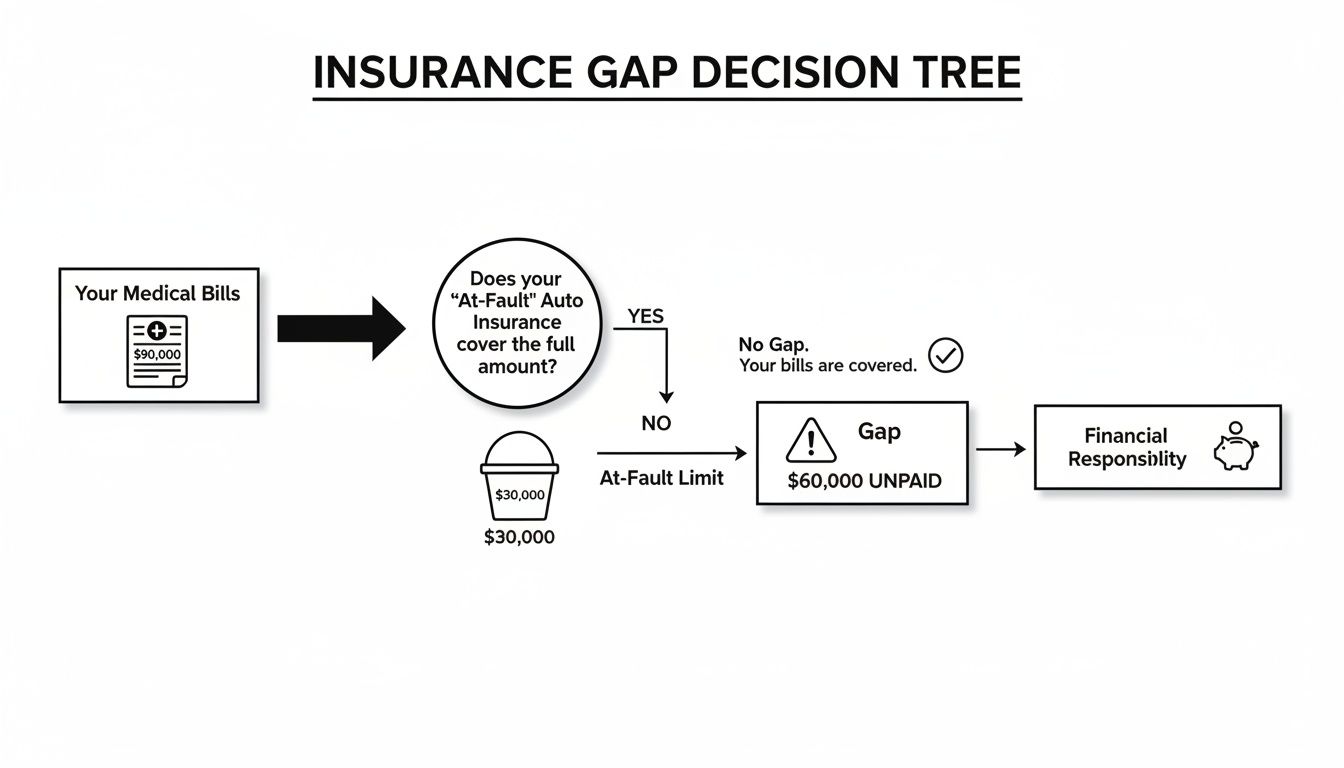
As you can see, a driver with bare-bones Texas coverage can easily leave you on the hook for tens of thousands of dollars in medical debt.
Exploring All Avenues for Full Compensation
If your own insurance isn’t enough to bridge the financial gap, our investigation is far from over. We dig into every possible avenue to make sure you aren't left paying for another person’s negligence.
This might involve filing a lawsuit directly against the at-fault driver to hold them personally accountable for the remaining damages. While many drivers lack significant personal assets, it’s a necessary step to secure what you are owed.
In some complex cases, a third party might share the blame. For instance, if the driver who hit you was on the clock—like a delivery driver or a salesperson—their employer could also be held liable for your injuries.
An experienced Houston car accident attorney will meticulously investigate the crash to identify every potential source of recovery. From analyzing insurance policies to uncovering third-party liability, we exhaust all options. Your job is to focus on healing; our job is to fight for the resources you need to do that.
How to Handle Insurance Companies After an Accident
Shortly after a car accident, you’ll probably get a call from an insurance adjuster representing the at-fault driver. They usually sound friendly and eager to help. But it’s critical to remember who they work for. Their primary job is to protect their company's bottom line by paying you the smallest settlement possible.
Insurance adjusters are professional negotiators, trained in tactics designed to reduce the value of your claim. One of their most common strategies is to offer a quick, lowball settlement before you even know how serious your injuries are.
Protecting Their Bottom Line, Not Your Health
Imagine this: you’re in Dallas, just a few days after a rear-end collision, and your neck is killing you. An adjuster calls and offers $5,000 to close your case. That money might sound tempting, but it's a trap. The adjuster is banking on you accepting it before you realize your "sore neck" is a serious injury that will require months of physical therapy.
Another tactic is asking for a recorded statement. They will frame it as a routine step, but they are fishing for anything to use against you. Even a simple, polite answer like “I’m doing okay” can be twisted to argue that your injuries aren’t severe.
An insurance adjuster's goal is to close your file for the lowest possible amount. A personal injury lawyer’s goal is to ensure you receive the maximum compensation you are rightfully owed for your medical care, lost income, and suffering.
When to Call a Lawyer
Bringing a skilled personal injury attorney into the picture completely changes this dynamic. We become a protective shield between you and the insurance company, handling all communication so you can focus on getting better. We know their playbook and how to build a powerful case that forces a fair negotiation.
While it’s true that roughly 95% of personal injury cases settle out of court, those settlements are directly tied to the strength of the evidence. A thorough investigation and a meticulously calculated demand package give you the leverage you need. You can read more about how settlement negotiations are influenced by industry trends on feather-insurance.com. Having an experienced lawyer from a firm that handles car accident and catastrophic injury claims means your case is built for the best possible outcome from day one.
Practical Advice: What to Do After an Accident

The minutes and days right after a Texas car accident are confusing and stressful. But the actions you take can make a powerful difference in your ability to secure fair compensation. Protecting your legal rights starts with a few practical steps.
Your top priority, always, is your health. Seek immediate medical attention, even if you feel okay. Some serious injuries don't show symptoms right away. A trip to the ER creates an official record linking your injuries to the crash—crucial evidence for your case.
Document Everything at the Scene
If you're physically able, gather as much information as you can right there. These details can be key to proving the other driver was at fault.
- Call the Police: Always report the crash and ensure an officer files an official police report. This document is a cornerstone of any injury claim.
- Take Photos and Videos: Use your phone to capture damage to all vehicles, skid marks, traffic signs, and any visible injuries.
- Get Witness Information: If anyone saw what happened, get their name and phone number. An independent witness is incredibly persuasive.
Once you've left the scene, notify your own insurance company, but be very careful when dealing with the other driver's insurer. Do not give a recorded statement to the at-fault driver’s insurance company. Their claims adjuster is trained to ask questions designed to hurt your case.
As you move forward, you'll need to understand how to put together a strong personal injury demand letter that outlines your damages and proves liability. Most importantly, contact a Texas personal injury lawyer before you sign anything. An experienced attorney can protect you from costly mistakes and handle all communications with insurance companies, letting you focus on your recovery.
How a Dedicated Attorney Helps You Recover Your Losses
When you're trying to heal from serious injuries, the last thing you need is the stress of fighting a powerful insurance company. A dedicated personal injury attorney’s most important job is to lift that burden from your shoulders, allowing you to focus completely on your recovery.
We step in to manage every detail of your bodily injury liability claim. Our team starts with a thorough investigation into the accident, gathering the evidence needed to prove the other driver was negligent.
Building Your Case for Maximum Compensation
Our focus shifts to calculating the full, true value of your losses. This goes far beyond just adding up medical bills. We account for everything, including:
- Future medical treatment you will need
- All past and future lost income
- The physical pain and emotional distress you have endured
Armed with this evidence, we negotiate aggressively with the insurance company on your behalf. When a loved one tragically dies, a dedicated wrongful death lawyer Texas plays a pivotal role in seeking justice. This often involves leveraging the crucial role of a wrongful death expert witness to establish the truth and recover your family's losses.
Our firm has extensive experience helping victims of car accidents, serious truck crashes, and families navigating devastating wrongful death claims across Texas. We know the tactics insurers use, and we know how to counter them effectively.
Your job is to heal. Our job is to handle the legal fight. We work on a contingency fee basis, meaning you never pay us an attorney fee unless we win your case.
Recovery is possible, and you don’t have to face this challenge by yourself. Legal help is available to protect your rights and secure the financial stability you and your family deserve. Let us fight for your justice while you focus on putting your life back together.
At The Law Office of Bryan Fagan, PLLC, your fight is our fight. We are here to provide the clear answers and strong advocacy you need. Contact us today for a free, no-obligation consultation to discuss your case and learn how we can help. https://texaspersonalinjury.net