Losing a family member is a devastating blow, and the idea of a lawsuit is probably the last thing on your mind. A serious accident can change your life in seconds — but you don’t have to face it alone. When a preventable tragedy strikes, a wrongful death lawsuit in Texas is a legal path for families to find answers, hold the responsible parties accountable, and secure a stable future. This guide is here to offer some clarity during a difficult time.
Losing a Loved One Is Devastating—You Are Not Alone
When someone you love is killed because of another person's negligence, recklessness, or intentional act, the grief is often mixed with confusion and anger. You're suddenly facing funeral costs you never planned for, the loss of income your family depended on, and the profound emotional pain that comes with it all.
We understand that legal action feels overwhelming right now. But Texas law provides a way for surviving family members to hold the responsible party accountable for the immense harm they’ve caused. A wrongful death lawsuit is a civil action—completely separate from any criminal charges—that seeks compensation for the losses your family is now forced to endure.
What Is the Purpose of a Wrongful Death Claim?
No amount of money can ever replace a person. That's not what this is about. Instead, a wrongful death claim serves three critical purposes for grieving families:
- Seeking Justice: It forces negligent individuals or companies to answer for their actions. This accountability can be a powerful step toward finding closure. For example, after a Houston freeway crash caused by a distracted truck driver, a lawsuit ensures the trucking company answers for its failure to enforce safety policies.
- Providing Financial Stability: The compensation recovered can replace lost income, cover medical and funeral bills, and provide for your family's future needs. It’s about easing the financial strain so you have the space to grieve.
- Preventing Future Harm: Holding negligent parties responsible often pushes them to change their ways. These lawsuits can lead to safer practices, which might just stop another family from going through the same heartbreak.
Beyond the legal fight, we know families are also dealing with the heavy emotional task of managing their loved one’s belongings. For help with this, you can find compassionate guidance for clearing out a deceased loved one's home. Our firm is here to carry the legal burden so you can focus on healing. The Law Office of Bryan Fagan, PLLC is ready to help you understand your rights and figure out the next steps.
Who Can File a Wrongful Death Lawsuit in Texas
When a life is cut short because of someone else’s negligence, Texas law is very specific about who has the right to step forward and seek justice. The grief that follows the loss of a family member is unimaginable, and the legal system provides a clear—though narrow—path for certain loved ones to file a wrongful death lawsuit in Texas.
Under the Texas Civil Practice and Remedies Code, only a select group of immediate family members have the legal standing to bring a claim. This is to ensure that the people most directly and profoundly affected by the loss are the ones empowered to take legal action.
Eligible Family Members Under Texas Law
The law explicitly names three groups who can file a wrongful death claim, and they can do so either on their own or together as a group:
- The Surviving Spouse: The husband or wife of the person who passed away has a primary right to file.
- The Surviving Children: This includes both biological and legally adopted children, no matter their age.
- The Surviving Parents: The mother and father of the deceased are also permitted to file a claim.
It's important to note who is not on this list. Siblings, grandparents (unless they legally adopted the deceased), and other relatives, no matter how close the relationship was, are unfortunately not allowed to file a wrongful death lawsuit in Texas.
For example, think of a situation a truck crash lawyer Houston might handle involving a fatal collision on I-10. If the victim was a father from San Antonio, his wife and two children could file a lawsuit together against the negligent trucking company. On the other hand, his wife could decide to file on her own, or his parents could file a claim if they chose to do so.
The Critical Three-Month Rule
Texas law understands the incredible emotional strain families are under after a sudden loss, so it provides a specific timeframe for them to act. If none of the eligible family members—the spouse, children, or parents—file a lawsuit within three months of their loved one's death, the law then allows the personal representative or executor of the deceased's estate to file the claim.
This rule is in place to make sure a valid claim isn't lost just because a family is too overwhelmed by grief to start the legal process. The family can, however, specifically request that a lawsuit not be filed at all.
Distinguishing Wrongful Death from Survival Actions
It's easy to get these two types of claims confused, but understanding the difference between a wrongful death claim and a "survival action" is key. They often stem from the same tragic event, but they serve different legal purposes and compensate for entirely different losses.
A wrongful death claim is designed to compensate the surviving family members for their own personal losses, like the loss of financial support and their emotional anguish. A survival action, however, is brought on behalf of the deceased person's estate to recover damages the victim themselves could have claimed if they had lived.
This graphic helps break down the core purpose of a wrongful death claim for Texas families.
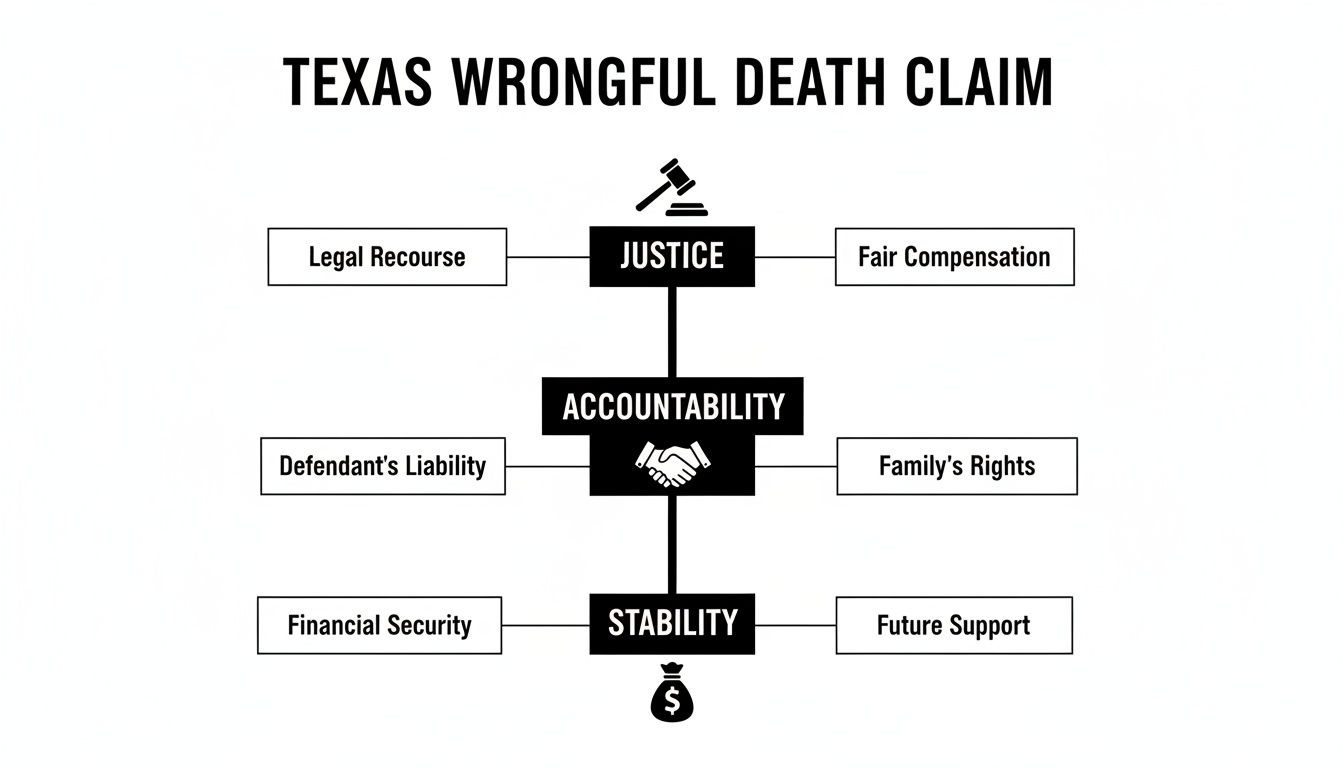
As you can see, these claims are about getting justice for the person who died, holding the responsible parties accountable, and providing financial stability for the grieving family left behind.
To make the distinction even clearer, let's compare them side-by-side.
Wrongful Death Claim vs Survival Action in Texas
| Feature | Wrongful Death Claim | Survival Action |
|---|---|---|
| Who Files? | Surviving spouse, children, or parents | The personal representative of the deceased's estate |
| Purpose | To compensate the family for their personal losses | To recover damages the deceased suffered before death |
| Damages | Loss of companionship, mental anguish, lost future income | The deceased's medical bills, lost wages, pain and suffering |
In practice, a skilled wrongful death lawyer Texas families rely on will typically file both claims at the same time. This strategy ensures that every possible avenue for compensation is pursued—covering both the family's devastating loss and the pain and suffering their loved one endured. Getting a handle on these differences is a crucial first step as you begin to explore your legal options.
Understanding the Critical Filing Deadline
When you're grieving, the last thing you want to think about is a legal clock ticking in the background. But in any legal matter, timing is absolutely everything. Texas law sets a firm deadline for filing a wrongful death lawsuit in Texas, known as the statute of limitations.
For most families, this deadline is two years from the date of their loved one’s death. We can't overstate how important this is. If you miss that two-year window, the court will almost certainly refuse to hear your case. You could lose your right to seek justice and compensation forever, no matter how strong your claim might be.
This is exactly why contacting an experienced wrongful death lawyer in Texas as soon as you can is so critical. Moving quickly allows your legal team to get to work preserving crucial evidence, interviewing witnesses while their memories are still sharp, and building the strongest possible case for your family.
Are There Exceptions to the Two-Year Rule?
While the two-year deadline is the standard, Texas law does recognize that some situations are more complicated. A few specific exceptions can extend the time you have to file a claim.
- The Discovery Rule: This comes into play when the cause of death wasn't immediately obvious or couldn't have been reasonably discovered right away. The two-year clock only starts ticking on the date the family knew, or should have known, that the death was caused by someone’s wrongful act.
- Cases Involving Minors: If the person eligible to file the claim is a minor (under 18), the statute of limitations is often "tolled," which is a legal term for paused. In these cases, the two-year clock may not start running until the child turns 18.
- Claims Against Government Entities: These are a different beast altogether and come with much shorter, stricter deadlines. If you believe a government employee or agency is responsible, you often have to give them formal notice of your claim within just a few months.
How These Exceptions Work in the Real World
Let's imagine a family whose loved one passed away after what seemed like a routine medical procedure. At first, they believed the death was just due to natural complications. But more than a year later, a whistleblower reveals that the medical device used in the surgery had a known defect that the manufacturer intentionally hid.
Under the discovery rule, that family’s two-year deadline would likely start from the day they found out about the defective device—the true cause of death—not from the day their loved one passed away. This kind of situation is tragically common.
Because these exceptions are so complex and depend entirely on the specific facts of your case, it's essential to have an attorney review your situation right away. To get a better handle on this critical topic, you can read more about the wrongful death statute of limitations in Texas in our detailed article.
What Compensation Can Your Family Recover
While no amount of money could ever replace the person you've lost, pursuing a wrongful death lawsuit in Texas can offer your family the financial stability and sense of justice you need to move forward. The legal term for this compensation is "damages," and they are meticulously calculated to reflect the enormous losses your family is now facing.
In Texas, damages are broken down into different categories to make sure the full scope of your family's hardship is recognized. A skilled attorney's job is to help you identify and calculate every single loss to build a powerful case for the support you rightfully deserve.

Economic Damages: Tangible Financial Losses
Economic damages are the most clear-cut types of compensation. They cover the direct, calculable financial holes left by your loved one's death—the bills and lost income that create immediate stress and uncertainty for your family.
Our legal team will gather evidence like pay stubs, tax returns, and expert financial projections to prove the full extent of these costs. Common examples include:
- Lost Earning Capacity: This represents the income your loved one would have earned over their lifetime and used to support the family.
- Loss of Inheritance: This is the value of the assets the deceased would have likely accumulated and eventually passed on to their heirs.
- Lost Household Services: This covers the monetary value of the essential services your loved one provided, like childcare, home maintenance, or managing family finances.
- Medical and Funeral Expenses: This includes all costs for their final medical treatments and burial services.
Non-Economic Damages: The Deeply Personal Losses
Non-economic damages are meant to address the profound, intangible losses that are much harder to put a price tag on but are often the most devastating. These damages acknowledge the deep emotional void and personal suffering your family is enduring.
Texas law understands this immense grief and allows families to seek compensation for these personal harms. To get a better sense of how these are valued, you can read our guide on the differences between economic and non-economic damages.
This type of compensation can cover:
- Mental and Emotional Anguish: The grief, sorrow, and emotional trauma suffered by the surviving family members.
- Loss of Companionship and Society: The loss of your loved one's presence, guidance, love, and comfort.
- Loss of Consortium: This applies specifically to a surviving spouse and refers to the loss of the unique intimacy, affection, and emotional support that was part of the marriage.
For instance, imagine an Austin family loses a primary breadwinner in a tragic construction accident. The economic damages would cover her lost salary and benefits. The non-economic damages would address her spouse's loss of a life partner and her children’s loss of a mother’s guidance and love.
Exemplary Damages: Punishing Extreme Negligence
In certain wrongful death cases, a third type of compensation might be on the table: exemplary damages, also known as punitive damages. These aren't designed to compensate your family for a specific loss. Instead, their purpose is to punish the at-fault party for particularly reckless or malicious behavior.
Exemplary damages are reserved for cases involving gross negligence—think of a fatal drunk driving crash or a company that knowingly sold a deadly product. The goal is to make an example of the wrongdoer and deter others from ever acting in such a dangerous way.
How to Prove Negligence in a Wrongful Death Case

For a wrongful death lawsuit in Texas to succeed, we have to do more than just blame someone. We have to clearly and methodically prove that another person's carelessness—what the law calls negligence—was the direct reason your loved one is no longer here. This is the bedrock of your entire case.
Proving negligence isn’t just about pointing fingers. It’s a painstaking process of building an undeniable case piece by piece, supported by solid evidence. The Texas legal system requires us to establish four specific elements. If we can't prove every single one, the case falls apart.
The Four Pillars of a Negligence Claim
Think of these four elements as the legs of a table. If one is missing or weak, the whole thing comes crashing down. Our job is to build each one so strongly that the other side’s arguments have nowhere to stand.
- Duty of Care: First, we have to show the person at fault owed your loved one a legal responsibility to act with reasonable caution. This is called a duty of care. It's a fundamental concept. A driver on the road has a duty to obey traffic laws and pay attention. A doctor has a duty to provide competent medical care.
- Breach of Duty: Next, we prove that the person breached that duty. In simple terms, they failed to act how any reasonably careful person would have in the same situation. A truck driver who was texting instead of watching the road is a classic—and tragic—example of a breach.
- Causation: The third pillar is all about connection. We must show that the other party’s failure was the direct cause of the fatal accident. That texting truck driver didn't just breach their duty; their texting is what caused the collision that took your loved one's life.
- Damages: Finally, we have to prove that your family suffered actual damages because of the death. These are the very real financial and emotional losses you're now facing—from funeral expenses and lost income to the profound grief and loss of companionship that can never be truly measured.
Building a Case with Strong Evidence
To prove those four elements, a good wrongful death lawyer in Texas has to become a skilled investigator. We dig deep, leaving no stone unturned to gather every piece of evidence needed to tell the true story of what happened.
The evidence we piece together often includes:
- Official Reports: This could be the police accident report, an incident report from a workplace, or findings from federal agencies like the NTSB or OSHA.
- Witness Testimony: We track down and interview everyone who saw what happened or who has knowledge about the events leading up to the incident.
- Expert Analysis: We often bring in experts to make sense of the facts. Accident reconstructionists can recreate the scene, medical experts can explain the precise cause of death, and economists can calculate the full extent of your family’s financial losses.
- Physical Evidence: This includes photos and videos from the scene, data from a vehicle’s black box recorder, surveillance footage, and medical records.
In certain cases, especially when the official cause of death is unclear or disputed, we may need to go a step further. It's a difficult topic, but sometimes private autopsies strengthen wrongful-death claims by providing definitive proof that links the negligence directly to the loss of life.
Understanding Comparative Responsibility in Texas
It's almost a guarantee that the person we sue will try to shift the blame. A common tactic in a wrongful death lawsuit in Texas is to argue that your loved one was partially responsible for what happened. This defense is rooted in a legal doctrine called comparative responsibility.
Under Texas's "modified comparative fault" rule, if your loved one is found to be partially at fault, your family's financial recovery is reduced by their percentage of blame. But if the court decides they were 51% or more responsible, your family is blocked from recovering any compensation at all.
For example, in a fatal car crash case, the defendant who ran a red light might try to argue that your loved one was speeding. A skilled attorney sees these arguments coming from a mile away. We build a powerful case from the start to shut down these blame-shifting tactics and protect your family's right to full and fair justice.
How a Wrongful Death Attorney Can Help Your Family Heal
During an impossibly difficult time like this, your energy should be spent with family, sharing memories, and starting to heal—not fighting with insurance companies or trying to make sense of dense legal paperwork. This is where a compassionate and experienced wrongful death lawyer in Texas comes in. Our job is to take that entire legal burden off your shoulders so you can focus on what really matters.
From the moment you trust us with your case, we become your family's dedicated advocates. We take charge of every single detail of the wrongful death lawsuit, beginning with our own comprehensive, independent investigation. We never just take a police report at face value; we always dig deeper.
Taking the Legal Weight Off Your Shoulders
Our team gets to work immediately, meticulously gathering evidence, tracking down and interviewing witnesses, and, when needed, bringing in top-tier experts like accident reconstructionists or medical specialists to build an undeniable case for you. We handle every phone call, email, and letter from insurance adjusters, opposing lawyers, and the courts. You will never have to face aggressive questioning or lowball settlement offers by yourself.
Our goal is to create a protective shield around your family, giving you the space and peace you need to grieve while we aggressively pursue the justice and financial security you deserve. We navigate the entire legal system for you, making sure every deadline is met and every one of your rights is protected.
This kind of comprehensive support is absolutely critical. Insurance companies are experts at minimizing what they pay out and often try to pressure grieving families into accepting far less than they are owed. Having a seasoned attorney in your corner levels the playing field and sends a powerful message that your family will not be taken advantage of.
Justice with No Upfront Costs
We know that the financial strain that comes after a fatal accident can be overwhelming. That is why The Law Office of Bryan Fagan, PLLC handles every wrongful death lawsuit in Texas on a contingency-fee basis. This is our promise to make sure every family has access to justice, no matter their financial situation.
Here’s what that means for you:
- No Upfront Fees: You pay absolutely nothing out of your own pocket to hire our firm.
- We Cover All Costs: We advance all the expenses needed to build and pursue your case, from expert witness fees to court filing costs.
- We Only Get Paid If We Win: Our fee is simply a percentage of the compensation we successfully recover for your family. If we don't secure a settlement or a favorable verdict, you owe us nothing.
This approach takes all the financial risk off your shoulders. To get a better sense of how it all works, we invite you to learn more about contingency fees for personal injury attorneys. Let our team carry the legal weight so you can focus on healing. The first step is a simple, no-obligation conversation where we can listen to your story and explain your options.
Answering Your Questions About Texas Wrongful Death Claims
When you're reeling from a devastating loss, the last thing you want is more confusion. The legal world can feel overwhelming, and you deserve clear, straightforward answers. We've put together some of the most common questions families ask us about wrongful death lawsuits in Texas to give you the clarity you need during this incredibly difficult time.
Think of this as a starting point. Every family's situation is unique, and these answers are meant to provide a solid foundation before we have a more personal conversation about your specific circumstances.
How Much Does It Cost to Hire a Wrongful Death Lawyer?
We believe every family should have the ability to seek justice, no matter their financial situation. That’s why at The Law Office of Bryan Fagan, PLLC, we handle wrongful death cases on a contingency-fee basis.
What does that mean for you? You pay absolutely nothing upfront. Our firm covers all the costs of investigating the incident, gathering evidence, and fighting your case. Our fee is simply a percentage of the compensation we successfully recover for you. If we don’t win, you owe us nothing. It’s that simple—no financial risk or burden on your family.
Will We Have to Go to Court?
It’s one of the first questions on everyone’s mind, and the answer is: not necessarily. The vast majority of wrongful death cases never see the inside of a courtroom. Instead, they’re resolved through a settlement agreement. Insurance companies and defendants often prefer to settle to avoid the expense, time, and sheer uncertainty of a trial.
That said, we prepare every single case as if it's going to trial. This intense preparation puts us in the strongest possible position to negotiate a full and fair settlement for you. And if the other side refuses to do what’s right, we are always ready to take the fight to a jury and advocate fiercely for your family.
What's the Difference Between a Settlement and a Trial Verdict?
It’s important to understand the two main ways a wrongful death claim can be resolved so you can make informed decisions for your family.
- A settlement is a private agreement negotiated between your family and the at-fault party (usually their insurance company). It provides a guaranteed outcome and often delivers the financial resources your family needs much faster, without the emotional toll of a prolonged court battle.
- A trial verdict is the final decision made by a judge or jury after hearing all the evidence in court. While a verdict can sometimes result in a larger award, it also comes with more risk, more time, and more emotional strain. There are no guarantees in a courtroom.
A skilled wrongful death lawyer in Texas will walk you through the pros and cons of each path. We’ll carefully evaluate every detail of your case and provide the experienced counsel you need to decide whether to push for a strong settlement or take your fight to trial.
Losing a loved one leaves an unimaginable void, but you don't have to carry the legal burden alone. The compassionate, experienced attorneys at The Law Office of Bryan Fagan, PLLC are here to listen to your story, answer your questions, and explain your options. We invite you to schedule a free, no-obligation consultation to learn how we can help your family seek the justice and stability you deserve. Contact us today at https://texaspersonalinjury.net.