A whiplash injury settlement is the financial agreement that helps put your life back together after an accident. A serious accident can change your life in seconds — but you don’t have to face it alone. It’s designed to compensate you for the neck, back, and shoulder injuries you suffered—usually in a car crash—because someone else was careless. The goal is to cover your medical bills, the income you lost while out of work, and the very real pain you’ve been forced to endure.
Your Guide to Navigating a Whiplash Claim in Texas
One moment, you’re driving down a Houston freeway. The next, the violent jolt of a rear-end collision leaves you with a painful injury that wasn’t your fault. A serious accident can change your life in seconds, but you don’t have to face the aftermath alone.
This type of injury is commonly known as whiplash, and its symptoms can linger for weeks, months, or even longer. Whiplash is a soft-tissue neck injury caused by a sudden, forceful back-and-forth snapping of the head, much like the crack of a whip. This violent motion can damage the delicate muscles, ligaments, and tendons in your neck and upper back. While it’s one of the most common injuries in car accidents, its impact is often unfairly downplayed by insurance companies.
Understanding the Impact of a Whiplash Injury
One of the trickiest things about whiplash is that the symptoms aren't always immediate. It can take hours or even days before you realize the full extent of the damage. This delayed onset is precisely why it’s so critical to get a medical evaluation right after any accident, even if you think you feel fine.
Common signs of whiplash include:
- Neck pain and stiffness: This is the hallmark symptom, and it often gets worse with movement.
- Headaches: These typically start at the base of your skull and can be debilitating.
- Limited range of motion: You might find it hard to turn your head from side to side or look over your shoulder without pain.
- Pain in the shoulders, upper back, or arms: The pain often radiates out from your neck into other areas.
- Fatigue and dizziness: Many people report a general feeling of being unwell or off-balance.
A whiplash injury settlement is designed to address not just the immediate medical bills but also the long-term consequences. This includes ongoing physical therapy, lost wages from time off work, and compensation for the physical pain and emotional distress the injury has caused you.
At The Law Office of Bryan Fagan, PLLC, our experienced Texas personal injury lawyers understand the true cost of a whiplash injury. We know how to document your suffering, calculate the full value of your claim, and stand up to insurance adjusters who will try to minimize your pain. Your focus should be on healing; we'll focus on fighting for the justice and financial support you deserve. If you've been injured, you have rights, and help is available.
How Much Is a Typical Whiplash Settlement in Texas
After the jarring impact of a car accident, one of the first questions on everyone's mind is, "What is my claim actually worth?" The honest answer is there’s no magic formula or single number for whiplash injury settlements. The value of your claim is deeply personal—it’s tied directly to how severe your injury is and how much it has turned your life upside down.
Think of it this way: a settlement isn’t just a number pulled from a hat. It’s a reflection of your unique story—the pain you've had to live with, the medical treatments you've needed, and the work you’ve been forced to miss. A minor strain from a slow-speed fender-bender on I-10 will lead to a very different settlement than a severe injury from a high-impact crash that needs surgery and months of physical therapy.
Your settlement is built from two main blocks: tangible losses, known in the legal world as "economic damages," and intangible losses, called "non-economic damages." The infographic below breaks down the core components that build the value of your claim.
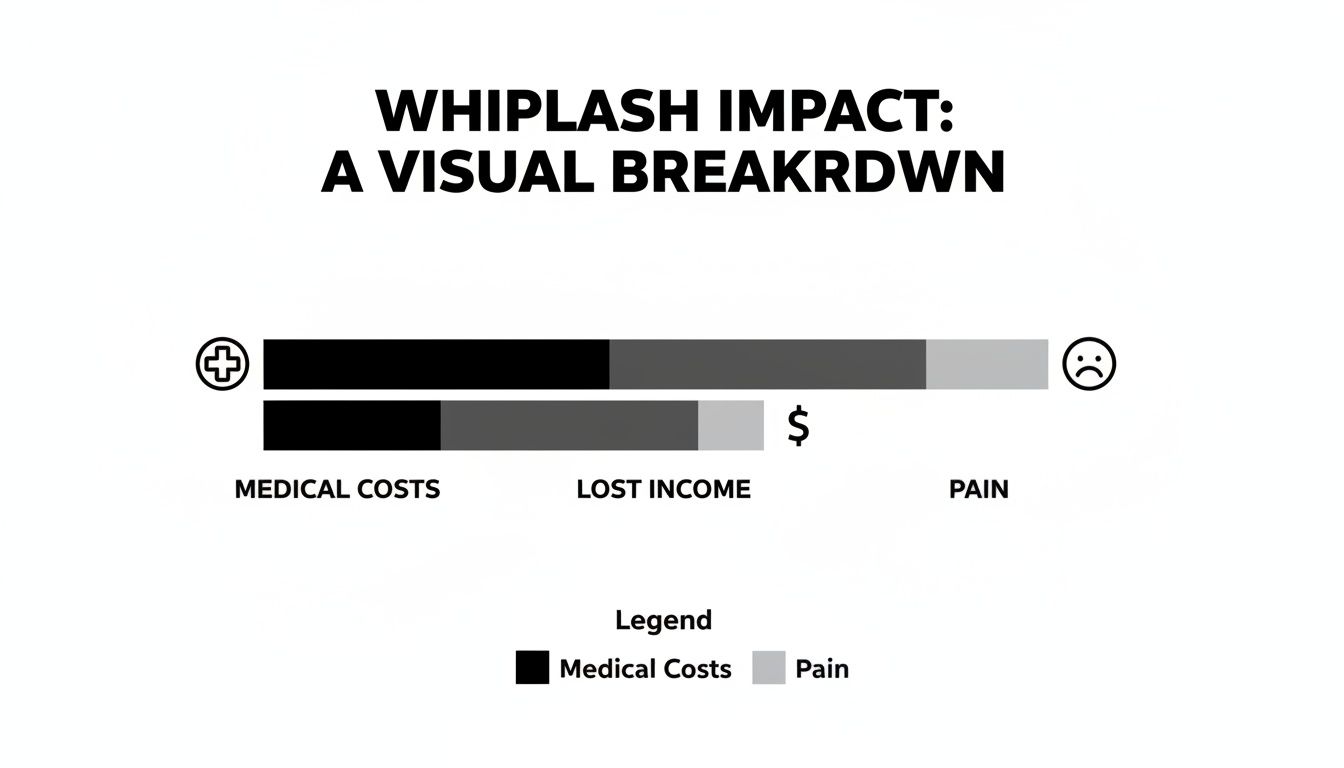
As you can see, medical costs, lost income, and the very real experience of pain and suffering all combine to determine what a fair settlement looks like. Each piece of that puzzle is critical, and an experienced Houston car accident attorney will meticulously document every detail to build your case.
Real-World Settlement Ranges
While every case stands on its own, looking at typical ranges can give you a helpful starting point. Generally, the value of whiplash injury settlements is directly linked to how intense your medical care has been and what your long-term prognosis looks like.
- For mild cases involving some chiropractic visits and pain medication, payouts often land between $5,000 to $15,000.
- If your injury is moderate and requires several months of physical therapy, the settlement could be in the $30,000 to $75,000 range.
- For severe whiplash that causes nerve damage, requires surgery like a cervical fusion, or leads to significant lost wages, settlements can climb well past $100,000 and sometimes reach $300,000 or more.
It’s clear that documenting your injuries is everything.
Whiplash Settlement Ranges by Injury Severity
To give you a clearer picture, it helps to connect the dots between how badly you were hurt and the potential settlement outcome. The more treatment you need and the bigger the impact on your daily life, the higher the settlement value is likely to be.
Of course, these are just general estimates. The specific details of your crash, the strength of your evidence, and the skill of your legal team all play a huge role in the final number. This table provides a basic framework for understanding how these factors connect.
| Injury Severity | Common Treatments | Typical Settlement Range |
|---|---|---|
| Minor | Chiropractic visits, over-the-counter pain medication, a few weeks of rest. | $5,000 – $15,000 |
| Moderate | Months of physical therapy, prescription pain management, specialist consultations. | $30,000 – $75,000 |
| Severe | Surgical intervention (e.g., spinal fusion), long-term pain management, extensive rehabilitation. | $100,000+ |
At the end of the day, a strong settlement is built on a foundation of undeniable proof. Every doctor's visit, every therapy session, and every day of missed work must be carefully documented to justify the compensation you deserve.
The final settlement isn't just about adding up receipts. It's about building a compelling story that shows the insurance company the true cost of the other driver's negligence on your life. For a deeper dive into how claims like these are valued, feel free to read our guide on the average car accident settlement in Texas.
At The Law Office of Bryan Fagan, PLLC, we help our clients understand every one of these factors and fight to make sure every aspect of their suffering is accounted for. We know this is more than just a claim—it’s your chance to get the resources you need to fully recover.
Key Factors That Determine Your Settlement Value
After a crash, it's only natural to wonder how an insurance company comes up with a number for your claim. They don’t just pull a figure out of thin air; they use a specific set of criteria to calculate a settlement offer. Getting a handle on these factors is the first real step toward fighting for the full compensation you’re owed.
Insurance adjusters are trained to do one thing: minimize payouts. They will pick apart every detail of your case, looking for any reason to downplay your suffering. Knowing what they look for—and how a skilled Houston car accident attorney can build a powerful counter-argument—can make a world of difference in the final value of your whiplash injury settlement.
The Foundation of Your Claim: Proving Negligence
Before anything else, you have to prove the other driver was at fault. In Texas law, this is called negligence, which is just a legal term for carelessness. To have a valid claim, you must show that the other driver’s failure to act with reasonable care is what directly caused your whiplash injury.
For example, after a Houston freeway crash, a police report showing the other driver admitted to texting while driving is powerful evidence. It clearly shows they were negligent and becomes the bedrock of your personal injury claim. Our team, which includes experienced truck crash lawyers in Houston, knows how to uncover this kind of critical proof.
The Power of Detailed Medical Records
Your medical records are, without a doubt, the most critical evidence in a whiplash case. They are the official story of your injury, your treatment, and your entire recovery journey. Vague complaints of "neck pain" are just too easy for an insurer to dismiss. Detailed medical documentation, on the other hand, is undeniable proof.
Crucial medical evidence includes things like:
- Diagnostic Imaging: MRIs, CT scans, and X-rays are the gold standard. They can actually show the damage to discs, ligaments, and other soft tissues, proving your injury is real and severe.
- Treatment Notes: Detailed records from your doctor, physical therapist, or chiropractor create a timeline. They document your symptoms, your treatment plan, and your progress (or lack thereof) over time.
- Prescription History: A list of medications prescribed for pain or muscle spasms isn't just a list—it's evidence that demonstrates the true level of your discomfort.
The strength of your whiplash settlement is directly tied to the quality of your medical documentation. Consistent treatment and thorough records transform your personal pain into compelling legal evidence.
How Comparative Responsibility Can Affect Your Payout
Texas law follows a rule called comparative responsibility, sometimes known as the 51% bar rule. This law essentially asks whether you were partially to blame for the accident. The good news is that as long as you are found to be 50% or less at fault, you can still recover compensation.
Here's the catch: your final settlement will be reduced by your percentage of fault. If a jury awarded you $50,000 but found you were 10% responsible for the crash (maybe you had a broken taillight), your award would be cut by 10% ($5,000), leaving you with $45,000. This is a favorite tactic for insurers trying to lowball offers, making it vital to have an attorney who can fight back against any unfair blame.
Insurance Policy Limits
Finally, the at-fault driver's insurance policy puts a cap on what you can recover. No matter how devastating your injuries are, you generally cannot get more than the maximum amount of coverage the other driver purchased. This is why it's so important to have a lawyer who can explore every single avenue for compensation, including your own Uninsured/Underinsured Motorist (UM/UIM) coverage if the at-fault driver’s policy isn’t enough.
Whiplash is one of the most common injuries after a car accident. Statistics show that whiplash-related claims dominate road traffic injury cases. While insurers might try to settle them quickly and cheaply, our goal is to make sure you receive maximum value for everything you've been through. You can find more details on these trends in various studies on car crash claims.
Building a Strong Whiplash Claim with Essential Evidence
The things you do in the hours and days right after a car accident can make or break your whiplash injury settlement. Putting together a solid claim is a lot like building a legal case—it needs a foundation of clear, undeniable proof.
This isn't about playing games or using legal tricks. It's about systematically documenting what happened to you and the real-world impact the injury has had on your life. You can bet the insurance company will look for any opening to minimize your pain, so your goal is to leave them no room for doubt.

What to Do After an Accident: Seek Immediate and Consistent Medical Attention
After a crash, your body is flooded with adrenaline, which is a powerful pain masker. You might feel "okay" at the scene, only to wake up the next day feeling like you've been hit by a truck. Getting a medical evaluation right away is the single most critical step for both your health and your legal claim.
A doctor's report creates a direct, official link between the accident and your whiplash. Just as important is following through on every single recommendation, whether that’s physical therapy, chiropractic visits, or appointments with a specialist.
Any big gap in your treatment timeline is a huge red flag for an insurance adjuster. They'll argue that if you weren't actively seeking care, your injuries must not have been that serious. Consistent medical attention is non-negotiable proof of your ongoing pain and commitment to recovery.
How to Handle Insurance Companies: Document Everything Meticulously
Your memory of the details will fade, but records and photos are forever. You need to become the lead detective on your own case. The more detailed your evidence, the tougher it is for an insurance company to poke holes in your story.
Here's your essential evidence checklist:
- Accident Scene Photos and Videos: Get pictures of the vehicle damage (both cars!), road conditions, traffic lights, and any visible injuries you have.
- Police Report: Get your hands on a copy of the official police report as soon as it’s ready. It often contains key details about who was at fault.
- Medical Records and Bills: Save every single receipt, bill, explanation of benefits, and report from doctors, therapists, pharmacies, and hospitals.
- Proof of Lost Wages: You'll need pay stubs and a letter from your employer that details the exact time you missed from work and the income you lost because of it.
Keep a Personal Injury Journal
Medical bills show the financial cost, but a personal journal tells the human side of the story. This is where you document how whiplash is affecting your daily life, turning your abstract pain into something concrete and relatable.
Try to jot down daily notes about:
- Your Pain Levels: Use a simple 1-to-10 scale to rate your pain each day.
- Daily Limitations: Make a note of anything you couldn't do—lift a bag of groceries, play with your kids, or even just turn your head to back out of the driveway without wincing.
- Emotional Toll: Describe any anxiety, frustration, or sleepless nights caused by the constant pain and disruption.
This journal will become an incredibly powerful tool for your attorney. It gives them the detailed narrative they need to argue for fair compensation that covers your suffering. With the right evidence in hand, a dedicated Houston car accident attorney can fight to get you a settlement that truly reflects everything you've been through.
How Long Do You Have to File a Claim in Texas?
Navigating a personal injury claim means getting familiar with the specific Texas laws that will shape your case. These rules aren't just legal fine print; they are critical factors that directly influence the final value of your whiplash injury settlement. Trying to figure all this out on your own can feel overwhelming, but a clear understanding of your rights is the first step toward protecting your claim.
A serious accident can change your life in an instant—but you don’t have to face the legal aftermath by yourself. An experienced Texas personal injury lawyer can guide you through every step, making sure deadlines are met and your rights are defended.
The Two-Year Statute of Limitations
One of the most unforgiving rules is the statute of limitations. In Texas, you generally have just two years from the date of the accident to file a lawsuit. While that might sound like a long time, it can fly by when you're juggling doctor's appointments and just trying to heal.
If you miss this critical deadline, the courthouse doors will likely close on you for good. You'll lose the right to seek any compensation for your injuries, no matter how strong your case is. This is exactly why it's so important to talk to an attorney as soon as you can after a wreck. We break down the specific timelines that apply in our detailed guide on the statute of limitations for a Texas car accident.
How Comparative Responsibility Can Reduce Your Settlement
Don't be surprised if the insurance company tries to shift some of the blame onto you—it's a common tactic to reduce their payout. Texas operates under a system called comparative responsibility, also known as the 51% bar rule. This rule means you can still recover money for your injuries as long as you are found to be 50% or less at fault for the crash.
But there's a catch: your final settlement will be reduced by your percentage of fault.
For example, if your total damages add up to $100,000, but a jury finds you 20% responsible for the collision, your compensation would be cut by $20,000. You would walk away with $80,000. However, if you're found to be 51% or more at fault, you get nothing.
Dealing with Uninsured or Underinsured Drivers
What happens if the driver who hit you has no insurance or a cheap policy that won't even begin to cover your medical bills? It’s a stressful situation that happens all too often, but there's a potential solution. If you have Uninsured/Underinsured Motorist (UM/UIM) coverage on your own auto policy, you can file a claim with your own insurance company to cover the difference.
Navigating a UM/UIM claim can be tricky, as you're essentially fighting your own insurer for the benefits you've been paying for. Having a skilled attorney in your corner is vital to make sure they honor their policy and pay you what you're owed. This also applies in tragic cases where you may need a wrongful death lawyer in Texas to help your family.
When to Call a Lawyer: Why You Need an Experienced Texas Attorney for Your Claim
Trying to take on an insurance company by yourself after an accident is a tough fight, especially when you're supposed to be healing. Insurance adjusters are professional negotiators. Their main goal? To protect their company's profits by paying you as little as possible. That’s where a dedicated Texas personal injury lawyer from The Law Office of Bryan Fagan, PLLC, can step in and completely level the playing field.

When you hire our firm, you get a fierce advocate fighting in your corner. We immediately take over all the phone calls and emails with the insurance company. This shields you from their pressure tactics so you can put your energy into your recovery. We handle the mountains of paperwork, watch every deadline, and manage all the complex legal steps for you.
Maximizing Your Whiplash Injury Settlement
An experienced attorney does a lot more than just file forms; we build the strongest case we possibly can to get you the maximum compensation you deserve. We know exactly what evidence is needed to prove the true extent of your damages—not just for today, but for the future as well.
Our team gets to work immediately to:
- Gather Critical Evidence: We track down police reports, talk to witnesses, and analyze photos from the accident scene to establish exactly who was at fault.
- Work with Medical Experts: We consult with your doctors to build a detailed record of your injuries, the treatment you've received, and what your long-term prognosis looks like. This is crucial for making sure your settlement covers any future medical care you might need.
- Calculate Your True Losses: We meticulously add up every dollar of your economic damages, from medical bills to lost paychecks. Just as important, we fight for the non-economic damages, like your pain and suffering, which insurance companies love to downplay or ignore completely.
A seasoned Texas attorney is also critical because they know how to perform thorough legal research, finding legal precedents and state laws that can give you a significant advantage during settlement talks.
Making Legal Help Accessible to Everyone
A lot of people hesitate to call a lawyer because they're worried about the cost. You shouldn't have to be. We firmly believe that everyone deserves justice, no matter what their bank account looks like. That's why we work on a contingency fee basis.
What does this mean? It's simple: we don’t get paid unless you do. You won't owe us a single penny upfront. Our fee is just a percentage of the settlement or verdict we win for you. There is absolutely zero financial risk on your part.
Hiring an experienced attorney gives you the peace of mind to focus on what truly matters: your health and your family. Let us handle the legal battle while you concentrate on putting your life back together. Recovery is possible, and expert legal help is right here when you need it.
Frequently Asked Questions About Texas Whiplash Claims
When you're reeling from the pain and stress of a whiplash injury, it’s completely normal to have a ton of questions about what comes next. Getting clear, straightforward answers can give you back a sense of control.
Here are some of the most common questions we hear from clients trying to make sense of whiplash injury settlements in Texas. An accident can turn your world upside down in an instant, but you don't have to navigate the confusion alone.
How Long Will My Whiplash Settlement Take in Texas?
This is the million-dollar question, and the honest answer is: it depends. The timeline for a whiplash settlement can vary wildly from one case to the next.
A relatively straightforward claim with minor injuries and clear liability might wrap up in just a few months. But if you're dealing with severe injuries, a dispute over who was at fault, or an uncooperative insurance company, it could take a year or even longer—especially if a lawsuit becomes necessary.
One of the biggest factors is reaching what's called Maximum Medical Improvement (MMI). This is simply the point when your doctor determines you've recovered as much as you're going to. We have to wait for you to reach MMI so we can understand the true, long-term costs of your injuries before we can demand a final, fair settlement.
Should I Accept the First Offer from the Insurance Company?
In a word: no. It's almost always a mistake to accept the first offer that comes your way. Insurance adjusters are trained professionals whose job is to resolve claims for as little money as possible. They often start with a lowball offer, hoping you’ll take the quick cash before you realize what your claim is actually worth.
That first offer rarely, if ever, accounts for future medical treatment, the full scope of your lost income, or what’s fair for your pain and suffering. Once you sign on the dotted line, you forfeit your right to seek any more compensation for that injury. Always have an experienced attorney review any offer before you even think about accepting it.
What if the At-Fault Driver Is Uninsured?
This is a scary and frustrating situation, but it's more common than you'd think. If the driver who hit you has no insurance—or not enough to cover all your damages—you can turn to your own auto insurance policy, provided you have Uninsured/Underinsured Motorist (UM/UIM) coverage.
This is an optional coverage you buy for this exact scenario. A skilled Texas personal injury lawyer can help you file a UM/UIM claim and ensure your own insurance company treats you fairly and doesn't try to undervalue your claim.
Can I Still Get a Settlement if I Was Partially at Fault?
Yes, in most cases, you absolutely can. Texas operates under a comparative responsibility rule, sometimes called the 51% rule. This means you can still recover damages as long as you are found to be 50% or less responsible for the accident.
Your final settlement, however, will be reduced by your percentage of fault. For example, if your total damages are $100,000 but you were found to be 20% to blame for the crash, your award would be cut by $20,000, leaving you with $80,000. A good attorney will fight to protect you from being assigned an unfair share of the blame.
The aftermath of a car accident is a confusing and overwhelming time, but you don’t have to find all the answers on your own. At The Law Office of Bryan Fagan, PLLC, we’re here to provide the clarity and guidance you deserve. Your recovery is possible, and expert legal help is available to ensure you receive the justice and financial support you need to move forward.
We invite you to schedule a free, no-obligation consultation to discuss your case and learn how we can help you. Contact us today and let us start fighting for you.