A serious accident can change your life in seconds — but you don’t have to face it alone. One moment, you’re driving home from work; the next, you’re dealing with injuries, overwhelming medical bills, and a car that’s completely totaled. If someone else’s carelessness caused your pain, you have rights.
Put simply, a personal injury claim is your legal right to demand financial compensation when someone else’s carelessness—or negligence—causes you harm. It’s a formal process to hold the at-fault person or company accountable and make them pay for your medical treatments, lost income, and the physical and emotional pain you’ve been forced to endure.
What Exactly Is a Personal Injury Claim?

When you’re recovering from an unexpected and traumatic event, the legal system can feel like the last thing you want to deal with. That’s why we’re here to cut through the jargon and give you clear, honest information so you can make confident decisions. A personal injury claim isn't about starting a fight; it's about getting the resources you need to put your life back together.
Think about it this way: after a Houston freeway crash, you’re left with a broken leg and can’t work. Your personal injury claim is the tool you use to hold the negligent driver accountable for the chaos they’ve caused. This isn’t just a random story—it’s a reality for thousands of Texans every single year.
Through this process, you can demand payment for all the ways the accident has impacted your life, including:
- Medical Expenses: Covering everything from the initial emergency room visit and surgeries to ongoing physical therapy and any future medical care you might need.
- Lost Wages: For the income you’ve lost while being unable to work during your recovery.
- Pain and Suffering: Compensation for the physical pain and emotional trauma the accident has put you through.
The Four Key Elements of a Texas Injury Claim
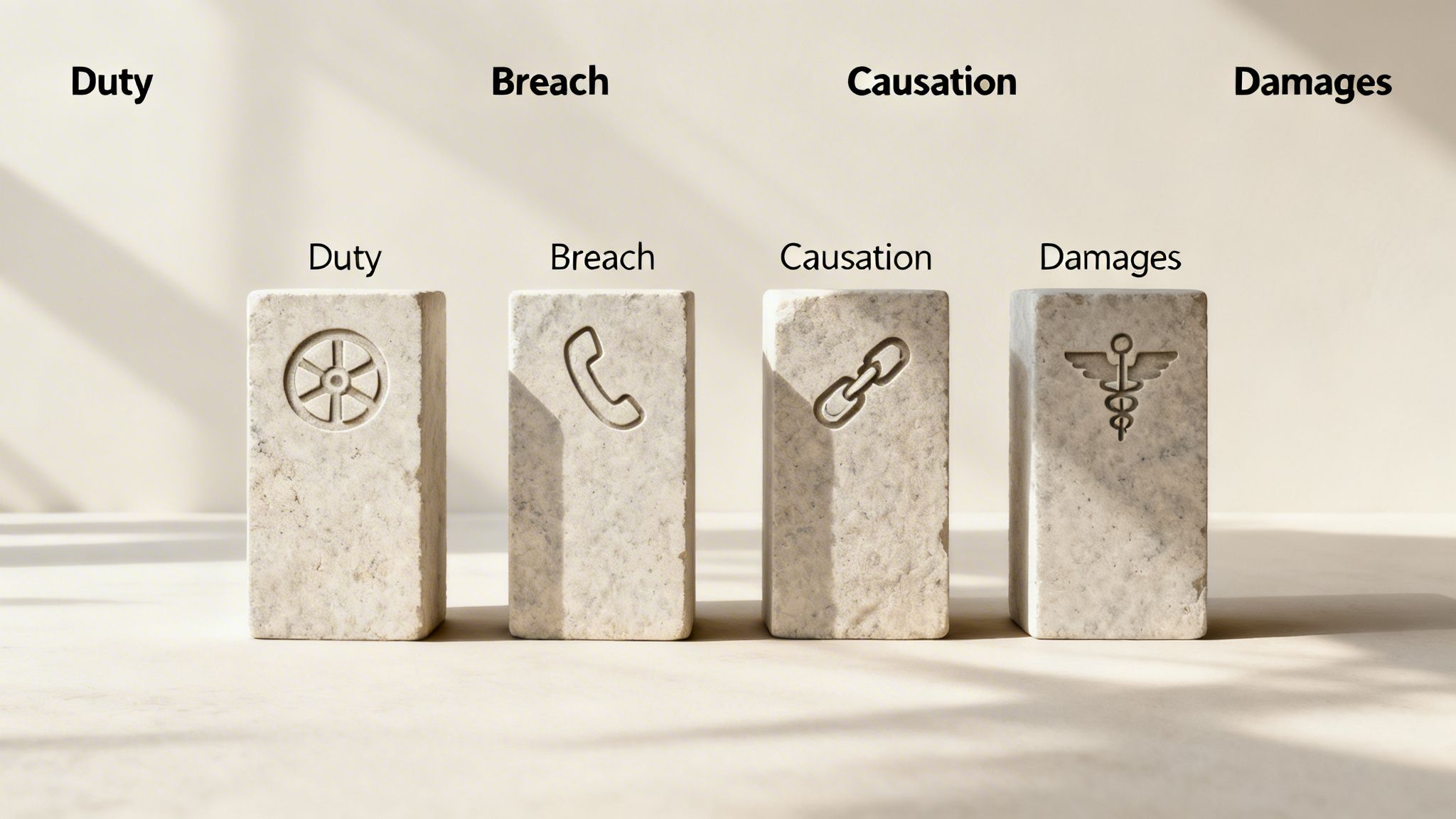
To win a personal injury claim in Texas, you and your attorney have to prove four specific things. Think of them as the four legs of a table—if one is missing, the whole thing falls apart. The legal term for this is negligence, and it’s the foundation of almost every injury case.
This table breaks down what you need to show to have a successful claim.
Key Elements of a Texas Personal Injury Claim at a Glance
| Element | What It Means for Your Case |
|---|---|
| Duty of Care | You must show the other person had a legal responsibility to act with reasonable care. (e.g., Every driver has a duty to follow traffic laws and pay attention.) |
| Breach of Duty | You need to prove the person failed to meet that duty. (e.g., The other driver was texting instead of watching the road, which breached their duty of care.) |
| Causation | You have to connect their failure directly to your injuries. Their actions must be the direct and foreseeable cause of the harm you suffered. |
| Damages | Finally, you must show you suffered actual harm, like medical bills, lost income, or physical pain, as a result of the accident. |
Proving these four elements is the key to holding the at-fault party financially responsible for their actions.
Why These Claims Are So Common in Texas
Accidents are an unfortunate but frequent part of life, and they’re the number one reason these legal claims exist. Motor vehicle crashes, in particular, are the leading cause of personal injury cases across the country.
In 2024, the National Highway Traffic Safety Administration reported an estimated 39,345 traffic fatalities in the U.S. alone. That number gives you a sense of just how often these tragic and preventable events happen. You can learn more about these personal injury trends and see for yourself how common these situations are.
A personal injury claim is much more than a lawsuit. It’s a tool for justice. It gives you a path to get back on your feet financially after a trauma and ensures the person who hurt you is held responsible for their choices.
This process gives you the space to focus on what’s truly important—your health and your family. Understanding what a personal injury claim involves is the first step toward taking back control of your future.
If you’ve been hurt, you don’t have to carry this weight by yourself. Our team at The Law Office of Bryan Fagan, PLLC is here to help you understand your rights and fight for the justice you deserve.
The Four Elements of a Successful Negligence Claim
When you've been hurt because of someone else's carelessness, the word you'll hear most often is negligence. It isn't just a legal term—it’s the heart of your personal injury claim and what we must prove to get you the compensation you deserve.
Think of it as building a structure. To have a strong case, we need to establish four key elements. If even one is missing, the entire claim can fall apart. Our job as your advocate is to prove each one, creating a solid foundation for your recovery.
Let’s use a common scenario to explain: a distracted driver runs a red light and causes a T-bone crash in Houston.
Element 1: Duty
First, we have to show the other person had a Duty of care. This is the legal obligation everyone has to act in a way that doesn't put others at unreasonable risk of harm. It's the baseline rule for how we interact in a safe society.
Every driver on a Texas road has a duty to everyone else out there—other cars, cyclists, and pedestrians. This duty includes:
- Obeying traffic laws, signs, and signals.
- Paying attention to the road.
- Keeping their vehicle under control.
In our example, the driver had a clear legal duty to stop at the red light and watch for cross-traffic.
Element 2: Breach
The second element is Breach. This is the specific action—or failure to act—that violated the duty of care. It's the moment the other person was careless.
When the driver looked at their phone or simply wasn't paying attention and blew through that red light, they breached their duty. Speeding, tailgating, and driving drunk are other all-too-common examples of a breach.
Element 3: Causation
Third, we have to connect the dots with Causation. This element proves that the other person’s breach of duty is what directly caused your injuries. In Texas, we must show their actions were a direct cause of the harm you suffered.
It’s not enough to show the driver ran a red light. We must prove that because they ran the red light, they crashed into your vehicle, and that this collision is what caused your broken arm and whiplash. This link is critical—it connects their negligent act to the harm you suffered.
Element 4: Damages
The final element is Damages. These are the real, measurable losses you experienced as a result of the accident. Without damages, there’s no basis for a claim, because there’s nothing for the at-fault party to compensate you for.
Damages are the costs—both financial and personal—that the crash forced upon you. They include things like:
- Medical bills from the hospital, doctors, and physical therapy.
- Lost income from the time you had to take off work.
- The cost to repair or replace your vehicle.
- Physical pain, mental anguish, and emotional suffering.
Your medical records, pay stubs, and repair estimates all serve as evidence of your damages. Together, these four elements create a complete picture, proving you deserve to be made whole after being harmed by another's negligence.
Common Types of Personal Injury Cases in Texas
When you're hurt in an accident, it can feel incredibly isolating. But the truth is, personal injury law exists because these situations are far too common, affecting countless Texans every year. Understanding the different kinds of personal injury claims can help you recognize where your own story fits and what you can do next.
Think of it this way: a personal injury claim is your tool for getting justice. Imagine a mother is biking through her Austin neighborhood when a driver, glued to their phone, blows through a stop sign and hits her. In an instant, her life is filled with serious injuries, crushing medical bills, and permanent scars. This is exactly what a personal injury claim is for—to hold that careless driver accountable for the damage they caused.
Accidents Involving Cars, Trucks, and Motorcycles
By far, the most common reason people need our help is after a motor vehicle accident. These aren't just numbers on a report; they are real people whose lives get turned upside down on Texas roads every single day.
- Car Accidents: These happen everywhere, from frustrating rear-end collisions on I-10 in Houston to serious T-bone crashes at a busy Dallas intersection. A skilled Houston car accident attorney can work to prove the other driver was at fault, whether from speeding, texting, or just not paying attention.
- Truck Accidents: A wreck involving an 18-wheeler is a different beast entirely. These cases are incredibly complex, involving federal trucking regulations and state laws. Our deep experience as a truck crash lawyer in Houston is vital when investigating things like driver fatigue, overloaded cargo, or shoddy maintenance.
- Motorcycle and Pedestrian Accidents: Riders and walkers have zero protection on the road, and their injuries are often catastrophic. We stand up for them and make sure insurance companies don’t try to unfairly pin the blame on the victim.
Wrongful Death and Catastrophic Injury Claims
Some accidents leave behind a level of harm so profound that a family’s world is shattered forever. These cases demand not only sharp legal skills but also genuine compassion.
A personal injury claim becomes your voice when you've been silenced by tragedy. It’s a path to hold negligent parties accountable and secure your family’s financial future after an immeasurable loss.
A wrongful death claim is a way for surviving family members to find a measure of justice when a loved one’s life is cut short by someone’s negligence. For example, if a family in Dallas loses a parent because of a drunk driver, a wrongful death lawyer in Texas can file a claim to recover damages for their lost income, lost companionship, and devastating emotional pain.
Catastrophic injuries, such as spinal cord damage or a traumatic brain injury from a fall on a construction site, often mean a lifetime of medical needs. These claims are specifically designed to secure the funds necessary for all future treatments, home modifications for accessibility, and a lifetime of lost earning potential.
What Compensation Can You Recover After an Injury
When you’re facing a mountain of medical bills and can't work, one of your most urgent questions is likely, "What compensation can I actually recover?" In Texas, the law allows you to seek financial recovery for all your losses caused by another’s negligence.
In the legal world, we call this financial recovery damages. The goal isn't just to cover your immediate, out-of-pocket costs; it’s about making you “whole” again, at least financially. Let's break down the three main types you can pursue.
Economic Damages
Economic damages are the most straightforward because they cover the tangible, financial losses that have a clear dollar amount attached. Think of these as all the bills and documented financial hits you've taken because of the accident.
These are the numbers we can add up, and they typically include:
- Medical Expenses: Every single cost, from the ambulance ride and ER visit to surgery, hospital stays, medication, and any future physical therapy you’ll need.
- Lost Wages: All the income you missed out on while you were unable to work during your recovery.
- Loss of Earning Capacity: This is a big one. If your injury keeps you from returning to your old job or limits your ability to earn a living in the future, you can be compensated for that long-term financial impact.
For example, imagine a San Antonio construction worker is hit by a commercial truck. His economic damages would include his hospital bills, the wages he lost during a six-month recovery, and the projected loss of future income if he can no longer handle the physical demands of his job.
Non-Economic Damages
While economic damages cover your financial setbacks, non-economic damages are meant to address the immense personal and emotional toll the accident has taken on you. These losses don't come with a receipt, but they are incredibly real and often have the most profound impact on your life.
Non-economic damages acknowledge that your suffering goes far beyond medical bills. They provide compensation for the invisible wounds that can take the longest to heal.
This category provides compensation for things like:
- Pain and Suffering: The physical pain you’ve had to endure because of your injuries.
- Mental Anguish: The emotional distress, anxiety, depression, and trauma the accident has forced upon you.
- Loss of Enjoyment of Life: This is for the inability to participate in the hobbies, activities, and relationships you once loved.
Punitive Damages
Finally, in some rare cases, Texas law allows for punitive damages. These aren't meant to compensate you for a specific loss. Instead, their purpose is to punish the at-fault party for extremely reckless or malicious behavior and to send a message that it won't be tolerated.
These are usually only awarded in cases involving "gross negligence," like an accident caused by a drunk driver who was also speeding excessively through a school zone.
To understand these concepts in more detail, you can learn more about the types of damages in Texas personal injury claims and how they apply to your specific situation.
How Long Do You Have to File a Claim in Texas?
When you're trying to heal from an injury, time is one of the most critical factors in your legal claim. Texas law has a strict deadline, called the statute of limitations, for taking legal action. If you miss this window, you will almost certainly lose your right to recover any compensation, no matter how strong your case is.
For most personal injury cases in Texas—including car and truck accidents—you have two years from the date of the incident to file a lawsuit. That two-year clock starts ticking the second the accident happens. It might seem like a lot of time, but building a solid claim involves a detailed investigation, collecting evidence, and negotiating with insurance companies. All of that takes time, which is why acting quickly is so important.
This timeline gives you a general idea of how a claim flows, from the accident all the way to recovery.
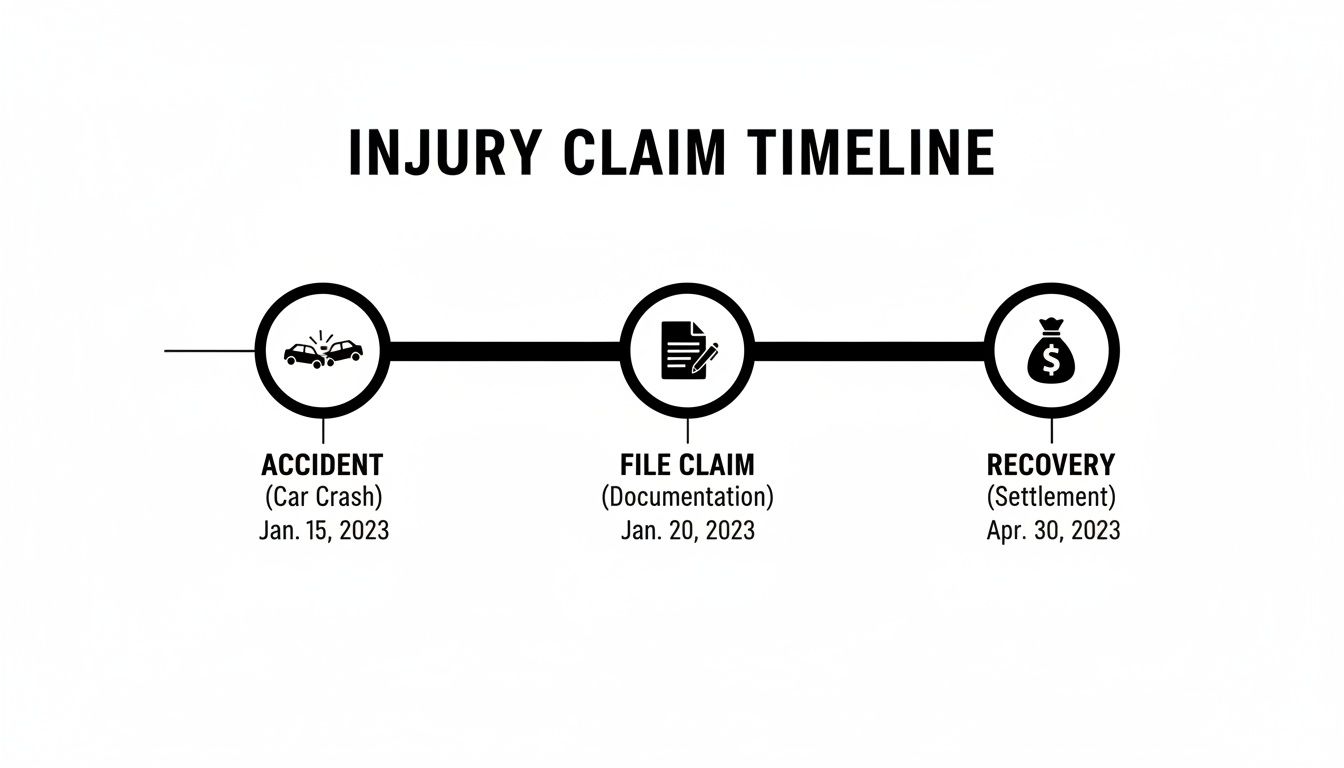
As you can see, the legal process kicks off right after the incident, which really highlights why it's so critical to act fast to protect your rights.
Important Exceptions to the Two-Year Rule
While the two-year deadline is the standard, Texas law does allow for a few key exceptions in certain situations.
- The Discovery Rule: Sometimes, you don’t realize you're hurt right away. If you couldn't have reasonably known about your injury at the time of the accident, the two-year clock might start on the date you discovered it—or reasonably should have discovered it.
- Claims Involving Minors: If the injured person is under 18, the statute of limitations is often paused or "tolled." The two-year deadline typically won't start running until the minor's 18th birthday.
Because these rules can get tricky, waiting is never a good idea. Getting in touch with a Texas personal injury lawyer soon after an accident is the single best way to make sure your legal rights are protected before they disappear. You can learn more in our guide on the statute of limitations for Texas personal injury cases.
Practical Advice: Steps to Protect Your Claim After an Accident
In the chaos and confusion right after an accident, it’s hard to think clearly. But what you do in those first few hours and days can make or break your ability to get fair compensation.
Taking a few key steps will protect your legal rights and start building a strong foundation for your personal injury claim. This checklist can guide you when you’re feeling stressed and unsure what to do next.

Your Post-Accident Checklist
Immediately after any accident, getting medical attention is the most important thing for both your health and your claim. You need to get checked out by a professional, but deciding between an urgent care vs emergency room depends on your specific situation. The critical part is getting evaluated.
Here are the crucial steps to take:
Get Medical Help Immediately: Your health comes first, always. Adrenaline is a powerful chemical, and it can easily mask serious injuries like internal bleeding or a concussion. Seeing a doctor creates an official medical record that links your injuries directly back to the accident.
Report the Accident to the Police: A police report is a vital piece of evidence. It officially documents the time, place, and parties involved. The officer’s report will also often include their initial thoughts on who was at fault, which can be very persuasive.
Document Everything You Can: If you're physically able, use your phone to take as many photos and videos as possible. Get pictures of the accident scene, the damage to all vehicles, and any visible injuries you have. Just as important, get the names and phone numbers of anyone who saw what happened.
A quick but critical tip: Never agree to give a recorded statement to the other driver's insurance adjuster before you've talked to a lawyer. Their job is to find reasons to pay you as little as possible.
Keep a Detailed Record: Start a folder—digital or physical—for every single document related to the accident. This includes medical bills, car repair estimates, and receipts for things like prescriptions or ride-sharing services. It’s also a great idea to keep a simple journal to track your pain levels and describe how your injuries are impacting your day-to-day life.
Stay Off Social Media: Be very careful about what you post online. Insurance companies will absolutely search your social media profiles, looking for anything they can twist to their advantage. A photo of you smiling at a family BBQ could be used to argue your injuries aren't as bad as you claim.
Contact a Texas Personal Injury Lawyer: This is the single most effective way to protect yourself. An experienced attorney will take over all communications with the insurance company, make sure all deadlines are met, and help you understand your options. For more on this, you can read about what to say to an insurance company after an accident.
Common Questions About Personal Injury Claims
It’s completely normal to feel overwhelmed and have a million questions running through your head. When you’re trying to figure out what a personal injury claim even is, the practical worries can be the most stressful. Here are some straightforward answers to the questions we hear most often from Texas families just like yours.
How Much Does It Cost to Hire a Personal Injury Lawyer?
This is often the very first thing people ask, and the answer should bring you some peace of mind. Here at The Law Office of Bryan Fagan, PLLC, we handle all personal injury cases on a contingency fee basis.
What does that mean for you? It means you pay absolutely no upfront costs and zero attorney's fees out of your own pocket. We only get paid if and when we win your case and recover money for you. This approach ensures you can get top-notch legal help without any financial risk or added stress.
Will My Personal Injury Case Go to Court?
Most people picture a dramatic courtroom battle, but that’s rarely how it plays out. The overwhelming majority of personal injury claims are settled directly with the insurance company through negotiation. We're skilled negotiators and, in most cases, can secure a fair settlement without ever having to step foot in a courthouse.
That said, if an insurance company refuses to make a fair offer that truly covers your losses, we won’t back down. Our experienced trial attorneys are always ready to take your case to court and fight for what you deserve.
How Long Will My Case Take?
There’s no one-size-fits-all answer, as the timeline depends on the specifics of your situation. The severity of your injuries and the complexity of the accident play a huge role. For example, a straightforward car accident claim might wrap up in a few months.
On the other hand, a complex truck accident case could easily take a year or more to resolve. We’ll always give you an honest, realistic expectation and keep you updated every step of the way so you’re never left in the dark.
What if I Was Partially at Fault?
This is a common worry, but in Texas, you can still recover compensation even if you were partially to blame. Texas uses a rule called modified comparative fault (or proportionate responsibility). This means that as long as you are 50% or less at fault for the accident, you can still file a claim. However, your financial recovery will be reduced by your percentage of fault. For example, if you were found to be 10% at fault, your final settlement would be reduced by 10%. An experienced attorney can help protect you from being unfairly blamed.
You Are Not Alone — We Are Here to Help
After a serious accident, feeling lost and uncertain is completely normal. But you don’t have to navigate the confusing legal process by yourself. At The Law Office of Bryan Fagan, PLLC, our compassionate and experienced team is dedicated to helping people just like you get the justice and financial security they need to rebuild their lives.
Recovery is possible, and legal help is available. You can take the first step toward taking back control by scheduling a free, no-obligation consultation with a dedicated Texas personal injury lawyer. We are here to listen to your story, answer your questions, and provide the clear guidance you deserve. Contact us today.